

The Importance of Protecting Client Information: Ensuring Trust and Privacy PowerPoint PPT Presentation
Title: The Importance of Protecting Client Information: Ensuring Trust and Privacy
1
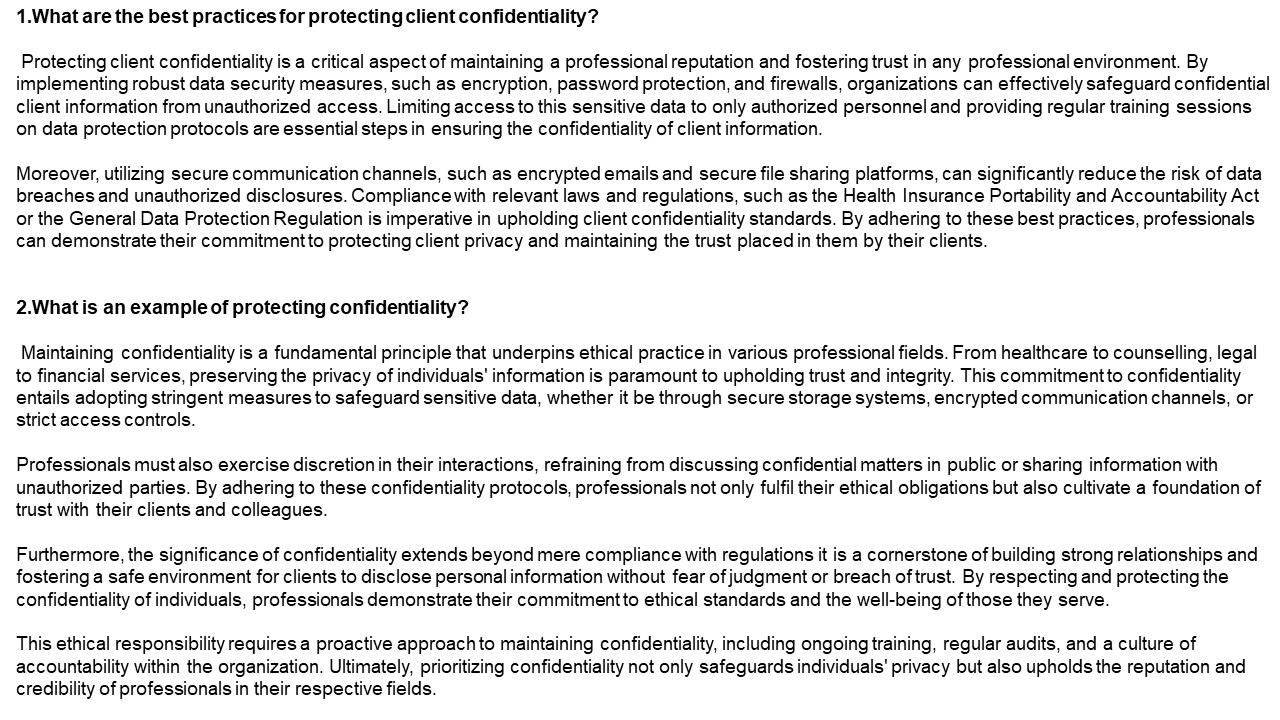
1.What are the best practices for protecting
client confidentiality? Protecting client
confidentiality is a critical aspect of
maintaining a professional reputation and
fostering trust in any professional environment.
By implementing robust data security measures,
such as encryption, password protection, and
firewalls, organizations can effectively
safeguard confidential client information from
unauthorized access. Limiting access to this
sensitive data to only authorized personnel and
providing regular training sessions on data
protection protocols are essential steps in
ensuring the confidentiality of client
information.Moreover, utilizing secure
communication channels, such as encrypted emails
and secure file sharing platforms, can
significantly reduce the risk of data breaches
and unauthorized disclosures. Compliance with
relevant laws and regulations, such as the Health
Insurance Portability and Accountability Act or
the General Data Protection Regulation is
imperative in upholding client confidentiality
standards. By adhering to these best practices,
professionals can demonstrate their commitment to
protecting client privacy and maintaining the
trust placed in them by their clients. 2.What
is an example of protecting confidentiality?
Maintaining confidentiality is a fundamental
principle that underpins ethical practice in
various professional fields. From healthcare to
counselling, legal to financial services,
preserving the privacy of individuals'
information is paramount to upholding trust and
integrity. This commitment to confidentiality
entails adopting stringent measures to safeguard
sensitive data, whether it be through secure
storage systems, encrypted communication
channels, or strict access controls.
Professionals must also exercise discretion in
their interactions, refraining from discussing
confidential matters in public or sharing
information with unauthorized parties. By
adhering to these confidentiality protocols,
professionals not only fulfil their ethical
obligations but also cultivate a foundation of
trust with their clients and colleagues.Furtherm
ore, the significance of confidentiality extends
beyond mere compliance with regulations it is a
cornerstone of building strong relationships and
fostering a safe environment for clients to
disclose personal information without fear of
judgment or breach of trust. By respecting and
protecting the confidentiality of individuals,
professionals demonstrate their commitment to
ethical standards and the well-being of those
they serve. This ethical responsibility
requires a proactive approach to maintaining
confidentiality, including ongoing training,
regular audits, and a culture of accountability
within the organization. Ultimately, prioritizing
confidentiality not only safeguards individuals'
privacy but also upholds the reputation and
credibility of professionals in their respective
fields.
2
3.Why is it important to maintain client
confidentiality? Ensuring the confidentiality
of client information is a cornerstone of
professional ethics in any field. It is not
merely a legal obligation but a fundamental
principle that underpins the trust and integrity
of the relationships we build with our clients.
By upholding strict confidentiality standards,
we signal to our clients that their privacy is of
utmost importance to us, creating a safe space
for them to share their most personal and
sensitive information.Breaching client
confidentiality can have far-reaching
consequences, not only in terms of legal
repercussions but also in eroding the trust that
is essential for effective professional
relationships. Maintaining strict
confidentiality safeguards not only the privacy
of individual clients but also upholds the
reputation and credibility of the organization.
It is incumbent upon us as professionals to
handle client information with the utmost care
and discretion, recognizing that confidentiality
is a non-negotiable aspect of ethical practice.
4.What are the four principles of
confidentiality? Confidentiality is a critical
cornerstone of maintaining trust and safeguarding
sensitive information in professional contexts.
The four key principles of confidentiality
encompass a range of ethical responsibilities,
including the imperative to uphold the privacy of
information, the necessity of sharing information
solely with authorized individuals, the
requirement to seek consent before disclosing
information, and the obligation to ensure the
security of confidential data. By strictly
abiding by these principles, professionals can
guarantee that personal and confidential
information is protected and treated with the
utmost respect. Upholding these principles not
only demonstrates a commitment to ethical
standards, integrity, and professionalism but
also underscores a profound respect for the
privacy rights of individuals.
3
Adherence to the principles of confidentiality is
paramount for establishing and nurturing trust
with clients, patients, and colleagues alike. By
consistently following these principles,
professionals showcase their dedication to
maintaining the highest standards of
confidentiality and ethical conduct in their
respective fields. This commitment not only
enhances the credibility and reputation of
professionals but also fosters a sense of
security and respect among those whose
information is being handled. Ultimately, by
prioritizing confidentiality, professionals can
build strong relationships based on trust,
integrity, and a deep respect for the privacy and
confidentiality of others. 5. What is the
principle of confidentiality? The principle of
confidentiality is a cornerstone of ethical
conduct in numerous professional environments,
underscoring the critical importance of
safeguarding sensitive information in a secure
and discreet manner. Upholding confidentiality
reflects a commitment to preserving the trust and
privacy of clients, patients, or colleagues by
refraining from disclosing their personal or
confidential details without explicit consent.
This principle serves as the bedrock for
fostering and nurturing trust, respect, and
professional relationships, which are essential
elements in any professional setting.Professiona
ls across a wide array of fields, including
healthcare, law, counselling, and finance, are
bound by both legal mandates and ethical
standards to adhere to strict confidentiality
protocols. By respecting and upholding
confidentiality, professionals can protect the
privacy and rights of individuals, which is
crucial for maintaining the integrity and
professionalism of their practice. Thus,
adherence to the principle of confidentiality is
not merely a best practice but an ethical
imperative that underscores one's commitment to
integrity, ethics, and professionalism in the
realm of professional services.
4
https//visualsculptors.com/ https//visualsculp
tors.com/our-portfolio/
Recommended

