

Enhancing Data Understanding: The Importance of Data Visualization in Analysis PowerPoint PPT Presentation
Title: Enhancing Data Understanding: The Importance of Data Visualization in Analysis
1
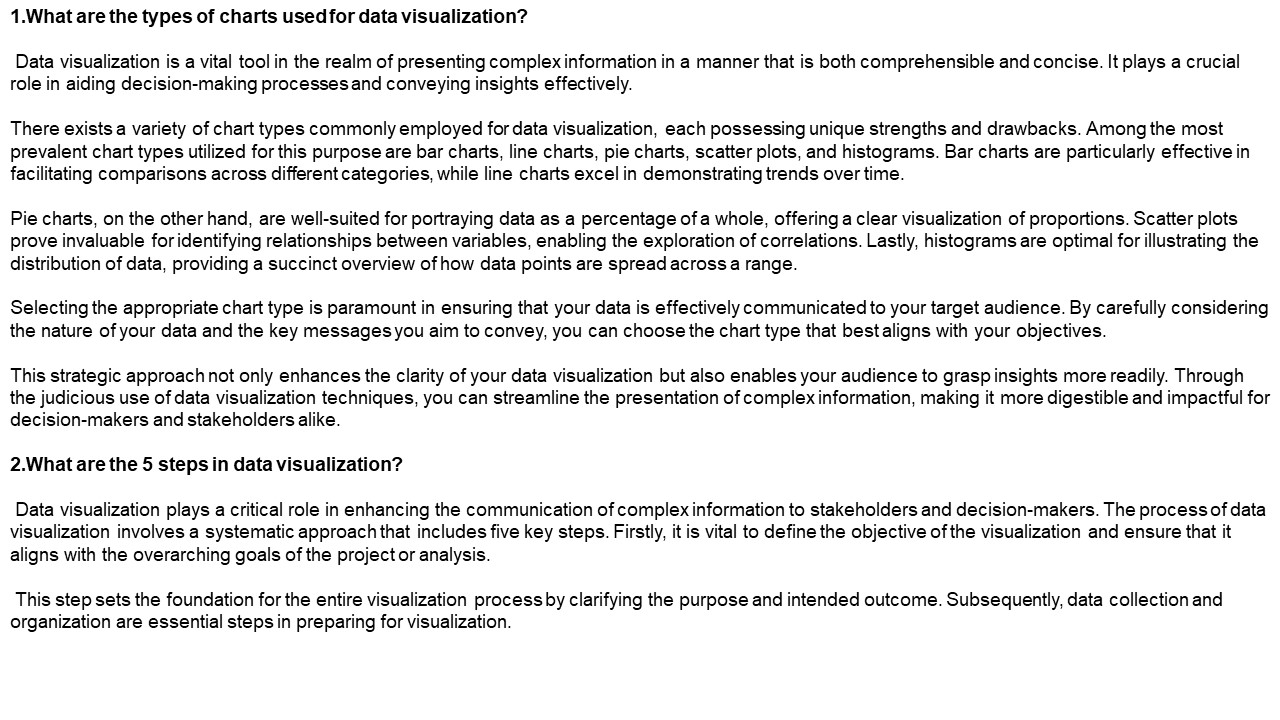
1.What are the types of charts used for data
visualization? Data visualization is a vital
tool in the realm of presenting complex
information in a manner that is both
comprehensible and concise. It plays a crucial
role in aiding decision-making processes and
conveying insights effectively. There exists a
variety of chart types commonly employed for data
visualization, each possessing unique strengths
and drawbacks. Among the most prevalent chart
types utilized for this purpose are bar charts,
line charts, pie charts, scatter plots, and
histograms. Bar charts are particularly effective
in facilitating comparisons across different
categories, while line charts excel in
demonstrating trends over time. Pie charts, on
the other hand, are well-suited for portraying
data as a percentage of a whole, offering a clear
visualization of proportions. Scatter plots prove
invaluable for identifying relationships between
variables, enabling the exploration of
correlations. Lastly, histograms are optimal for
illustrating the distribution of data, providing
a succinct overview of how data points are spread
across a range.Selecting the appropriate chart
type is paramount in ensuring that your data is
effectively communicated to your target audience.
By carefully considering the nature of your data
and the key messages you aim to convey, you can
choose the chart type that best aligns with your
objectives. This strategic approach not only
enhances the clarity of your data visualization
but also enables your audience to grasp insights
more readily. Through the judicious use of data
visualization techniques, you can streamline the
presentation of complex information, making it
more digestible and impactful for decision-makers
and stakeholders alike. 2.What are the 5 steps
in data visualization? Data visualization plays
a critical role in enhancing the communication of
complex information to stakeholders and
decision-makers. The process of data
visualization involves a systematic approach that
includes five key steps. Firstly, it is vital to
define the objective of the visualization and
ensure that it aligns with the overarching goals
of the project or analysis. This step sets the
foundation for the entire visualization process
by clarifying the purpose and intended outcome.
Subsequently, data collection and organization
are essential steps in preparing for
visualization.
2
The quality and structure of the data directly
impact the effectiveness of the visualization,
emphasizing the importance of thorough and
accurate data management.Following the data
preparation phase, the selection of an
appropriate visualization method is crucial in
effectively conveying the intended message.
Different types of data call for specific
visualization techniques to best represent the
information and facilitate understanding. Once
the data is visualized, the interpretation and
analysis of the results play a pivotal role in
extracting meaningful insights and implications.
This step transforms raw data into actionable
knowledge that can inform decision-making
processes. Finally, presenting the
visualization in a clear and concise manner is
key to ensuring that the information is easily
comprehensible to the target audience. By
following these steps diligently, data
visualization serves as a powerful tool in
promoting informed decision-making and
problem-solving within organizations and
projects. 3.What is a chart in data analytics?
In the realm of data analytics, the utilization
of charts plays a pivotal role in enhancing the
understanding and interpretation of complex data
sets. Charts serve as powerful visual tools
that offer a comprehensive overview of data
points, enabling analysts to identify patterns,
trends, and outliers with greater clarity and
precision. Whether it be through bar graphs,
line charts, pie charts, or scatter plots, each
type of chart offers a unique perspective on the
data, empowering analysts to extract valuable
insights and derive informed decisions from the
information at hand.The strategic integration
of charts within the data analytics process not
only enriches the visual representation of data
but also streamlines the communication of key
findings to stakeholders and decision-makers.
By presenting data in a graphical format,
charts facilitate the effective dissemination of
data-driven insights, making complex information
more accessible and comprehensible to a wider
audience. Ultimately, the incorporation of
charts in data analytics serves as a fundamental
tool in optimizing decision-making processes and
driving organizational success through
data-driven strategies.
3
4.Which line charts can be used to visualize
data? Line charts serve as a crucial
visualization tool to effectively illustrate data
trends over a designated period, making them an
indispensable asset in data analysis and
decision-making processes. This type of chart is
particularly advantageous for showcasing changes
and patterns in data sets that involve continuous
values, allowing for a comprehensive analysis of
trends over time. The versatility of line
charts is evident in the various types available,
including basic line charts, stacked line charts,
and multi-series line charts, each offering
unique benefits for different analytical needs.
For instance, basic line charts are ideal for
representing a single continuous data series with
clarity and simplicity, while stacked line charts
facilitate the comparison of multiple data series
by visually stacking them on top of each other.
In contrast, multi-series line charts enable the
simultaneous display of multiple data series on a
single chart, streamlining the process of
comparing trends and drawing insights from
complex datasets. The ability of line charts to
distil complex data into a visually intuitive
format makes them an invaluable tool for
professionals across various industries, from
finance and marketing to healthcare and beyond.
By leveraging line charts, organizations can gain
a deeper understanding of data patterns and
trends, enabling informed decision-making and
strategic planning. Whether tracking sales
performance over time, monitoring website traffic
fluctuations, or analysing patient outcomes in a
healthcare setting, line charts provide a clear
and concise representation of data that empowers
users to extract actionable insights effectively.
As such, mastering the art of utilizing line
charts is essential for professionals seeking to
unlock the full potential of their data and make
data-driven decisions with confidence. 5.What
are the 5 basic types of charts or graphs? There
are five basic types of charts or graphs commonly
used in data visualization line charts, bar
graphs, pie charts, scatter plots, and
histograms. Line charts are used to show trends
over time, making them ideal for tracking changes
in data. Bar graphs are effective for comparing
different categories or groups of data. Pie
charts are useful for representing parts of a
whole, showing the proportion of each category
relative to the total. Scatter plots display
the relationship between two variables, helping
to identify correlations or patterns. Histograms
are used to show the distribution of data and are
particularly helpful for analysing large
datasets. Each type of chart or graph serves a
specific purpose in conveying information
visually and can be selected based on the nature
of the data being presented.
4
https//visualsculptors.com/ https//visualsculp
tors.com/our-portfolio/
Recommended

