

Sicilia Agrigento 2 UNESCO Heritage Site PowerPoint PPT Presentation
Title: Sicilia Agrigento 2 UNESCO Heritage Site
1
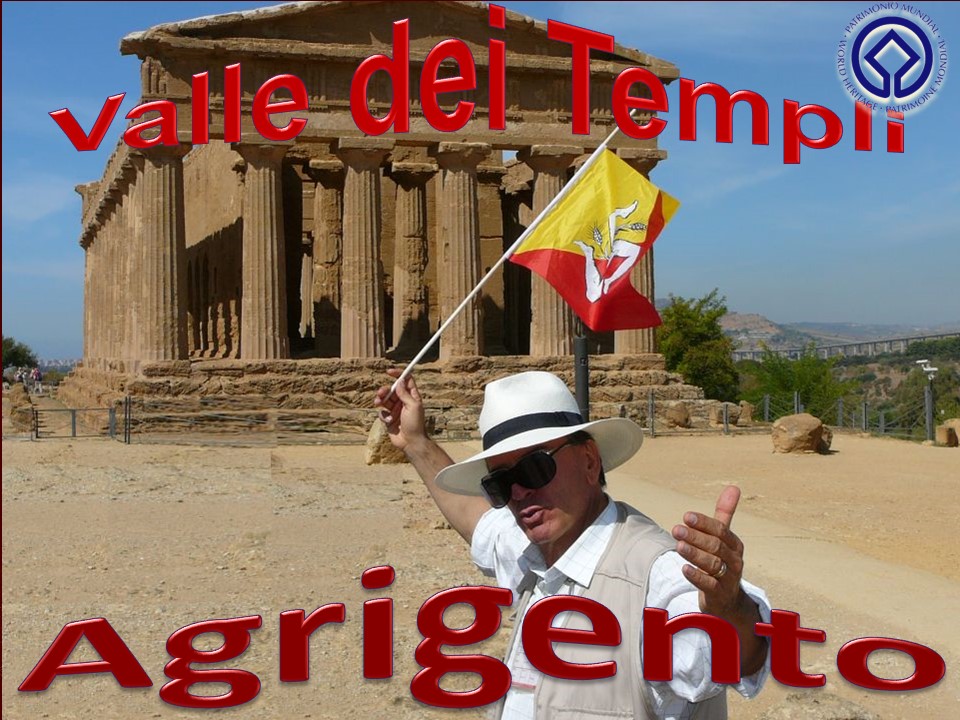
Valle dei Templi
Agrigento
Presenter Notes
Ancient Akragas , in its hey-day, was a
flourishing cultural centre it gave the world
Empedocles, the pre-socratic philosopher, whose
concept of matter as divided into four elements-
Earth, Air, Fire and Water- was the foundation of
science for many centuries to come. The city
attracted poets like Simonides and Pyndar who
described it as "the most beautiful of mortal
cities".
In Roman times, Agrigento was visited by Cicero
in search of evidence of pro-consul Verres' abuse
of power and later described by Virgil in the
Eneid. From the Middle Ages up to modern times,
its remains, landscapes, flora, colours and the
echo of lost civilizations have inspired poets,
writers and painters Ludovico Ariosto, Wolfgang
Goethe, Guy de Maupassant, Alexandre Dumas,
Anatole France, Murilo Mendes, Lawrence Durrell,
E.M.Forster, Francesco Lojacono, Nicolas de
Stael, Salvatore Quasimodo, Luigi Pirandello.
2
Agrigento
Agrigento (Sicilian Girgenti), is a city on the
southern coast of Sicily, and capital of the
province of Agrigento. It is renowned as the site
of the ancient Greek city of Akragas in Greek,
Agrigentum in Latin and Kirkent or Jirjent in
Arabic, one of the leading cities of Magna
Graecia during the golden age of Ancient
Greece. Agrigento (în dialect Sicilian
Girgenti), orasul situat pe coasta de sud a
Siciliei, este capitala provinciei cu acelasi
nume. Cunoscut ca fiind vechiul Akragas al
Magnei Grecia, Agrigentum în timpul Imperiului
Roman, redenumit apoi Kirkent sau Jirjent de
arabi, Agrigento a fost unul dintre orasele de
frunte din Magna Grecia în timpul epocii de aur a
Greciei Antice..
Presenter Notes
Orasul ale carui baze au fost puse de colonistii
greci din Gela in 582 i.e.n. s-a numit Akragas -
in greaca Agrigentum - in latin Kirken - in
araba. Agrigento s-a dezvoltat in perioada de
aur a Greciei. In 406 i.e.n. este asediat si
distrus de cartaginezi. In 260, dupa razboiaele
punice, este luat de romani, iar dupa moartea lui
Cezar in 44 i.e.n. locuitorii primesc toti
cetatenie romana. Orasul urmeaza sa suporte
invazia ostrogotilor, sa fie luat de bizantinii,
iar in 828 e.n. este capturat de catre arabi. In
1027 este cucerit de normanzi - contele Roger
care stabileste o episcopie latina aici. Ca orice
oras port a suferit bombardamente in timpul celui
de al doilea razboi mondial.
3
"To have seen Italy without having seen Sicily is
not to have seen Italy at all, for Sicily is the
clue to everything." Johann Wolfgang von Goethe
Presenter Notes
Perched on a hill overlooking the ocean on one
side and Agrigento on the other is The Valley of
the Temples. This is the finest collection of
Greek temples in Europe and the temple of Concord
is the world's best preserved Greek Temple.
4
The term "valley" is a misnomer, the site being
located on a ridge outside the town of Agrigento.
5
Tempio di Concordia
One of the most outstanding examples of Greater
Greece art and architecture, and one of the main
attractions of Sicily as well as a national
monument of Italy, the area was included in the
UNESCO Heritage Site list in 1997 Desi
Parthenonul din Atena este unul dintre cele mai
vizitate obiective turistice, Valea Templelor din
Sicilia are cel mai mare numar de ruine grecesti.
Situl dateaza din secolul V î.Hr. si cuprinde
unul dintre cele mai bine pastrate temple dorice
grecesti . Situl arheologic Valle dei Templi din
Agrigento a fost înscris în anul 1997 pe lista
patrimoniului cultural mondial UNESCO
"winged legs", by IGOR MITORAJ, Agrigento, Sicily
Presenter Notes
Lesposizione si svolge allinterno del Parco
Archeologico e Paesaggistico della Valle dei
Templi di Agrigento.È stata organizzata da Il
Cigno GG Edizioni, dal Parco Archeologico e
Paesaggistico della Valle dei Templi, dalla
Galleria dArte Contini di Venezia (con la
partecipazione de I Luoghi dellArcadia) ed è
stata realizzata grazie al sostegno della
Fondazione Roma Mediterraneo. Si avvale delle
sponsorizzazioni de Il Giornale di Sicilia,
Telesia e Reale Mutua Assicurazioni.La mostra
nasce da unidea di Lorenzo Zichichi de Il Cigno
GG Edizioni e Rosalia Camerata Scovazzo,
presidente pro tempore del Parco, a seguito di
unesposizione di Igor Mitoraj tenutasi a Palermo
nel 2007 nel 2010 Giuseppe Castellana, direttore
del Parco, in pochi mesi ha concretizzato il
progetto della monumentale mostra di Igor Mitoraj
nellincantevole paesaggio archeologico della
Valle dei Templi.Lesposizione è la prima nel
suo genere, la più importante di sempre tra le
mostre dellartista e anche la più lunga nel
tempo (dura infatti 8 mesi).
6
This year (2011) there is an additional reason to
visit the Valle dei Templi. About two dozen works
in bronze and marble by a modern Polish/German
artist who lives in Italy, Igor Mitoraj, have
been installed around the site. Mitoraj (born
1944) is heavily influenced by classical
sculpture, so his works complement the scenic
ruins. Sometime in November his sculptures will
be removed.
Armless Male and Icarus by Igor Mitoraj (Exhibit
from March to November, 2011)
Presenter Notes
Le opere esposte rappresentano il lavoro dello
scultore dal 1980 a oggi.
7
The temple of Hera Lacinia (Juno) was built
around the 5th century BC and set on fire by the
Carthaginians in 406 BC. It was attributed to
Juno, the goddess of marriage and birth, and it
still keeps unchanged the entrance cell colonnade
(in part restored in the 20th century).
Templul Iunonei (Hera) a fost construit în
secolul V î.Hr si a fost incendiat de cartaginezi
în anul 406 î.Hr. El a fost destinat zeitei
casatoriei si nasterii si a fost partial
reconstruit în secolul XX.
Presenter Notes
The Greek temple emerged as the archetypal shrine
of all time. Unlike the Egyptians, the Greeks put
their walls inside to protect the cella and their
columns on the outside, where they could
articulate exterior space. Perhaps for the first
time, the overriding concern is for the building
seen as a beautiful object externally, while at
the same time containing precious and sacred
inner space. Greek architects have been praised
for not crushing the viewer with over
monumentality yet they found it appropriate to
build temples on basically the same theme ranging
in size from the tiny Temple of Nike Apteros
(427-424 BC) of about 6 by 9 m (about 20 by 30
ft) on the Athens Acropolis to the gigantic
Temple of Zeus (500? BC) at Agrigento in Sicily,
which covered more than 1 hectare (more than 2
acres). The Greeks seldom arranged their
monuments hierarchically along an axis,
preferring to site their temples to be seen from
several viewpoints in order to display the
relation of ends to sides.
8
(Opuntia, ficus-indica), smochina indiana
9
(No Transcript)
Presenter Notes
In successive efforts during many centuries the
Greeks modified their earlier models. Concern for
the profile of the building in space spurred
designers toward perfection in the articulation
of parts, and these parts became intellectualized
as stylobate, base, shaft, capital, architrave,
frieze, cornice, and pediment, each representing
metaphorically its structural purpose.
10
Sicilia este un tarâm aparte, o insula separata
de restul Italiei, nu numai de mare, ci si de
secole de experiente istorice si culturale. Ea
este o parte extrem de importanta a Italiei
despre care, profund impresionat de frumusetile
sale, scriitorul german Johann Wolfgang von
Goethe spunea sa vezi Italia fara sa vezi
Sicilia este ca si cum nu ai fi vazut Italia
deloc, pentru ca Sicilia este cheia întregii tari
Because of its strategic location, Sicily was
invaded over the centuries by many armies.
11
Brought from Persia, Arabs introduced terracing
and irrigation for farming plus sugar cane,
rice, cotton, pistachios, almonds, pomegranates,
apricots, peaches, citrus, mulberry trees for
silk-worms plus roses and jasmine for perfume
early forms of ice cream....
Grecii au adus Siciliei strugurii si maslinele si
au învatat populatia sa faca vin. ... Arabii au
adus migdalele, sistemul de irigatii, caisele,
portocalul si scortisoara
12
Tempio di Concordia, 440-430 BC, best preserved
temple
Presenter Notes
The temple of Concorde is the only temple still
standing in its whole. It was built in 430 BC,
and in the 6th century BC it was changed into a
sacred building. You can still see the arches
included in the central cell walls. Here there
are massive tapered columns and the frieze is
decorated with triglyphs and metopes. The name
Concorde comes from a Latin inscription founded
nearby the temple itself.
13
Tempio di Concordia, 440-430 BC, best preserved
temple
Presenter Notes
Uno dei siti archeologici più rappresentativi
della civiltà greca classica, inserito nel 1998
dall'UNESCO nell'elenco del Patrimonio Mondiale.
Su un crinale roccioso che delimita a sud
l'altopiano su cui sorgeva l'abitato classico,
ancora emergono i resti dei templi dorici, di
incerta attribuzione da est verso ovest, da
quota 127 a quota 70, Hera (Giunone) Lacinia,
Concordia, Eracle (Ercole), Zeus (Giove)
Olimpico, Castore e Polluce (Dioscuri) e
Hephaistos (Vulcano). Più in basso, la piana di
San Gregorio attraversata dal corso del fiume
Akragas, alla cui foce si trovava il porto e
emporion della città antica. Vicino al fiume, il
tempio dedicato al dio della medicina,
AsclepioTempio di Era Lacinia (Giunone)Tempio
della ConcordiaTempio di Eracle (Ercole)Tempio
di Zeus (Giove) OlimpicoTempio dei Dioscuri
(Castore e Polluce)Tempio di Efesto
(Vulcano)Termpio di Asclepio (Esculapio)Santuari
o rupestre di Demetra
14
Tempio di Concordia, 440-430 BC, best preserved
temple
Presenter Notes
The Valley of the Temples is one of the most
important archeological sites in the world and in
1997 it was named a UNESCO World heritage site.
The temples are located in Agrigento, which is in
the region of Sicily. The city was initially
founded as a Greek colony in the 6th century BC
and it quickly became a major cultural center.
The doric style temples in the valley were all
constructed within a century. Each of the temples
face east, which was a standard criteria for both
Greek and Roman temples. This was done so that
the statue of the god housed in each temple would
be illuminated by the rising sun. One can only
imagine how beautiful this area was when it was a
thriving city and the temples were almost all
complete. I am sure it would have been a site to
behold.
15
The temple of Concorde is the only temple still
standing in its whole. It was built in 430 BC,
and in the 6th century BC it was changed into a
basilica. The name Concorde comes from a Latin
inscription founded nearby the temple
itself Ridicat în jurul anului 430 î.Hr., templul
Concordia este cel mai bine pastrat templu doric
din lumea greaca (datorita transformarii sale în
biserica crestina la începutul secolului VII,
când preotul Gregorio di Agrigento a dedicat
templul pagân Sfintilor Apostoli Petru si Pavel)
si unul din cele mai frumoase din punct de vedere
al proportiei si armoniei formei.
Presenter Notes
Templul Concordia
Ridicat în jurul anului 430 Î.Ch., templul
Concordia este cel mai bine pastrat templu Doric
din lumea greaca si unul din cele mai frumoase
din punct de vedere al proportiei si armoniei
formei.
Este o structura din patru laturi, 20/42 m.
Colonadele elegante, urmând un model clasic, are
6/13 coloane, fiecare cu o înaltime de 6,75 m.
Când episcopul Gregorio a transferat locul
catedralei la Agrigento, templul a trecut prin
transformari majore (secolul VI AD)
La nord de templu se întinde Necropola Bizantina
Paleocrestina, un complex vast de morminte în aer
liber.
16
Tempio di Concordia, 440-430 BC, best preserved
temple
17
Un motiv în plus pentru vizitarea ruinelor din
Valle dei Templi în acest an (2011) este faptul
ca aproape doua duzini dintre lucrarile din bronz
sau marmura ale artistului Igor Mitoraj (polonez
nascut în Germania în anul 1944) au fost
instalate printre ruinele templelor, urmând sa
fie expuse acolo pâna în luna noiembrie.
Presenter Notes
... Ad Agrigento, nella Valle dei Templi, ancora
una volta gli antichi resti della civiltà
classica e le gigantesche sculture di Igor
Mitoraj si confronteranno, in una istallazione di
potente impatto estetico ed emozionale che nel
seducente dialogo tra presente e passato trova
nuovi accenti di inquietudine e straniamento. Un
percorso lungo la via sacra, che tocca tutti i
templa aree misurate, orientate e consacrate
agli dei davanti ai quali, moderne offerte
votive, si stagliano le sculture di Mitoraj. Il
travertino e il bronzo risaltano contro le pietre
dei templi crollati. Il muto dialogo tra le
frammentate sculture di Mitoraj e i templi
dellantica Akagras-Agrigentum in frammenti
rendono il silenzio di quei luoghi una pagina di
storia senza tempo che ogni visitatore è invitato
a scrivere con emozioni ed esperienze tutte
proprie.
Some suggest that this mutilated head represents
a loss of history, myths and of a connection with
higher powers to others it is a criticism of
contemporary civilization and a warning against
its destructive power.
18
Agrigento, Valle dei Templi
Presenter Notes
Sembra incredibile, ma questa atmosfera surreale
che permea le sculture di Mitoraj sparisce ogni
qual volta le sue opere vengono inserite in un
contesto vissuto sia esso antico o moderno purché
sia capace di interagire con i vuoti ed i pieni
delle sue sculture. Diventando di fatto delle
nuove opere darte non più finite in sé, ma
istallazioni contemporanee capaci di offrire
emozioni inaspettate per proiettarci o nel
passato più remoto, oppure nel futuro più
avveniristico. È questa la grandezza di Mitoraj,
un artista che cerca la monumentalità e
leccessivo fuori misura delle sue figure per
dialogare con larchitettura moderna, come è
accaduto alla Defence di Parigi, oppure per
confrontarsi con lantico come ha fatto nelle
numerose esposizioni promosse a Siracusa, a
Firenze e a Roma... (Francesco Buranelli,
Segretario della Pontificia Commissione per i
Beni Culturali della Chiesa, Igor Mitoraj nella
Valle dei Templi).Uno degli scopi dellevento è
quello di aumentare ancora di più linteresse del
pubblico per la Sicilia, e incentivare gli
ingressi al Parco Archeologico, già
precedentemente (secondo dati forniti dalla
direzione del Parco) aumentati del 15 grazie
alliniziativa analoga svoltasi nel 2010 (la
mostra con cinquanta opere tra sculture e dipinti
denominata Arte Contemporanea per il Tempio di
Zeus).
19
Tempio di Concordia, 440-430 BC, best preserved
temple
Presenter Notes
Igor Mitoraj was born in 1944 of a Polish mother
and a French father in Oederan, Germany. He spend
his youth in Krakow where he studied at the
Academy of Fine Arts. Under the tutelage of
Tadeusz Kantor, he was introduced to contemporary
artist such as Andy Wharhol, Lichenstein, Merz
and Klein.In 1968 he arrived in Paris to
continue his studies at the Ecole Nazionale
Superieure des Beaux- Arts (National High School
of Fine Arts). A lengthy stay in Mexico in the
early seventies allowed him to study South
American and Aztec cultures. At this point,
Mitoraj chooses to express himself artistically
in the form of sculpture.In 1976, his first
personal exhibition at the La Hune Gallery in
Paris is an enormous success. He is awarded
important prizes such as the Montrouge Prix de
la Sculpture and is encouraged by the French
minister of Culture who provides him with a
studio at Montmartre. Mitoraj travelled
extensively in particular to New York and Greece.
After a visit to Pietrasanta in Tuscany, the
artist discovers marble as an ideal material for
his sculptures, in addition to his previous use
of terracotta and bronze.In 1983, he chooses to
make Italy his home and opens a studio in
Pietrasanta, though he continues to maintain his
Paris atelier.
20
Agrigento, Valle dei Templi, Catacombs
Presenter Notes
In 1986, Mitoraj accepts an invitation to
participate in the XLII International Biennial
Art Exhibition in Venice. In only a few years
time, Mitorajs works of art have been exhibited
in many countries, often one-man showings as well
as large museum expositions. He began to receive
important international commissions for his huge
monumental sculptures both from private
collectors as well as public sectors. His works
can be seen in London at the British Museum and
Canary Wharf, at Bamberg and Krakow in Paris at
La Défence, at the Uffizi Museum and the Boboli
Gardens in Florence, in Piazza del Carmine and
the Scala Theatre in Milan as well as in Rome in
Piazza Monte Grappa and Piazza Mignanelli.In
2004, Mitoraj exhibits his monumental sculptures
at the Tulleie Gardens of Paris, at the Mercati
di Traiano in Rome and at the Royal Palace of
Warsaw.In September 2005, The Contini Art
Gallery of Venice in collaboration with the
Venetian Civic Museums of Art and History,
inaugurate an exhibition entitled Mitoraj a
Venezia, an exposition of 21 sculptures, 16 of
monumental size along with 25 inedited designs.
This exhibition followed an artistic route
throughout the heart of the city of Venice
(Contini Gallery, Cà Pesaro Musuem of Modern Art,
various campos, along the Grand Canal and even in
Mestre on the mainland situated in the San
Giuliano Park and at the Civic Center. The
exposition is a huge success. Presently, Igor
Mitoraj divides his time between Pietrasanta and
Paris.
21
Tempio di Eracle (Ercole) - Temple of Herakles
(Hercules)
Presenter Notes
Colonne e ruderi abbattuti dichiarano al
visitatore che il tempio di Ercole, uno dei più
belli dell'antichità, è ora ridotto a povere
vestigia. Ma anche così l'edificio, visibile da
lontano, è imponente e sorge nella valle dei
templi proprio come il simbolo della potenza e
della Sicilia e, in particolare, di Agrigento,
che gli consacrò questo sontuoso tempio e celebrò
in suo onore le feste eraclee. Il tempio che è
rivolto come gli altri, ad oriente, ha le
seguenti dimensioni l'alta piattaforma
rettangolare montata su 4 gradoni, misura m. 73,
992 in lunghezza e 27, 788 in larghezza, un
triplice quadrato che occupa una superficie di mq
2.056,89 e raggiungeva un'altezza di m 16,264.
Delle 38 colonne, che si presentavano 6 sui lati
lunghi, contando anche quelle degli angoli, solo
9, che furono rialzate nel 1922 grazie alla
munificenza del capitano Alexander Hardcastle, si
stagliano con il loro aspetto imponente, in mezzo
a tutte quelle rovine. Sono formate da 4 tamburi
tufacei, hanno un diametro di m. 2,21 e sono alte
m. 10.
22
Tempio di Eracle (Ercole) - Temple of Herakles
(Hercules)
Presenter Notes
La cella adornata da 4 colonne, era lunga m 48 e
larga m 13 e anzichè in 3 vani, è divisa in 6
vani si tratta di una modifica apportata dai
romani quando, impadronitisi della città,
dovettero ricostruire le case distrutte e
restaurare i templi danneggiati. I corridoi tra
le colonne e la cella sono ampii, nella facciata
orientale vi è stata sovrapposta una scalinata
con 8 alzate. Fra l'echino, abbastanza espanso, e
la colonna vi è una gola restano tracce dello
stucco. Nel tempio si venerava una statua bronzea
di Ercole di particolare bellezza, rubata da
Verre. Niente fu risparmiato in questo tempio per
quanto riguarda la decorazione. Nella cornice Vi
era una disegno ricco di colore rosso, azzurro,
tacchino, di un fascio con meandri terminanti ai
lati con palmette verticali tra teste di leoni,
che rispondevano ad un tempo alle esigenze
funzionali ed ornamentali della plastica
architettonica greca. Anche per il nome di questo
tempio ci affidiamo alla tradizione che, anche in
questo caso, non è lontana dal vero. Cicerone
infatti dice che " il tempio di Ercole non è
lontano dal foro" ed il foro di Akragas,
ritrovato pochi anni fa, ha dato ragione a
Cicerone.
23
Tempio di Eracle (Ercole) - Temple of Herakles
(Hercules)
24
Tempio di Eracle (Ercole) - Temple of Herakles
(Hercules)
25
(No Transcript)
26
Temple of Heracles, who was one of the most
venerated deities in the ancient Akragas. It is
the most ancient in the Valley destroyed by an
earthquake, it consists today of only eight
columns. Templul lui Hercule este cel mai vechi
templu din Agrigento, construit pentru cel mai
venerat zeu din Akragas
27
Ombra mai fu.
28
(No Transcript)
29
Agrigento, Valle dei Templi, Tempio di Giove
30
Agrigento, Valle dei Templi, Tempio di Giove
31
(No Transcript)
32
The temple of Olympian Zeus (Jupiter) was built
to thank Zeus after the successful war of the
Agrigentinians against the Carthaginians in 480
BC. Originally the temple was 113 metres long and
56 metres large, one of the most impressive in
ancient times. It had a trabeations supported by
20 metre tall columns alternated by the so-called
Telamoni, huge man-like statues. Din Templul
lui Zeus din Olimp au ramas doar ruine desi a
fost una din cele mai impresionante cladiri,
masurând 112,60 / 56,30 m. A fost construit în
480 î.Hr. în cinstea lui Zeus, dupa victoria
împotriva Cartaginezilor. Între coloane erau
statui ale gigantilor, telamones, care aveau
rolul de sustinatori ai structurii.
Presenter Notes
The temple of Olympian Zeus (Jupiter) was built
to thank Zeus after the successful war of the
Agrigentinians against the Carthaginians in 480
BC. Originally the temple was 113 metres long and
56 metres large, one of the most impressive in
ancient times. It had a trabeations supported by
20 metre tall columns alternated by the so-called
Telamoni, huge man-like statues. Many of the tufa
blocks have peculiar U-shape cuts, which were
used to channel the rope when lifting and setting
the stones.
33
(No Transcript)
34
Agrigento, Valle dei Templi, Tempio di Giove
35
Agrigento, Valle dei Templi, Tempio di Giove
Presenter Notes
Igor Mitoraj Poland/Italy Patinated Bronze
Mitorajs work exhibits a contemporary
sensitivity, but references a lost classical
aesthetic.
This work depicts a fragment of an ancient
monument to Eros, the god of love, here
blindfolded, suggesting that love is blind.
Mitoraj is one of the foremost Polish artists to
have gained international success.
Igor Mitoraj, one of the foremost Polish artists
and one of a few to have gained international
success, creates gigantic figures of ancient
gods, heroes, muses and titans, often depicting
them as bandaged heroic figures. Long fascinated
with the beauty of Greek and Roman sculptures,
his work exhibits a contemporary sensitivity, but
references back to a lost classical beauty.
Eros Bendato Scrippolato (Eros blindfolded and
cracked) is a bronze sculpture made to look like
a fragment of an ancient monument to Eros, the
god of love. Known as Amor in Latin and Cupid in
Roman mythology, Eros is the youngest, most
mischievous, and beautiful of the immortal gods.
Often portrayed with his arrows, Eros is
represented here as blind folded, suggesting that
love is blind, and also that Eros victims were
randomly selected.
The head with its surface patina, cracked plates
and pieces of shattered fragments suggest the
destruction of objects and monuments brought on
by time.
Some suggest that this mutilated head represents
a loss of history, myths and of a connection with
higher powers to others it is a criticism of
contemporary civilization and a warning against
its destructive power.
36
Agrigento, Valle dei Templi, Tempio di Giove,
Telamon
37
Telamon, Agrigento, Valle dei Templi, Tempio di
Giove
38
In the classical European architectural tradition
an atlas (also known as a atlant, or atlantid
plural atlantes) is a support sculpted in the
form of a man, which may take the place of a
column, a pier or a pilaster. The Roman term for
such a sculptural support is telamon (plural
telamones or telamons) Telamon este denumirea
latina întâlnita prima data la Vitruviu (De
Arhitectura) a motivului reprezentând varianta
masculina a cariatidei. Cu bratele ridicate sau
sprijinite pe solduri, într-un efort de
sustinere, având rol functional sau decorativ,
telamonul este initial întâlnit sub numele de
atlant în sculptura greaca.
39
Telamon, Agrigento, Valle dei Templi, Tempio di
Giove
40
Image Internet
Agrigento, Valle dei Templi, Tempio di Giove,
Telamon
41
Agrigento, Valle dei Templi, Tempio di Dioscuri
42
Agrigento, Valle dei Templi, Tempio di Dioscuri
43
Many of the tufa blocks have peculiar U-shape
cuts, which were used to channel the rope when
lifting and setting the stones. Multe dintre
blocurile de piatra au o taietura (o scobitura)
în forma literei U, utilizata pentru fixarea
frânghiilor cu care erau ridicate blocurile de
piatra.
Agrigento, Valle dei Templi, Tempio di Dioscuri
44
(No Transcript)
45
(No Transcript)
46
(No Transcript)
47
Image Internet
The Sicilian cart (or carretto Siciliano in
Italian and carrettu Sicilianu in Sicilian) is an
ornate, colorful style of horse or donkey-drawn
cart native to the island of Sicily, in Italy.
The carts were introduced to the island by the
ancient Greeks. Panel illustrations depicted the
Crusades, chivalry and other important events in
Catholic and European history. Sicilia mai este
cunoscuta în lume si pentru teatrul de papusi,
caracteristic, dar si pentru carutele siciliene,
decorate cu desene inspirate din istoria
europeana pusa în scena la teatrul de papusi
Lopera dei pupi în care joaca personaje
cunoscute, cum ar fi Carol cel Mare (Carolus
Magnus) si Paladinii lui, tipic pentru traditia
siciliana
48
The Sicilian cart (or carretto Siciliano)
49
Text Internet Pictures Sanda Foisoreanu
Otilia Contras Gabriela Cristescu Presentation
Sanda Foisoreanu
2011
Sound Tarantella siciliana - Marranzanu
Scacciapensieri
Presenter Notes
Eros Bound (Eros spetany) sculpture by Igor
Mitoraj was placed at Main Market Square (Rynek
Glówny) in Kraków. This is the sculptures
temporary location. Nobody knows where its
permanent place shall be. In the Internet poll,
the inhabitants of Kraków chose to locate the
sculpture a Railway Station Square (Plac
Dworcowy). The artist is of a different opinion
he spent his youth in Kraków and wishes to have
his work placed in the town's most prestigious
place.
The sculpture is over 3.5 m long and over 2 m
high. Eros Bound depicts a mans lying head.
This is Igor Mitorajs fourth sculpture in
Kraków, but the first presented outdoors. The
National Museum has two works by him in its
collection one decorates the court of Collegium
Iuridicum, the Jagiellonian University.
Igor Mitorajs sculpture shall remain in front of
the town hall for 4 months. Then... perhaps for
another 4 months. Before it can be taken to Maly
Rynek (Small Market Square) - as Jacek
Majchrowski, President, wishes - the
reconstruction of this square may begin. However,
it is known that Rynek Glówny is the sculptures
exhibition only location accepted by the artist
Now is before Castor Polux temple
Recommended

