

Installing And Maintaining Three-Phase Transformers - Miracle Electronic Devices Pvt. Ltd. PowerPoint PPT Presentation
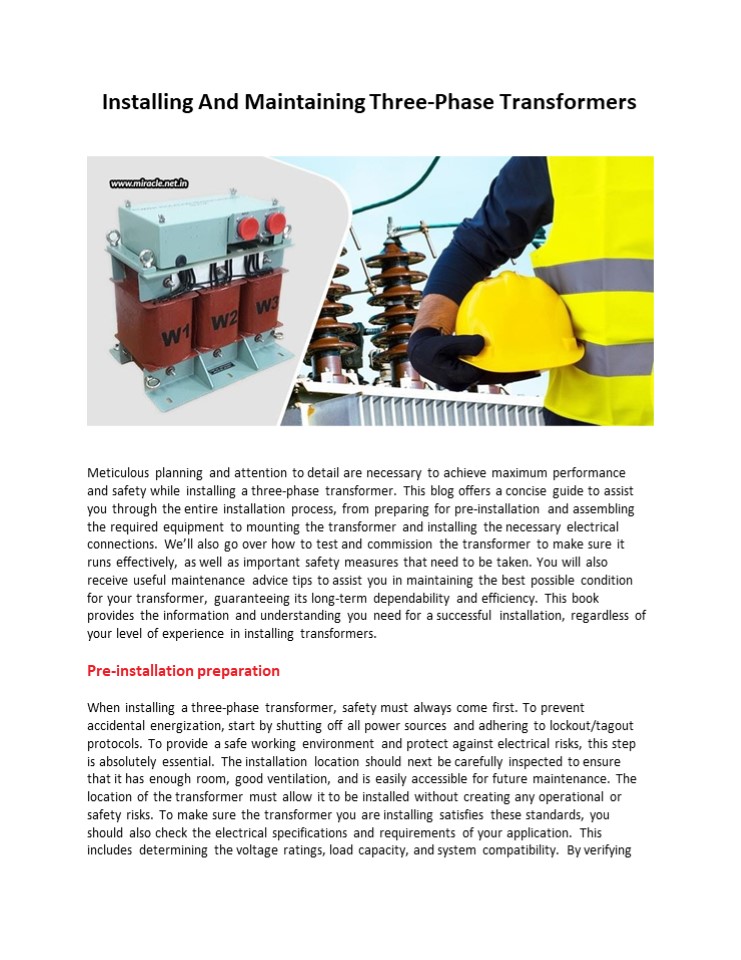
Title: Installing And Maintaining Three-Phase Transformers - Miracle Electronic Devices Pvt. Ltd.
1
Installing And Maintaining Three-Phase
Transformers
Meticulous planning and attention to detail are
necessary to achieve maximum performance and
safety while installing a three-phase
transformer. This blog offers a concise guide to
assist you through the entire installation
process, from preparing for pre-installation and
assembling the required equipment to mounting the
transformer and installing the necessary
electrical connections. Well also go over how to
test and commission the transformer to make sure
it runs effectively, as well as important safety
measures that need to be taken. You will also
receive useful maintenance advice tips to assist
you in maintaining the best possible condition
for your transformer, guaranteeing its long-term
dependability and efficiency. This book provides
the information and understanding you need for a
successful installation, regardless of your level
of experience in installing transformers. Pre-inst
allation preparation When installing a
three-phase transformer, safety must always come
first. To prevent accidental energization, start
by shutting off all power sources and adhering to
lockout/tagout protocols. To provide a safe
working environment and protect against
electrical risks, this step is absolutely
essential. The installation location should next
be carefully inspected to ensure that it has
enough room, good ventilation, and is easily
accessible for future maintenance. The location
of the transformer must allow it to be installed
without creating any operational or safety risks.
To make sure the transformer you are installing
satisfies these standards, you should also check
the electrical specifications and requirements of
your application. This includes determining the
voltage ratings, load capacity, and system
compatibility. By verifying
2
these specifications, you can be confident that
the transformer will work properly and
effectively in your electrical system and avoid
any potential mismatches that can cause problems
or harm. These preliminary actions lay the
groundwork for a safe and effective transformer
installation. Mounting the transformer Installing
the transformer correctly requires appropriate
positioning and securing. Start by setting up the
transformer on a mounting platform or flat,
sturdy surface. To avoid any instability or
vibrations that might impair the transformers
performance and durability, make sure the surface
is level and stable. After positioning the
transformer, secure it in accordance with the
manufacturers instructions by using the proper
bolts and brackets. To keep the transformer
securely in place, this entails choosing the
right kind and size of fasteners and making sure
they are fastened correctly. In addition to
guaranteeing the transformer operates safely,
this meticulous attention to placement and
securing also makes future maintenance and
inspections easier. Electrical connections Make
sure that the input voltage satisfies the
transformers requirements before making any
primary connections to guarantee compatibility
and correct operation. After confirmation,
establish the primary connections using
appropriate cables and connectors, making sure
that every connection is tight and adequately
insulated to avoid electrical risks and guarantee
effective functioning. Make sure you have
verified the secondary voltage requirements for
secondary connections before moving ahead. This
step is essential to prevent mismatches that
might harm the connected equipment or the
transformer. The secondary connections should
then be connected in accordance with the
manufacturers wiring schematic. Ensuring that
the connections are completed accurately and
safely requires careful adherence to
the manufacturers instructions. For the
transformer to operate safely and effectively,
possible problems must be avoided and dependable
performance must be ensured by paying attention
to these elements in both the primary and
secondary connections. Grounding and bonding An
effective bonding and grounding system is
essential to a three-phase transformers safe
functioning. By carefully directing any stray
electrical currents into the earth, grounding the
transformer reduces the risk of an electrical
fire and improves general safety. It is
imperative that you take this action to safeguard
the transformer and any attached equipment from
any potential electrical problems. Furthermore,
by connecting the transformers entire metal
structure to the ground, any possible variations
that can result in hazardous electrical faults
are eliminated. To do this, every metallic
component must be safely connected to a single
grounding point. You may provide a stable and
safe electrical environment, lower the danger of
electrical shock and equipment damage, and
guarantee safety standard compliance with proper
3
grounding and bonding. Testing and
commissioning Make sure that every connection and
component is visually inspected before powering
on the transformer. Keep an eye out for any
indications of damage, loose connections, or
incorrect installation that can jeopardize
performance or safety. In order to avoid any
problems during operation, it is essential to
make sure that every component is intact and
placed appropriately. After the inspection is
over, turn the transformer on gradually. Keep a
watchful eye out for any unusual vibrations,
sounds, or temperature increases throughout this
procedure since these hints might point to
underlying issues. Early detection of these
irregularities enables prompt remedial action,
limiting additional harm. Apply the load
progressively once the transformer has
successfully been energized to evaluate its
performance under operating conditions. This step
ensures dependable operation by confirming that
the transformer can safely carry the anticipated
load. Gradual load testing ensures that the
transformer is prepared for continuous operation
under real-world conditions by pointing out any
flaws or inefficiencies. Maintenance tips for
three-phase transformers For three-phase
transformers to operate dependably and last a
long time, regular maintenance is essential.
Following a planned maintenance schedule might
help you avoid problems and get more use out of
your equipment. Scheduled inspections To begin,
check transformers on a regular basis for
physical deterioration, corrosion, or
overheating. Frequent visual inspections assist
in spotting issues early. It is important to do
routine oil analysis on transformers that contain
oil. This examination keeps an eye on the
insulations quality and assists in identifying
any problems before they become more significant
ones. Cleaning and ventilation Its critical to
keep the area around the transformer clean.
Debris and dust can obstruct insulation and
cooling, causing inefficiency or damage. To keep
the transformer surfaces clear of impurities,
clean them on a regular basis. In addition,
efficient heat dissipation during operation
depends on adequate ventilation. To avoid
overheating, make sure there is enough
ventilation around the transformer. Monitoring
temperature and load Keep an eye on transformer
temperatures to identify any overheating
symptoms, since they might point to more serious
issues. In order to avoid putting undue strain on
a single winding, load balancing is also very
important. Make sure that the load is equally
distributed over all stages. Inequitable loading
may cause components to fail and wear out too
soon.
4
Electrical testing Periodically check the
integrity of the transformers insulation by
conducting dielectric tests. These tests aid in
the early detection of any malfunctions before
they become serious. Furthermore, confirm that
the transformer maintains output within
reasonable bounds by checking the voltage
regulation. An uninterrupted supply of power to
connected devices is contingent upon proper
voltage management. Repairs and upgrades Take
quick action to resolve any identified problems
to stop more harm and reduce downtime. To
increase overall performance and efficiency,
think about making improvements like upgrading
cooling systems or retrofitting with more
energy-efficient components. Improvements and
repairs may extend the transformers lifespan and
improve its performance. Training and
documentation To guarantee that employees
performing transformer maintenance adhere to
correct protocols and safety standards, you need
to offer them thorough training. Keep thorough
records of all maintenance operations as well,
including dates, conclusions, and remedial
measures. Tracking the transformers performance
and dependability over time requires accurate
documentation. You can minimize the chance of
unplanned breakdowns and maximize the performance
of your three-phase transformer by adhering to
these maintenance recommendations, which
will guarantee the transformers continuous
dependability and efficiency. To maximise
three-phase transformer performance, efficiency,
and longevity, it is not only essential to select
the right three-phase transformer for your needs,
but it is also essential to implement proper
installation and routine maintenance. You can
maximize the dependability of your electrical
power distribution system, minimize downtime, and
ensure safe operation by adhering to this
thorough guidance and putting good maintenance
methods into practice. To get the best outcomes,
always put safety first, follow product
instructions, and abide by industry standards.
Take into consideration Miracle Electronics, a
well-known three phase transformer manufacturer
in India recognized for their dependable and
effective solutions, if youre looking for
premium three-phase transformers. Their
dedication to quality guarantees that your
transformer installations and upkeep endeavours
are bolstered by top-notch products and
expertise. Resource Read more
Recommended

