

Innovations in Artificial Blood Vessels Market: Future of CVD Care PowerPoint PPT Presentation
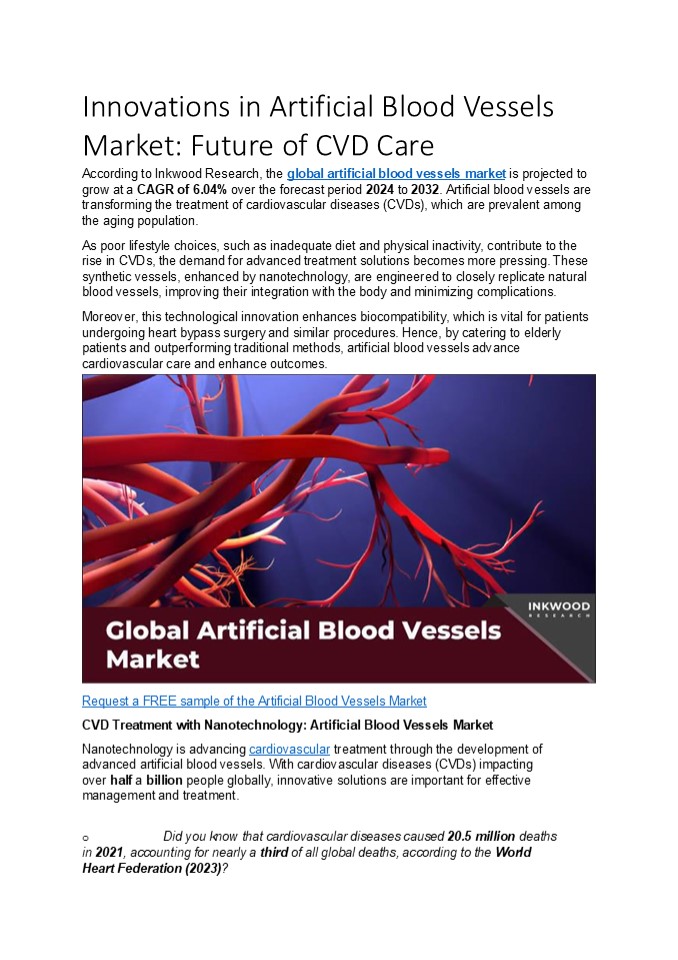
Title: Innovations in Artificial Blood Vessels Market: Future of CVD Care
1
Innovations in Artificial Blood Vessels Market
Future of CVD Care According to Inkwood Research,
the global artificial blood vessels market is
projected to grow at a CAGR of 6.04 over the
forecast period 2024 to 2032. Artificial blood
vessels are transforming the treatment of
cardiovascular diseases (CVDs), which are
prevalent among the aging population. As poor
lifestyle choices, such as inadequate diet and
physical inactivity, contribute to the rise in
CVDs, the demand for advanced treatment solutions
becomes more pressing. These synthetic vessels,
enhanced by nanotechnology, are engineered to
closely replicate natural blood vessels,
improving their integration with the body and
minimizing complications. Moreover, this
technological innovation enhances
biocompatibility, which is vital for patients
undergoing heart bypass surgery and similar
procedures. Hence, by catering to elderly
patients and outperforming traditional methods,
artificial blood vessels advance cardiovascular
care and enhance outcomes.
Request a FREE sample of the Artificial Blood
Vessels Market CVD Treatment with Nanotechnology
Artificial Blood Vessels Market Nanotechnology is
advancing cardiovascular treatment through the
development of advanced artificial blood vessels.
With cardiovascular diseases (CVDs) impacting
over half a billion people globally, innovative
solutions are important for effective management
and treatment. o Did you know that
cardiovascular diseases caused 20.5 million
deaths in 2021, accounting for nearly a third of
all global deaths, according to the World Heart
Federation (2023)?
2
Traditional treatments for CVDs often result in
systemic side effects and limited efficacy. Given
the complexity of cardiovascular dynamics,
nanotechnology offers targeted and precise
solutions that could significantly improve
treatment outcomes. Further, nanotechnology
allows for the creation of artificial blood
vessels that deliver targeted therapies directly
to affected areas, minimizing damage to healthy
tissues and reducing side effects. Nanocoatings
on artificial blood vessels also improve
biocompatibility, reduce thrombosis risk, and
promote integration with existing vasculature.
This, in turn, enhances the functionality and
longevity of artificial vessels. (Source) In this
regard, organizations like the World Health
Organization (WHO), the American Heart
Association (AHA), and the National Institutes of
Health (NIH) are at the forefront of supporting
research and development in nanotechnology for
cardiovascular treatment. The WHO funds studies
on nanotechnology in cardiovascular care to
address the global burden of CVDs with innovative
treatments. Click here to get more insights about
the Global Artificial Blood Vessels Market The
AHA further promotes research grants and
partnerships aimed at developing
nanotechnology-based solutions for heart disease
and related conditions. Similarly, the NIH has
invested heavily in nanomedicine initiatives,
focusing on creating advanced materials for
artificial blood vessels and other cardiovascular
applications. Furthermore, renowned events like
the European Society of Cardiology (ESC) Congress
and the International Conference on Nanomedicine
and Nanotechnology in Health Care provide
platforms for showcasing advancements in
nanotechnology for cardiovascular health. The ESC
Congress, organized by one of the largest
professional societies in cardiology, features
sessions on modern research and innovations,
including nanotechnology applications. Likewise,
the International Conference on Nanomedicine and
Nanotechnology in Health Care brings together
experts to discuss the future of nanomedicine,
including its applications in artificial blood
vessels. As a result, these global efforts by
leading health organizations and renowned events
are accelerating innovations in nanotechnology,
establishing a brighter future for cardiovascular
care. From 3D Printing to Clinical Trials
Artificial Blood Vessels Industry Coronary heart
disease is the most common form of heart and
circulatory disease, affecting around 2.3 million
people in the United Kingdom. It occurs when
coronary arteries become narrowed due to a
build-up of fatty material within their walls. In
essence, researchers from the University of
Edinburgh, in collaboration with Heriot- Watt
University, have unveiled that artificial blood
vessels created using innovative 3D printing
technology could transform the treatment of
cardiovascular diseases. These advanced vessels
have the potential to improve outcomes for heart
bypass patients, a procedure used to treat
coronary heart disease. The development involves
creating tubular grafts from a water-based gel
using a rotating spindle integrated into a 3D
printer. These grafts are reinforced through a
process called electrospinning, which uses high
voltage to produce thin nanofibres that coat the
vessels with biodegradable polyester molecules.
The grafts, which can range from one
3
- to 40mm in diameter, are designed to integrate
seamlessly into the human body and exhibit
strength comparable to natural blood vessels. - Additionally, the use of synthetic vessels may
reduce scarring, pain, and infection risk
compared to traditional methods involving the
removal of human veins. This - advancement addresses challenges related to small
synthetic grafts that are difficult to integrate.
Moreover, to evaluate the effectiveness of the
artificial blood vessels, researchers, in
collaboration with the University of Edinburghs
Roslin Institute, now plan to test them in
animals, with subsequent trials in humans.
(Source) - Kindly click here to view the LinkedIn post
related to this market - Artificial Blood Vessels Market Advances in
Elderly Cardiovascular Health - The increasing geriatric population and evolving
lifestyles are influencing the demand for
advanced medical treatments, particularly
artificial blood vessels. As people age, they
face a higher incidence of cardiovascular
conditions, such as coronary heart disease, which
affects millions globally. - This trend is exacerbated by modern lifestyle
factors like poor diet, sedentary behavior, and
the rising prevalence of chronic diseases,
creating a pressing need for effective
cardiovascular solutions. In this regard, various
key players are advancing the field of artificial
blood vessels through innovative materials,
advanced manufacturing techniques, and ongoing
research. - Discover how key players are driving advancements
in artificial blood vessels with targeted
research - Terumo Corporation and Medtronic have been
pivotal in developing advanced materials for
artificial blood vessels. By incorporating
biodegradable polymers and innovative materials,
these companies enhance the biocompatibility and
performance of synthetic vessels, addressing the
complex needs of an aging population. - Covalon Technologies has introduced specialized
coatings for artificial blood vessels that
prevent thrombosis and improve tissue
integration. These advancements reduce
complications and ensure better outcomes for
elderly patients undergoing cardiovascular
procedures. - BioLamina and CureVac are progressing in the
field by integrating nanotechnology into
artificial blood vessel development. Nanocoatings
and nanofibers enhance the vessels mechanical
properties, reduce the risk of complications, and
improve their integration with natural tissues.
This technology is integral for ensuring that
artificial vessels remain functional and safe,
especially for elderly patients with compromised
vascular health. - The growing geriatric population and shifting
lifestyles are amping advancements in artificial
blood vessel technology. Innovations in
materials, nanotechnology, and ongoing research
are addressing the unique challenges faced by
older patients with cardiovascular conditions. As
these technologies evolve, they will enhance
treatments, improve tissue integration, and
deliver better outcomes for elderly patients with
cardiovascular diseases. - With the progressions of artificial blood
vessels, the medical field is improving treatment
effectiveness, enhancing patient outcomes, and
pushing the boundaries of cardiovascular care.
The development of innovative materials and
technologies for artificial blood vessels is
crucial for achieving better integration with
natural tissues and reducing complications.
4
- Therefore, this focus on innovation is expected
to elevate prominent progress in the artificial
blood vessels market throughout the forecast
period. - Explore the market insights in this YouTube video
by clicking here Cant find what youre looking
for? Talk to an expert NOW! - FAQs
- How are artificial blood vessels created?
- A Artificial blood vessels are created using
various techniques, including 3D printing - and electrospinning. The process typically
involves constructing tubular grafts from
materials like water-based gels or biodegradable
polymers. These grafts are then reinforced with
nanofibers or other advanced materials to enhance
their strength, biocompatibility, and integration
with natural tissues. - Are artificial blood vessels safe and effective?
- A Yes, artificial blood vessels have been shown
to be safe and effective in numerous - studies and clinical trials. They are designed to
closely replicate the characteristics of natural
blood vessels, reducing the risk of complications
and improving treatment outcomes for patients
undergoing procedures like heart bypass surgery.
Recommended

