

Education for All How Cloud Computing Transforms Public Education Systems PowerPoint PPT Presentation
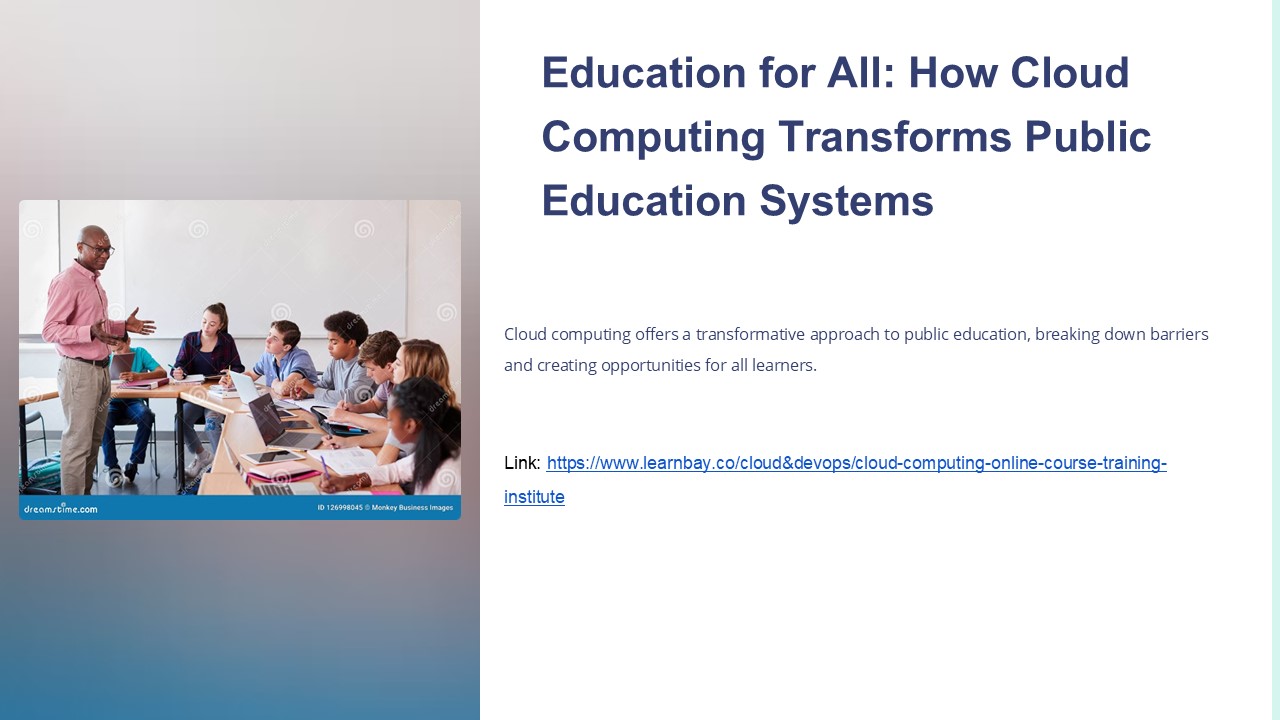
Title: Education for All How Cloud Computing Transforms Public Education Systems
1
Education for All How Cloud Computing Transforms
Public Education Systems
Cloud computing offers a transformative approach
to public education, breaking down barriers and
creating opportunities for all learners. Link
https//www.learnbay.co/clouddevops/cloud-computi
ng-online-course-training-institute
2
Challenges in Traditional Education Systems
Limited Resources
Accessibility Barriers
1
2
Traditional education systems often struggle with
limited resources, including funding, technology,
and qualified teachers.
Physical location, disabilities, and
socioeconomic factors can hinder access to
quality education.
Standardized Curriculum
Lack of Personalized Learning
3
4
One-size-fits-all curriculum fails to cater to
diverse learning needs and individual strengths.
Traditional methods often focus on rote learning
and standardized testing, neglecting personalized
learning experiences.
3
Leveraging Cloud Computing for Accessibility
Anytime, Anywhere Learning
Adaptive Learning Technologies
Accessibility Features
Cloud-based platforms allow students to access
educational materials and participate in virtual
classrooms from any location with an internet
connection.
Cloud-based platforms can provide adaptive
learning experiences tailored to individual
student needs, pacing, and learning styles.
Cloud-based platforms offer built-in
accessibility features, such as screen readers,
text-to-speech, and closed captions, making
education more inclusive.
4
Personalized Learning Experiences
Customized Learning Paths
Adaptive Assessments
Real-Time Progress Tracking
Cloud-based platforms allow educators to create
personalized learning paths for each student,
catering to their specific interests and skills.
Cloud-based platforms can provide adaptive
assessments that adjust difficulty levels based
on student performance, offering targeted
feedback and support.
Educators can monitor student progress in
real-time, identify areas needing improvement,
and adjust instruction accordingly.
5
Collaborative Teaching and Learning
Virtual Collaboration Tools
Cloud-based platforms offer a range of tools,
including video conferencing, shared documents,
and online whiteboards, enabling seamless
collaboration.
Interactive Learning Environments
Cloud-based platforms foster interactive learning
environments where students can connect, discuss,
and learn from each other.
Global Learning Communities
Cloud computing facilitates the creation of
global learning communities, connecting students
and educators worldwide.
6
Data-Driven Decision Making
Data Collection
Cloud-based platforms capture vast amounts of
student data, including performance, engagement,
and learning patterns.
Data Analysis
Cloud-based analytics tools help educators
analyze data to identify trends, strengths, and
areas needing improvement.
Informed Decisions
Data-driven insights allow educators to make
informed decisions about curriculum, instruction,
and resource allocation.
7
Scalable and Cost-Effective Infrastructure
On-Demand Resources
Cloud-based infrastructure provides on-demand
access to computing resources, allowing schools
to scale up or down as needed.
Reduced Costs
Cloud computing eliminates the need for costly
hardware investments and reduces maintenance
costs.
Improved Efficiency
Cloud-based platforms streamline administrative
tasks, allowing educators to focus on teaching
and learning.
Enhanced Security
Cloud providers offer robust security measures,
protecting sensitive student data and ensuring
system reliability.
8
Preparing Students for the Digital Future
Collaboration and Communication
Digital Literacy
Cloud-based platforms equip students with
essential digital literacy skills, preparing them
for a future dominated by technology.
Cloud-based platforms foster collaboration and
communication skills, essential for success in a
globalized workforce.
1
2
3
4
Problem-Solving Skills
Innovation and Creativity
Cloud-based learning environments encourage
critical thinking and problem-solving skills,
preparing students for complex challenges.
Cloud-based platforms provide opportunities for
innovation and creativity, allowing students to
explore new ideas and develop solutions.
Recommended

