

Headless AEM: Separating Content And Delivery For Microservices Architectures PowerPoint PPT Presentation
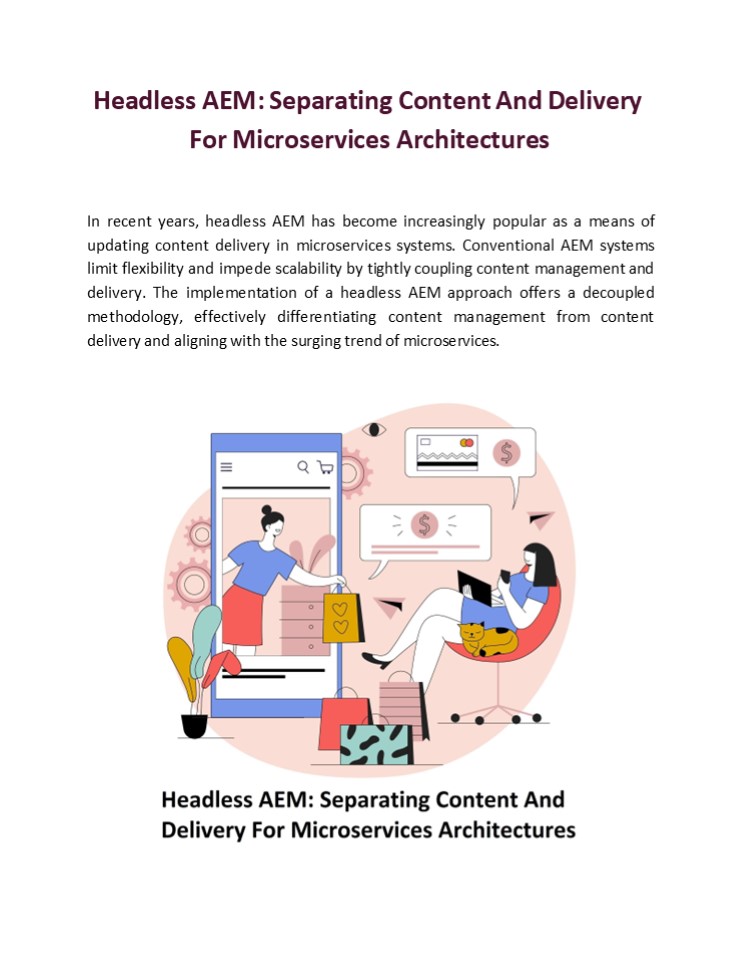
Title: Headless AEM: Separating Content And Delivery For Microservices Architectures
1
Headless AEM Separating Content And Delivery For
Microservices Architectures
In recent years, headless AEM has become
increasingly popular as a means of updating
content delivery in microservices systems.
Conventional AEM systems limit flexibility and
impede scalability by tightly coupling content
management and delivery. The implementation of a
headless AEM approach offers a decoupled
methodology, effectively differentiating
content management from content delivery and
aligning with the surging trend of microservices.
2
- This discussion shall delve into the notion of
headless AEM, highlighting its benefits and how
it empowers businesses to harness the
capabilities of microservices for extensive and
personalized content dissemination. - What Is Headless AEM?
- The architecture of Headless AEM, also referred
to as Adobe Experience Manager Headless, divides
the delivery and administration layers of a CMS.
This facilitates the transmission of content
through APIs to various channels and devices. In
traditional CMS designs, the dissemination of
content across multiple platforms poses
difficulties due to the close link between
display and content layers. The utilization of
a headless CMS design allows for enhanced
flexibility and adaptability, as content control
is detached from its display layer. - Benefits Of Headless AEM For Microservices
- Increased Flexibility
- Headless AEM provides heightened adaptability,
especially for eCommerce companies. It allows
effortless content generation and distribution
across various platforms such as websites, mobile
applications, kiosks, and social media networks. - By separating content from the presentation
layer, businesses can deliver content to any
channel or device without constraints. This
flexibility enables enterprises to efficiently
reach their desired customer base and stay ahead
of the competition by adapting to emerging
technologies and trends.
3
- Improved Scalability
- Headless AEM revolutionizes scalability for
enterprises. The separation of the back-end and
front-end allows each layer to expand
independently to meet specific demands. For
example, companies can easily increase server
capacity during peak sales or promotions
without impacting content delivery. This ensures
a smooth user experience regardless of traffic
volume. - Faster Development Cycles
- Headless AEM accelerates development cycles. By
separating front-end and back-end components,
developers can work on their respective layers
simultaneously without dependencies. This
speeds up development, enables more frequent
deployments and updates, and facilitates the
addition of new features or functionalities to
the platform. - Omni-Channel Delivery
- Providing a consistent experience across many
platforms and devices may be difficult with a
traditional CMS. On the other hand, a headless
strategy enables content producers to offer
unified and customized content across all
platforms, resulting in a uniform consumer
journey. Customers want impeccable service at
every touchpoint in the omnichannel retail
ecosystem of today, and headless AEM helps
deliver on that promise. - Future-Proof Architecture
- Businesses want a CMS that can adapt to new
trends in the ever-changing technology world.
Headless AEM makes it possible to seamlessly
integrate cutting-edge channels and technologies
into current systems, guaranteeing outstanding
client experiences without hiccups or delays. The
platform guarantees efficacy and relevance in
delivering exceptional client experiences
amongst the ongoing advancements in technology.
4
- Implementation Considerations
- Building APIs For Content Retrieval And
Management - APIs function as the conduit between the back-end
content repository and front-end application,
facilitating the distribution of content across
various channels. Organizations must consider
the intricacies and potential expenses of
constructing and sustaining these APIs. Depending
on the scope of the project, specialized
resources or dedicated tools may be necessary to
ensure optimal efficiency, scalability, and
security. - Choosing And Developing Front-Ends For Different
Channels Organizations must carefully select and
create suitable front-end applications for each
channel to deliver headless AEM content. These
applications not only render the content but also
provide a seamless user experience. Factors such
as the targeted audience, device compatibility,
and performance considerations should guide
the selection of front-end technologies for
each channel. - Potential Need For More Technical Expertise
Compared To Traditional CMS - Headless Adobe Experience Manager presents a
higher level of complexity compared to
traditional CMS, with multiple components and
tiers that must work together seamlessly. Content
creators use the AEM interface, while developers
collaborate with APIs and front-end technologies
to distribute the content. This increased
complexity may require organizations to have a
higher level of technical proficiency or seek
assistance from AEM specialists.
5
- Use Cases For Headless AEM
- Building Modern Web Applications (Single Page
Applications) With A Headless CMS - Popular dynamic and interactive web experiences
are being developed using SPAs, including React,
Angular, and Vue.js frameworks. However,
effectively handling content on these SPAs
necessitates a headless CMS. For this purpose,
Headless AEM proves to be an optimal choice as it
offers a formidable CMS equipped with a potent
API layer that seamlessly blends with any chosen
SPA framework. - Developers can concentrate on producing
unparalleled UI and UX for their web applications
by separating the front end from the back end.
The boundaries of a conventional CMS no longer
constrain them, allowing their creativity to
flourish without limitations. - Delivering Content To Mobile Apps, IoT Devices,
And AR/VR Experiences - Currently, individuals can acquire content and
utilize services through a multitude of devices
and platforms including mobile applications, IoT
devices, and AR/VR encounters. Nonetheless,
creators may face difficulties in managing the
distinct specifications for disbursing content
across these platforms. - This is precisely where headless AEM comes into
play, simplifying the intricate procedure. AEMs
headless methodology facilitates the effortless
distribution of content across various channels
and devices via its RESTful API. This
functionality empowers content creators to uphold
a singular origin of veracity, independent of
platform or device.
6
- Integrating Content With Custom Back-End Systems F
or Personalized Experiences - Utilizing Headless AEM, businesses can seamlessly
merge their content with bespoke backend systems
such as CRM systems, eCommerce platforms, and
marketing automation tools. By doing so, these
entities are empowered to tap into valuable
customer data from these systems to curate
personalized content for end-users. - For instance, a retail platform could showcase
individualized product recommendations on its
webpage by harnessing customer insights gleaned
from a CRM system. This valuable
application greatly enhances the customer
experience, like a valuable treasure for
companies seeking to elevate their consumer
interactions. - Conclusion
- In essence, the uptake of headless AEM goes
beyond mere tech changes its a strategic leap
towards embracing the agility and scalability
craved by todays digital setups. By breaking
free from old-school CMS setups, headless AEM
gives businesses the power not just to meet
current demands, but to foresee and adapt to
upcoming shifts seamlessly. - Its knack for blending in with state-of-the-art
tech and handling various scenarios showcases its
pivotal role in driving content innovation. As
firms wade through the murky waters of digital
transformation, headless AEM emerges as a
game-changer, not just providing fixes, but
opening up vistas for growth, distinction, and
enduring success in the industry.
7
Discover the difference by partnering with
EnFuse Solutions! We provide development and
integration support for AEM to create captivating
and impactful digital experiences tailored to
your target demographic. Whether you require
Adobe Experience Cloud setup, project management,
or analytics, our team has the knowledge to help
you succeed. Our team of experienced AEM
architects and developers will design and
implement bespoke solutions that smoothly connect
the AEM platform with your ecosystem. Let us help
you make a lasting impact on your audience while
being functional, contact us today to begin your
digital adventure. Read More Navigating The
Future Exploring The Top Trends (In AEM) Shaping
Digital Experiences In 2024
Recommended

