

Keeping Liquid Argon Cool: 5 Insulation Methods for Particle Physics PowerPoint PPT Presentation
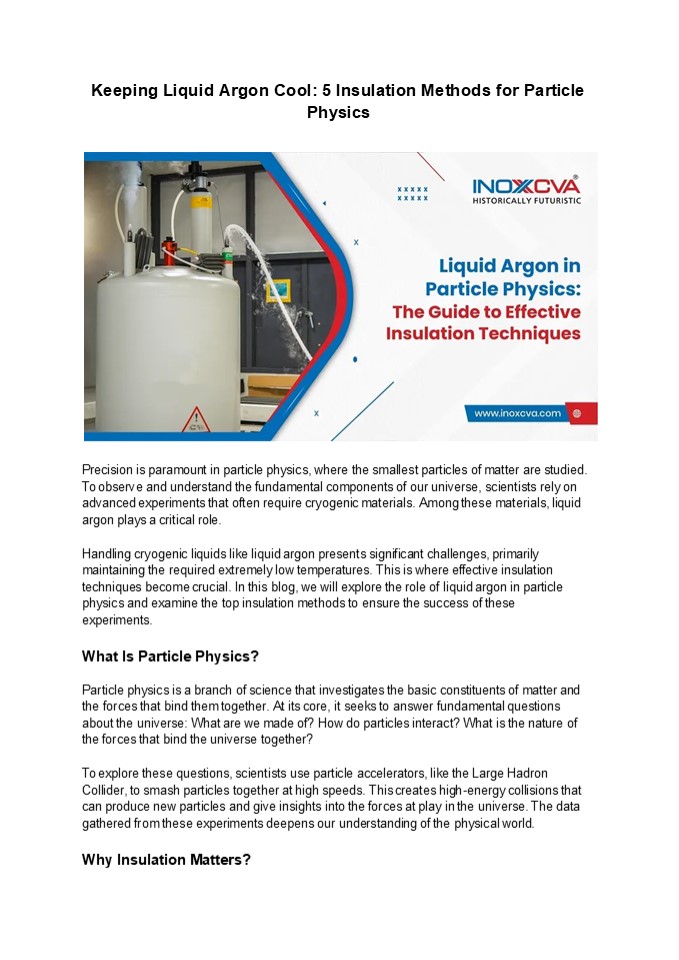
Title: Keeping Liquid Argon Cool: 5 Insulation Methods for Particle Physics
1
Keeping Liquid Argon Cool 5 Insulation Methods
for Particle Physics
Precision is paramount in particle physics, where
the smallest particles of matter are studied. To
observe and understand the fundamental components
of our universe, scientists rely on advanced
experiments that often require cryogenic
materials. Among these materials, liquid argon
plays a critical role. Handling cryogenic
liquids like liquid argon presents significant
challenges, primarily maintaining the required
extremely low temperatures. This is where
effective insulation techniques become crucial.
In this blog, we will explore the role of liquid
argon in particle physics and examine the top
insulation methods to ensure the success of these
experiments. What Is Particle Physics? Particle
physics is a branch of science that investigates
the basic constituents of matter and the forces
that bind them together. At its core, it seeks to
answer fundamental questions about the universe
What are we made of? How do particles interact?
What is the nature of the forces that bind the
universe together? To explore these questions,
scientists use particle accelerators, like the
Large Hadron Collider, to smash particles
together at high speeds. This creates high-energy
collisions that can produce new particles and
give insights into the forces at play in the
universe. The data gathered from these
experiments deepens our understanding of the
physical world. Why Insulation Matters?
2
The primary challenge with liquid argon is
preventing heat ingress from the external
environment, which could cause the liquid to
evaporate, thereby disrupting the experiment.
Effective insulation minimizes this heat
transfer, ensuring that the argon remains in its
liquid state, which is essential for preserving
the integrity of particle detection processes.
The importance of insulation cannot be overstated
it not only preserves the cryogenic state but
also significantly reduces operational costs and
energy consumption associated with maintaining
these extremely low temperatures. Types of
Insulation Techniques
There are several insulation techniques employed
to maintain the cryogenic conditions required for
liquid argon tanks, each with its own set of
advantages and challenges. The most common
methods include 1. Vacuum Insulation Vacuum
insulation is one of the most effective
techniques for insulating cryogenic tanks. The
principle is straightforward yet effective by
evacuating air from the space between two layers
of the tank (creating a vacuum), the primary mode
of heat transfer convection is eliminated.
This significantly reduces the amount of heat
that can enter the tank.
3
- In practice, the tank is designed with double
walls, and the space between these walls is
evacuated to create a high vacuum. The principle
is straightforward yet effective by evacuating
air from the space between two layers of the tank
(creating a vacuum), the primary mode of heat
transfer convection is eliminated. Vacuum
insulation offers excellent thermal resistance,
making it a popular choice for liquid argon
tanks. - Multilayer Insulation (MLI)
- Multilayer insulation is another highly effective
method used in cryogenic applications. MLI
consists of multiple layers of thin, reflective
materials (such as aluminized Mylar or Kapton)
separated by low-density spacer materials, like
glass fiber. These layers are designed to reflect
radiant heat, which is a significant mode of heat
transfer in cryogenic environments. - The effectiveness of MLI increases with the
number of layers, as each layer adds to the
overall thermal resistance. MLI is often used in
conjunction with vacuum insulation, providing a
robust barrier against all forms of heat
transfer radiation, conduction, and convection. - Foam Insulation
- Foam insulation is widely used due to its
simplicity and ease of application. This
technique involves spraying or applying foam
materials, such as polyurethane or polystyrene,
around the tank. These materials have low thermal
conductivity and are effective at minimizing heat
transfer. - Although foam insulation is less effective than
vacuum or MLI in extreme cryogenic environments,
it is often used as a supplementary insulation
layer. It can also provide structural support and
protect the tank from mechanical damage, making
it a versatile option. - Aerogel Insulation
- Aerogel is a state-of-the-art insulation material
known for its ultra-low thermal conductivity.
Made from silica, aerogel is a lightweight,
porous material that provides exceptional thermal
resistance. Its structure consists of 99.8 air,
making it an incredibly effective insulator. - Although aerogel is more expensive than
traditional insulation materials, its superior
performance in extreme conditions makes it a
valuable choice for certain high-stakes particle
physics experiments. Aerogel insulation is
especially useful in situations where space is
limited, and maximum insulation performance is
required.
4
These systems are often customized based on the
specific requirements of the experiment, the
design of the tank, and the environmental
conditions. Composite insulation offers
flexibility in adapting to various challenges,
ensuring the long-term stability of liquid
argon. Technological Innovations and Advances
Where is Insulation Headed
As particle physics experiments become more
complex, the demand for more efficient and
reliable insulation techniques has driven
significant technological advancements.
Innovations in material science, manufacturing
processes, and monitoring technologies have all
contributed to the evolution of cryogenic
insulation. Advanced Materials The development
of new materials with enhanced thermal properties
has been a major research focus. For example,
nanomaterials and composites are being explored
for their potential to improve insulation
performance. These materials offer higher thermal
resistance and durability, making them ideal for
long-term cryogenic applications. Cryogenic
Monitoring Systems Modern cryogenic tanks are
often equipped with advanced monitoring systems
that track temperature, pressure, and other
critical parameters in real time. These systems
detect even
5
minor deviations from desired conditions,
enabling immediate corrective action. This not
only helps maintain the cryogenic state but also
extends the lifespan of the insulation. Manufactu
ring Techniques Precision manufacturing
techniques, such as 3D printing and advanced
molding, have enabled the production of more
efficient insulation systems. These techniques
allow for the creation of complex geometries and
custom designs, optimizing thermal performance to
fit the specific needs of each experiment. By
understanding and implementing the best
insulation techniques, scientists can ensure that
their liquid argon tanks remain stable and
effective, allowing them to continue exploring
the fundamental nature of the universe. Are you
involved in particle physics experiments or
considering liquid argon as a cryogenic material?
INOXCVA offers cutting-edge solutions for
insulating liquid argon tanks, ensuring optimal
performance and reliability. Contact us today to
learn more about our products and services!
Recommended

