

Essential Tips for Choosing the Right Font When Starting Your Newsletter PowerPoint PPT Presentation
Title: Essential Tips for Choosing the Right Font When Starting Your Newsletter
1
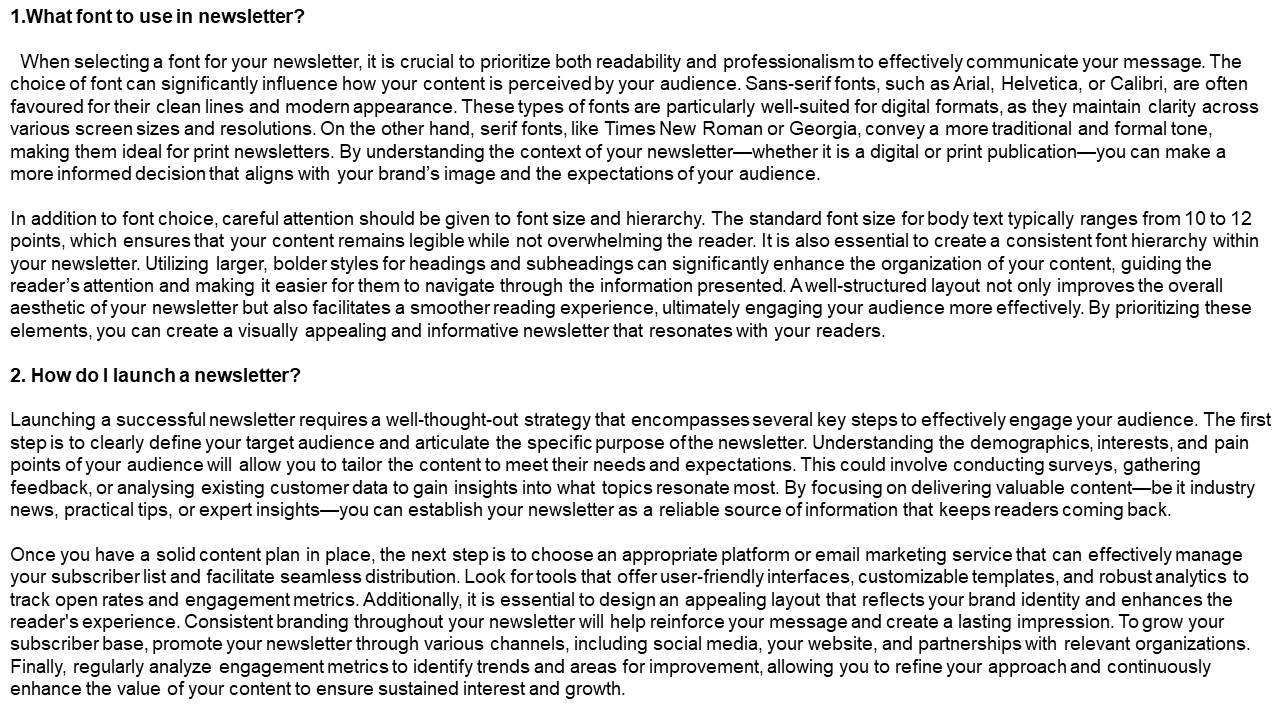
1.What font to use in newsletter? When
selecting a font for your newsletter, it is
crucial to prioritize both readability and
professionalism to effectively communicate your
message. The choice of font can significantly
influence how your content is perceived by your
audience. Sans-serif fonts, such as Arial,
Helvetica, or Calibri, are often favoured for
their clean lines and modern appearance. These
types of fonts are particularly well-suited for
digital formats, as they maintain clarity across
various screen sizes and resolutions. On the
other hand, serif fonts, like Times New Roman or
Georgia, convey a more traditional and formal
tone, making them ideal for print newsletters. By
understanding the context of your
newsletterwhether it is a digital or print
publicationyou can make a more informed decision
that aligns with your brands image and the
expectations of your audience.In addition to
font choice, careful attention should be given to
font size and hierarchy. The standard font size
for body text typically ranges from 10 to 12
points, which ensures that your content remains
legible while not overwhelming the reader. It is
also essential to create a consistent font
hierarchy within your newsletter. Utilizing
larger, bolder styles for headings and
subheadings can significantly enhance the
organization of your content, guiding the
readers attention and making it easier for them
to navigate through the information presented. A
well-structured layout not only improves the
overall aesthetic of your newsletter but also
facilitates a smoother reading experience,
ultimately engaging your audience more
effectively. By prioritizing these elements, you
can create a visually appealing and informative
newsletter that resonates with your readers. 2.
How do I launch a newsletter? Launching a
successful newsletter requires a well-thought-out
strategy that encompasses several key steps to
effectively engage your audience. The first step
is to clearly define your target audience and
articulate the specific purpose of the
newsletter. Understanding the demographics,
interests, and pain points of your audience will
allow you to tailor the content to meet their
needs and expectations. This could involve
conducting surveys, gathering feedback, or
analysing existing customer data to gain insights
into what topics resonate most. By focusing on
delivering valuable contentbe it industry news,
practical tips, or expert insightsyou can
establish your newsletter as a reliable source of
information that keeps readers coming back.
Once you have a solid content plan in place,
the next step is to choose an appropriate
platform or email marketing service that can
effectively manage your subscriber list and
facilitate seamless distribution. Look for tools
that offer user-friendly interfaces, customizable
templates, and robust analytics to track open
rates and engagement metrics. Additionally, it is
essential to design an appealing layout that
reflects your brand identity and enhances the
reader's experience. Consistent branding
throughout your newsletter will help reinforce
your message and create a lasting impression. To
grow your subscriber base, promote your
newsletter through various channels, including
social media, your website, and partnerships with
relevant organizations. Finally, regularly
analyze engagement metrics to identify trends and
areas for improvement, allowing you to refine
your approach and continuously enhance the value
of your content to ensure sustained interest and
growth.
2
3. What are the 9 steps to make a newsletter?
Creating an effective newsletter requires a
systematic and strategic approach that ensures
your message resonates with your audience. The
first step involves defining your target
audience, as understanding their preferences,
interests, and demographics is crucial for
tailoring content that captures their attention.
Once your audience is clearly identified,
selecting an appropriate platform for design and
distribution becomes essential. There are various
tools available, each with distinct features that
cater to different needs, so it's important to
choose one that aligns with your goals. Following
this, developing a robust content strategy is
vital this should encompass key topics and
themes that not only align with your audience's
interests but also reflect your brand's identity.
Once the groundwork is laid, creating engaging
and concise copy becomes the focus. The content
should be informative yet succinct, ensuring that
readers remain captivated without feeling
overwhelmed. Complementing the written content
with relevant visuals can enhance engagement and
understanding. Additionally, it is imperative to
ensure that your newsletter is mobile-friendly,
as an increasing number of readers access content
via their smartphones. Establishing a consistent
distribution schedule is also recommended, as it
helps to build anticipation and fosters a sense
of reliability among your readership.
Incorporating calls to action throughout the
newsletter encourages readers to engage further,
whether that means visiting your website,
participating in a survey, or sharing the
newsletter with others. Finally, analysing
performance metrics such as open rates and
click-through rates will provide valuable
insights into what works and what doesnt.
Gathering feedback from your audience is equally
important for continuous improvement, allowing
you to refine your approach and cultivate a loyal
readership over time. 4. What is the purpose of
newsletter? The primary purpose of a newsletter
is to serve as a strategic communication tool
that delivers valuable information and updates to
a specific audience in a clear, concise, and
engaging manner. By doing so, newsletters become
instrumental in nurturing and strengthening
relationships between organizations and their
stakeholders, which include customers, employees,
partners, and even the broader community.
3
The content typically encompasses a variety of
curated topicssuch as industry news, product
announcements, company achievements, and
educational resourcesdesigned to inform and
captivate readers. This targeted approach not
only keeps recipients updated on relevant
developments but also instills a sense of
connection and trust between the organization and
its audience.Moreover, newsletters
significantly contribute to enhancing brand
visibility and cultivating customer loyalty. By
consistently delivering high-quality content,
organizations encourage their audience to engage
with their brand more deeply, whether through
purchasing products, subscribing to services,
attending events, or participating in community
initiatives. This proactive engagement can lead
to a stronger sense of community and belonging
among stakeholders. Ultimately, newsletters are
not merely a means of disseminating information
they play a pivotal role in maintaining an
ongoing dialogue that aligns with and reinforces
the organizations goals and values, fostering a
culture of collaboration and shared purpose. 5.
How do I create a unique newsletter? Creating a
unique newsletter entails a series of strategic
steps that are essential for capturing and
retaining the interest of your audience. The
first and foremost step is to clearly identify
your target audience and delve into their
specific interests and preferences. This
foundational understanding allows you to tailor
your content in a way that resonates deeply with
readers. Incorporating a variety of formatssuch
as articles, infographics, interviews, and even
video snippetscan significantly enhance
engagement levels. By diversifying the
presentation of information, you not only cater
to different learning styles but also keep the
content fresh and appealing. Furthermore,
maintaining consistency in branding is
imperative this includes harmonizing visuals,
tone, and layout across all editions. Such
consistency not only bolsters brand recognition
but also imparts a sense of professionalism and
reliability to your publication. In addition to
these foundational elements, regularly featuring
exclusive content is crucial for providing added
value to your subscribers. This could take the
form of expert insights, industry trends, or
special reports that are not available elsewhere.
By offering unique content, you create a
compelling reason for readers to stay subscribed
and engaged. Encouraging interaction through the
inclusion of polls, surveys, or feedback sections
can also foster a sense of community among your
readership. This engagement not only enriches the
reader experience but also provides valuable
insights into their preferences and opinions.
Lastly, leveraging analytics to assess the
performance of your newsletter is vital for
ongoing improvement. By analysing open rates,
click-through rates, and reader feedback, you can
adapt your content strategy to better align with
audience interests, ensuring that your newsletter
remains relevant and distinctive in an
increasingly crowded marketplace.
4
https//visualsculptors.com
/ https//visualsculptors.com/our-portfolio/
Recommended

