

AI in Education: Transforming Learning Experiences and Unlocking New Opportunities PowerPoint PPT Presentation
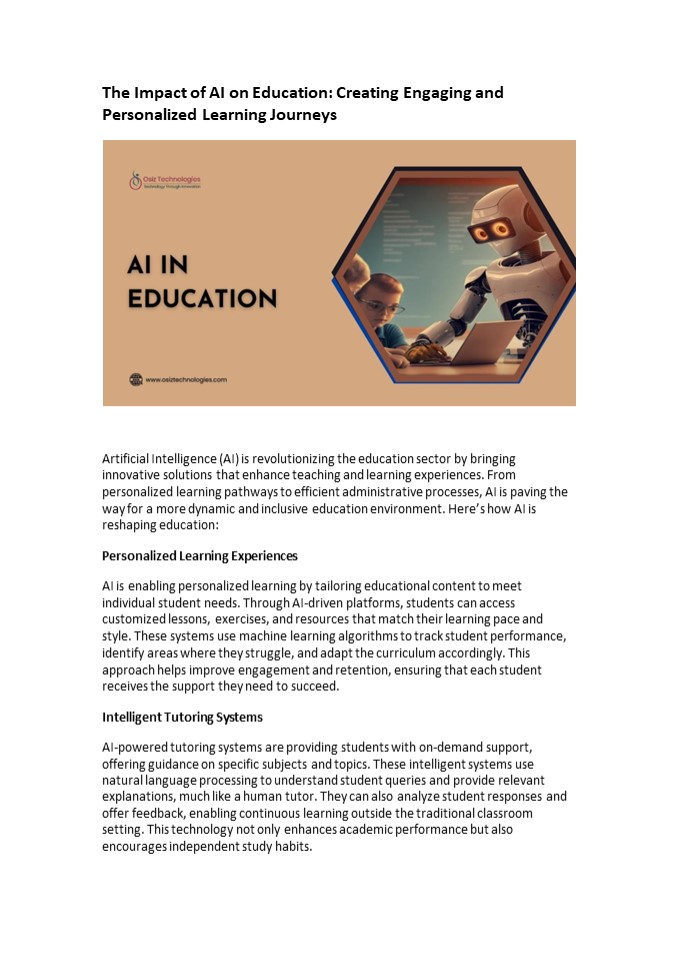
Title: AI in Education: Transforming Learning Experiences and Unlocking New Opportunities
1
The Impact of AI on Education Creating Engaging
and Personalized Learning Journeys
Artificial Intelligence (AI) is revolutionizing
the education sector by bringing innovative
solutions that enhance teaching and learning
experiences. From personalized learning pathways
to efficient administrative processes, AI is
paving the way for a more dynamic and inclusive
education environment. Heres how AI is reshaping
education Personalized Learning Experiences AI
is enabling personalized learning by tailoring
educational content to meet individual student
needs. Through AI-driven platforms, students can
access customized lessons, exercises, and
resources that match their learning pace and
style. These systems use machine learning
algorithms to track student performance, identify
areas where they struggle, and adapt the
curriculum accordingly. This approach helps
improve engagement and retention, ensuring that
each student receives the support they need to
succeed. Intelligent Tutoring Systems AI-powered
tutoring systems are providing students with
on-demand support, offering guidance on specific
subjects and topics. These intelligent systems
use natural language processing to understand
student queries and provide relevant
explanations, much like a human tutor. They can
also analyze student responses and offer
feedback, enabling continuous learning outside
the traditional classroom setting. This
technology not only enhances academic performance
but also encourages independent study habits.
2
Streamlining Administrative Tasks AI is
transforming educational administration by
automating routine tasks such as attendance
tracking, grading, and scheduling. By using
AI-based software, educators can save time on
administrative duties, allowing them to focus
more on teaching and student interaction.
Automated grading systems, for instance, can
quickly evaluate student assignments, provide
instant feedback, and maintain accurate records,
improving the efficiency of the educational
process. Enhancing Accessibility and Inclusion AI
is playing a crucial role in making education
more accessible and inclusive. AI- powered tools
such as speech-to-text applications, real-time
translation services, and adaptive learning
technologies help cater to students with diverse
needs, including those with disabilities and
language barriers. These solutions ensure that
all students, regardless of their background or
abilities, have equal access to quality
education. AI-Powered Predictive
Analytics Educational institutions are leveraging
AI to predict student outcomes and identify
potential challenges early on. By analyzing data
such as attendance, grades, and participation, AI
algorithms can forecast student performance and
flag at-risk students. Educators can then take
proactive measures to provide additional support,
helping students stay on track and achieve their
academic goals. The Future of Education with
AI As AI technology continues to advance, its
impact on education will become even more
profound. From immersive virtual classrooms to
AI-driven career counseling, the future of
education is poised to be more interactive,
personalized, and outcome- oriented. Embracing AI
in education is about enhancing the learning
experience and equipping students with the skills
they need to thrive in an increasingly digital
world. However, while AI offers tremendous
benefits, its successful implementation requires
careful planning and expertise. Challenges such
as data privacy, algorithm bias, and integration
with existing systems must be addressed to
maximize the potential of AI in education.
Collaborating with a specialized AI development
company can help educational institutions
navigate these challenges and create AI- driven
solutions that truly enhance the learning
experience.
Recommended

