

Cloud-Enabled Public Libraries: Access to Information in the Digital Era PowerPoint PPT Presentation
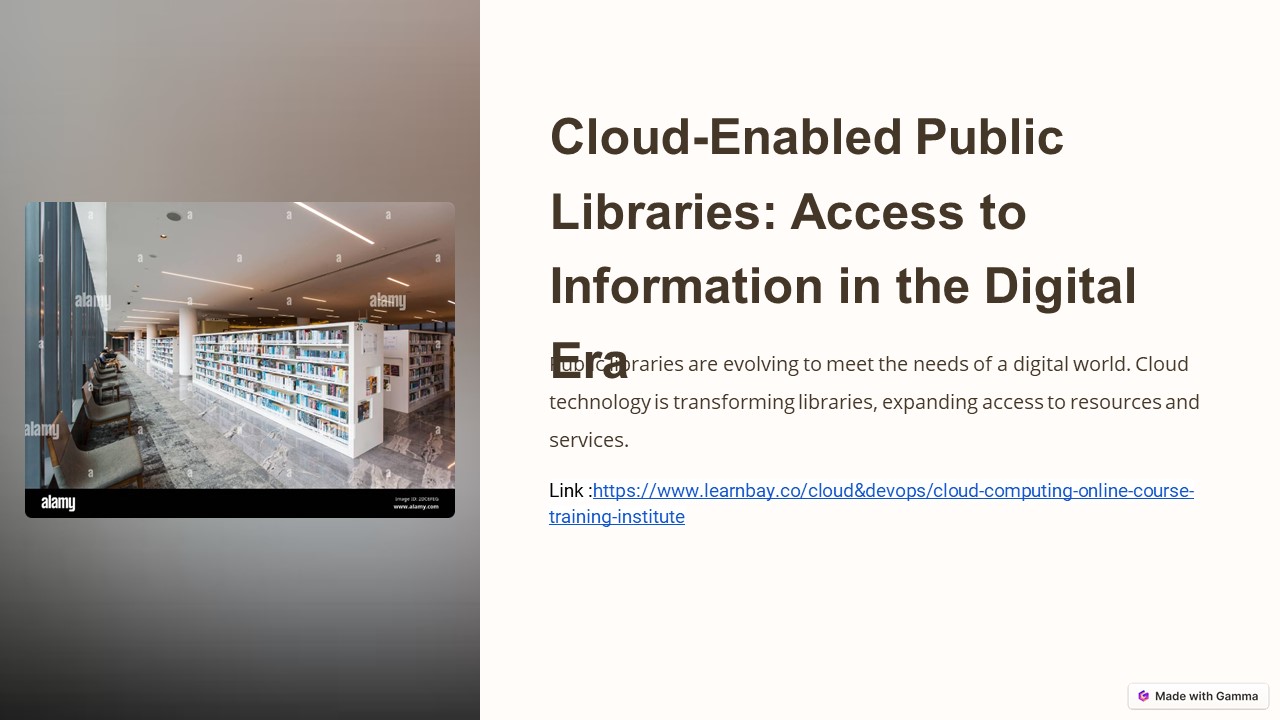
Title: Cloud-Enabled Public Libraries: Access to Information in the Digital Era
1
Cloud-Enabled Public Libraries Access to
Information in the Digital Era
Public libraries are evolving to meet the needs
of a digital world. Cloud technology is
transforming libraries, expanding access to
resources and services. Link https//www.learnbay
.co/clouddevops/cloud-computing-online-course-tra
ining-institute
2
The Evolving Role of Public Libraries
Libraries have become more than just repositories
of books. They are now vibrant community hubs,
offering a wide range of resources and services
to meet the diverse needs of their patrons.
Traditional Library
1
Physical books, limited access hours, and a focus
on providing physical resources.
Modern Library
2
Digital collections, extended hours, and a focus
on providing digital resources and services.
Future Library
3
Cloud-based infrastructure, personalized
experiences, and a focus on innovation and
community engagement.
3
Bridging the Digital Divide
Access to technology is crucial for participation
in the digital economy. Public libraries play a
vital role in bridging the digital divide,
providing free and equitable access to technology
and digital literacy resources.
Computer Access
Digital Literacy Programs
1
2
Public libraries offer free computer access and
Wi-Fi, allowing individuals to connect to the
internet and utilize online resources.
Libraries provide training and workshops to help
individuals develop essential digital skills,
such as computer basics, online safety, and
internet research.
Technology Lending
3
Libraries often lend out laptops, tablets, and
other devices, expanding access to technology for
those who may not own their own devices.
4
Cloud Computing Empowering Public Libraries
Cloud computing has revolutionized the way
libraries manage their resources. It offers a
cost-effective and scalable solution for storing,
accessing, and sharing digital content.
Scalability
Accessibility
Cost-Effectiveness
Cloud infrastructure can easily scale to
accommodate growing needs, ensuring libraries
have the capacity to handle increasing demand for
resources.
Cloud-based services allow users to access
resources from anywhere with an internet
connection, expanding access beyond library walls.
Cloud computing eliminates the need for expensive
hardware and software, saving libraries valuable
resources and allowing them to invest in other
areas.
5
Expanding Digital Collections and Services
Cloud technology empowers libraries to expand
their digital collections and offer a wider range
of services to patrons.
Ebooks and Audiobooks
Online Resources
Digital Learning
Cloud-based platforms allow libraries to offer
digital books and audiobooks, providing patrons
with a wider selection and greater convenience.
Libraries can provide access to a vast array of
online resources, such as databases, research
journals, and streaming services.
Cloud platforms enable libraries to offer online
learning resources, such as MOOCs, language
learning programs, and coding courses.
6
Enhancing User Experience with Cloud Technologies
Cloud-based solutions improve the user experience
by providing seamless access to resources,
personalized recommendations, and intuitive
interfaces.
Search and Discovery
Cloud-based search engines and discovery tools
enable users to easily find the resources they
need.
Personalized Recommendations
Libraries can utilize user data to provide
personalized recommendations for books, articles,
and other resources.
User Profiles and Preferences
Cloud-based systems allow users to create
profiles, save their preferences, and track their
borrowing history.
7
Ensuring Data Security and Privacy
Data security and privacy are paramount concerns
for libraries, and cloud providers offer robust
security measures to protect sensitive
information.
Encryption
Data is encrypted both at rest and in transit,
ensuring confidentiality.
Access Control
Strong access controls are implemented to
restrict unauthorized access to sensitive data.
Regular Security Audits
Cloud providers conduct regular security audits
to identify and address vulnerabilities.
8
Embracing the Future Strategies for
Cloud-Enabled Libraries
Libraries must embrace innovation and continually
adapt to the evolving landscape of technology to
remain relevant and serve their communities
effectively.
Cloud Adoption
Digital Literacy
Libraries should prioritize the adoption of
cloud-based solutions to leverage the benefits of
scalability, cost-effectiveness, and enhanced
access.
Libraries should invest in programs and resources
that promote digital literacy, empowering
individuals to navigate the digital world
confidently.
Collaboration
Innovation
Libraries should collaborate with other
institutions, organizations, and technology
providers to share best practices and develop
innovative solutions.
Libraries should embrace emerging technologies
and explore new ways to utilize technology to
enhance services and engage with their
communities.
Recommended

