

How to Choose between React Native and Flutter App Development? PowerPoint PPT Presentation
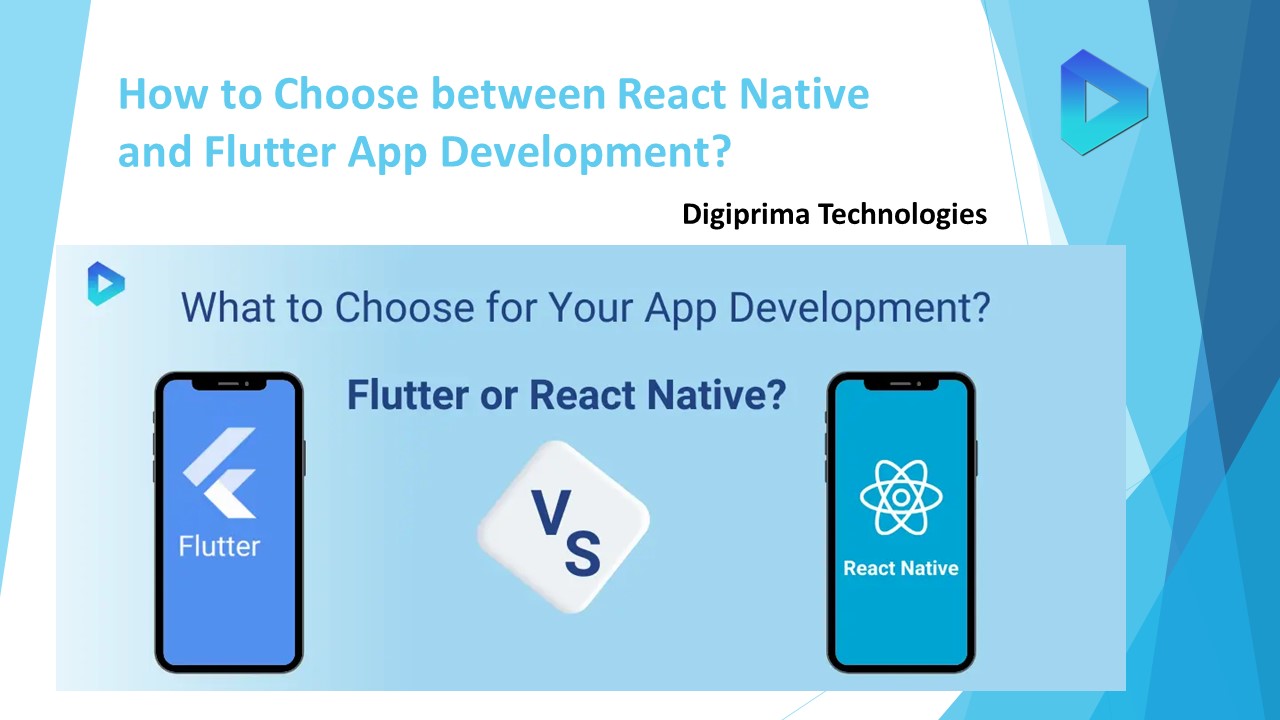
Title: How to Choose between React Native and Flutter App Development?
1
How to Choose between React Native and Flutter
App Development?
- Digiprima Technologies
2
How to Choose between React Native and Flutter
App Development?
- Mobile apps are gaining immense popularity
worldwide. Offering an innovative
technology-driven mobile app is the dream of
every business today. Developers are entrusted to
choose the right app framework for faster and
low-cost mobile app development. - As we will soon usher in 2025, most developers
have to choose the right mobile app framework for
the future. The choice of the right app framework
is largely driven by a faster app development
turnaround along with reduced costs and
cross-platform development capabilities.
3
Compare the Two leading app frameworks Flutter
vis-a-vis React Native
- In this article, we will compare the two leading
app frameworks, Flutter and React Native, and
help you decide which one to go for. From a
developer's perspective, the two leading
cross-platform app development technologies that
are creating buzz worldwide are React Native by
Facebook and Google by Flutter. - Both Apple and Google have offered native tools
and technologies to create apps seamlessly, such
as Xcode and Swift on iOS, and Android Studio and
Kotlin/Java on Android. However, this requires
developers to learn both new technologies. - To make developers lives easy, software
development organizations have used
cross-platform solutions over native solutions to
create apps on both iOS and Android using a
single language to build apps quickly. With the
launch of React Native and Flutter Developers can
build cross-platform Apps using a single language.
4
Facebook started React Native, which they made it
open source in 2015. Google promoted Flutter in
2017. However, Flutter has witnessed a larger
response for adoption by developers since
2017. Flutter is a portable UI toolkit that
enables cross-platform app development. It brings
along a comprehensive app Software Development
Kit (SDK), complete with widgets and tools to
enable developers to build natively compiled
mobile, desktop, and visually attractive web
applications. React Native is a
JavaScript-supported open-source application
development framework used for Cross-platform app
development. It helps create mobile apps using
JavaScript language for both Android and iOS. It
uses a single codebase and the same design as
React.
5
Flutter Pros
- Hot reload results in fast coding
- Two mobile platforms with a single codebase
- Less testing, down by up to 50
- The faster App development process
- Fascinating designs the users will admire with
Stronger UI - Same app UI even for older devices
- Perfect for MVPs
6
React Native Pros
- Fast refresh results in fast coding
- Two mobile platforms with a single codebase
- JavaScript is the preferred and widely popular
language for app development - Freedom of Choice for Developers
- Relatively higher maturity
- Vast and active community support
- Easy to learn and adapt to React developers
- Less testing, down by up to 50
7
Gazing Flutter and React Native from different
perspectives
- From the Programming Language perspective
- React Native Language is JavaScript, which is a
popular language used with React and other
JavaScript frameworks. Flutter Language is Dart.
The easy availability of documentation on the
Dart site made it for developers easy to get
started. - From the technical architecture perspective
- You need to choose the right technical
architecture while going for a cross-platform
mobile app development framework. Flutter offers
everything needed for your app development, as
Flutter contains all the needed technologies to
develop mobile apps within it. React Native needs
a bridge to communicate with its native
components.
8
- From the ease of installation point of view
- React Native installation is easy for developers
with a JavaScript background, but they still need
to learn Node Package Manager for the
installation. Flutter installation is easy and
developers need not learn new packages for the
installation as the documentation is easily
available. - Ease of getting community support
- The React Native community support is enormous
and growing in size. Flutter is fairly new, but
growing fast in terms of community support and
will soon catch up.
9
- App framework DevOps and CI/CD support
- Flutter apps can be easily and painlessly set up
on CD/CI services by leveraging its strong CLI
tools, while React Native does not provide
official instruction for CD/CI practices. - Flutter vs React Native-At a Glance
- Both Flutter and React Native offer a free
open-source framework for app development. While
the programming language for Flutter is DART, for
React Native it is JavaScript which most
developers are familiar with. Both deliver great
native performance for app development. React
Native uses native components, and after an OS UI
upgrade, the apps will be upgraded instantly.
Flutter is much faster than native development.
10
- Concluding Remarks
- Development firms prefer Flutter over React
Native. Flutter is improving fast, and Google is
relentlessly refining its tool. As a result,
Flutters is turning out to be a popular choice
for the App framework for development. Flutter,
as envisioned by technologists, is going to be
the future of the mobile app development
framework. In the present, Flutter seems to have
a clear competitive edge over React Native.
Lets Discuss Your Idea
- Have Question? Call Us 24/7 For Business Inquiry
- 1 (347) 9739732, 91-90399-28143
- inquiry_at_digiprima.com
- ashesh_at_digiprima.com
Recommended

