

What Are the 5 Key Investments Needed to Start a Mango Farmland? PowerPoint PPT Presentation
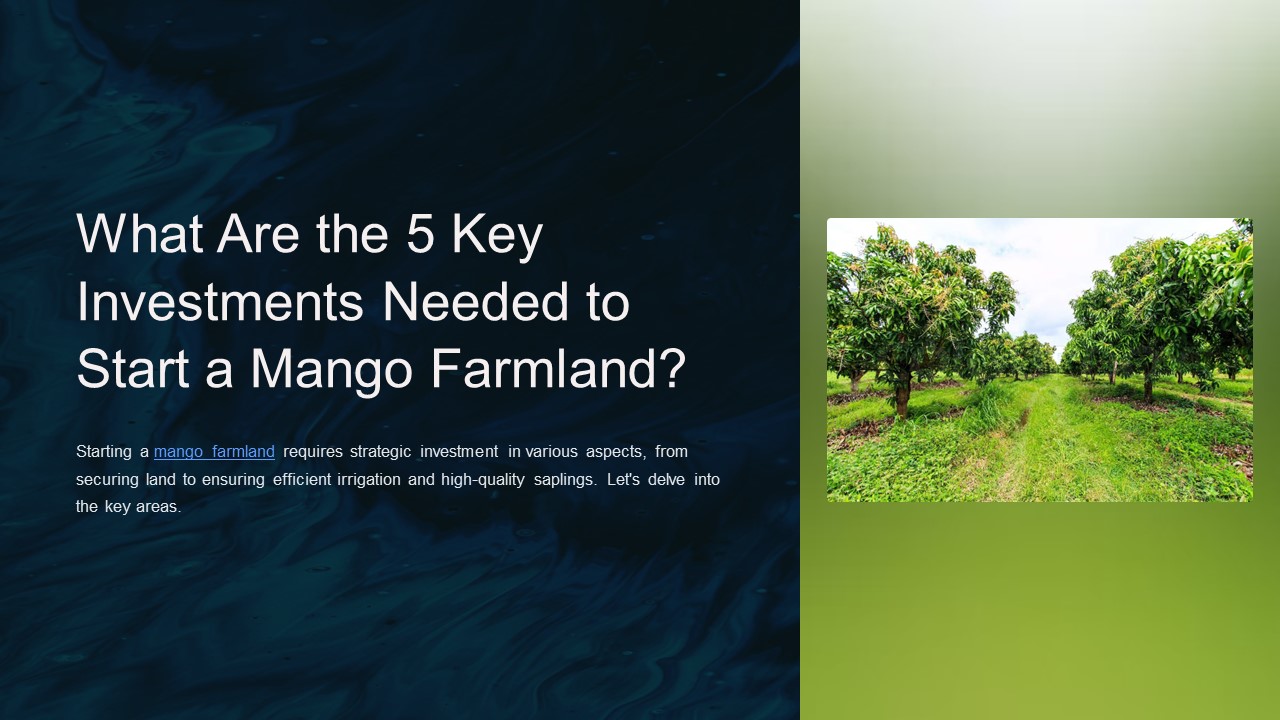
Title: What Are the 5 Key Investments Needed to Start a Mango Farmland?
1
What Are the 5 Key Investments Needed to Start a
Mango Farmland?
Starting a mango farmland requires strategic
investment in various aspects, from securing land
to ensuring efficient irrigation and high-quality
saplings. Let's delve into the key areas.
2
Securing Ideal Land for Mango Farming Key
Factors and Costs
Soil Type
Sunlight Exposure
Water Availability
Mango trees thrive in well-drained, loamy soils
with a pH between 6.0 and 7.0. Avoid clay soils
that retain water, leading to root rot.
Mango trees require at least 6-8 hours of direct
sunlight per day. Choose land with minimal
shading from surrounding trees or buildings.
Mango trees need consistent water, especially
during the flowering and fruit development
stages. Ensure access to a reliable water source.
3
Preparing and Testing Soil Essential Steps and
Investment
Soil Analysis
Soil Amendment
1
2
A soil test reveals the pH, nutrient levels, and
potential deficiencies, allowing for targeted
fertilization.
Adding organic matter, like compost or manure,
improves soil structure, aeration, and water
retention.
Tilling and Preparation
Weed Control
3
4
Tilling the soil before planting helps break up
clumps, create a smooth bed for planting, and
control weeds.
Pre-emergent herbicides can prevent weed growth,
while manual weeding is necessary after planting.
4
Investing in Efficient Irrigation Systems Types
and Costs
Drip Irrigation
Sprinkler Irrigation
This system delivers water directly to the roots,
minimizing water waste and improving efficiency.
This system distributes water over a wider area,
suitable for larger farms, but can lead to water
evaporation and weed growth.
Surface Irrigation
Water Harvesting
This method uses gravity to flow water through
furrows, but can lead to soil erosion and uneven
water distribution.
Collecting rainwater or runoff in tanks or ponds
provides a sustainable water source, reducing
reliance on external sources.
5
Selecting High-Quality Mango Saplings Varieties
and Sources
Mango Varieties
Certified Saplings
Choose varieties suited to your climate and soil,
considering factors like fruit size, sweetness,
and disease resistance.
Obtain saplings from reputable nurseries or
organizations that guarantee their health and
genetic purity.
6
Fertilizers and Pesticides Essential Products
and Costs
Fertilizers
Pesticides
Nitrogen (N), Phosphorus (P), and Potassium (K)
are essential nutrients for mango growth and
fruit development.
Fungicides, insecticides, and herbicides are
crucial for managing diseases, pests, and weed
infestations.
Organic fertilizers, like compost and manure,
improve soil health and nutrient availability.
Integrated pest management (IPM) practices
minimize pesticide use, promoting environmental
sustainability.
7
Conclusion
Starting a mango farmland requires a combination
of strategic planning, financial investment, and
careful management. By focusing on key areas like
land selection, soil preparation, irrigation,
sapling quality, and pest control, mango farmers
can establish a successful and profitable venture.
For more details
Website URL https//holidaysfarm.in/
Facebook URL https//facebook.com/MS-Holidays-Man
go-Farm-104420379037313
Instagram URL https//www.instagram.com/holidaysm
angofarm/
Mobile Number91 8925913216
Recommended

