

Armored Vehicles: The Backbone of Modern Security and Defense PowerPoint PPT Presentation
Title: Armored Vehicles: The Backbone of Modern Security and Defense
1
Armored Vehicles The Backbone of Modern
Security and Defense
- Armored vehicles have evolved into an essential
tool in military, law enforcement, and private
sectors due to their unique blend of protection,
mobility, and versatility. From safeguarding
troops in combat zones to providing secure
transport for high- profile individuals, armored
vehicles are designed to withstand various
threats, including ballistic, explosive, and
chemical attacks. - This article delves into the industry forecast,
types, technology, applications, and future of
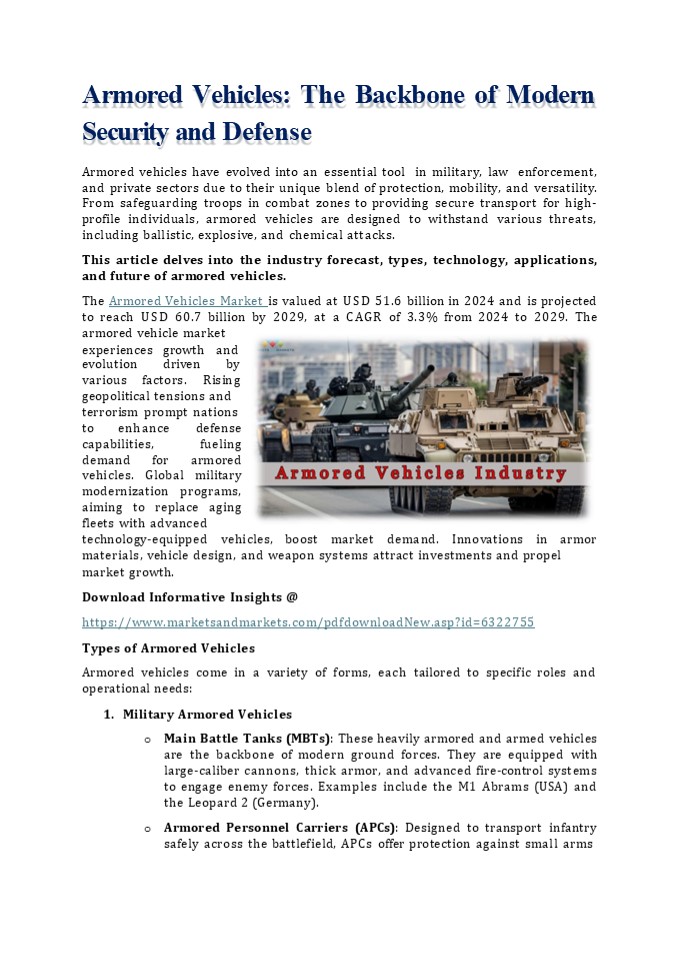
armored vehicles. - The Armored Vehicles Market is valued at USD 51.6
billion in 2024 and is projected to reach USD
60.7 billion by 2029, at a CAGR of 3.3 from 2024
to 2029. The armored vehicle market - experiences growth and
evolution various
driven by factors. Rising
geopolitical tensions and terrorism prompt
nations
to enhance capabilities,
defense fueling armored
demand for
- vehicles. Global military modernization
programs, aiming to replace aging fleets with
advanced - technology-equipped vehicles, boost market
demand. Innovations in armor materials, vehicle
design, and weapon systems attract investments
and propel - market growth.
- Download Informative Insights _at_
- https//www.marketsandmarkets.com/pdfdownloadNew.a
sp?id6322755 - Types of Armored Vehicles
- Armored vehicles come in a variety of forms, each
tailored to specific roles and operational
needs - Military Armored Vehicles
- Main Battle Tanks (MBTs) These heavily armored
and armed vehicles are the backbone of modern
ground forces. They are equipped with
large-caliber cannons, thick armor, and advanced
fire-control systems to engage enemy forces.
Examples include the M1 Abrams (USA) and the
Leopard 2 (Germany). - Armored Personnel Carriers (APCs) Designed to
transport infantry safely across the
battlefield, APCs offer protection against small
arms
2
- fire and shrapnel. The M113 (USA) and the Patria
AMV (Finland) are common examples. - Infantry Fighting Vehicles (IFVs) More heavily
armed than APCs, IFVs are designed to both
transport troops and engage in combat. They are
often equipped with auto-cannons, machine guns,
and anti-tank missiles. The BMP-2 (Russia) and
Bradley Fighting Vehicle (USA) are examples. - Mine-Resistant Ambush Protected (MRAP) Vehicles
Built to withstand IEDs (improvised explosive
devices) and landmines, MRAPs have specialized
V-shaped hulls to deflect blasts. Examples
include the Cougar and the Oshkosh M-ATV (USA). - Law Enforcement and Civilian Armored Vehicles
- Armored Cars Used by private companies and
governments for transporting valuable goods such
as cash, diamonds, or confidential documents,
these vehicles have reinforced bulletproof
windows and body panels. - Armored SUVs and Sedans These vehicles offer
personal security for VIPs, politicians, and
corporate leaders. They are designed to blend in
while offering protection against small arms fire
and explosive threats. Custom conversions of
luxury models like the Mercedes-Benz S-Class or
Cadillac Escalade are common. - Key Technologies in Armored Vehicles
- Ballistic Armor The core feature of any armored
vehicle is its protective armor. Modern armor
systems use a combination of materials to balance
protection, weight, and mobility. - Steel Armor Traditionally used due to its
strength, but often heavy, limiting speed and
maneuverability. - Composite Armor Modern vehicles often employ
layered materials, such as ceramic plates and
kevlar, to offer high protection at a lower
weight. - Reactive Armor This involves explosive tiles
that detonate outward when struck by a
projectile, reducing the impact of anti-tank
rounds. - Active Protection Systems (APS) Advanced
vehicles use APS like the Trophy system, which
detects and intercepts incoming threats, such as
RPGs, before they hit the vehicle. - Weaponry and Fire Control Systems Armored
vehicles are equipped with state-of-the-art
weaponry systems to ensure combat readiness - Cannons and Machine Guns Mounted on military
vehicles for engaging infantry and armored
threats. - Missile Systems Advanced IFVs and MBTs may also
carry guided missile systems for long-range
engagements.
3
- o Fire Control Systems These systems integrate
sensors, radars, and computer algorithms to
enhance targeting accuracy in dynamic
battlefield conditions. - Mobility and Engines
- Tracks vs. Wheels MBTs and heavy armored
vehicles often use tracked systems for enhanced
off-road mobility, while lighter vehicles may
use wheels for better speed and fuel efficiency. - Hybrid and Electric Engines With increasing
environmental concerns and the need for longer
operational range, research into hybrid and
fully electric armored vehicles is gaining
momentum. - Communication and Surveillance Systems Armored
vehicles are now integrated with advanced
communication systems that allow for real-time
data sharing, battlefield awareness, and
coordination with other units. Many vehicles are
equipped with surveillance cameras, infrared
sensors, and radar to detect and track potential
threats. - Applications of Armored Vehicles
- Military Operations
- Armored vehicles are indispensable in modern
warfare. They provide critical support for
infantry, enhance the firepower of military
forces, and are instrumental in both offensive
and defensive operations. - In peacekeeping missions, APCs and IFVs offer
protection to soldiers in volatile regions while
enabling humanitarian assistance. - Counter-Terrorism and Law Enforcement
- Armored vehicles are often used by SWAT teams and
other law enforcement agencies for hostage
rescues, anti-terrorism operations, and crowd
control. - Civilian armored vehicles, such as bulletproof
cars, are commonly used for transporting
high-value assets or providing secure
transportation for dignitaries. - Private Security and VIP Transport
- High-profile individuals often face threats from
kidnapping, terrorism, or criminal
organizations. Armored SUVs and sedans provide
discreet yet effective protection without
sacrificing luxury or comfort. - Challenges Facing Armored Vehicle Development
- Weight vs. Mobility While increased armor offers
better protection, it also adds weight, reducing
speed and agility. Striking a balance between
protection and mobility is a constant challenge
for designers. - Cost Armored vehicles, especially advanced
military ones, are expensive to produce,
maintain, and operate. This can place a heavy
burden on national defense budgets, particularly
for countries with limited resources.
4
- 3. Evolving Threats The development of new
anti-armor weaponry, such as guided missiles and
drones, requires continuous innovation in armor
technology. Active protection systems, like those
that intercept incoming projectiles, are
becoming essential in modern armored vehicles. - Future of Armored Vehicles
- Autonomous Armored Vehicles The next generation
of armored vehicles is likely to see increased
automation, with some vehicles operating
autonomously or semi-autonomously. Autonomous
vehicles could conduct reconnaissance, supply
delivery, or even combat missions with reduced
risk to human life. - Advanced Materials Researchers are exploring the
use of nanotechnology, graphene, and other
cutting-edge materials to create lighter,
stronger, and more adaptive armor. These
materials will allow for faster, more
maneuverable vehicles with enhanced protection. - Integration with Drones and Robotics Future
armored vehicles may work in tandem with
unmanned systems, such as drones or ground
robots, to enhance battlefield awareness and
tactical capabilities. These systems will offer
new ways to gather intelligence, disrupt enemy
operations, and provide direct fire support. - Top Leaders in Armored Vehicles Industry
- The Armored Vehicles market is dominated by a few
globally established players such as - Rheinmetall AG (Germany)
- General Dynamics Corporation (US)
- Oshkosh Corporation (US)
- BAE Systems (UK)
- Hanwha Defense (South Korea)
- Ask for Sample Report _at_
- https//www.marketsandmarkets.com/requestsampleNew
.asp?id6322755 - Armored vehicles have become an indispensable
asset across military, law enforcement, and
private sectors. As threats evolve and technology
advances, armored vehicles will continue to be
at the forefront of security and defense
operations. From traditional tanks to futuristic
autonomous systems, their development will shape
the future of warfare and personal security.
Recommended

