

John Deere G4 Spread Pattern Operator’s Manual Instant Download PowerPoint PPT Presentation
Title: John Deere G4 Spread Pattern Operator’s Manual Instant Download
1
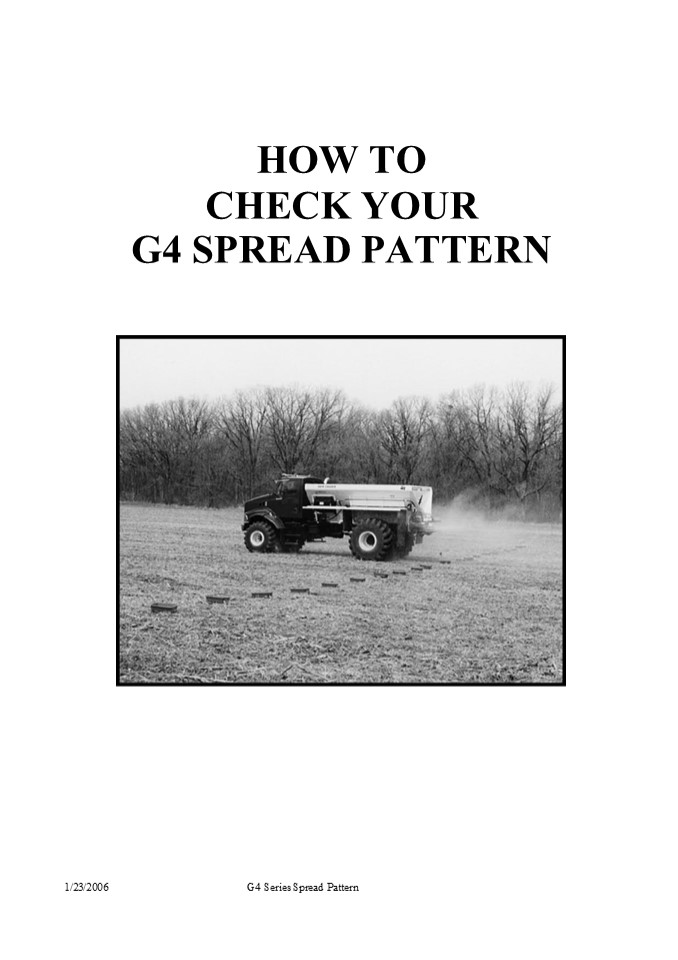
HOW TO CHECK YOUR
G4 SPREAD PATTERN
1/23/2006
G4 Series Spread Pattern
2
TECHNICAL SUPPORT MANUAL SPINNER ASSEMBLY
INSTALLATION
Keep spinner assembly supported until mounting is
complete. Never exceed workload limits or use
slings to lift items over people.
WARNING
Use the following instructions when installing a
G4 Spinner Assembly on a L2020G4 or L3020G4
1. Use a suitable lifting device to hoist the
spinner assembly (Item 1 - Figure A) onto
2 9 7/8" 3 1
the rear of the sills. Note The spinner
assembly weighs approximately 340 lbs.
Align the spinner assembly holes with the sill
holes. If assembling G4 spinner to GT unit,
align spinner holes with front set of sill holes
(closest to the cab). Insert four (4) carriage
bolts (Item 2) through holes, place spinner
shield supports (Item 3) on front bolts and
attach with washers, lock washers and nuts.
Hand-tighten only. Remove the two wooden 2 x 4s
and hardware used during shipping. 2. Make sure
the spinner assembly is square. Measure from the
spinner mounting bracket that sits on the sill
to the end of the sill on
Figure A Spinner Assembly Installation
both sides. The distance should be
approximately 9 7/8 on each side as shown in
Figure A. Center the spinner assembly from
side-to-side by measuring from the spinner hub
to the sill on each sidethese two measurements
should be equal. Tighten the rear bolts securely.
5 3 4
3. See Figure B. Install the right-hand (Item 4)
and left-hand (Item 5) spinner shields on the
spinner assembly using four (4) cap screws,
washers, lock washers and hex nuts. Attach the
shield supports (Item 3) to the shields using
two (2) cap screws, washers, lock washers and
hex nuts. Tighten all shield support hardware
securely, including the front bolts of the
spinner assembly.
Figure B Shield Installation
4. Install the pressure, return and case drain
hoses. Crank the spinner assembly all the way
forward and back to make sure the hoses and
fittings do not interfere with the spinner
assembly as it moves. Tie all loose areas of
hose together with wire ties to prevent contact
with moving parts during operation.
1/23/2006
G4 Series Spread Pattern
3
TECHNICAL SUPPORT MANUAL SPINNER ASSEMBLY
INSTALLATION CONTINUED
- Make sure the fins are installed on the spinner
discs correctly. When spreading with a L3020G4,
position two opposing fins in the forward
position (1) and two fins in the center position
(2) as shown in Figure C. With a L2020G4,
position all fins in the center position (2). - Measure the RPM of the spinners at operating
engine RPM using a tachometer. Mark the control
valve at the 500, 600, 700 and 800 RPM settings
for future reference. Set at 700 initially. If
the spreader has the
Figure C L3020G4 Fin Location
optional tachometer installed on the spinner
assembly, these settings can be
found using the processor in the cab. If not, a
hand held electronic tachometer should be
used. 7. Position the material divider (Item
6) on the sills as shown in Figure D. Center the
divider from side to side to make sure equal
amounts of material go to each spinner and
attach using two (2) cap screws, lock washers
and hex nuts. (See note below.)
6
Figure D Material Divider Installation NOTE
If the unit does not have slots in the sills for
the divider, holes must be drilled. Measure from
the front plate of the spinner assembly to the
drop-off point on the front plate of the material
divider the distance should be 12 1/4 on each
side of the divider.The hold-down brackets on the
material divider should be almost flush with the
end of the sill. Mark the location of the
material dividers two (2) bolt holes on the
sills. Remove the material divider and drill 3/8
holes where marked. Measure the distance from
the spinner assemblys front plate to the
material dividers drop-off point to make sure
its at 12 1/4. Adjust as necessary and tighten
hardware.
1/23/2006
G4 Series Spread Pattern
4
https//www.ebooklibonline.com Hello dear
friend! Thank you very much for reading. Enter
the link into your browser. The full manual is
available for immediate download. https//www.eb
ooklibonline.com
5
TECHNICAL SUPPORT MANUAL SPINNER ASSEMBLY
INSTALLATION CONTINUED
- Mount the right-hand (Item 7) and left-hand
(Item 8) spinner guards on the sills as shown in
Figure E, using two (2) cap screws, lock washers
and hex nuts per side. Hand tighten only.
Install the center spinner guard (Item 9)
between the two sides and attach using six - (6) cap screws, washers and lock nuts. Level
guard and tighten hardware securely. - Remove the two rear chain shield cap screws
- from each side. Install the hillside divider
(Item 10) as shown in Figure F, using the chain
shield hardware. Make sure the hillside divider
panel (Item 11) is straight and level so - it will distribute materials evenly to the
8
9
7
Figure E Spinner Guard Installation
material divider (Item 6). Do not set the
10 11 6
panel directly on the conveyor. Tighten
hillside divider hardware securely.
- Grease all lubrication pointstwo grease zerks
are located on the jack under the spinner
assembly and two are on the shaft. Lubricate the
spreader according to the lubrication chart. - Check all hoses, fittings and hardware on the
spinner assembly and tighten as necessary.
Figure F Hillside Divider Installation
6
TECHNICAL SUPPORT MANUAL ADJUSTING THE SPREAD
PATTERN
Spinner assembly has NOT been adjusted at the
factory. Before spreading material, spread
pattern tests must be conducted to properly
adjust the spread pattern. A Spread Pattern Test
Kit, part number 70889, is available for this
purpose. THE MANUFACTURER OF THIS SPREADER WILL
NOT BE LIABLE FOR MISAPPLIED MATERIAL DUE TO AN
IMPROPERLY ADJUSTED SPREADER!
IMPORTANT!
- It is recommended that spread pattern tests be
conducted prior to each spreading season, after
any spreader maintenance, and periodically
during the spreading season. Spread pattern tests
must be conducted whenever a new product is to
be applied. - Spread pattern is affected by many factors. Among
the more significant of these are - Spinner speed.
- Material weight per cubic foot.
- Material granule size.
- Material flow characteristics.
- Rate of delivery of material.
- Point of delivery of material on spinner discs.
- Balance between deliveries to both spinner discs.
- Angle of the distributor fins on the spinner
discs. - Cleanliness of the spinner fins and discs.
- Level of spreader.
- Wind and humidity.
- Spacing of swaths.
- Wear on spinner fins.
- Since many of these factors will vary for each
job, trial and experience must be used to
determine the adjustments which must be made to
obtain the spread width and spread pattern
desired. The following instructions are given to
cover the adjustments available and the effect
that each will have on the spread pattern.
As contact with spinners and other moving parts
is very dangerous, great caution must be used
while working around the spreader. Do not adjust
while machinery is moving, wear eye protection
and avoid discharge from spinners. Do not ride
on moving spreader.
WARNING
7
TECHNICAL SUPPORT MANUAL ADJUSTING THE SPREAD
PATTERN CONTINUED A. SPINNERS
Spinner discs and fins must be kept clean and
polished. Even a small build-up IMPORTANT! on a
spinner fin can significantly affect the spread
pattern. Rusty, rough, bent or worn fins will
produce poor spread patterns.
Fan speed is adjustable from approximately 400 to
800 RPM. This is accomplished by moving the
spinner speed control valve lever. Proper fan
speed adjustment is very important in obtaining
good spread patterns. The best fan speed to use
will depend entirely on the material being
spread, and must be determined by testing. Once
established for the materials you use, paint
marks on the control valve body as shown in
Figure G.
Paint marks on your valve to indicate fan speed
for the materials you spread.
Figure G - Spinner Control Valve Maximum pattern
width is determined by particle size. This may
vary anywhere from 25 feet for very finely
ground dry lime up to 120 feet or more for
extremely large fertilizer pellets. For every
particle size and density, there is a critical
fan speed. In other words, there is a speed which
will result in the maximum width obtainable.
Going beyond this speed will not increase spread
width, but will result in poor patterns. Too
high a fan speed could result in a heavy deposit
behind the truck due to break-down of material.
This upper speed limit will be quite low for
finely powdered material, and will be very high
for extremely coarse materials. In general, this
critical speed will fall somewhere between 500
and 800 RPM for ordinary materials. One way to
adjust fan speed is to watch the material leaving
the fans. At slow speed the material leaves the
blades in bands. At medium speed it forms wide
bands in the air. At somewhat higher speed, the
bands close into a uniform blur. Normally, the
proper fan speed is slightly higher than that
when the bands close to a blur.
8
TECHNICAL SUPPORT MANUAL TEST EQUIPMENT AND
PROCEDURES It is recommended that a spread
pattern test be performed for all products you
handle. Once initial testing is completed,
testing should be repeated at the beginning of
every season, or any time repair work is
performed on any component affecting spread
patterns. SPREAD PATTERN TEST KIT
PART NO. DESCRIPTION QTY PART NO. DESCRIPTION QTY
300508 Kit - Spread Pattern Test,
Includes the Following
70890 Collection Tray 21 99418 Data Sheets 100
87200 Divider 21 300503 Screw 6-32 x 3/8 42
300506 Rack Tube 1 300504 Nut Lock 6-32 42
300507 Test Tubes 21 70897 Flags 5
300505 Clip Molded 21 87199 Rope 120 marked 1
87332 Funnel 1 87201 Stakes 2
SPREADER PREPARATION The spreader to be tested
shall be in good mechanical condition and
properly adjusted according to the Operation and
Maintenance Manual. All damaged and worn parts
must be replaced. Spinner discs and blades must
be free of any material build-up, rust or
paint. Fill the hopper with the material to be
spread. Run the material out to the end of the
conveyor. Set the feedgate to deliver the
required rate per acre. Make sure the feedgate is
level and the indicator reflects the actual gate
opening measured by standing a tape measure
vertically in the fertilizer. NOTE Do not
follow contour of sloped endgate when making this
measurement. Adjust the spinner assembly by
turning the crank. To begin testing, position the
spinner according to the chart below. NOTE
This chart is to be used as a reference only to
begin testing.
MATERIAL (Weight in Pounds) SPINNER POSITION (SEE DECAL) MATERIAL (Weight in Pounds) SPINNER POSITION (SEE DECAL)
LIME LIGHT (80-90) 1 FERTILIZER (65) 3
LIME HEAVY (100) 0 UREA (48) 4
9
TECHNICAL SUPPORT MANUAL TEST EQUIPMENT AND
PROCEDURES CONTINUED TEST PROCEDURE The area
selected for testing, measuring 120 feet x 400
feet, should have a slope of less than two
degrees. Insert a plastic grid into each of the
21 collection trays. Position the 21 collection
trays on six-foot (6) centers with the longest
dimension of the tray parallel to the direction
of travel. (Figure H)
DIRECTION OF TRAVEL COURSE SET UP FOR PATTERN TEST
DIRECTION OF TRAVEL COURSE SET UP FOR PATTERN TEST
Figure H Tray Positions
Figure I Spreader Position
10
TECHNICAL SUPPORT MANUAL TEST EQUIPMENT AND
PROCEDURES CONTINUED
All testing should be done when the wind velocity
is less than 5 MPH. If wind is present, testing
must be done with spreader traveling parallel
(within 15 degrees) to the wind direction. Do
not allow loaded spreader to sit for more than
four hours prior to testing. Prior to driving the
spreader through the test course, it should be
driven at least 450 feet at spreader test
speeds. Spreader must be driven over the
collection trays in ONLY ONE DIRECTION. Position
spreader at the beginning of the course so that
vehicle will straddle center collection tray.
(Figure I, page 8) NOTE If vehicle is a three-
wheeled type, straddling the center tray will not
be possibleplace center tray behind front tire
when the spreader is in position at beginning of
course and move the two adjacent trays from the
6 foot to a 7 foot position from point 0.
(Figure J) Set gate opening based on desired
rate/acre according to theoretical application
charts supplied with each unit.
DIRECTION OF TRAVEL COURSE
SET UP FOR PATTERN TEST
Figure J 3-Wheeler Position Drive spreader
completely through course at normal operating
speeds. NOTE If vehicle is a three- wheeled
type, the operator should select a lower gear
ratio than normally used. By selecting a gear
ratio that will produce 5 to 7 MPH at normal
operating engine RPM, the vehicle will be
traveling slow enough so that the spreader will
be at full RPM before passing over the center
collection tray. DATA RECORDING Using the data
sheets supplied with the kit, document all
spreader adjustments required. Using the funnel,
transfer the contents of each collection tray
into its corresponding test tube beginning at
one end of the trays and working towards the
opposite end. Record the volume in each test tube
in the box on the data sheet under the
corresponding tray position. (Figure K, Page 10)
NOTE It is highly recommended that ONLY ONE
ADJUSTMENT be made between test samples taken.
If more than one adjustment is made, it will be
difficult to determine which adjustment was
responsible for the change in pattern shape.
11
TECHNICAL SUPPORT MANUAL TEST EQUIPMENT AND
PROCEDURES CONTINUED
Figure K Spread Chart Example
12
Suggest For more complete manuals. Please go to
the home page. https//www.ebooklibonline.com If
the above button click is invalid. Please
download this document first, and then click the
above link to download the complete
manual. Thank you so much for reading
13
TECHNICAL SUPPORT MANUAL TEST EQUIPMENT AND
PROCEDURES CONTINUED Once you attain one of the
three desirable pattern shapes (Figure N),
optimum-driving centers can be determined. To
determine optimum driving centers (effective
swath width), locate the points on both the left
and right side of the graph where the amount of
material applied is half the amount at the 0
foot mark (center tube). The distance between
these two points represents the driving centers
to be used. When blended fertilizers are being
applied, a visual inspection of the samples
should be made to determine whether the blend
within the effective swath width is consistent
with the desired blend. If the blend is not
consistent, a narrower overall swath width should
be used and a new optimum driving center
(effective swath width) should be
determined. Once the effective swath width has
been established, a change in the processor may
be required. RECOMMENDED DRIVING METHOD
It is highly recommended to use the perimeter
driving method (Figure L) whenever possible, as
this method compensates for non-symmetrical
patterns by blending the right side of the
pattern with the left side of the adjacent
pattern or vice versa.
Figure L Perimeter Method Figure M Switch
Back Method
However, due to the irregular shapes of some
fields, the only practical driving method is
Switch Back. (Figure M) When this method is
utilized, the driver should be aware that
non-symmetrical patterns are amplified by
blending right side on right and left side on
left.
IDEAL PATTERN OVERLAP FLAT TOP OVAL PYRAMID
Figure N - Acceptable Patterns
1/23/2006
G4 Series Spread Pattern
14
TECHNICAL SUPPORT MANUAL
TROUBLESHOOTING PATTERNS RECOMMENDED ADJUSTMENTS
PROBLEMS Heavy Directly Behind the Vehicle
- Move the spinner forward (toward the conveyor).
- Decrease spinner RPM.
- Move one or two spinner blades to a lower
numbered hole.
Light Directly Behind the Vehicle
- Move the spinner rearward (away from conveyor).
- Increase spinner RPM.
- Move one or two spinner blades to a higher
numbered hole. - Move the spinner blades to hole numbers 1, 2,
and 3 on each disc. - Decrease spinner RPM.
Light Outside Vehicles Tire Tracks
Pattern Off Center
- Check to see feedgate is level and free of caked
material. - Make sure hillside divider is mounted squarely
and centered. - Check to be sure spinner assembly is mounted
squarely and centered. - Make sure material divider is mounted
- squarely and centered.
- Testing should be done parallel to wind.
1/23/2006
G4 Series Spread Pattern
15
https//www.ebooklibonline.com Hello dear
friend! Thank you very much for reading. Enter
the link into your browser. The full manual is
available for immediate download. https//www.eb
ooklibonline.com
Recommended

