

Protecting Personal Data: How Data Science Enhances Encryption and Privacy on Smartphones PowerPoint PPT Presentation
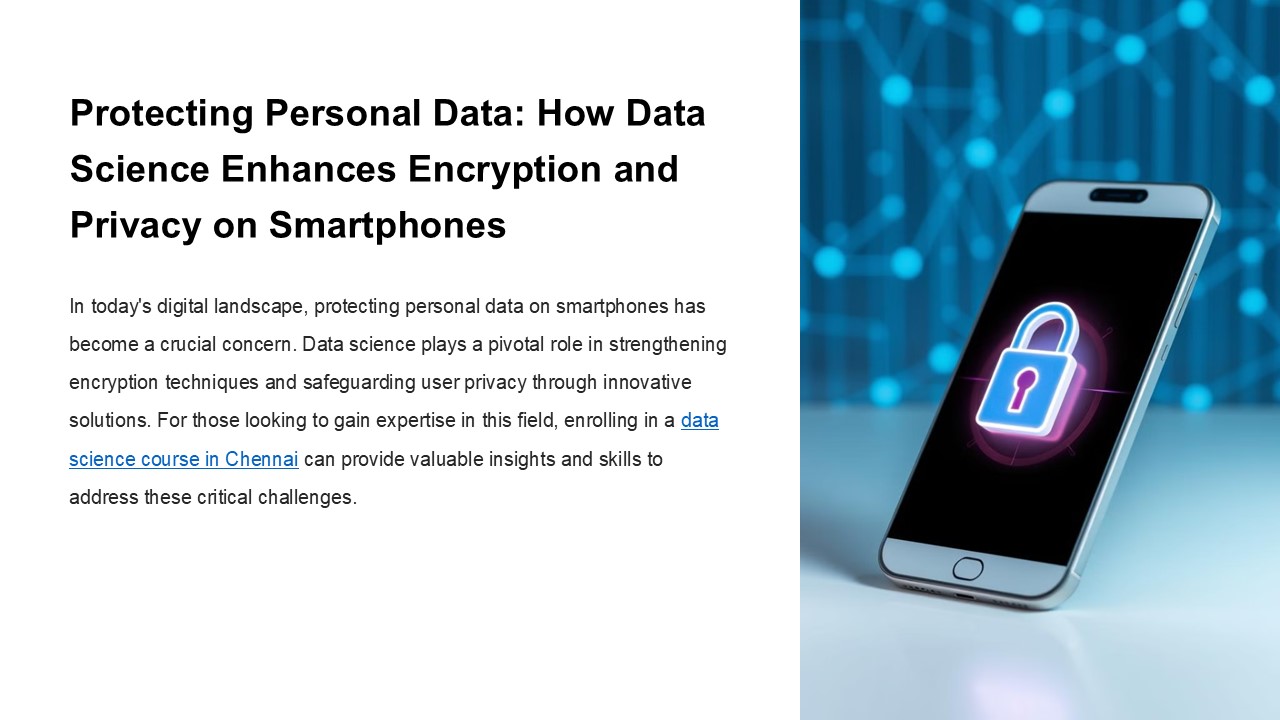
Title: Protecting Personal Data: How Data Science Enhances Encryption and Privacy on Smartphones
1
Protecting Personal Data How Data Science
Enhances Encryption and Privacy on Smartphones
In today's digital landscape, protecting personal
data on smartphones has become a crucial concern.
Data science plays a pivotal role in
strengthening encryption techniques and
safeguarding user privacy through innovative
solutions. For those looking to gain expertise in
this field, enrolling in a data science course in
Chennai can provide valuable insights and skills
to address these critical challenges.
2
The Importance of Data Privacy in the Digital Age
Sensitive Information
Evolving Threats
Trust and Transparency
1
2
3
Smartphones store a wealth of personal data,
including contacts, messages, financial details,
and location history.
With the rise of cybercrime, data breaches, and
unauthorized access, the need for robust privacy
measures is paramount.
Users demand that their data be protected, and
companies must prioritize privacy to maintain
consumer trust.
3
Understanding the Threats to Personal Data on
Smartphones
Malware
Unsecured Networks
Physical Theft
Malicious software can infiltrate smartphones,
stealing sensitive data or holding it for ransom.
Public Wi-Fi hotspots can expose data to
eavesdropping and man-in-the-middle attacks.
Loss or theft of a smartphone can lead to
unauthorized access to personal information.
4
Principles of Secure Data Storage and Transmission
Encryption
Secure Protocols
Advanced encryption algorithms protect data at
rest and in transit, ensuring confidentiality.
Secure communication protocols, such as HTTPS and
VPNs, safeguard data during transmission.
1
2
3
Tokenization
Sensitive information is replaced with
non-sensitive placeholders, reducing the risk of
exposure.
5
Leveraging Data Science for Advanced Encryption
Techniques
Homomorphic Encryption
Differential Privacy
Allows computations to be performed on encrypted
data without decrypting it, preserving privacy.
Injects noise into data to obscure individual
information while preserving the overall
dataset's utility.
Quantum-Resistant Cryptography
Adaptive Security
Machine learning models continuously monitor and
adapt encryption to evolving threats.
Develops encryption methods resilient to the
threat of quantum computing's decryption
capabilities.
6
Biometric Authentication Enhancing Smartphone
Security
Fingerprint
Secure and convenient authentication using the
unique patterns of an individual's fingerprint.
Facial Recognition
Advanced facial mapping and computer vision
techniques for seamless user identification.
Iris Scanning
Highly accurate and secure authentication using
the distinct patterns of the human iris.
7
Emerging Trends in Privacy-Preserving Mobile
Applications
Differential Privacy
Federated Learning
Blockchain-Based Identity
Protecting individual-level data while enabling
data analysis and insights.
Training AI models on decentralized data without
compromising user privacy.
Decentralized identity management with improved
data security and user control.
8
Conclusion Safeguarding the Future of Personal
Data
As data science continues to evolve, the
landscape of smartphone data protection will only
become more robust, empowering users to take
control of their personal information and
safeguard their digital identities.
Recommended

