

The Competitive Edge: Cloud ERP Systems for Optimized Business Performance PowerPoint PPT Presentation
Title: The Competitive Edge: Cloud ERP Systems for Optimized Business Performance
1
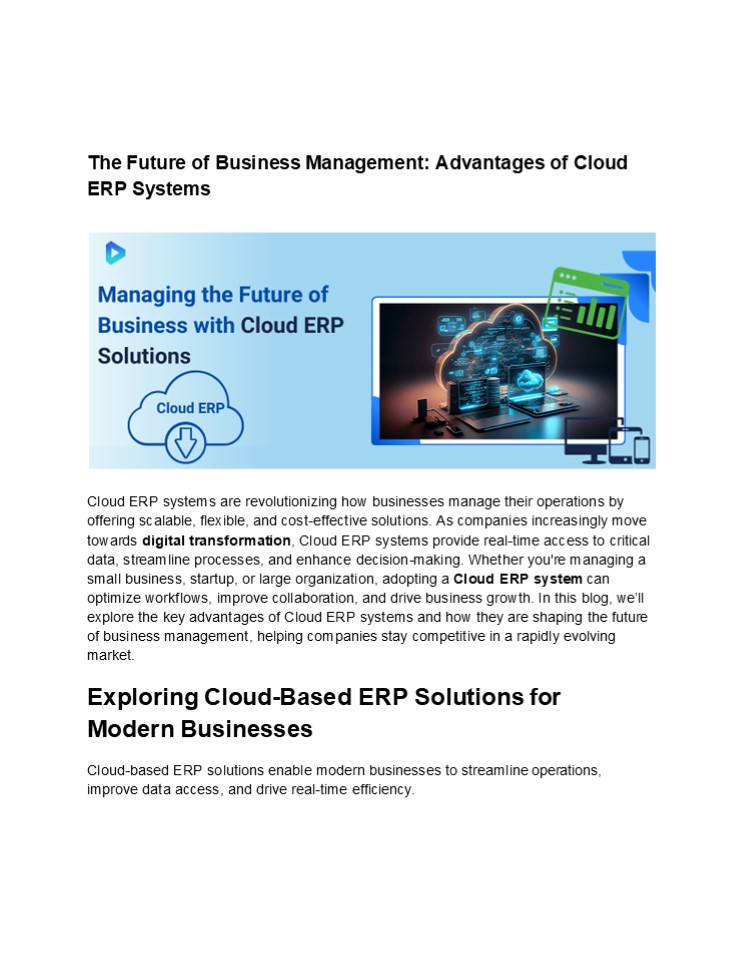
The Future of Business Management Advantages of
Cloud ERP Systems
Cloud ERP systems are revolutionizing how
businesses manage their operations by offering
scalable, flexible, and cost-effective solutions.
As companies increasingly move towards digital
transformation, Cloud ERP systems provide
real-time access to critical data, streamline
processes, and enhance decision-making. Whether
you're managing a small business, startup, or
large organization, adopting a Cloud ERP system
can optimize workflows, improve collaboration,
and drive business growth. In this blog, well
explore the key advantages of Cloud ERP systems
and how they are shaping the future of business
management, helping companies stay competitive in
a rapidly evolving market.
Exploring Cloud-Based ERP Solutions for Modern
Businesses Cloud-based ERP solutions enable
modern businesses to streamline operations,
improve data access, and drive real-time
efficiency.
2
Key Features of Cloud-Based ERP Solutions Cloud
ERP solutions offer a range of features tailored
for streamlined operations and improved data
management. Key functionalities often include
real-time data access, customizable dashboards,
and automated workflows. With cloud-based
systems, businesses benefit from scalability,
allowing them to add or reduce resources as
needed. Additionally, cloud ERP enhances
collaboration by enabling remote access for
teams, which is essential for companies with
distributed workforces or remote employees. How
Cloud ERP Streamlines Business Operations Cloud
ERP systems significantly improve business
operations by automating key processes and
centralizing data management. From inventory
tracking to customer relationship management,
these systems consolidate data, reducing manual
effort and errors. This real-time accessibility
across departments increases operational
efficiency by eliminating the need for repetitive
tasks. For growing companies, cloud ERP ensures
that every aspect of the business runs smoothly,
with instant updates and insights available for
decision-makers. Integrating Cloud ERP Solutions
with Existing Systems Integrating cloud ERP
solutions with existing business systems offers
seamless data flow across platforms, enhancing
overall functionality. By connecting ERP with
other software like CRM and HR management tools,
companies can ensure data consistency and
eliminate silos. Additionally, many cloud ERP
platforms offer robust APIs and integration
options, allowing easy connectivity with various
applications. This integration
3
leads to a unified technology ecosystem that
supports scalability and flexibility as the
business grows, making it a powerful foundation
for digital transformation. Top Cloud ERP
Benefits for Business Efficiency Cloud ERP offers
key business benefits like cost reduction,
enhanced scalability, and efficient data
management for greater productivity.
Enhancing Flexibility and Scalability with Cloud
ERP Cloud ERP systems provide businesses with
flexible, scalable solutions to support growth.
As businesses expand, cloud ERP can easily adjust
to increased demands, allowing for the quick
addition of users, features, and resources
without complex upgrades. This scalability means
companies only pay for what they need, making it
cost-effective. Additionally, with cloud-based
access, teams can work from anywhere, fostering a
flexible work environment that boosts
productivity and aligns with modern business
needs. Cost-Saving Advantages of Cloud ERP
Systems One of the main benefits of cloud ERP is
the reduction in upfront costs associated with
hardware and IT infrastructure. Cloud ERP systems
operate on a subscription model, eliminating
large initial investments and enabling businesses
to spread costs over time. Maintenance and
upgrades are handled by the service provider,
reducing the need for in-house IT staff and
ongoing system maintenance expenses. This
cost-efficiency makes cloud ERP especially
attractive for small and medium-sized businesses
looking to optimize budgets without sacrificing
functionality.
4
Cloud ERP and Improved Data Accessibility Cloud
ERP systems provide real-time data access,
allowing decision-makers to retrieve and analyze
information from any location. This enhanced
accessibility improves collaboration across
departments, as all team members work with
up-to-date information. Moreover, cloud ERP
ensures data is consistently backed up and
securely stored, reducing the risk of data loss
and unauthorized access. With instant data
access, managers can make timely, data-driven
decisions that support quick responses to market
changes and improve overall operational
efficiency. H2 Cloud-Based ERP for Small
Businesses Small businesses leverage cloud-based
ERP systems for growth, improved
cost-effectiveness, and simplified day-to-day
operations.
Benefits of Cloud ERP for Small Business
Growth Cloud ERP solutions empower small
businesses with the same advanced tools available
to larger companies but at a fraction of the
cost. These systems provide small businesses with
real-time insights into their operations,
allowing for better decision-making and faster
responses to market changes. Cloud ERP supports
scalability, enabling businesses to expand their
capabilities as they grow without needing
extensive investments in hardware or IT staff.
This growth-centric flexibility makes cloud ERP
ideal for small businesses aiming to compete on a
larger scale.
5
Choosing Affordable Cloud ERP Solutions For small
businesses, affordability is key when selecting
an ERP system. Cloud ERP solutions remove the
requirement for expensive on-premise
infrastructure and use a subscription-based
pricing model, making them more affordable and
accessible. Businesses should look for providers
offering flexible pricing plans that align with
their budgets and operational needs. Evaluating
features and support options helps ensure that
the chosen ERP solution meets current
requirements and can scale as the business
evolves. Cost-effective cloud ERP solutions offer
essential functions without the high costs of
traditional ERP systems. Simplifying Operations
for Small Businesses with Cloud ERP Cloud ERP
solutions streamline day-to-day operations,
making tasks like inventory management, financial
reporting, and customer relations more efficient.
By consolidating various business functions into
one system, cloud ERP reduces redundant tasks and
minimizes the risk of human error. This
simplification allows small business owners and
managers to focus more on strategic growth
initiatives rather than administrative tasks.
Cloud ERP also improves collaboration, as team
members can access the system from any location,
promoting a more agile and responsive work
environment. Why Choose Cloud-Based Enterprise
Software Introduction Cloud-based enterprise
software provides organizations with agility,
seamless integration, and advanced tools for
scalable business management.
6
Why Cloud-Based Enterprise Software is the
Future Cloud-based enterprise software is
transforming how businesses operate, enabling
greater flexibility, scalability, and cost
savings. Unlike traditional software, cloud
solutions allow users to access essential
applications from any location, promoting a more
mobile and collaborative workforce. With regular
updates managed by the provider, companies can
focus on innovation rather than IT maintenance.
This forward-thinking approach ensures businesses
remain competitive, adaptable, and resilient in a
fast-paced market. Embracing cloud-based
enterprise software is, therefore, a strategic
investment for future growth. Key Features of
Cloud Enterprise Solutions Cloud-based enterprise
solutions offer a range of features designed to
enhance operational efficiency and drive business
growth. Key functionalities include automated
data backup, real-time data analytics, and
seamless integration with other business tools.
These features help organizations manage
processes more efficiently, from finance and HR
to inventory management. Additionally, robust
security protocols protect sensitive business
data, offering peace of mind and regulatory
compliance. The ability to scale resources on
demand is another standout feature, allowing
businesses to adjust based on their needs without
overcommitting resources. How Cloud Software
Enhances Business Productivity Cloud software
enhances productivity by streamlining workflows
and reducing downtime. With cloud-based systems,
employees can collaborate in real-time, sharing
data and insights across departments, which
improves decision-making speed and accuracy. The
cloud also reduces time spent on maintenance,
allowing IT teams to focus on strategic projects
rather than routine updates. Automated reporting
and data access further improve efficiency,
enabling teams to monitor key performance
indicators and make data-driven decisions that
enhance overall productivity. Cloud software
ensures businesses operate smoothly, focusing on
growth rather than operational hiccups. Understan
ding the Value of SAP Cloud ERP SAP Cloud ERP
drives business growth with integrated solutions,
enhanced performance, and real-time insights for
decision-making.
7
Top Benefits of SAP Cloud ERP for Companies SAP
Cloud ERP offers numerous benefits that help
businesses streamline operations and reduce
costs. This cloud-based solution provides
on-demand scalability, allowing companies to
adjust resources as they grow. The software also
supports advanced analytics, giving businesses
real-time insights into their operations to make
data-driven decisions. Additionally, SAP Cloud
ERP improves team collaboration by centralizing
data and processes in one platform, enhancing
productivity. By automating routine tasks and
enhancing data security, SAP Cloud ERP reduces
manual work and safeguards sensitive business
information. SAP Cloud ERP Features That Drive
Business Growth SAP Cloud ERP is packed with
features that help drive business growth and
efficiency. Core functionalities include
financial management, supply chain optimization,
and human resource management, all accessible
from a single platform. This ERP system also
supports advanced analytics and AI, empowering
businesses to forecast trends and automate
repetitive tasks. SAPs customizable dashboards
and reporting tools enable users to visualize
data in ways that support faster decision-making.
Furthermore, integration capabilities allow
businesses to seamlessly connect SAP Cloud ERP
with other tools, creating a more cohesive
workflow.
8
Comparing SAP Cloud ERP with Other Solutions When
comparing SAP Cloud ERP to other ERP solutions,
several advantages stand out. Unlike some
platforms, SAP offers unparalleled scalability
and adaptability, making it suitable for
businesses of all sizes. SAP Cloud ERP is highly
customizable, allowing companies to tailor
modules to their specific needs. Additionally,
SAPs global support and extensive network
provide users with reliable assistance, ensuring
smoother implementation and ongoing support.
While some solutions may offer similar
functionalities, SAPs industry expertise and
continuous innovation make it a preferred choice
for companies looking to stay ahead in a
competitive market. Selecting the Best Cloud ERP
for Manufacturing Introduction Manufacturing
businesses benefit from cloud ERP with
streamlined processes, optimized supply chains,
and improved production efficiency.
Key Considerations for Manufacturing ERP
Systems When selecting a cloud ERP system for
manufacturing, consider factors like scalability,
integration, and industry-specific
functionalities. Manufacturing requires real-time
tracking of production and inventory, so a system
that provides live data monitoring and analytics
is essential. Also, ensure that the ERP supports
supply chain management and quality control for
seamless operations. Look for systems that are
customizable and can be tailored to meet the
unique needs of your manufacturing processes.
Data security and compliance with industry
regulations are also critical for safeguarding
sensitive information.
9
Top Cloud ERP Features for Manufacturing
Needs The best cloud ERP systems for
manufacturing include features like production
scheduling, resource planning, and inventory
management. An effective ERP should provide
production tracking that captures data from the
shop floor to optimize workflows. Advanced
forecasting tools help anticipate demand, while
quality control modules ensure products meet
required standards. Additionally, integration
with supply chain and logistics management tools
allows manufacturers to oversee distribution and
raw material sourcing efficiently. Look for
real-time reporting features and customizable
dashboards that enhance visibility across
departments, facilitating better
collaboration. Enhancing Manufacturing
Operations with Cloud ERP Implementing a cloud
ERP system can streamline manufacturing
operations by automating repetitive tasks and
minimizing human error. Automated scheduling and
resource allocation ensure production processes
run smoothly and efficiently. Cloud ERP also
enables manufacturers to monitor production
performance and address potential bottlenecks
before they become issues. By centralizing data
on a single platform, cloud ERP systems
facilitate collaboration between departments and
improve decision-making. Furthermore, cloud-based
solutions offer flexibility and scalability,
allowing manufacturers to expand their operations
seamlessly as their business grows.
LETS DISCUSS YOUR IDEA
HAVE QUESTION? Call Us 1 (347) 9739732,
91-90399-28143 Email Us inquiry_at_digiprima.com,
ashesh_at_digiprima.com
Recommended

