

Mastering Forex Trading in India: A Comprehensive Guide for Beginners PowerPoint PPT Presentation
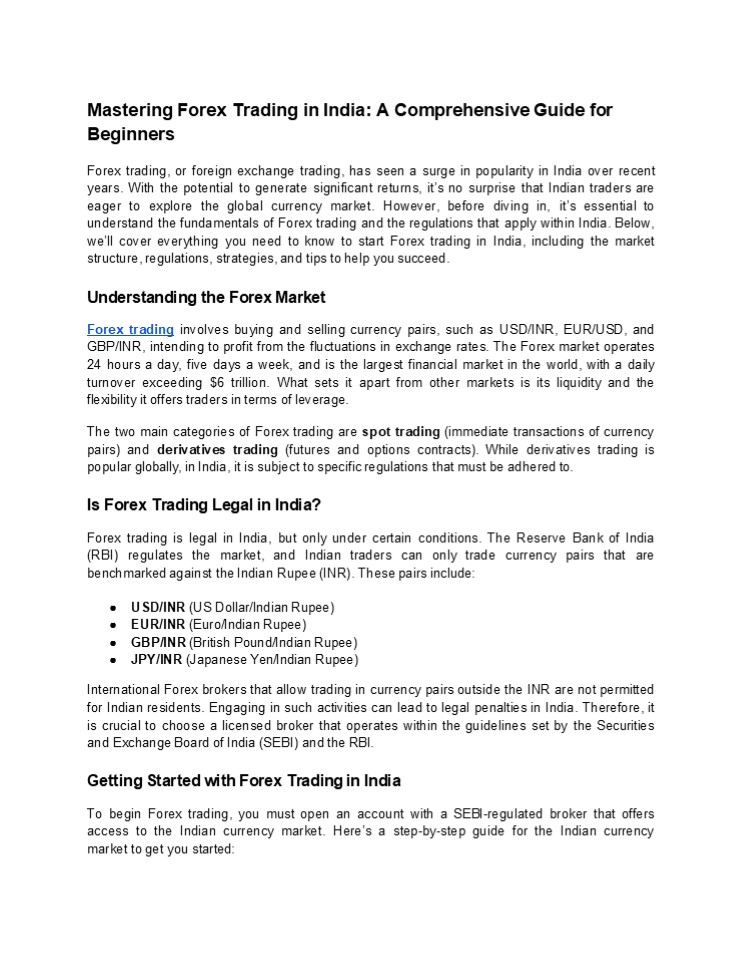
Title: Mastering Forex Trading in India: A Comprehensive Guide for Beginners
1
- Mastering Forex Trading in India A Comprehensive
Guide for Beginners - Forex trading, or foreign exchange trading, has
seen a surge in popularity in India over recent
years. With the potential to generate significant
returns, its no surprise that Indian traders are
eager to explore the global currency market.
However, before diving in, its essential to
understand the fundamentals of Forex trading and
the regulations that apply within India. Below,
well cover everything you need to know to start
Forex trading in India, including the market
structure, regulations, strategies, and tips to
help you succeed. - Understanding the Forex Market
- Forex trading involves buying and selling
currency pairs, such as USD/INR, EUR/USD, and
GBP/INR, intending to profit from the
fluctuations in exchange rates. The Forex market
operates 24 hours a day, five days a week, and is
the largest financial market in the world, with a
daily turnover exceeding 6 trillion. What sets
it apart from other markets is its liquidity and
the flexibility it offers traders in terms of
leverage. - The two main categories of Forex trading are spot
trading (immediate transactions of currency
pairs) and derivatives trading (futures and
options contracts). While derivatives trading is
popular globally, in India, it is subject to
specific regulations that must be adhered to. - Is Forex Trading Legal in India?
- Forex trading is legal in India, but only under
certain conditions. The Reserve Bank of India
(RBI) regulates the market, and Indian traders
can only trade currency pairs that are
benchmarked against the Indian Rupee (INR). These
pairs include - USD/INR (US Dollar/Indian Rupee)
- EUR/INR (Euro/Indian Rupee)
- GBP/INR (British Pound/Indian Rupee)
- JPY/INR (Japanese Yen/Indian Rupee)
- International Forex brokers that allow trading in
currency pairs outside the INR are not permitted
for Indian residents. Engaging in such activities
can lead to legal penalties in India. Therefore,
it is crucial to choose a licensed broker that
operates within the guidelines set by the
Securities and Exchange Board of India (SEBI) and
the RBI. - Getting Started with Forex Trading in India
- To begin Forex trading, you must open an account
with a SEBI-regulated broker that offers access
to the Indian currency market. Heres a
step-by-step guide for the Indian currency market
to get you started
2
- Choose a Reputable Broker
- Research brokers carefully, ensuring they are
registered with SEBI and comply with Indian
regulations. Factors to consider include fees,
platform ease-of-use, customer service, and
educational resources. - Open a Trading Account
- Once you've selected a broker, you'll need to
open a trading account. This typically involves
providing identification and financial
documentation for verification purposes. Many
brokers offer demo accounts, which allow you to
practice trading without risking real money. - Fund Your Account
- After your account is verified, you can deposit
funds using bank transfers, credit cards, or
other methods offered by your broker. Always be
aware of any minimum deposit requirements and
fees associated with funding. - Start Trading
- Once you add money to your account, you can start
trading Forex. Begin with small amounts and use
low leverage to lower your risk as you learn
about the market. - Developing a Trading Strategy
- Success in Forex trading depends largely on
having a well-defined strategy. Here are some
common approaches used by traders - Day Trading
- This strategy involves entering and exiting
trades within the same day, typically closing all
positions before the market closes. Day traders
rely on technical analysis and short-term price
movements to profit from small market
fluctuations. - Swing Trading
- Swing traders hold positions for several days or
even weeks, seeking to profit from medium-term
price movements. This strategy requires
patience and a deep understanding of market
trends. - Scalping
- Scalping involves making many quick trades
throughout the day to capture small price
movements. It requires fast decision-making and a
reliable trading platform with low fees, as even
small costs can eat into profits. - Position Trading
3
- Understanding Risks and Rewards
- Forex trading can be very profitable, but it also
carries risks. The volatile nature of currency
markets means that even experienced traders can
suffer losses. Be aware of these common risks in
forex trading - Market Risk The risk that currency prices move
in an unexpected direction. - Leverage Risk While leverage can amplify
profits, it can also magnify losses, making it
essential to use leverage cautiously. - Liquidity Risk The risk that you cannot execute
a trade at your desired price due to market
conditions. - Regulatory Risk Always ensure you are trading
within the regulations to avoid legal issues. - By managing these risks effectively, you can
increase your chances of becoming a successful
Forex trader. - Forex Trading Platforms
- Choosing the right trading platform is crucial
for executing trades efficiently. Most brokers
offer proprietary platforms or access to popular
ones like MetaTrader 4 (MT4) or MetaTrader 5
(MT5). These platforms provide traders with
charting tools, technical indicators, and
automated trading options to help make informed
decisions. - Before committing to a platform, consider
features such as ease of use, available tools,
and customer support. Some platforms also offer
mobile apps, which are useful for monitoring
trades while on the go. - Conclusion
- Forex trading in India offers an exciting
opportunity to participate in the global
financial markets, but it requires knowledge,
discipline, and compliance with regulations. By
following the steps outlined in this guide and
developing a robust trading strategy, you can
navigate the Forex market with greater
confidence. Remember, success in Forex trading
doesnt happen overnightcontinuous learning and
practice are key to mastering the art of currency
trading. - Happy trading, and always trade responsibly!
Recommended

