

Storytelling Through Animation: The Creative Process of Visual Narrative Development PowerPoint PPT Presentation
Title: Storytelling Through Animation: The Creative Process of Visual Narrative Development
1
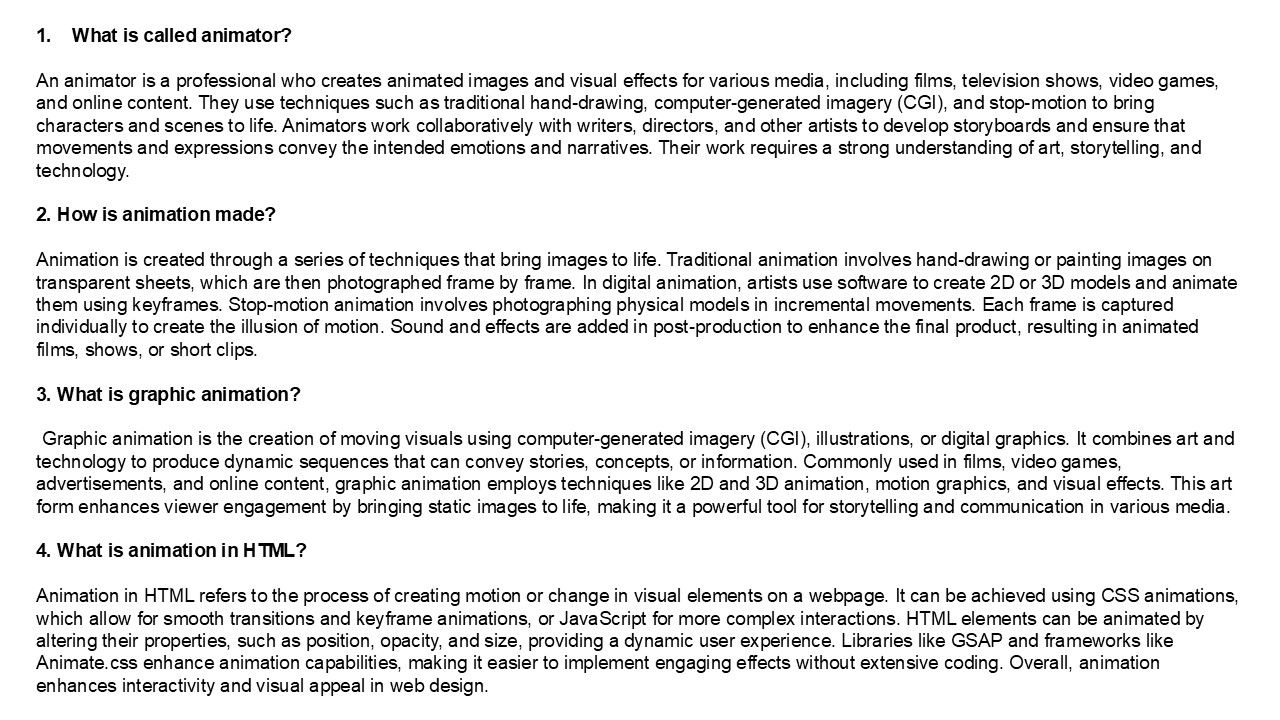
- What is called animator?
- An animator is a professional who creates
animated images and visual effects for various
media, including films, television shows, video
games, and online content. They use techniques
such as traditional hand-drawing,
computer-generated imagery (CGI), and stop-motion
to bring characters and scenes to life. Animators
work collaboratively with writers, directors, and
other artists to develop storyboards and ensure
that movements and expressions convey the
intended emotions and narratives. Their work
requires a strong understanding of art,
storytelling, and technology. - 2. How is animation made?
- Animation is created through a series of
techniques that bring images to life. Traditional
animation involves hand-drawing or painting
images on transparent sheets, which are then
photographed frame by frame. In digital
animation, artists use software to create 2D or
3D models and animate them using keyframes.
Stop-motion animation involves photographing
physical models in incremental movements. Each
frame is captured individually to create the
illusion of motion. Sound and effects are added
in post-production to enhance the final product,
resulting in animated films, shows, or short
clips. - 3. What is graphic animation?
- Graphic animation is the creation of moving
visuals using computer-generated imagery (CGI),
illustrations, or digital graphics. It combines
art and technology to produce dynamic sequences
that can convey stories, concepts, or
information. Commonly used in films, video games,
advertisements, and online content, graphic
animation employs techniques like 2D and 3D
animation, motion graphics, and visual effects.
This art form enhances viewer engagement by
bringing static images to life, making it a
powerful tool for storytelling and communication
in various media. - 4. What is animation in HTML?
- Animation in HTML refers to the process of
creating motion or change in visual elements on a
webpage. It can be achieved using CSS animations,
which allow for smooth transitions and keyframe
animations, or JavaScript for more complex
interactions. HTML elements can be animated by
altering their properties, such as position,
opacity, and size, providing a dynamic user
experience. Libraries like GSAP and frameworks
like Animate.css enhance animation capabilities,
making it easier to implement engaging effects
without extensive coding. Overall, animation
enhances interactivity and visual appeal in web
design.
2
5. What is the basic concept of animation? The
basic concept of animation involves creating the
illusion of movement by displaying a series of
static images in rapid succession. This technique
exploits the phenomenon of persistence of vision,
where the human eye perceives a sequence of
images as continuous motion. Animators use
various methods, such as traditional hand-drawn
frames, computer-generated imagery (CGI), or
stop-motion techniques, to produce these images.
By manipulating elements like timing, spacing,
and character movement, animators convey stories
and emotions, bringing characters and scenes to
life in diverse media, from films to video
games. Visit VS Website See more Blog
Recommended

