

Exploring Different Types of Animation PowerPoint PPT Presentation
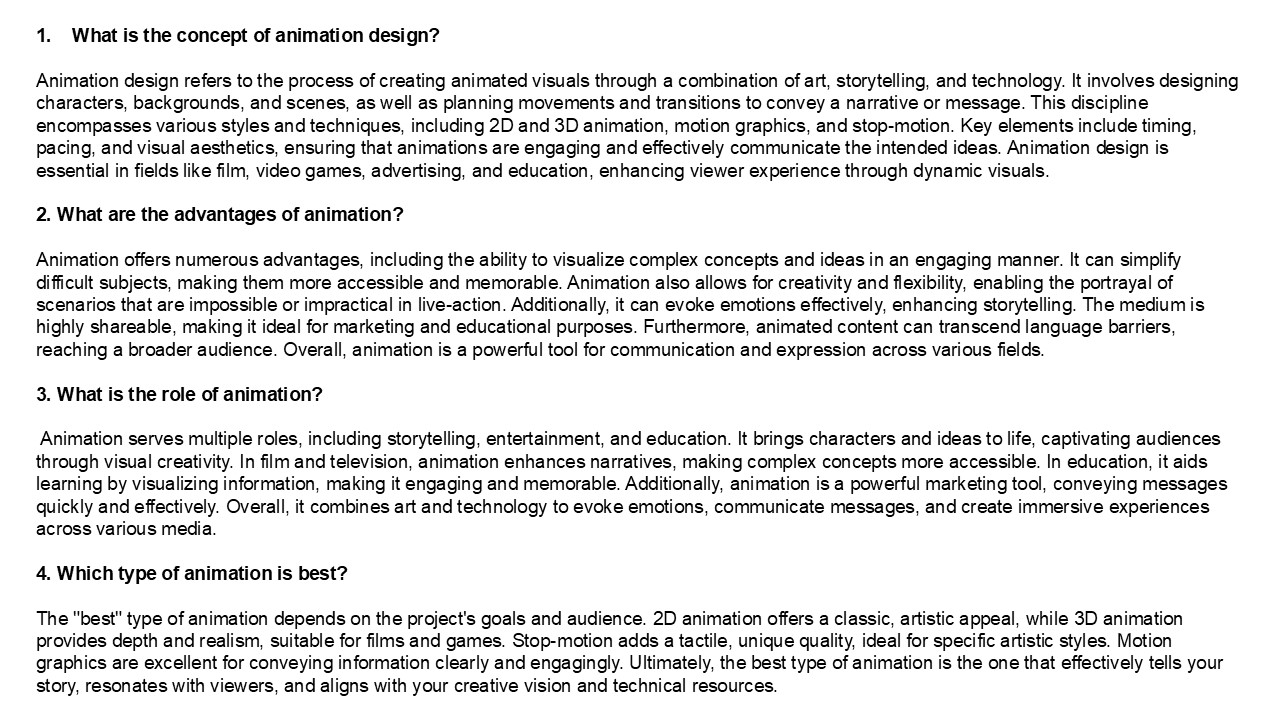
Title: Exploring Different Types of Animation
1
- What is the concept of animation design?
- Animation design refers to the process of
creating animated visuals through a combination
of art, storytelling, and technology. It involves
designing characters, backgrounds, and scenes, as
well as planning movements and transitions to
convey a narrative or message. This discipline
encompasses various styles and techniques,
including 2D and 3D animation, motion graphics,
and stop-motion. Key elements include timing,
pacing, and visual aesthetics, ensuring that
animations are engaging and effectively
communicate the intended ideas. Animation design
is essential in fields like film, video games,
advertising, and education, enhancing viewer
experience through dynamic visuals. - 2. What are the advantages of animation?
- Animation offers numerous advantages, including
the ability to visualize complex concepts and
ideas in an engaging manner. It can simplify
difficult subjects, making them more accessible
and memorable. Animation also allows for
creativity and flexibility, enabling the
portrayal of scenarios that are impossible or
impractical in live-action. Additionally, it can
evoke emotions effectively, enhancing
storytelling. The medium is highly shareable,
making it ideal for marketing and educational
purposes. Furthermore, animated content can
transcend language barriers, reaching a broader
audience. Overall, animation is a powerful tool
for communication and expression across various
fields. - 3. What is the role of animation?
- Animation serves multiple roles, including
storytelling, entertainment, and education. It
brings characters and ideas to life, captivating
audiences through visual creativity. In film and
television, animation enhances narratives, making
complex concepts more accessible. In education,
it aids learning by visualizing information,
making it engaging and memorable. Additionally,
animation is a powerful marketing tool, conveying
messages quickly and effectively. Overall, it
combines art and technology to evoke emotions,
communicate messages, and create immersive
experiences across various media. - 4. Which type of animation is best?
- The "best" type of animation depends on the
project's goals and audience. 2D animation offers
a classic, artistic appeal, while 3D animation
provides depth and realism, suitable for films
and games. Stop-motion adds a tactile, unique
quality, ideal for specific artistic styles.
Motion graphics are excellent for conveying
information clearly and engagingly. Ultimately,
the best type of animation is the one that
effectively tells your story, resonates with
viewers, and aligns with your creative vision and
technical resources.
2
5. What are the 3 stages of animation? The
three stages of animation are 1.
Pre-production This stage involves planning,
storyboarding, character design, and
scriptwriting to outline the animation's vision
and narrative. 2. Production In this phase,
animators create the actual animation, including
modeling, rigging, and animating characters and
scenes, as well as adding voiceovers and sound
effects. 3. Post-production This final stage
includes editing, adding visual effects, sound
design, and finalizing the animation for
distribution, ensuring all elements come together
cohesively. Visit VS Website See more Blog
Recommended

