

The Role Of Mobile Banking In Revolutionizing Rural Financial Inclusion PowerPoint PPT Presentation
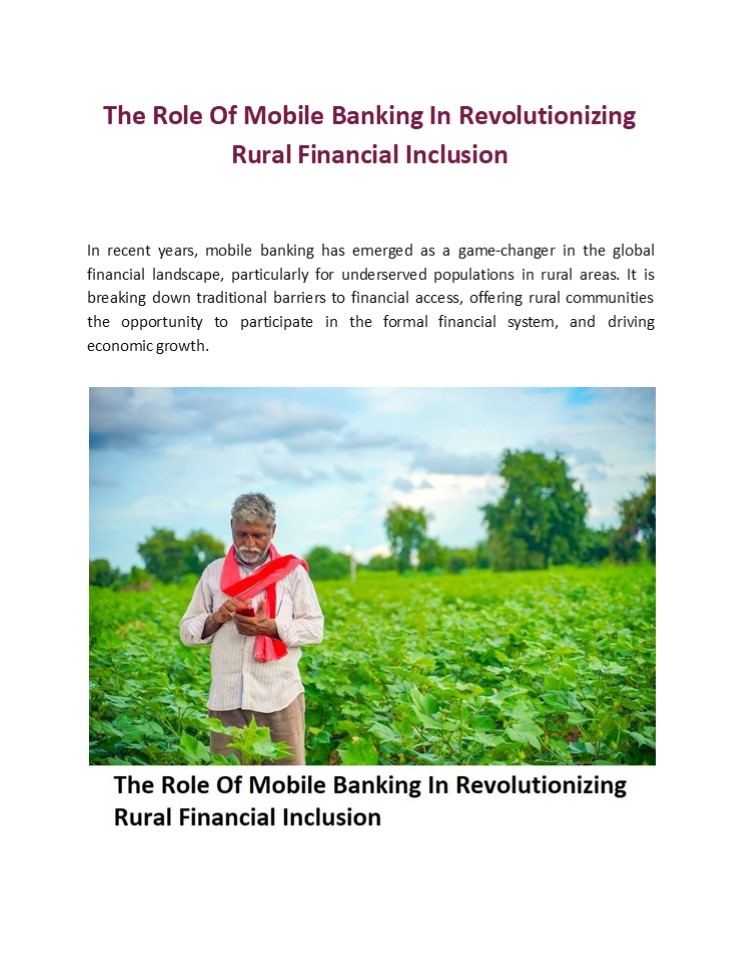
Title: The Role Of Mobile Banking In Revolutionizing Rural Financial Inclusion
1
The Role Of Mobile Banking In Revolutionizing
Rural Financial Inclusion
In recent years, mobile banking has emerged as a
game-changer in the global financial landscape,
particularly for underserved populations in rural
areas. It is breaking down traditional barriers
to financial access, offering rural communities
the opportunity to participate in the formal
financial system, and driving economic growth.
2
According to the Global Findex Database, 69 of
adults globally now have access to financial
services, largely thanks to the surge in mobile
banking. This transformation is proving to be a
key driver in promoting financial inclusion for
billions of unbanked individuals worldwide,
particularly in developing nations. The Growing
Impact Of Mobile Banking The rise of mobile
banking is nothing short of a revolution.
Financial institutions, fintech companies, and
governments have recognized the immense potential
of mobile technology to bridge the financial
inclusion gap. In rural areas, where traditional
banks have limited reach due to inadequate
infrastructure and logistical challenges, mobile
banking offers a lifeline. According to Allied
Market Research, the global mobile banking
industry is expected to expand at a Compound
Annual Growth Rate (CAGR) of 16.8 between 2023
and 2032. This robust growth is fueled by the
increasing penetration of smartphones and mobile
internet, even in the most remote parts of the
world. In rural regions, mobile banking can be a
catalyst for achieving the United Nations'
Sustainable Development Goal (SDG) of reducing
poverty and improving economic opportunities by
2030. Financial Inclusion And Mobile Banking In
Rural Areas Mobile banking provides a useful and
affordable way to address financial exclusion
for people living in rural areas. In many rural
areas, traditional banking systems have failed
to provide accessible services due to the high
cost of setting up physical branches. Millions
of individuals are consequently deprived of
access to essential financial services including
insurance, loans, and savings accounts.
3
- However, mobile banking is turning the tide. With
just a mobile phone and an internet connection,
users can now perform a variety of financial
transactions. In fact, over 1.2 billion people
in developing economies have gained access to
financial services through mobile technology,
according to the GSMA's 2023 State of the
Industry Report. - Heres How Mobile Banking Is Driving Rural
Financial Inclusion - Accessibility To Financial Services
- Mobile banking platforms eliminate the need for
physical infrastructure, making financial
services more accessible to rural communities.
Individuals no longer need to travel long
distances to visit a bank they can manage their
finances directly from their phones. - Reduction Of Transaction Costs
- By using mobile banking, the cost of transactions
is significantly reduced. Many mobile banking
apps allow for free or low-cost transactions,
which is a stark contrast to traditional banking
fees. This is particularly beneficial for
low-income households in rural areas. - Financial Literacy
- Many mobile banking services come with tools that
help users better understand financial products
and manage their money. This increased financial
literacy empowers individuals to make informed
financial decisions, which is critical for
fostering long-term economic growth.
4
- Women Empowerment
- Mobile banking is also playing a pivotal role in
empowering rural women, many of whom have
historically been excluded from formal financial
systems. The ability to access financial services
via a mobile phone can significantly improve
their financial independence, offering them
greater control over their livelihoods. - Mobile Banking Success Stories In Rural Financial
Inclusion - M-Pesa In Kenya
- A leading example of mobile banking
revolutionizing financial inclusion is Kenya's
M-Pesa. Since its inception in 2007, M-Pesa has
grown to serve over 51 million users across
multiple countries. This mobile money platform
allows users to store money, transfer funds, and
pay for goods and services using their mobile
phones. It has had a particularly impact on rural
Kenya, where traditional banks had limited
presence. - M-Pesa has transformed the lives of millions,
lifting approximately 194,000 households out of
poverty between 2008 and 2016. A significant
percentage of these households were
female-headed, highlighting the role of mobile
banking in promoting gender equality. - Indias Digital Revolution
- Another interesting story is the rapid adoption
of mobile banking in India. With over 350
million mobile internet users in rural areas as
of 2023, India has become a hotbed for mobile
financial services.
5
- The Indian governments Pradhan Mantri Jan Dhan
Yojana (PMJDY) initiative aims to promote
financial inclusion by providing banking services
to the unbanked population, especially in rural
regions. As of June 2023, over 500 million bank
accounts have been opened under this scheme, with
67 of them being in rural areas. - Challenges In Expanding Mobile Banking In Rural
Areas - While mobile banking has made significant strides
in rural financial inclusion, challenges remain.
Many rural populations still face issues such as - Limited Digital Literacy Although smartphones
are becoming more common, digital literacy
remains low in many rural areas, preventing users
from fully benefiting from mobile banking
services. - Inadequate Internet Connectivity Poor or
non-existent Internet connectivity is another
barrier to mobile banking in rural areas. Many
regions still lack the infrastructure needed for
reliable mobile internet services. - Trust Issues In some rural areas, a lack of
trust in digital financial systems continues to
hamper mobile banking adoption. Building trust in
these systems requires education and awareness
campaigns. - The Role Of EnFuse Solutions In Driving Digital
Transformation - EnFuse Solutions plays a vital role in the
ongoing digital transformation efforts that
support financial inclusion. As a company
dedicated to helping organizations unlock the
power of their data, EnFuse Solutions offers a
suite of services that enhance the efficiency
and scalability of mobile banking platforms,
particularly in rural areas.
6
EnFuse Solutions helps financial institutions
manage and optimize their data, enabling them to
deliver personalized and secure mobile banking
services to rural populations. Through their
innovative solutions, they support the creation
of user-friendly interfaces, secure data
management protocols, and customized financial
products tailored to the unique needs of rural
communities. By streamlining data processes,
EnFuse Solutions is helping bridge the gap
between financial institutions and underserved
rural populations, fostering financial inclusion
at a global scale. The Future Of Mobile Banking
In Rural Financial Inclusion As mobile banking
continues to evolve, the future of rural
financial inclusion looks promising. According
to the World Bank and McKinsey Company report,
financial inclusion through digital services
could help increase the global GDP by as much as
6 by 2025. The continued expansion of mobile
internet access, coupled with advancements in
financial technology, will likely bring millions
more into the fold of the formal financial
system. Furthermore, as governments, financial
institutions, and technology providers
collaborate to overcome the remaining barriers,
we expect mobile banking to play an even more
significant role in improving the livelihoods of
rural populations worldwide.
7
Conclusion Mobile banking is revolutionizing
rural financial inclusion by providing a
practical, accessible, and cost-effective
alternative to traditional banking. With millions
of previously unbanked individuals gaining
access to financial services, mobile banking has
the power to drive economic growth, reduce
poverty, and promote gender equality in rural
areas. While challenges remain, the continued
efforts of organizations like EnFuse Solutions
and the rapid advancement of mobile technology
signal a brighter, more financially inclusive
future for rural communities across the
globe. Read More Empowering Rural Economies
The Significance Of Farmer Loan Digitization In
Indian PACS
Recommended

