

The Role of EHR Systems in Healthcare: Maximizing Provider Efficiency PowerPoint PPT Presentation
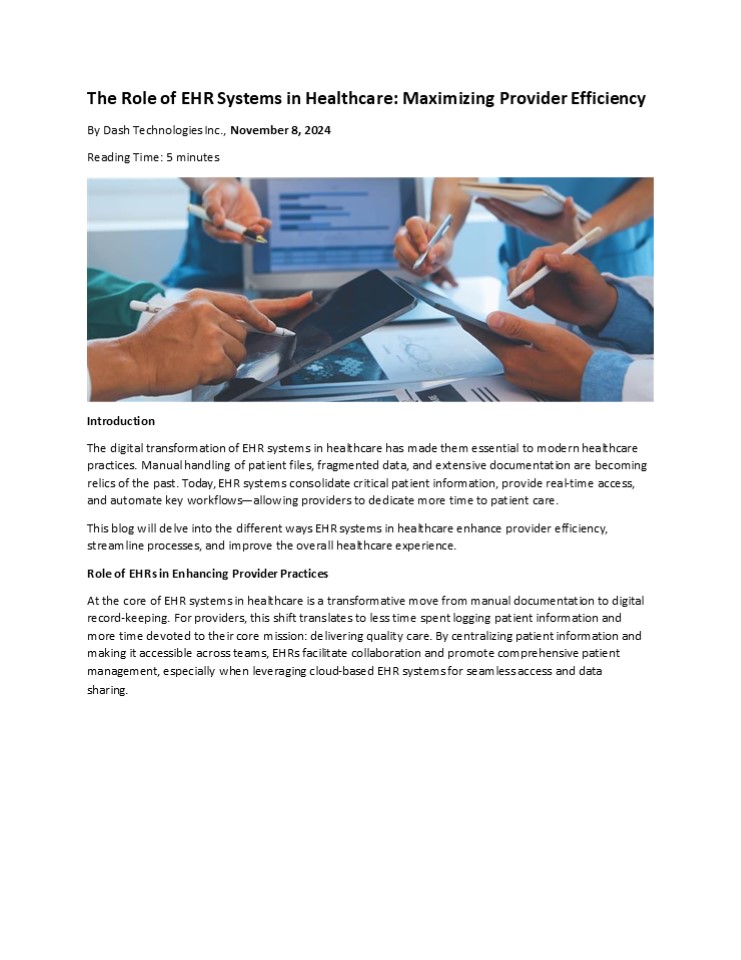
Title: The Role of EHR Systems in Healthcare: Maximizing Provider Efficiency
1
The Role of EHR Systems in Healthcare Maximizing
Provider Efficiency By Dash Technologies Inc.,
November 8, 2024 Reading Time 5 minutes
Introduction The digital transformation of EHR
systems in healthcare has made them essential to
modern healthcare practices. Manual handling of
patient files, fragmented data, and extensive
documentation are becoming relics of the past.
Today, EHR systems consolidate critical patient
information, provide real-time access, and
automate key workflowsallowing providers to
dedicate more time to patient care. This blog
will delve into the different ways EHR systems in
healthcare enhance provider efficiency,
streamline processes, and improve the overall
healthcare experience. Role of EHRs in Enhancing
Provider Practices At the core of EHR systems in
healthcare is a transformative move from manual
documentation to digital record-keeping. For
providers, this shift translates to less time
spent logging patient information and more time
devoted to their core mission delivering quality
care. By centralizing patient information and
making it accessible across teams, EHRs
facilitate collaboration and promote
comprehensive patient management, especially when
leveraging cloud-based EHR systems for seamless
access and data sharing.
2
- Research revealed the following facts
- 94 of providers state that their EHR enables
easy access to records at the point of care. - 88 confirm that their EHR brings clinical
advantages to their practice. - 75 of providers say that their EHR helps them
offer improved patient care. - Providers no longer need to sift through stacks
of files instead, EHR systems in healthcare
provide a consolidated view of a patients
medical history, lab results, medications, and
treatment plans. This immediate access to
relevant information enhances clinical
decision-making, minimizes errors, and enables a
proactive approach to patient health. From
scheduling to follow-ups, EHR workflow
improvements are designed to support providers at
every stage, significantly enhancing efficiency
in medical practices. - EHR Systems in Healthcare Core Components Key
Functions - EHR systems in healthcare are multifaceted, with
core components designed to support both clinical
and administrative tasks. Key functions include - Patient Data Storage and Retrieval EHRs store
patient demographics, medical histories, and
clinical data in a central database, accessible
at any time. - Clinical Documentation Notes and treatment plans
can be documented directly within the EHR system,
eliminating the need for manual paperwork. - Order Entry and Management EHRs allow providers
to enter orders for tests, medications, and
treatments, which are then transmitted
electronically to labs and pharmacies. - Patient Portals Many cloud-based EHR systems
include portals for patients to view their health
records, test results, and treatment plans.
3
- Decision Support EHRs offer real-time clinical
decision support tools, such as drug interaction
alerts and recommended care pathways, assisting
providers in making safer, evidence-based
decisions. - Simplifying Patient Information Management with
EHRs - Managing patient information is one of the
biggest challenges in healthcare. EHR systems in
healthcare simplify this task by organizing
patient data into a single, secure, and easily
accessible system. This consolidation minimizes
the risk of lost information and ensures that
providers have all the details they need at their
fingertips. - For example, a provider can quickly review a
patients past diagnoses, lab results, and
treatments before a consultation, allowing them
to make informed decisions swiftly. Cloud-based
EHR systems facilitate the secure sharing of
patient data with other healthcare providers,
ensuring continuity of care when patients see
multiple specialists. This real-time access to
patient data is invaluable for reducing
administrative time and providing efficient,
coordinated care. - Achieve Effortless Data Sharing with Seamless EHR
Integration! - EHRs Driving Provider Efficiency with Clinical
Data Management - EHRs make it easier for providers to organize and
analyze clinical data, which directly impacts
patient care and provider productivity. With
EHRs, providers can track patient data over time,
spot trends, and use this information to guide
treatment plans. For example, a provider can use
EHR data to monitor a patients progress on
medication or evaluate the effectiveness of a
treatment plan. - Clinical data management through EHRs enables
providers to take a proactive approach to patient - health, identifying risk factors early and
addressing potential health issues before they
become serious. This approach is especially
useful for chronic disease management, where
ongoing monitoring and - timely intervention are crucial.
- By driving more efficient data management, EHRs
empower providers to offer preventive care,
improving patient outcomes while saving time and
resources. - EHR Systems in Healthcare Enhancing
Collaboration and Streamlining Documentation - EHR systems in healthcare improve collaboration
among healthcare teams by centralizing patient - information, making it accessible to all
authorized team members. This accessibility
ensures that every provider involved in a
patients care has a comprehensive understanding
of their medical history, current treatments, and
any recent developments. It removes the need for
repetitive explanations and supports a seamless
continuum of care. - Additionally, EHR workflow improvements
streamline documentation by automating much of
the paperwork traditionally handled manually.
Templates, pre-populated fields, and voice
recognition features simplify data entry,
reducing the time providers spend documenting
each case. This faster - documentation process not only enhances
productivity but also minimizes errors caused by
handwritten misinterpretations or incomplete
records.
4
Improving Provider Flexibility and Scheduling
with EHR Systems in Healthcare EHRs offer
features that support efficient scheduling,
enabling practices to manage patient
appointments, minimize no-shows, and optimize the
providers time. With automated scheduling and
reminders, providers can handle patient flow more
effectively and reduce wait times. Moreover, many
EHR systems offer remote access capabilities,
allowing providers to access patient records from
anywhere. This flexibility is especially valuable
for providers who work across multiple locations
or conduct telemedicine appointments. By
supporting both in-person and virtual care, EHRs
adapt to the growing need for flexible healthcare
solutions, enabling providers to offer care when
and where patients need it. Transforming Billing,
Alerts, and Integrations with EHR Systems in
Healthcare EHR systems significantly enhance the
billing process by making it faster, more
accurate, and virtually error-free. With clinical
services automatically recorded and billed
digitally, the need for manual entries is
eliminated, leading to more precise financial
workflows and greater efficiency. Beyond
streamlining billing, EHRs excel through seamless
integration with CRMs and advanced financial
management platforms. This connectivity enhances
patient engagement by facilitating personalized
care management and robust communication
channels. Simultaneously, linking with
sophisticated accounting systems ensures
real-time financial updates, accurate reporting,
and smoother payment cycles.
5
- EHRs also enhance patient care through automated
alerts for appointments, medication schedules,
and preventive screenings. By sending timely
reminders, they ensure critical aspects of
patient care are managed effectively, improving
coordination among healthcare teams. - Transformed Orthopedic Care Streamlined Surgery
and EMR-EHR Integration for a Top Fortune 500
Leader! - Read Case Study
- Navigating Challenges in EHR Implementation for
Providers - Implementing EHR systems in healthcare presents
several challenges for healthcare providers,
ranging from data interoperability issues to
ensuring compliance with evolving regulations. - Data Interoperability
- Seamless communication between different EHR
platforms remains a hurdle, with only 29 of - U.S. hospitals achieving substantial data
exchange capabilities. This gap in EHR
interoperability hinders effective care
coordination across various healthcare settings,
emphasizing the need for EHR systems in
healthcare that enable true connectivity. - Data Usability
- Providers often face cumbersome interfaces,
redundant data entry, and low usability, - contributing to clinician burnout, as nearly 50
of physicians cite EHRs as a primary stressor.
Streamlined data visualization tools are needed
for improved decision-making. - Workflow Integration
- EHR implementation frequently disrupts existing
clinical processes. Studies show a 20-30 drop in
productivity during the transition phase, as
staff adapt to new systems and workflows, - necessitating targeted training and gradual
integration. - Data Security and Compliance
- Ensuring compliance with regulations like HIPAA,
GDPR, the HITECH Act, and FHIR is critical.
Robust data security measures must be in place to
protect patient privacy, as healthcare - continues to experience breaches, with average
data breach costs surpassing 10.93 million in
2023.
6
- As healthcare technology evolves, providers need
a reliable partner to implement, manage, and
optimize their EHR systems. Dash Technologies
offers end-to-end support, from system selection
to seamless integration and ongoing management,
ensuring that healthcare providers can maximize
the value of - their EHR investments. Heres how Dash can help
- Expert EHR System Selection
- Dash assists healthcare providers in choosing the
right EHR system tailored to their unique - needs, ensuring they invest in a solution that
fits their practice size, specialty, and
operational goals. - Seamless Integration
- Dash ensures smooth integration of the EHR system
with existing healthcare platforms, minimizing
disruptions and streamlining workflows for
improved efficiency. - Comprehensive Data Security and Compliance
- With expertise in healthcare IT and regulatory
requirements, Dash ensures that EHR systems are
secure, compliant with HIPAA, HITECH, GDPR, and
other regulations, protecting sensitive patient
data and avoiding costly penalties. - Ongoing Support and Optimization
- Dash provides continuous maintenance, regular
updates, and troubleshooting, ensuring that the
EHR system operates efficiently and remains
up-to-date with evolving healthcare standards. - Improved Patient Care and Operational Efficiency
- By leveraging Dashs comprehensive support,
providers can unlock the full potential of EHR
systems, leading to better patient care, improved
decision-making, and reduced administrative
burden. - Partnering with Dash enables healthcare providers
to maximize the benefits of their EHR systems in
healthcareboosting efficiency, enhancing patient
care, and ensuring long-term success in a fast- - evolving healthcare landscape. Lets talk!
- About Dash
- Dash Technologies Inc.
- Were technology experts with a passion for
bringing concepts to life. By leveraging a
unique, consultative process and an agile
development approach, we translate business
challenges into technology solutions Get in
touch.
Recommended

