

Volvo EC360 LC EC360LC Excavator Service Repair Manual Instant Download PowerPoint PPT Presentation
Title: Volvo EC360 LC EC360LC Excavator Service Repair Manual Instant Download
1
Service Information
Document Title Engine, description Function Group 210 Information Type Service Information Date 2014/7/1 0
Profile Profile Profile Profile
- Engine, description
- Cummins LTA 10C M11C
- The engine is a 6-cylinder, 4-stroke, direct
injected, turbocharged, water cooled assembly
with a cast iron block and cylinder head. - Gears in the engine gear case are hardened
helical type for strength and reduced noise,
arranged to provide quiet, smooth transmission of
power. - The cylinder block and head are designed with
internal passages formed as sets for lubrication
and cooling. The water pump and oil cooler are
integrally mounted. - The fan belt is a poly type V-belt for improved
performance.
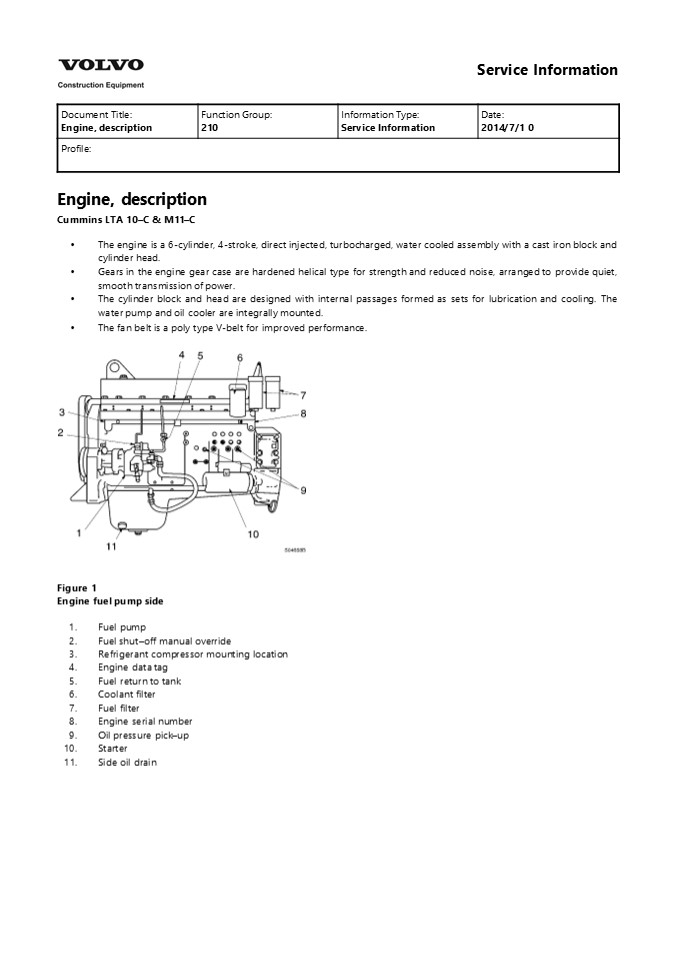
- Figure 1
- Engine fuel pump side
- Fuel pump
- Fuel shutoff manual override
- Refrigerant compressor mounting location
- Engine data tag
- Fuel return to tank
- Coolant filter
- Fuel filter
- Engine serial number
- Oil pressure pickup
- Starter
- Side oil drain
2
- Figure 2
- Engine exhaust side
- Provision for coolant heater
- Heater supply
- Coolant temperature pickup
- Engine vent (coolant)
- Heater return
- Makeup line from radiator
- Coolant inlet
- Oil drain
- Provision for oil pan sump heater
- Engine characteristic curve (EC360) Cummins LTA
10C - Engine characteristics
Item Specifications
Rated output (Net) 250 PS / 1700 rpm (248 HP / 1700 rpm)
Max. torque (Net) 114 kgfm /1300 rpm (823 lbfft / 1300 rpm)
Min. fuel consumption 152 g / PSh
Rated fuel consumption 153 g / PSh
3
Figure 3 Engine, characteristic curve (EC360)
A Fuel consumption (g/PSHR) C Engine speed (RPM)
B Torque (kgm) D Power (PS)
NOTE! For detailed information on the engine,
consult the separate engine service manual Engine
characteristic curve (EC360) Cummins M11C Engine
characteristics
Item Specifications
Rated output (Net) 250 PS / 1700 rpm (248 HP / 1700 rpm)
Max. torque (Net) 120 kgfm / 1300 rpm (866 lbfft / 1300 rpm)
Min. fuel consumption 153 g / PSh
Rated fuel consumption 157 g / PSh
4
https//www.ebooklibonline.com Hello dear
friend! Thank you very much for reading. Enter
the link into your browser. The full manual is
available for immediate download. https//www.ebo
oklibonline.com
5
Figure 4 Engine, characteristic curve (EC360)
A Fuel consumption (g/PSHR) C Engine speed (RPM)
B Torque (kgm) D Power (PS)
NOTE! For detailed information on the engine,
consult the separate engine service manual Engine
characteristic curve (EC460) Cummins LTA
10C Engine characteristics
Item Specifications
Rated output (Net) 300 PS / 2000 rpm (298 HP / 2000 rpm)
Max. torque (Net) 135 kgfm /1500 rpm (975 lbfft / 1500 rpm)
Min. fuel consumption 152 g / PSh
Rated fuel consumption 156 g / PSh
6
Figure 5 Engine, characteristic curve (EC460)
A Fuel consumption (g/PSHR) C Engine speed (RPM)
B Torque (kgm) D Power (PS)
NOTE! For detailed information on the engine,
consult the separate engine service manual Engine
characteristic curve(EC460) Cummins M11-C Engine
characteristics
Item Specifications
Rated output (Net) 300 PS / 2000 rpm (298 HP / 2000 rpm)
Max. torque (Net) 120 kgfm / 1500 rpm (866 lbfft / 1500 rpm)
Min. fuel consumption 150 g / PSh
Rated fuel consumption 160 g / PSh
7
Figure 6 Engine, characteristic curve (EC460)
A Fuel consumption (g/PSHR) C Engine speed (RPM)
B Torque (kgm) D Power (PS)
NOTE! For detailed information on the engine,
consult the separate engine service manual
8
Service Information
Document Title Adjusting engine valve and injectors Function Group 214 Information Type Service Information Date 2014/7/1 0
Profile Profile Profile Profile
Adjusting engine valve and injectors Valves and
injectors must be correctly adjusted for the
engine to operate efficiently. Valve and injector
adjustment must be performed using the values
listed in this section. The table gives the
adjustment limits for fixed timed engines. Adjust
the valves and the injectors at each 1500 hours
or 1 year maintenance interval. If the valves and
injectors have been adjusted during
troubleshooting or before the 1500 hours or 1
year scheduled maintenance interval, adjustment
is not required at this time. Valve and injector
adjustment limits
Valve and injector Adjustment Limits Valve and injector Adjustment Limits Valve and injector Adjustment Limits Valve and injector Adjustment Limits
Top stop Injector Preload 0.6 0.7 Nm Top stop Injector Preload 0.6 0.7 Nm Top stop Injector Preload 0.6 0.7 Nm Top stop Injector Preload 0.6 0.7 Nm
Intake valve mm 0.35 0.014
Exhaust valve in 0.68 0.027
All overhead valve and injector adjustments must
be made when the engine is cold, and stabilized
coolant temperature is 60 C (140 F) or below.
Figure 1 Valve and injector adjustment
condition Remove the crankcase breather tube
from the crankcase breather outlet. Remove the 16
capscrews, isolators and spacers from the
cover. Remove the rocker lever cover and gasket.
Figure 2 Remove the rocker lever cover and gasket
9
- Each cylinder has three rocker levers
- The long rocker lever (E) is the exhaust lever.
- The center rocker lever is the injector lever.
- The short rocker lever (I) is the intake lever.
- Refer to the figure for valve rocker lever
locations.
Figure 3 Valve rocker lever locations The
crankshaft rotation is clockwise when viewed from
the front of the engine. The cylinders are
numbered from the front gear cover end of the
engine. The engine firing order is 153624
Figure 4 The engine firing order The valves and
injectors on the same cylinders are not adjusted
at the same index mark on the accessory drive
pulley on fixed timed engines. One pair of valves
and one injector are adjusted at each pulley
index mark before rotating the accessory drive to
the next index mark. Two crankshaft revolutions
are required to adjust all the valves and
injectors. Injector and valve adjustment sequence
Injector and valve adjustment sequence Injector and valve adjustment sequence Injector and valve adjustment sequence Injector and valve adjustment sequence
Bar engine in direction of rotation Pulley position Set cylinder Set cylinder
Bar engine in direction of rotation Pulley position Injector Valve
Start A 3 5
Advance to B 6 3
Advance to C 2 6
Advance to A 4 2
Advance to B 1 4
Advance to C 5 1
Firing order 1 5 3 6 2 4 Firing order 1 5 3 6 2 4 Firing order 1 5 3 6 2 4 Firing order 1 5 3 6 2 4
WARNING
Do not pull or pry on the fan to manually rotate
the crankshaft. To do so can damage the fan
blades. Damaged fan blades can cause premature
fan failures which can result in serious personal
injury or property damage. The valve set marks
are located on the accessory drive pulley. The
marks align with a pointer on the gear cover. Use
the accessory drive shaft to rotate the
crankshaft.
10
Figure 5 Rotation, crankshaft The adjustment can
begin on any valve set mark. In the following
example the adjustment will begin on the A
valve set mark with cylinder No. 5 valves closed
and cylinder No. 3 injector ready for
adjustment. Rotate the accessory drive shaft
clockwise until the A valve set mark on the
accessory drive pulley is aligned with the
pointer on the gear cover.
Figure 6 Position, valve mark When the A mark
is aligned with the pointer, the intake and
exhaust valves for cylinder No. 5 must be closed.
If these conditions are correct, cylinder No. 4
injector and cylinder No. 2 valves are ready to
set. Both valves are closed when both rockers are
loose, and can be moved from side to side.
Figure 7 Position, valve Loosen the injector
adjusting screw locknut on cylinder No. 3 Tighten
the adjusting screw until all the clearance is
removed from the injector train. Tighten the
adjusting screw one additional turn to correctly
seat the link.
11
Figure 8 Adjustment, injector Loosen the
injector adjusting screw until the injector
spring retainer washer touches the top stop screw.
Figure 9 Adjustment, injector
CAUTION
An over-tightened setting on the injector
adjusting screw will produce increased stress on
the injector train and the camshaft injector lobe
which can result in engine damage. Use torque
wrench to tighten the adjusting screw. Tightening
torque 0.6 0.7 Nm (5 6 lbin)
- Figure 10
- Tightening torque, adjusting screw
- Hold the adjusting screw in this position.
- The adjusting screw must not turn when the
locknut is tightened. - Tightening torque
- Without torque wrench adapter 61 Nm (45
lbfft) - With torque wrench adapter (1) (Part no.
ST669) 47 Nm (35 lbfft)
12
Figure 11 Tightening torque, adjusting
screw Adjust the valves on the appropriate
cylinder according to the sequence chart before
rotating the accessory drive to the next valve
set mark. Injector and valve adjustment sequence
Injector and valve adjustment sequence Injector and valve adjustment sequence Injector and valve adjustment sequence Injector and valve adjustment sequence
Bar engine in direction of rotation Pulley position Set cylinder Set cylinder
Bar engine in direction of rotation Pulley position Injector Valve
Start A 3 5
Advance to B 6 3
Advance to C 2 6
Advance to A 4 2
Advance to B 1 4
Advance to C 5 1
Firing order 1 5 3 6 2 4 Firing order 1 5 3 6 2 4 Firing order 1 5 3 6 2 4 Firing order 1 5 3 6 2 4
Select a feeler gauge for the correct valve lash
specifications. Valve lash specifications
Valve lash specifications Valve lash specifications
Intake Exhaust
0.36 mm (0.014 in) 0.69 mm (0.027 in)
Insert the feeler gauge between the top of the
cross-head and the rocker lever pad.
- Figure 12
- Checking, clearance
- Two different methods for establishing valve lash
clearance are described below. Either method can
be used, however, the torque wrench method has
proven to be the most consistent. It eliminated
the need to feel the drag on the feeler gauge. - Torque wrench method
13
- Use the inch pound torque wrench, (Part No.
3376592) (Normally used to set preload on top
stop injectors) and tighten the adjusting screw. - Tightening torque 0.7 Nm (6 lbin)
- Touch method
- Tighten the adjusting screw until a light drag is
felt on the feeler gauge.
- Figure 13
- Adjusting, valve clearance
- Hold the adjusting screw in this position. The
adjusting screw must not turn when the locknut is
tightened. Tighten the locknut. - Tightening torque
- Without torque wrench adapter 61 Nm (45
lbfft) - With torque wrench adapter (1) (Part no.
St669) 47 Nm (35 lbfft)
Figure 14 Tightening torque, locknut After
tightening the locknut to the correct torque
value, check to make sure the feeler gauge will
slide backward and forward between the cross
4head and the rocker lever with only a slight
drag.
Figure 15 Checking, locknut torque If using the
touch method, attempt to insert a feeler gauge
that is 0.03 mm (0.001 in) thick between the
crosshead and the
14
rocker lever pad. The valve lash is not correct
when a thicker feeler gauge will fit.
Figure 16 Checking, valve lash Adjust the jacobs
engine brake, if applicable, after adjusting the
valves before rotating the accessory drive pulley
to the next index mark. Refer to jacobs engine
brakeadjustment following this procedure. After
adjusting the valves, rotate the accessory drive
and align the next valve set mark on the
accessory drive pulley with the pointer on the
gear cover.
Figure 17 Marking, drive pulley with the pointer
on the gear cover Adjust the appropriate
injector and valves following the injector and
valve adjustment sequence chart. Repeat the
process to adjust all injectors and valves. After
adjusting all the valves and injectors, check the
torque on the adjusting screw locknuts to make
sure none were overlooked. Injector and valve
adjustment sequence
Injector and valve adjustment sequence Injector and valve adjustment sequence Injector and valve adjustment sequence Injector and valve adjustment sequence
Bar engine in direction of rotation Pulley position Set cylinder Set cylinder
Bar engine in direction of rotation Pulley position Injector Valve
Start A 3 5
Advance to B 6 3
Advance to C 2 6
Advance to A 4 2
Advance to B 1 4
Advance to C 5 1
Firing order 1 5 3 6 2 4 Firing order 1 5 3 6 2 4 Firing order 1 5 3 6 2 4 Firing order 1 5 3 6 2 4
If the valve cover gasket was not damaged, it can
be used again. If the gasket was damaged, it must
be discarded and a new one used. Install the
gasket on the cover.
15
Figure 18 Install the gasket on the
cover Install the cover on the rocker lever
housing. Install the 16 isolators, spacers and
capscrews in the cover.
Figure 19 Install the cover on the rocker lever
housing Tighten the capscrews in the sequence
shown. Torque value 15 Nm (130 lbin)
Figure 20 Tighten the capscrews Install the hose
on the crankcase breather.
Figure 21 Install, breather
16
Service Information
Document Title Engine mounting Function Group 218 Information Type Service Information Date 2014/7/1 0
Profile Profile Profile Profile
Engine mounting
Figure 1 Engine mounting, side view
CAUTION
Check the color markings for cushion
installation. Front (fan side) Blue and white
Rear (flywheel side) Green
Figure 2 Cushion Tightening torque, unit kgfm
(lbfft)
No. Mounting position Mounting position Tightening torque
1 Engine mounting bracket Front (A) 52 5 (375 36)
1 Engine mounting bracket Rear (B) 18 20 (133 144)
2 Engine mounting cushion Front (A) 70 7 (505 50)
2 Engine mounting cushion Rear (B) 90 9 (650 65)
17
Service Information
Document Title Lubrication system Function Group 220 Information Type Service Information Date 2014/7/1 0
Profile Profile Profile Profile
Lubrication system Engine lubricating oil is
supplied to the contact faces of rotating
components such as air compressor, camshaft,
piston, intake/exhaust valve, rocker arm and
timing gear by means of forced lubrication from
the oil pump. Lubricating oil flow diagram
- Figure 1
- Lubricating oil flow diagram
- Oil pump
- Pressure regulator valve
- Oil return to pan
- High pressure relief valve
- Oil return to pan
- Cooled oil bypass valve
- Oil cooler
- Bypass filtered oil return
- Combination oil filter
- Filter bypass valve
- Accessory drive/air compressor
- Idler gears
18
Service Information
Document Title Fuel injection system Function Group 230 Information Type Service Information Date 2014/7/1 0
Profile Profile Profile Profile
Fuel injection system Highly pressurized fuel
compressed by the fuel PT pump is direct injected
through the injection nozzle into the combustion
chamber. Remaining fuel after injection is
returned to tank automatically. A water separator
installed to protect the fuel system components
provides a means to drain off the water and
contaminants collected from the system.
- Figure 1
- Fuel injection system
- Fuel inlet supply
- Fuel filter
- Fuel PT pump
- Fuel to injectors
- Injector
- Fuel drain return
- Gear pump cooling return
19
Service Information
Document Title Fuel tank, description Function Group 2341 Information Type Service Information Date 2014/7/1 0
Profile Profile Profile Profile
Fuel tank, description
Figure 1 Fuel tank
1 Tank 6 Oring 11 Spring washer
2 Cap 7 Capscrew 12 Capscrew
3 Screen 8 Plain washer 13 Level gauge
4 Drain cock 9 Spring washer
5 Plug 10 Shim
- When mounting the tank, adjust the height by use
of shim (10). - Tightening torque
- Bolt (7) 52.2 5.2 kgfm (377 38 lbfft)
- Drain cock 1.6 1.9 kgfm (11.6 13.7 lbfft)
- Bolt (13) 2.0 0.2 kgfm ( 14 1.4 lbfft )
20
Suggest If the above button click is invalid.
Please download this document first, and then
click the above link to download the complete
manual. Thank you so much for reading
21
Service Information
Document Title Fuel filling pump, description Function Group 2344 Information Type Service Information Date 2014/7/1 0
Profile Profile Profile Profile
- Fuel filling pump, description
- The pump outlet is plumbed directly to the fuel
tank to reduce the risk of introducing
contamination. - The master switch must be in the ON position to
operate the fuel filling pump.
CAUTION
The filter at the end of fuel filling pump inlet
hose is a strainer, and will not filter
impurities from the fuel. When filling use CLEAN
fuel only!
CAUTION
Do not operate the fuel filling pump without fuel
or for extended periods of time.
CAUTION
Drain the fuel from the suction hose before
putting it in the storage compartment.
CAUTION
In case of the pump has been disassembled,
assemble the pump so the that the sharp portion
of the vane faces the counterclockwise direction.
Figure 1 Structure, fuel filling pump (35
liter) 1. X Section X - X
22
https//www.ebooklibonline.com Hello dear
friend! Thank you very much for reading. Enter
the link into your browser. The full manual is
available for immediate download. https//www.ebo
oklibonline.com
Recommended

