

Surgical Site Infection Control Market: Key Trends & Innovations PowerPoint PPT Presentation
Title: Surgical Site Infection Control Market: Key Trends & Innovations
1
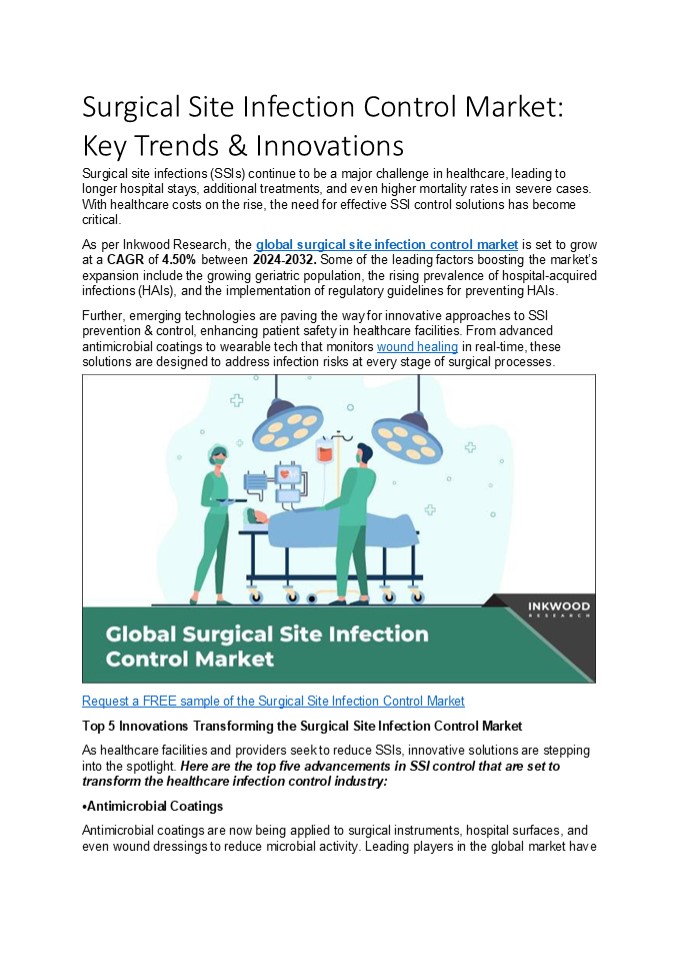
Surgical Site Infection Control Market Key
Trends Innovations Surgical site infections
(SSIs) continue to be a major challenge in
healthcare, leading to longer hospital stays,
additional treatments, and even higher mortality
rates in severe cases. With healthcare costs on
the rise, the need for effective SSI control
solutions has become critical. As per Inkwood
Research, the global surgical site infection
control market is set to grow at a CAGR of 4.50
between 2024-2032. Some of the leading factors
boosting the markets expansion include the
growing geriatric population, the rising
prevalence of hospital-acquired infections
(HAIs), and the implementation of regulatory
guidelines for preventing HAIs. Further, emerging
technologies are paving the way for innovative
approaches to SSI prevention control, enhancing
patient safety in healthcare facilities. From
advanced antimicrobial coatings to wearable tech
that monitors wound healing in real-time, these
solutions are designed to address infection risks
at every stage of surgical processes.
- Request a FREE sample of the Surgical Site
Infection Control Market - Top 5 Innovations Transforming the Surgical Site
Infection Control Market - As healthcare facilities and providers seek to
reduce SSIs, innovative solutions are stepping
into the spotlight. Here are the top five
advancements in SSI control that are set to
transform the healthcare infection control
industry - Antimicrobial Coatings
- Antimicrobial coatings are now being applied to
surgical instruments, hospital surfaces, and even
wound dressings to reduce microbial activity.
Leading players in the global market have
2
- developed advanced coatings with broad-spectrum
antimicrobial properties that can be used across
various surfaces, helping to limit bacterial
growth. - BioCote, for instance, offers silver-ion
additives that have been shown to reduce
bacterial presence by over 99, making it a
powerful tool for SSI prevention. - ConvaTec, a leader in wound management, has
introduced a range of antimicrobial dressings,
such as AQUACEL Ag Extra, that feature silver
ions, which disrupt bacterial cell function,
significantly reducing the risk of infection in
surgical wounds. - Novel Disinfectants
- Disinfection practices have received a
technological upgrade. Traditional disinfectants
often leave residual bacteria, but companies are
now introducing powerful solutions that kill
bacteria more effectively. - For instance, Xenex Disinfection Services
launched a UV light-based disinfection system
known as LightStrike, which uses pulsed xenon
light to kill pathogens, including
antibiotic-resistant bacteria, in a matter of
minutes. - Meanwhile, ProKure has introduced a chlorine
dioxide disinfectant product specifically
designed for healthcare environments. Chlorine
dioxides fast- acting and broad-spectrum
antimicrobial activity offers a solution that can
eliminate pathogens on surfaces and in the air,
enhancing the standard of SSI prevention in
surgical suites. - Stay up-to-date with whats trending in the
Global Surgical Site Infection Control Market - Advanced Wound Dressings
- Wound dressings play a critical role in SSI
prevention by protecting the wound site and
preventing microbial entry. Companies like 3M and
Smith Nephew have released advanced dressings
that promote healing while actively fighting
infection. - 3Ms Tegaderm Dressings incorporate transparent
films that enable wound inspection without the
need to remove the dressing, reducing the risk of
contamination. - Smith Nephews ALLEVYN Life Dressings use a
multi-layered structure to manage exudate (wound
fluid) while maintaining a moist - environment, supporting faster healing and
reducing infection risk. These - dressings are especially beneficial for high-risk
surgeries, providing consistent protection and
reducing the need for frequent dressing changes. - Wearable Tech for Wound Monitoring
- Wearable health tech is revolutionizing
post-operative care by enabling continuous
monitoring of wound sites, which can detect early
signs of infection before they escalate. - For example, Swift Medical has introduced a
smartphone-based app called Swift Skin and Wound
that captures detailed images of wounds, analyzes
healing progress, and flags potential issues for
healthcare providers.
3
- o Another notable development is by SentiAR, a
startup developing augmented reality wearables
that allow clinicians to visualize real-time data
over the patients body, including information
about wound sites. These wearable technologies
offer a promising solution for remote monitoring
and early infection detection, reducing the
likelihood of full-blown infections. - Smart Sutures and Staples
- The latest in SSI prevention also includes
smart sutures and staples that release
antimicrobial agents directly into the wound.
Companies like Ethicon (a subsidiary - of Johnson Johnson) have introduced
antibacterial-coated sutures that incorporate
triclosan, an antimicrobial agent that helps
prevent bacteria from colonizing the suture site. - Ethicons Plus Sutures are clinically proven to
reduce the risk of SSIs by inhibiting bacterial
growth on the suture itself, adding a vital layer
of protection to the surgical wound. - In fact, the National Institute for Health and
Care Excellence (NICE) specifically recommends
Plus Sutures as part of a comprehensive care
bundle aimed at reducing the risk of surgical
site infections (SSI). ETHICON Plus Antibacterial
Sutures are designed to inhibit the colonization
of MRSA and MRSE on the suture for 7 days or
longer, providing an added layer of protection
against infection. (Source) - Kindly click here to view the LinkedIn post
related to this market - Surgical Site Infection Control Market How AI
IoT Are Shaping the Future of SSI Prevention in
Healthcare - Artificial Intelligence (AI) and the Internet of
Things (IoT) are also playing transformative
roles in SSI control. By leveraging predictive
analytics, AI can help healthcare providers
anticipate infection risks based on patient data,
surgical type, and environmental factors. - AI-Driven Predictive Analytics AI models are now
being used to analyze data from patient records,
identifying patterns that may indicate a
heightened risk of infection. For instance, IBM
Watson Health has developed machine learning
algorithms that predict SSI risk, allowing for
preventive measures tailored to each patients
unique risk profile. - IoT-Connected Monitoring Devices IoT devices
embedded in wearable tech or surgical dressings
can continuously monitor wound temperature,
moisture levels, and pH balancefactors that
often indicate infection. MolecuLight, a portable
imaging device, detects bacterial presence in
wounds, providing real-time feedback that
clinicians can use to make informed decisions
regarding wound care. - The Role of Nanotechnology in Minimizing SSI
Rates Whats Next? - Nanotechnology is pushing the boundaries of
whats possible in SSI prevention. By
manipulating materials at the nanoscale,
researchers are developing new tools to combat
infection at its source. - Nano-Coated Materials Key players like
NanoVibronix are creating nanotechnology- driven
products that use ultrasound waves to inhibit
bacterial growth and biofilm formation. These
nano-coatings can be applied to catheters,
surgical instruments, and even implants, reducing
the risk of SSIs associated with medical devices.
4
- Nanoparticle-Enhanced Wound Dressings Some
companies are also embedding nanoparticles into
wound dressings to release antimicrobial agents
slowly over time. For instance, Smith Nephew
has developed dressings incorporating
nanocrystalline silver, which provides sustained
antibacterial activity that can last up to a
week, significantly reducing the risk of
bacterial infection in post-operative wounds. - Nanotechnology is also making headway in
developing biofilm-resistant materials. Biofilms,
colonies of bacteria that can form on surgical
implants and within wounds, are notoriously
difficult to treat. By applying nano-coatings
that repel bacterial adhesion, companies are
working on solutions that prevent biofilm
formation before it starts. - The landscape of surgical site infection control
is evolving rapidly, driven by innovative
technologies that address infection risks from
multiple angles. As these technologies continue
to develop, they hold the promise of reducing
healthcare costs, improving patient outcomes, and
advancing the standard of care. - In essence, healthcare facilities and providers
must stay informed about these advancements to
adopt the most effective SSI prevention methods.
With the ongoing emergence of new technologies,
the future of the global SSI control market is
bright, offering hope for a safer, more efficient
healthcare environment. - Explore the market insights in this YouTube video
by clicking here - FAQs
- What are the latest advancements in surgical site
infection (SSI) control technology? - A New innovations in SSI control include
antimicrobial coatings, - advanced wound dressings, high-powered
disinfectants, and wearable devices that monitor
wound health. These solutions work together to
prevent bacterial growth, detect infection early,
and protect wound sites, significantly reducing
SSI rates. - How are AI and IoT impacting SSI prevention in
healthcare? A AI-driven predictive analytics and
IoT-connected devices are transforming SSI
prevention. AI can identify patients at high risk
of - SSIs based on their data, while IoT sensors in
dressings or wearables monitor wound temperature,
moisture, and pHoffering real-time insights that
help detect infections before they worsen. - How does nanotechnology play a role in SSI
control? - A Nanotechnology enables the development of
biofilm-resistant materials and
nanoparticle-enhanced dressings that release
antimicrobial agents gradually. Nano-coatings on
surgical tools and implants help prevent
bacterial adhesion, making infections less likely
and promoting faster, safer healing.
Recommended

