

Unlocking Efficiency: A Deep Dive into Manufacturing Execution Systems (MES) PowerPoint PPT Presentation
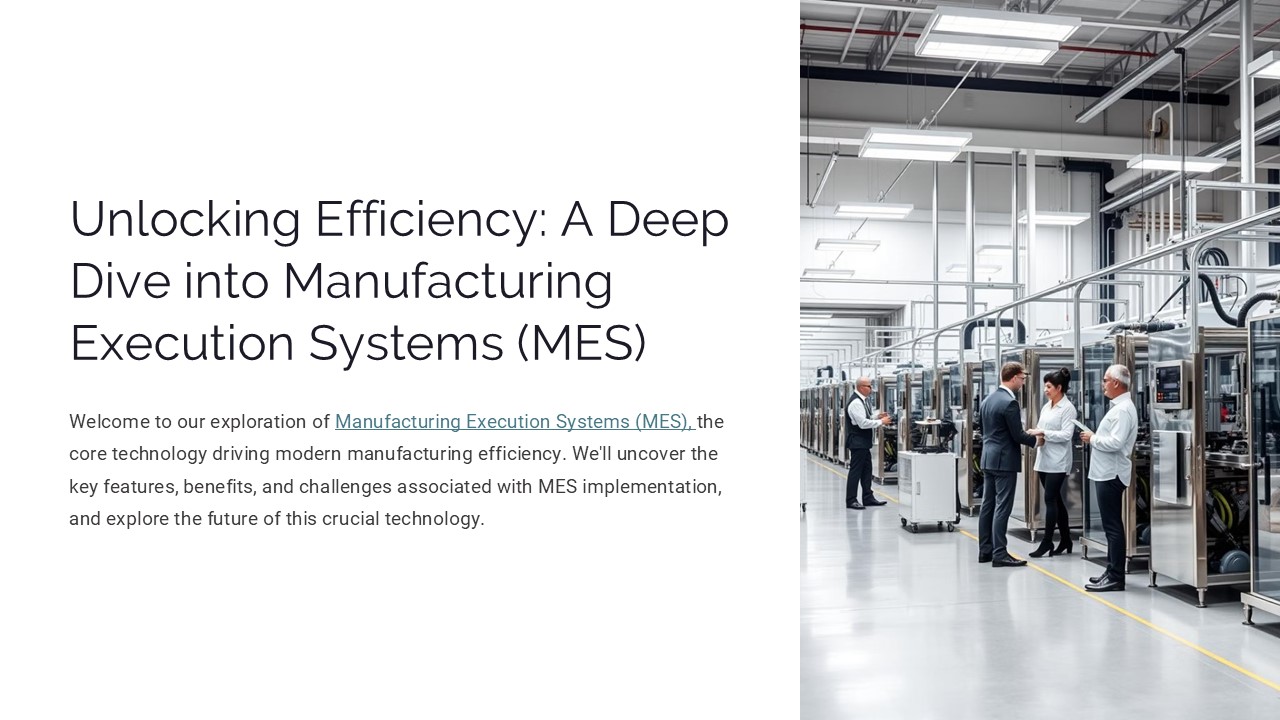
Title: Unlocking Efficiency: A Deep Dive into Manufacturing Execution Systems (MES)
1
Unlocking Efficiency A Deep Dive into
Manufacturing Execution Systems (MES)
Welcome to our exploration of Manufacturing
Execution Systems (MES), the core technology
driving modern manufacturing efficiency. We'll
uncover the key features, benefits, and
challenges associated with MES implementation,
and explore the future of this crucial technology.
2
What is a Manufacturing Execution System (MES)?
Real-time Control
Data-driven Insights
Integrated Platform
MES provides real-time visibility into production
processes, enabling tracking and monitoring of
every step from raw materials to finished goods.
This allows for immediate adjustments and
proactive problem-solving.
MES collects and analyzes vast amounts of data,
providing valuable insights into production
performance, equipment utilization, and product
quality. This data can then be used to optimize
operations and drive continuous improvement.
MES acts as a central hub, connecting various
manufacturing systems, including PLCs, SCADA, and
ERP. This integration creates a unified view of
operations and streamlines data flow across the
enterprise.
3
Key Features of an Effective MES
Production Scheduling and Planning
Quality Management
1
2
MES integrates quality control processes,
enabling real-time tracking of product quality,
identifying defects, and implementing corrective
actions, ensuring consistent product quality.
MES optimizes production schedules by considering
resource availability, demand forecasts, and
production constraints, ensuring efficient
allocation of resources and timely completion of
orders.
Work-in-Progress (WIP) Tracking
3
MES provides detailed visibility into the status
of WIP throughout the manufacturing process,
allowing for accurate inventory management and
optimization of production flow.
4
Advantages of Implementing an MES
Increased Productivity
1
Streamlined processes, reduced downtime, and
improved resource allocation drive higher
production output.
Reduced Costs
2
Optimized inventory management, improved resource
utilization, and fewer production errors minimize
waste and reduce costs.
Enhanced Quality Control
3
Real-time monitoring and data-driven insights
lead to fewer defects, consistent product
quality, and improved customer satisfaction.
Improved Visibility and Transparency
4
Real-time access to production data provides
comprehensive insights into operations,
facilitating better decision-making and proactive
problem-solving.
Compliance and Traceability
5
MES ensures compliance with industry regulations
and facilitates product traceability, enhancing
quality assurance and consumer confidence.
5
Challenges in MES Deployment
Complexity
Data Integration
Implementing an MES can be complex, requiring
extensive planning, integration, and data
migration. This can involve significant
investment and require expertise from various
departments.
Integrating data from different systems and
sources can be a challenge, requiring seamless
connectivity and data standardization to ensure
accurate and reliable information.
Change Management
Successfully deploying an MES requires buy-in and
support from all stakeholders, including
management, operators, and IT. This can involve
overcoming resistance to change and ensuring
effective training and communication.
6
Selecting the Right MES Software for Your Business
Define Requirements
1
Clearly define your business needs,
industry-specific requirements, and integration
needs before selecting an MES solution.
Evaluate Options
2
Thoroughly research and compare different MES
vendors, considering features, functionalities,
cost, and customer support.
Pilot Implementation
3
Consider a pilot implementation to test the
selected MES software before full-scale
deployment, ensuring it meets your specific
requirements.
Continuous Optimization
4
Regularly review and optimize your MES
implementation based on feedback, changing
business needs, and technology advancements.
7
Integrating MES with other Manufacturing Systems
ERP
MES integration with ERP systems ensures seamless
data flow, providing real-time insights into
production performance, inventory levels, and
financial data.
PLCs
Integrating MES with PLCs enables direct control
and monitoring of production equipment,
facilitating real-time process adjustments and
data collection.
Cloud Platforms
Cloud-based MES solutions offer scalability,
flexibility, and remote access, enabling
real-time monitoring and management from anywhere.
8
Real-world Case Studies MES in Action
20
15
99
Increased Output
Reduced Costs
Defect Reduction
A leading automotive manufacturer achieved a 20
increase in production output by implementing an
MES solution to optimize scheduling and resource
allocation.
A food processing company successfully reduced
manufacturing costs by 15 through improved
inventory management and reduced waste.
An electronics manufacturer achieved a 99
reduction in product defects by integrating
quality control processes into their MES system.
9
Optimizing Your MES for Maximum Efficiency
Data Analytics
Leverage data analytics to identify bottlenecks,
inefficiencies, and areas for improvement,
guiding optimization efforts.
Process Automation
Automate repetitive tasks, reducing human error
and freeing up staff for more strategic
activities.
Continuous Training
Provide ongoing training to operators and
managers to ensure effective utilization of MES
functionalities and maximize its benefits.
10
The Future of MES Trends and Innovations
The future of MES holds exciting advancements,
fueled by emerging technologies like artificial
intelligence, the Internet of Things (IoT), and
cloud computing. These innovations will further
enhance production efficiency, optimize resource
utilization, and drive continuous improvement in
manufacturing.
Recommended

