

John Deere 2500E Professional Greens Mower Service Repair Manual Instant Download (1) PowerPoint PPT Presentation
Title: John Deere 2500E Professional Greens Mower Service Repair Manual Instant Download (1)
1
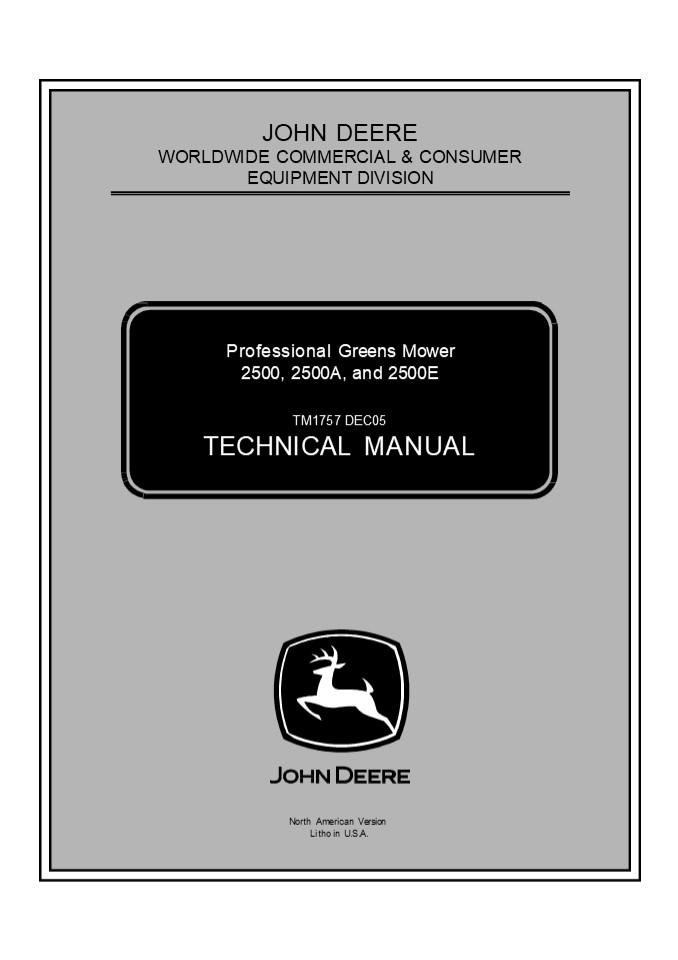
JOHN DEERE WORLDWIDE COMMERCIAL CONSUMER
EQUIPMENT DIVISION
Professional Greens Mower 2500, 2500A, and
2500E TM1757 DEC05 TECHNICAL MANUAL
North American Version Litho in U.S.A.
2
INTRODUCTION
Safety
Manual Description This technical manual is
written for an experienced technician and
contains sections that are specifically for this
product. It is a part of a total product support
program. The manual is organized so that all the
information on a particular system is kept
together. The order of grouping is as follows
Specifications and Information
Gas Engine
- Table of Contents
- Specifications and Information
- Identification Numbers
- Tools and Materials
- Component Location
- Schematics and Harnesses
- Theory of Operation
- Operation and Diagnostics
- Diagnostics
- Tests and Adjustments
- Repair
- Other
Diesel Engine
Electrical
Power Train
Hydraulics
Steering
NOTE Depending on the parti3ular se3tion or
system being 3overed, not all of the above groups
may be used.
Brakes
The bleed tabs for the pages of each section will
align with the sections listed on this page. Page
numbering is consecutive from the beginning of
the Safety section through the last section. We
appreciate your input on this manual. If you find
any errors or want to comment on the layout of
the manual please contact us.
Attachments
Miscellaneous
All information, illustrations and specifications
in this manual are based on the latest
information at the time of publication. The right
is reserved to make changes at any time without
notice. COPYRIGHT 2005 Deere Co. John Deere
Worldwide Commercial and Consumer Equipment
Division All rights reserved Previous Editions
COPYRIGHT 2003, 2004, 2005
Introduction
3
SAFETY Handle Fluids Safely - Avoid Fires
Recognize Safety Information
Be Prepared For Emergencies
MIF This is the safety-alert symbol. When you see
this symbol on your machine or in this manual, be
alert to the potential for personal
injury. Follow recommended precautions and safe
servicing practices.
Understand Signal Words A signal word - DANGER,
WARNING, or CAUTIon - is used with the
safety-alert symbol. DANGER identifies the most
serious hazards. DANGER or WARNING safety signs
are located near specific hazards. General
precautions are listed on CAUTIon safety signs.
CAUTIon also calls attention to safety messages
in this manual.
MIF
- When you work around fuel, do not smoke or work
near heaters or other fire hazards. - Store flammable fluids away from fire hazards. Do
not incinerate or puncture pressurized
containers. - Make sure machine is clean of trash, grease, and
debris. - Do not store oily rags they can ignite and burn
spontaneously.
Replace Safety Signs
- Be prepared if a fire starts.
- Keep a first aid kit and fire extinguisher handy.
- Keep emergency numbers for doctors, ambulance
service, hospital, and fire department near your
telephone. Use Care In Handling and Servicing
Batteries
MIF
Replace missing or damaged safety signs. See the
machine operators manual for correct safety sign
placement.
MIF
Safety
4
https//www.ebooklibonline.com Hello dear
friend! Thank you very much for reading. Enter
the link into your browser. The full manual is
available for immediate download. https//www.ebo
oklibonline.com
5
SAFETY
- Prevent Battery Explosions
- Keep sparks, lighted matches, and open flame away
from the top of battery. Battery gas can explode. - Never check battery charge by placing a metal
object across the posts. Use a volt-meter or
hydrometer. - Do not charge a frozen battery it may explode.
Warm battery to 16C (60F).
Operating equipment safely requires the full
attention of the operator. Do not wear radio or
music headphones while operating machine.
Use Care Around High-Pressure Fluid Lines
Avoid High-Pressure Fluids
- Prevent Acid Burns
- Sulfuric acid in battery electrolyte is
poisonous. It is strong enough to burn skin, eat
holes in clothing, and cause blindness if
splashed into eyes.
- Avoid acid burns by
- Filling batteries in a well-ventilated area.
- Wearing eye protection and rubber gloves.
- Avoiding breathing fumes when electrolyte is
added. - Avoiding spilling or dripping electrolyte.
- Use proper jump start procedure.
MIF
Escaping fluid under pressure can penetrate the
skin causing serious injury. Avoid injury from
escaping fluid under pressure by stopping the
engine and relieving pressure in the system
before disconnecting or connecting hydraulic or
other lines. Tighten all connections before
applying pressure. Search for leaks with a piece
of cardboard. Protect hands and body from high
pressure fluids. If an accident occurs, see a
doctor immediately. Any fluid injected into the
skin must be surgically removed within a few
hours or gangrene may result. Doctors unfamiliar
with this type of injury should reference a
knowledgeable medical source. Such information is
available from Deere Company Medical Department
in Moline, Illinois, U.S.A.
- If you spill acid on yourself
- Flush your skin with water.
- Apply baking soda or lime to help neutralize the
acid. - Flush your eyes with water for 10 - 15 minutes.
- Get medical attention immediately.
- If acid is swallowed
- Drink large amounts of water or milk.
- Then drink milk of magnesia, beaten eggs, or
vegetable oil. - Get medical attention immediately.
Avoid Heating Near Pressurized Fluid Lines
Wear Protective Clothing
MIF
Flammable spray can be generated by heating near
pressurized fluid lines, resulting in severe
burns to yourself and bystanders. Do not heat by
welding, soldering, or using a torch near
pressurized fluid lines or other flammable
materials. Pressurized lines can be accidentally
cut when heat goes beyond the immediate flame
area.
MIF
Wear close fitting clothing and safety equipment
appropriate to the job. Prolonged exposure to
loud noise can cause impairment or loss of
hearing. Wear a suitable hearing protective
device such as earmuffs or earplugs to protect
against objectionable or uncomfortable loud
noises.
6
SAFETY
Service Machines Safely
Support Machine Properly and Use Proper Lifting
Equipment
MIF
Tie long hair behind your head. Do not wear a
necktie, scarf, loose clothing, or necklace when
you work near machine tools or moving parts. If
these items were to get caught, severe injury
could result. Remove rings and other jewelry to
prevent electrical shorts and entanglement in
moving parts.
MIF
If you must work on a lifted machine or
attachment, securely support the machine or
attachment. Do not support the machine on cinder
blocks, hollow tiles, or props that may crumble
under continuous load. Do not work under a
machine that is supported solely by a jack.
Follow recommended procedures in this
manual. Lifting heavy components incorrectly can
cause severe injury or machine damage. Follow
recommended procedure for removal and
installation of components in the manual.
Use Proper Tools Use tools appropriate to the
work. Makeshift tools and procedures can create
safety hazards. Use power tools only to loosen
threaded parts and fasteners. For loosening and
tightening hardware, use the correct size tools.
Do not use U.S. measurement tools on metric
fasteners. Avoid bodily injury caused by slipping
wrenches. Use only service parts meeting John
Deere specifications.
Work In Clean Area
- Before starting a job
- Clean work area and machine.
- Make sure you have all necessary tools to do your
job. - Have the right parts on hand.
- Read all instructions thoroughly do not attempt
shortcuts.
Park Machine Safely
Using High Pressure Washers Directing pressurized
water at electronic/electrical components or
connectors, bearings, hydraulic seals, fuel
injection pumps or other sensitive parts and
components may cause product malfunctions. Reduce
pressure and spray at a 45 to 90 degree angle.
MIF
- Before working on the machine
- Lower all equipment to the ground.
- Stop the engine and remove the key.
- Disconnect the battery ground strap.
- Hang a Do Not Operate tag in operator station.
Illuminate Work Area Safely Illuminate your work
area adequately but safely. Use a portable safety
light for working inside or under the machine.
Make sure the bulb is enclosed by a wire cage.
The hot filament of an accidentally broken bulb
can ignite spilled fuel or oil.
7
SAFETY
Work In Ventilated Area
Avoid Harmful Asbestos Dust Avoid breathing dust
that may be generated when handling components
containing asbestos fibers. Inhaled asbestos
fibers may cause lung cancer. Components in
products that may contain asbestos fibers are
brake pads, brake band and lining assemblies,
clutch plates, and some gaskets. The asbestos
used in these components is usually found in a
resin or sealed in some way. Normal handling is
not hazardous as long as airborne dust containing
asbestos is not generated. Avoid creating dust.
Never use compressed air for cleaning. Avoid
brushing or grinding material containing
asbestos. When servicing, wear an approved
respirator. A special vacuum cleaner is
recommended to clean asbestos. If not available,
apply a mist of oil or water on the material
containing asbestos. Keep bystanders away from
the area.
MIF
Engine exhaust fumes can cause sickness or death.
If it is necessary to run an engine in an
enclosed area, remove the exhaust fumes from the
area with an exhaust pipe extension. If you do
not have an exhaust pipe extension, open the
doors and get outside air into the area.
Service Tires Safely Warning California
Proposition 65 Warning Gasoline engine exhaust
from this product contains chemicals known to the
State of California to cause cancer, birth
defects, or other reproductive harm. Diesel
engine exhaust and some of its constituents are
known to the State of California to cause cancer,
birth defects, and other reproductive harm.
Remove Paint Before Welding or Heating Avoid
potentially toxic fumes and dust. Hazardous fumes
can be generated when paint is heated by welding,
soldering, or using a torch. Do all work outside
or in a well ventilated area. Dispose of paint
and solvent properly. Remove paint before welding
or heating If you sand or grind paint, avoid
breathing the dust. Wear an approved respirator.
If you use solvent or paint stripper, remove
stripper with soap and water before welding.
Remove solvent or paint stripper containers and
other flammable material from area. Allow fumes
to disperse at least 15 minutes before welding or
heating.
MIF Explosive separation of a tire and rim parts
can cause serious injury or death. Do not attempt
to mount a tire unless you have the proper
equipment and experience to perform the
job. Always maintain the correct tire pressure.
Do not inflate the tires above the recommended
pressure. Never weld or heat a wheel and tire
assembly. The heat can cause an increase in air
pressure resulting in a tire explosion. Welding
can structurally weaken or deform the wheel. When
inflating tires, use a clip-on chuck and
extension hose long enough to allow you to stand
to one side and not in front of or over the tire
assembly. Use a safety cage if available. Check
wheels for low pressure, cuts, bubbles, damaged
rims or missing lug bolts and nuts.
8
SAFETY
Avoid Injury From Rotating Blades, Augers and PTO
Shafts
Direct exposure to hazardous chemicals can cause
serious injury. Potentially hazardous chemicals
used with John Deere equipment include such items
as lubricants, coolants, paints, and adhesives. A
Material Safety Data Sheet (MSDS) provides
specific details on chemical products physical
and health hazards, safety procedures, and
emergency response techniques. Check the MSDS
before you start any job using a hazardous
chemical. That way you will know exactly what the
risks are and how to do the job safely. Then
follow procedures and recommended equipment.
Dispose Of Waste Properly Improperly disposing of
waste can threaten the environment and ecology.
Potentially harmful waste used with John Deere
equipment include such items as oil, fuel,
coolant, brake fluid, filters, and batteries. Use
leakproof containers when draining fluids. Do not
use food or beverage containers that may mislead
someone into drinking from them. Do not pour
waste onto the ground, down a drain, or into any
water source. Inquire on the proper way to
recycle or dispose of waste from your local
environmental or recycling center, or from your
John Deere dealer.
MIF
Keep hands and feet away while machine is
running. Shut off power to service, lubricate or
remove mower blades, augers or PTO shafts.
Service Cooling System Safely
Live With Safety
MIF Explosive release of fluids from pressurized
cooling system can cause serious burns. Shut off
machine. Only remove filler cap when cool enough
to touch with bare hands. Slowly loosen cap to
first stop to relieve pressure before removing
completely. Handle Chemical Products
Safely MIF Before returning machine to customer,
make sure machine is functioning properly,
especially the safety systems. Install all guards
and shields.
MIF
9
SPECIFICATIONS AND INFORMATION
TABLE OF CONTENTS
Table of Contents Specifications
..................................................
.9 General Vehicle Specifications.................
......9 Repair Information.......................
...................12 Metric Fastener Torque
Values ....................12 Metric Fastener
Torque Values - Grade 7 ....13 Inch Fastener
Torque Values .......................14 O-Ring
Seal Service Recommendations......15 Fuel
..................................................
................19 Using Proper Fuel
........................................19 Oils
Lubricants........................................
....20 Engine Oil ................................
....................20 Hydrostatic Transmission
and Hydraulic Oil ................................
.................20 Grease........................
..................................21 Alternative
Lubricants...................................21 Sy
nthetic Lubricants ...............................
......21 Lubricant Storage .......................
..................21 Mixing of Lubricants
.....................................21 Oil
Filters ..........................................
............22 Coolant Specifications............
.......................22 Engine
Coolant...........................................
..22 Engine Coolant Drain Interval
......................23 Identification
Numbers...................................24
Machine Identification Number Locations ....24
Operational Checkout .............................
.......25 Interlock System Operation
..........................25 General
Information......................................2
6 Diesel Engine Air Filter Restriction Indicator
Check ............................................
26 Hydraulic Reservoir Oil Level
Check............26 Hydraulic Oil Filter
Restriction Indicator Check ......................
......................27 Start Circuit Check
.......................................28 Electron
ic Control Module Check .................28
Specifications and Information
Table of Contents - 7
10
SPECIFICATIONS AND INFORMATION
SPECIFICATIONS
Specifications General Vehicle
Specifications NOTE Spe3ifi3ations and design
subje3t to 3hange without noti3e. Gasoline
Engine Make. . . . . . . . . . . . . . . . . . .
. . . . . . . . . . . . . . . . . . . . . . . . .
. . . . . . . . . . . . . . . . . . . . . . . . .
. . . . . . . . . . . . . . . Kawasaki Type . . .
. . . . . . . . . . . . . . . . . . . . . . . . .
. . . . . . . . . . . . . . . . . . . . . . . . .
. . . . . . . . . . . . . . . . . . . . . . . . .
. 4 Cycle, V-Twin Model . . . . . . . . . . . . .
. . . . . . . . . . . . . . . . . . . . . . . . .
. . . . . . . . . . . . . . . . . . . . . . . . .
. . . . . . . . . . . . . . . . . . . . . .
FD620D Displacement . . . . . . . . . . . . . . .
. . . . . . . . . . . . . . . . . . . . . . . . .
. . . . . . . . . . . . . . . . . . . . . . . . .
. . 617 mL (37.7 cu in.) Aspiration . . . . . . .
. . . . . . . . . . . . . . . . . . . . . . . . .
. . . . . . . . . . . . . . . . . . . . . . . . .
. . . . . . . . . . . . . . . . . . . . . . . .
Natural Cooling System . . . . . . . . . . . . .
. . . . . . . . . . . . . . . . . . . . . . . . .
. . . . . . . . . . . . . . . . . . . . . . . . .
. . . . . . . . Liquid cooled Cooling System
Capacity . . . . . . . . . . . . . . . . . . . .
. . . . . . . . . . . . . . . . . . . . . . . . .
. . . . . . . . . . . . . . . . . . 3.5 L (3.7
qt) Lubrication . . . . . . . . . . . . . . . . .
. . . . . . . . . . . . . . . . . . . . . . . . .
. . . . . . . . . . . . . . . . . . . . . . . . .
. . . . . . . . Full pressure Engine Oil Capacity
(With Filter). . . . . . . . . . . . . . . . . .
. . . . . . . . . . . . . . . . . . . . . . . . .
. . . . . . . . . . . . . . . 1.9 L (2.0 qt) Oil
Filter. . . . . . . . . . . . . . . . . . . . . .
. . . . . . . . . . . . . . . . . . . . . . . . .
. . . . . . . . . . . . . . . . . . . . . . . .
Replaceable, full flow Valving . . . . . . . . .
. . . . . . . . . . . . . . . . . . . . . . . . .
. . . . . . . . . . . . . . . . . . . . . . . . .
. . . . . . . . . . . . . . . . . Overhead
valves Air Cleaner . . . . . . . . . . . . . . .
. . . . . . . . . . . . . . . . . . . . . . . . .
. . . . . . . . . . . . . . . Paper element with
foam pre-cleaner Bore . . . . . . . . . . . . . .
. . . . . . . . . . . . . . . . . . . . . . . . .
. . . . . . . . . . . . . . . . . . . . . . . . .
. . . . . . . . . . . . . . 79 mm (3.11
in.) Stroke . . . . . . . . . . . . . . . . . . .
. . . . . . . . . . . . . . . . . . . . . . . . .
. . . . . . . . . . . . . . . . . . . . . . . . .
. . . . . . . 68 mm (2.68 in.) Compression
Ratio. . . . . . . . . . . . . . . . . . . . . .
. . . . . . . . . . . . . . . . . . . . . . . . .
. . . . . . . . . . . . . . . . . . . . . . . . .
. . . . 9.01 Slow Idle . . . . . . . . . . . . .
. . . . . . . . . . . . . . . . . . . . . . . . .
. . . . . . . . . . . . . . . . . . . . . . . . .
. . . . . . . . . . . . 1550 100 rpm Fast Idle
. . . . . . . . . . . . . . . . . . . . . . . . .
. . . . . . . . . . . . . . . . . . . . . . . . .
. . . . . . . . . . . . . . . . . . . . . . . . .
. . 3400 50 rpm Fuel System - Gasoline
Engine Fuel Tank Location . . . . . . . . . . . .
. . . . . . . . . . . . . . . . . . . . . . . . .
. . . . . . . . . . . . . . . . . . . . . . . . .
Behind operator seat Fuel Tank Capacity . . . . .
. . . . . . . . . . . . . . . . . . . . . . . . .
. . . . . . . . . . . . . . . . . . . . . . . . .
. . . . . . . . . . . . 32.2 L (8.5 gal) Fuel
(Minimum Octane) . . . . . . . . . . . . . . . .
. . . . . . . . . . . . . . . . . . . . . . . . .
. . . . . . . . . . Unleaded gasoline, 87
octane Fuel Delivery . . . . . . . . . . . . . .
. . . . . . . . . . . . . . . . . . . . . . . . .
. . . . . . . . . . . . . . . . . . . . . . . . .
. . . . . . Electric fuel pump Carburetor . . . .
. . . . . . . . . . . . . . . . . . . . . . . . .
. . . . . . . . . . . . . . . . . . . . . . . . .
. . . . . . . . . . . . . . .Float-type, down
draft Fuel Filter . . . . . . . . . . . . . . . .
. . . . . . . . . . . . . . . . . . . . . . . . .
. . . . . . . . . . . . . . . . . . . . . . . . .
. . . .Replaceable element Gasoline/Alcohol
Blends . . . . . . . . . . . . . . . . . . . . .
. . . . . . . . . . .Up to 10 Ethyl Alcohol/90
Unleaded (by volume) Gasoline/Ether Blends . . .
. . . . . . . . . . . . . . . . . . . . . . . . .
. . . . . . . . . . . . Up to 15 MTBE/85
Unleaded (by volume) Fuel Shutoff Solenoid . . .
. . . . . . . . . . . . . . . . . . . . . . . . .
. . . . . . . . . . . . . . . . . . . . . . . . .
Below carburetor float bowl
11
SPECIFICATIONS AND INFORMATION SPECIFICATIONS Dies
el Engine Make. . . . . . . . . . . . . . . . . .
. . . . . . . . . . . . . . . . . . . . . . . . .
. . . . . . . . . . . . . . . . . . . . . . . . .
. . . . . . . . . . . . . . . . . . Yanmar Type .
. . . . . . . . . . . . . . . . . . . . . . . . .
. . . . . . . . . . . . . . . . . . . . . . . . .
. . . . . . . . . . . . . . . . . . . .4 Cycle, 3
cylinder, in-line Model . . . . . . . . . . . . .
. . . . . . . . . . . . . . . . . . . . . . . . .
. . . . . . . . . . . . . . . . . . . . . . . . .
. . . . . . . . . . . . . . . . . . . . . .
3TNE68 Displacement . . . . . . . . . . . . . . .
. . . . . . . . . . . . . . . . . . . . . . . . .
. . . . . . . . . . . . . . . . . . . . . . . . .
. . 784 mL (47.8 cu in.) Aspiration . . . . . . .
. . . . . . . . . . . . . . . . . . . . . . . . .
. . . . . . . . . . . . . . . . . . . . . . . . .
. . . . . . . . . . . . . . . . . . . . . . . .
Natural Cooling System . . . . . . . . . . . . .
. . . . . . . . . . . . . . . . . . . . . . . . .
. . . . . . . . . . . . . . . . . . . . . . . . .
. . . . . . . . Liquid cooled Cooling System
Capacity . . . . . . . . . . . . . . . . . . . .
. . . . . . . . . . . . . . . . . . . . . . . . .
. . . . . . . . . . . . . . . . . . 3.5 L (3.7
qt) Lubrication . . . . . . . . . . . . . . . . .
. . . . . . . . . . . . . . . . . . . . . . . . .
. . . . . . . . . . . . . . . . . . . . . . . . .
. . . . . . . . Full pressure Engine Oil Capacity
(With Filter). . . . . . . . . . . . . . . . . .
. . . . . . . . . . . . . . . . . . . . . . . . .
. . . . . . . . . . . . . . . 2.2 L (2.3 qt) Oil
Filter. . . . . . . . . . . . . . . . . . . . . .
. . . . . . . . . . . . . . . . . . . . . . . . .
. . . . . . . . . . . . . . . . . . . . . . . .
Replaceable, full flow Valving . . . . . . . . .
. . . . . . . . . . . . . . . . . . . . . . . . .
. . . . . . . . . . . . . . . . . . . . . . . . .
. . . . . . . . . . . . . . . . . Overhead
valves Air Cleaner . . . . . . . . . . . . . . .
. . . . . . . . . . . . . . . . . . . . . . . . .
. . . . . . . . . . . . . . . . . Semi-cyclone,
dry type duel stage Bore . . . . . . . . . . . .
. . . . . . . . . . . . . . . . . . . . . . . . .
. . . . . . . . . . . . . . . . . . . . . . . . .
. . . . . . . . . . . . . . . . 68 mm (2.68
in.) Stroke . . . . . . . . . . . . . . . . . . .
. . . . . . . . . . . . . . . . . . . . . . . . .
. . . . . . . . . . . . . . . . . . . . . . . . .
. . . . . . . 72 mm (2.83 in.) Compression
Ratio. . . . . . . . . . . . . . . . . . . . . .
. . . . . . . . . . . . . . . . . . . . . . . . .
. . . . . . . . . . . . . . . . . . . . . . . . .
. . . . . 231 Slow Idle . . . . . . . . . . . .
. . . . . . . . . . . . . . . . . . . . . . . . .
. . . . . . . . . . . . . . . . . . . . . . . . .
. . . . . . . . . . . . . 1450 100 rpm Fast
Idle . . . . . . . . . . . . . . . . . . . . . .
. . . . . . . . . . . . . . . . . . . . . . . . .
. . . . . . . . . . . . . . . . . . . . . . . . .
. . . . . 3225 50 rpm Fuel System - Diesel
Engine Fuel Tank Location . . . . . . . . . . . .
. . . . . . . . . . . . . . . . . . . . . . . . .
. . . . . . . . . . . . . . . . . . . . . . . . .
Behind operator seat Fuel Tank Capacity . . . . .
. . . . . . . . . . . . . . . . . . . . . . . . .
. . . . . . . . . . . . . . . . . . . . . . . . .
. . . . . . . . . . . . 32.2 L (8.5 gal) Fuel
(Above 4C 40F) . . . . . . . . . . . . . . .
. . . . . . . . . . . . . . . . . . . . . . . . .
. . . . . . . . . . . . . . . . . . . . . . . .
Grade No. 2-D Fuel (Below 4C 40F) . . . . . .
. . . . . . . . . . . . . . . . . . . . . . . . .
. . . . . . . . . . . . . . . . . . . . . . . . .
. . . . . . . . Grade No. 1-D Fuel (All
Temperatures - Above 1500 M 5000 ft) . . . . .
. . . . . . . . . . . . . . . . . . . . . . . . .
. . . . . . . . . . . . . Grade No. 1-D Fuel
Centane (Minimum) . . . . . . . . . . . . . . . .
. . . . . . . . . . . . . . . . . . . . . . . . .
. . . . . . . . . . . . . . . . . . . . . . . . .
. . . . . . . 45 Fuel Delivery . . . . . . . . .
. . . . . . . . . . . . . . . . . . . . . . . . .
. . . . . . . . . . . . . . . . . . . . . . . . .
. . . . . . . .Mechanical fuel pump Drive
Train Type . . . . . . . . . . . . . . . . . . .
. . . . . . . . . . . . . . . . . . . . . . . . .
. . . . . . . . . . . . . . . . . . . . . . . . .
. . . . . . . . . . . . . Hydrostatic Drive
Wheels. . . . . . . . . . . . . . . . . . . . . .
. . . . . . . . . . . . . . . . . . . . . . . . .
. . . . . . . . . . . . . . . . . . . . . . . . .
. . . . . . . . . Front Pump Drive . . . . . . .
. . . . . . . . . . . . . . . . . . . . . . . .
Flex coupler on engine flywheel-to-driven coupler
on pump shaft Travel Speed (Forward) . . . . . .
. . . . . . . . . . . . . . . . . . . . . . . . .
. . . . . . . . . . . . . . . . . . . . . . . . .
0-12.9 km/h (0-8.0 mph) Travel Speed (Forward -
Mowing) . . . . . . . . . . . . . . . . . . . . .
. . . . . . . . . . . . . . . . . . . . . . . . .
. . . 0-6.4 km/h (0-4.0 mph) Travel Speed
(Reverse) . . . . . . . . . . . . . . . . . . . .
. . . . . . . . . . . . . . . . . . . . . . . . .
. . . . . . . . . . . . 0-7.1 km/h (0-4.4
mph) Hydraulics Hydraulic Reservoir Oil Capacity
. . . . . . . . . . . . . . . . . . . . . . . . .
. . . . . . . . . . . . . . . . . . . . . . . . .
. . . . . 20.4 L (5.4 gal) Hydraulic System Oil
Capacity . . . . . . . . . . . . . . . . . . . .
. . . . . . . . . . . . . . . . . . . . . . . . .
. . . . . . . . . . . . 28.8 L (7.6 gal) Pump
Type - 2500, 2500A. . . . . . . . . . . . . . . .
. . . . . . . . . . . . . . . . . . . . . . . . .
. . . . . . . . . . . . . . . . . . . . . . . . .
Triple gear Pump Type - 2500E. . . . . . . . . .
. . . . . . . . . . . . . . . . . . . . . . . . .
. . . . . . . . . . . . . . . . . . . . . . . . .
. . . . . . . . . . Double gear Pump Drive . . .
. . . . . . . . . . . . . . . . . . . . . . . . .
. . . . . . . . . . . . . . . . . . . . . Driven
coupler from hydrostatic pump shaft Systems. . .
. . . . . . . . . . . . . . . . . . . . . . . . .
. . . . . . . . . . . . . . . . . . . . . . . . .
. . . . . . . . Mow (reel drive), lift, and
steering Cutting Unit Lift . . . . . . . . . . .
. . . . . . . . . . . . . . . . . . . . . . . . .
. . . . . . . . . . . . . . . . . . . . . . . . .
. . Front and rear cylinder Oil Cooler . . . . .
. . . . . . . . . . . . . . . . . . . . . . . . .
. . . . . . . . . . . . . . . . . . . . . . . . .
. . . . . .Standard - all except E
model Mow/Backlap Valve - 2500 and 2500A. . . . .
. . . . . . . . . . . . . . . . . . . . . . . . .
. . . . . . . . . . . . . . . . . . . . .
Electro-hydraulic Mow/Backlap Function - 2500E .
. . . . . . . . . . . . . . . . . . . . . . . . .
. . . . . . . . . . . . . . . . . . . . . . . . .
. Electrically controlled Lift Control Valve . .
. . . . . . . . . . . . . . . . . . . . . . . . .
. . . . . . . . . . . . . . . . . . . . . . . . .
. . . . . . . . . . . . . . . Electro-hydraulic
12
SPECIFICATIONS AND INFORMATION SPECIFICATIONS Stee
ring Type . . . . . . . . . . . . . . . . . . . .
. . . . . . . . . . . . . . . . . . . . . . . . .
. . . . . . . . . . . . . . . . . . . . . . .
Power, hydraulic, rear wheel Brakes Main Braking.
. . . . . . . . . . . . . . . . . . . . . . . . .
. . . . . . . . . . . . . . . . . . . . . . . . .
. . . . . . . . . . . . . . . .Hydrostatic
(dynamic) Park Brake. . . . . . . . . . . . . . .
. . . . . . . . . . . . . . . . . . . . . . . . .
. . . . . . . . . . . . . . . . . . . . . . . . .
. . . . . . . . . . . . . . Dual disc Park Brake
Actuation . . . . . . . . . . . . . . . . . . . .
. . . . . . . . . . . . . . . . . . . . . . . . .
. . . . . . . . . . . . . . . . . . . . . . . . .
. . . . Pedal Cutting Units Number of Cutting
Units . . . . . . . . . . . . . . . . . . . . . .
. . . . . . . . . . . . . . . . . . . . . . . . .
. . . . . . . . . . . . . . . . . . . . . . . . .
. . 3 Cutting Unit Drive - 2500 and 2500A. . . .
. . . . . . . . . . . . . . . . . . . . . . . . .
. . . . . . . . . . . . . . . . . Direct
hydraulic motors Cutting Unit Drive - 2500E . . .
. . . . . . . . . . . . . . . . . . . . . . . . .
. . . . . . . . . . . . . . . . . . . . . . 48V
Electric with controllers Reel Diameter . . . . .
. . . . . . . . . . . . . . . . . . . . . . . . .
. . . . . . . . . . . . . . . . . . . . . . . . .
. . . . . . . . . . . . . . . . . 12.7 cm (5
in.) Number of Blades (Standard) . . . . . . . .
. . . . . . . . . . . . . . . . . . . . . . . . .
. . . . . . . . . . . . . . . . . . . . . . . . .
. . . . . . . . . . . 11 Number of Blades
(Optional). . . . . . . . . . . . . . . . . . . .
. . . . . . . . . . . . . . . . . . . . . . . . .
. . . . . . . . . . . . . . . . . . . . . . . . .
. 7 Clip Frequency _at_ 6.4 km/h (4.0 mph). . . . .
. . . . . . . . . . . . . . . . . . . . . . . . .
. . . . . . . . . . . . . . . . . . . 4.44 mm
(0.175 in.) Front Rollers . . . . . . . . . . . .
. . . . . . . . . . . . . . . . . . . . . . . . .
. . . . . . . . . . . . . . . . . . . . . . .
Optional - smooth or grooved Bed Knife Adjustment
. . . . . . . . . . . . . . . . . . . . . . . . .
. . . . . . . . . . . . . . . . . . . . . . . . .
. . . . . . . . . . . . . Bed knife-to-reel Height
-of-Cut1 . . . . . . . . . . . . . . . . . . . .
. . . . . . . . . . . . . . . . . . . . . . . . .
. . . . . . . . . . . . . . . . . . 2.4-22 mm
(3/32-7/8 in.) Tires Smooth - Front and Rear . .
. . . . . . . . . . . . . . . . . . . . . . . . .
. . . . . . . . . . . . . . . . . . . . . . . . .
. . . . . . . 18 x 10.50-10, 2 Ply Smooth - Front
and Rear . . . . . . . . . . . . . . . . . . . .
. . . . . . . . . . . . . . . . . . . . . . . . .
. . . . . . . . . . . . . . 20 x 10.00-10, 2
Ply Soft Trac - Front and Rear . . . . . . . . .
. . . . . . . . . . . . . . . . . . . . . . . . .
. . . . . . . . . . . . . . . . . . . . . . . .
20 x 10.00-10, 4-Ply Weights and Dimensions
Weight Machine (Gasoline Powered). . . . . . . .
. . . . . . . . . . . . . . . . . . . . . . . . .
. . . . . . . . . . . . . . . . . . . . . . . . .
576 kg (1270 lb) Machine (Diesel Powered) . . .
. . . . . . . . . . . . . . . . . . . . . . . . .
. . . . . . . . . . . . . . . . . . . . . . . . .
. . . . . . . 626 kg (1380 lb) Overall
Width Without Cutting Reels . . . . . . . . . . .
. . . . . . . . . . . . . . . . . . . . . . . . .
. . . . . . . . . . . . . . . . . . . . . . . . .
1294.9 mm (51 in.) With Cutting Reels . . . . . .
. . . . . . . . . . . . . . . . . . . . . . . . .
. . . . . . . . . . . . . . . . . . . . . . . . .
. . . . . . . 1694.8 mm (66.7 in.) With Optional
Grass Catchers. . . . . . . . . . . . . . . . . .
. . . . . . . . . . . . . . . . . . . . . . . . .
. . . . . . . . . . 1847.9 mm (72.75 in.) Overall
Length Without Cutting Reels . . . . . . . . . .
. . . . . . . . . . . . . . . . . . . . . . . . .
. . . . . . . . . . . . . . . . . . . . . . . . .
. 2272 mm (89.5 in.) With Cutting Reels . . . . .
. . . . . . . . . . . . . . . . . . . . . . . . .
. . . . . . . . . . . . . . . . . . . . . . . . .
. . . . . . . . . 2272 mm (89.5 in.) With
Optional Grass Catchers. . . . . . . . . . . . .
. . . . . . . . . . . . . . . . . . . . . . . . .
. . . . . . . . . . . . . . . . 2630 mm (103.5
in.) Overall Height . . . . . . . . . . . . . . .
. . . . . . . . . . . . . . . . . . . . . . . . .
. . . . . . . . . . . . . . . . . . . . . . . . .
. . 1940.3 mm (76.5 in.)
1. Minimum 2 mm (0.080 in.) with ultra low cut
tournament bedknife.
13
SPECIFICATIONS AND INFORMATION REPAIR
INFORMATION Repair Information Metric Fastener
Torque Values
Property Class and Head Markings 4.8 4.8 4.8 4.8 4.8 4.8 8.8 8.8 8.8 9.8 9.8 9.8 10.9 10.9 10.9 10.9 10.9 10.9 12.9 12.9 12.9 12.9
Property Class and Nut Markings 5 5 10 10 10 10 12 12 12
MIF (TS1163)
Class 4.8 Class 4.8 Class 4.8 Class 4.8 Class 8.8 or 9.8 Class 8.8 or 9.8 Class 8.8 or 9.8 Class 8.8 or 9.8 Class 10.9 Class 10.9 Class 10.9 Class 10.9 Class 12.9 Class 12.9 Class 12.9 Class 12.9
Lubricated1 Lubricated1 Drya Drya Lubricateda Lubricateda Drya Drya Lubricateda Lubricateda Drya Drya Lubricateda Lubricateda Drya Drya
SIZE Nm lb-ft Nm lb-ft Nm lb-ft Nm lb-ft Nm lb-ft Nm lb-ft Nm lb-ft Nm lb-ft
M6 4.8 3.5 6 4.5 9 6.5 11 8.5 13 9.5 17 12 15 11.5 19 14.5
M8 12 8.5 15 11 22 16 28 20 32 24 40 30 37 28 47 35
M10 23 17 29 21 43 32 55 40 63 47 80 60 75 55 95 70
M12 40 29 50 37 75 55 95 70 110 80 140 105 130 95 165 120
M14 63 47 80 60 120 88 150 110 175 130 225 165 205 150 260 109
M16 100 73 125 92 190 140 240 175 275 200 350 225 320 240 400 300
M18 135 100 175 125 260 195 330 250 375 275 475 350 440 325 560 410
M20 190 140 240 180 375 275 475 350 530 400 675 500 625 460 800 580
M22 260 190 330 250 510 375 650 475 725 540 925 675 850 625 1075 800
M24 330 250 425 310 650 475 825 600 925 675 1150 850 1075 800 1350 1000
M27 490 360 625 450 950 700 1200 875 1350 1000 1700 1250 1600 1150 2000 1500
M30 675 490 850 625 1300 950 1650 1200 1850 1350 2300 1700 2150 1600 2700 2000
M33 900 675 1150 850 1750 1300 2200 1650 2500 1850 3150 2350 2900 2150 3700 2750
M36 1150 850 1450 1075 2250 1650 2850 2100 3200 2350 4050 3000 3750 2750 4750 3500
1. Lubricated means coated with a lubricant
such as engine oil, or fasteners with phosphate
and oil coatings. Dry means plain or zinc
plated (yellow dichromate - Specification JDS117)
without any lubrication.
DO NOT use these hand torque values if a
different torque value or tightening procedure is
given for a specific application. Torque values
listed are for general use only and include a
10 variance factor. Check tightness of
fasteners periodically. DO NOT use air powered
wrenches. Shear bolts are designed to fail under
predetermined loads. Always replace shear bolts
with identical grade. Fasteners should be
replaced with the same class. Make sure fastener
threads are clean and that you properly start
thread engagement. This will prevent them from
failing when tightening. When bolt and nut
combination fasteners are used, torque values
should be applied to the NUT instead of the bolt
head. Tighten toothed or serrated-type lock nuts
to the full torque value. Reference JDS-G200.
14
SPECIFICATIONS AND INFORMATION
REPAIR INFORMATION
Metric Fastener Torque Values - Grade 7
Size Steel or Gray Iron Torque Steel or Gray Iron Torque Aluminum Torque Aluminum Torque
Size Nm lb-ft Nm lb-ft
M6 11 8 8 6
M8 24 18 19 14
M10 52 38 41 30
M12 88 65 70 52
M14 138 102 111 82
M16 224 165 179 132
15
SPECIFICATIONS AND INFORMATION OILS LUBRICANTS
Grease
Alternative Lubricants Conditions in certain
geographical areas outside the United States and
Canada may require different lubricant
recommendations than the ones printed in this
technical manual or the operator's manual.
Consult with your John Deere Dealer, or Sales
Branch, to obtain the alternative lubricant
recommendations.
IMPORTANT Avoid damage! Use recommended John
Deere greases to avoid component failure and
premature wear. The recommended John Deere
greases are effective within an average air
temperature range of -29 to 135 C (-20 to 275
F). If operating outside that temperature range,
contact your Servicing dealer for a special-use
grease.
IMPORTANT Avoid damage! Use of alternative
lubricants could cause reduced life of the
component.
If alternative lubricants are to be used, it is
recommended that the factory fill be thoroughly
removed before switching to any alternative
lubricant.
- The following greases are preferred (this may
change for high-speed applications such as
cutting units) - John Deere Multi-Purpose SD Polyurea Grease
- John Deere Multi-Purpose HD Lithium Complex
Grease - If not using any of the preferred greases, be
sure to use a general all-purpose grease with an
NLGI grade No. 2 rating. - Wet or high-speed conditions may require use of a
special- use grease. Contact your Servicing
dealer for information.
Synthetic Lubricants Synthetic lubricants may be
used in John Deere equipment if they meet the
applicable performance requirements (industry
classification and/or military specification) as
shown in this manual. The recommended air
temperature limits and service or lubricant
change intervals should be maintained as shown in
the operators manual. Avoid mixing different
brands, grades, or types of oil. Oil
manufacturers blend additives in their oils to
meet certain specifications and performance
requirements. Mixing different oils can interfere
with the proper functioning of these additives
and degrade lubricant performance.
- Chassis And Roller Water Resistant Grease
- This grease is specially formulated to prevent
corrosion and water washout when used in a wet
environment. - The following water resistant greases are
PREFERRED - Special Purpose HD Water Resistant Grease -
TY24425. - Multi-Purpose HD Lithium Complex Grease -
TY24416. - Other greases may be used if they meet or exceed
the following specifications - John Deere Standard JDM J13A2, NLGI Grade 2.
Lubricant Storage All machines operate at top
efficiency only when clean lubricants are used.
Use clean storage containers to handle all
lubricants. Store them in an area protected from
dust, moisture, and other contamination. Store
drums on their sides. Make sure all containers
are properly marked as to their contents. Dispose
of all old, used containers and their contents
properly.
IMPORTANT Avoid damage! ONLY use quality grease
in this application. DO NOT mix any other greases
in this application. DO NOT use any BIO- GREASE
in this application.
Mixing of Lubricants In general, avoid mixing
different brands or types of lubricants.
Manufacturers blend additives in their lubricants
to meet certain specifications and performance
requirements. Mixing different lubricants can
interfere with the proper functioning of these
additives and lubricant properties which will
downgrade their intended specified performance.
Specifications and Information Oils Lubricants
- 21
16
SPECIFICATIONS AND INFORMATION COOLANT
SPECIFICATIONS Oil Filters Coolant Specifications
IMPORTANT Avoid damage! Filtration of oils is
critical to proper lubrication performance. Always
change filters regularly.
- Engine Coolant
- The engine cooling system when filled with a
proper dilution mixture of anti-freeze and
deionized or distilled water provides year-round
protection against corrosion, cylinder or liner
pitting, and winter freeze protection down to
-37C (-34F). - The following John Deere coolant is PREFERRED
- COOL-GARD PRE-DILUTED SUMMER COOLANT (TY16036).
- This coolant satisfies specifications for
Automobile and Light Duty Engine Service and is
safe for use in John Deere Lawn and Grounds
Care/Golf and Turf Division equipment, including
aluminum block gasoline engines and cooling
systems. - The above preferred pre-diluted anti-freeze
provides
The following John Deere oil filters are
PREFERRED
- AUTOMOTIVE AND LIGHT TRUCK ENGINE OIL FILTERS.
- Most John Deere filters contain pressure relief
and anti- drainback valves for better engine
protection. - Other oil filters may be used if above
recommended John Deere oil filters are not
available, provided they meet the following
specification - ASTB Tested In Accordance with SAE J806.
- Adequate heat transfer
- Corrosion-resistant chemicals for the cooling
system - Compatibility with cooling system hose and seal
- material
- Protection during extreme cold and extreme hot
weather operations - Chemically pure water for better service life
- Compliance with ASTM D4656 (JDM H24C2)
specifications - If above preferred pre-diluted coolant is not
available, the following John Deere concentrate
is recommended - COOL-GARD CONCENTRATED SUMMER COOLANT
CONCENTRATE (TY16034). - If either of above recommended engine coolants
are not available use any Automobile and Light
Duty Engine Service ethylene glycol base coolant,
meeting the following specification - ASTM D4985 (JDM H24A2).
- Read container label completely before using and
follow instructions as stated.
17
SPECIFICATIONS AND INFORMATION
COOLANT SPECIFICATIONS
IMPORTANT Avoid damage! To prevent engine
damage, DO NOT use pure anti-freeze or less than
a 50 anti-freeze mixture in the cooling system.
DO NOT mix or add any additives/ conditioners to
the cooling system in Lawn and Grounds Care/Golf
and Turf Division equipment. Water used to dilute
engine coolant concentrate must be of high
quality - clean, clear, potable water (low in
chloride and hardness - see table below) is
generally acceptable. DO NOT use salt water.
Deionized or distilled water is ideal to use.
Coolant that is not mixed to these specified
levels and water purity can cause excessive
scale, sludge deposits, and increased corrosion
potential.
Property Requirements
Total Solids, Maximum 340 ppm (20 grns/gal)
Total Hardness, Maximum 170 ppm (10 grns/gal)
Chloride (as Cl), Maximum 40 ppm (2.5 grns/gal)
Sulfate (as SO4), Maximum 100 ppm (5.8 grns/gal)
Mix 50 percent anti-freeze concentrate with 50
percent distilled or deionized water. This
mixture and the pre-diluted mixture (TY16036)
will protect the cooling system down to - 37C
(-34F) and up to 108C (226F). Certain
geographical areas may require lower air
temperature protection. See the label on your
anti-freeze container or consult your John Deere
dealer to obtain the latest information and
recommendations. Engine Coolant Drain
Interval When using John Deere Pre-Diluted
(TY16036) Automobile and Light Duty Engine
Service coolants, drain and flush the cooling
system and refill with fresh coolant mixture
every 36 months or 3,000 hours of operation,
whichever comes first. When using John Deere
Concentrate (TY16034) Automobile and Light Duty
Engine Service coolants, drain and flush the
cooling system and refill with fresh coolant
mixture every 24 months or 2,000 hours of
operation, whichever comes first. If above John
Deere Automobile and Light Duty Engine Service
coolants are not being used drain, flush, and
refill the cooling system according to
instructions found on product container or in
equipment operators manual or technical manual.
18
SPECIFICATIONS AND INFORMATION IDENTIFICATION
NUMBERS
Identification Numbers
Hydrostatic Pump Serial Number
Machine Identification Number Locations When
ordering parts or submitting a warranty claim, it
is IMPORTANT that the machine product
identification number and component serial number
are included. The location of the machine
identification number and component serial
numbers are shown. Machine Identification Number
M84786
Cutting Unit Serial Number
M84560
Gasoline Engine Serial Number
M84563
M84561
Diesel Engine Serial Number
M84562
Specifications and Information
Identification Numbers - 24
19
SPECIFICATIONS AND INFORMATION
OPERATIONAL CHECKOUT
Operational Checkout
RUN
Interlock System Operation It is important to
understand the interlock system and how it works.
Before performing the checkout procedures, become
familiar with the interlock system so that an
interlock function will not be mistaken for a
machine problem.
OFF
SEAT
ON
ON
BRAKE
OFF
ON
BACKLAP
OFF
SEAT
START
MOW
MOW/TRANSPORT
ON OFF
TRANSPORT
OFF
BRAKE ON
ENGINE STOPS
SOS CODE 12
ENGINE RUNS
MOW MOW/TRANSPORT TRANSPORT SOS CODE
13 ON BACKLAP
MIF
- For the engine to run, the following condition
must be met - Operator must be on the seat or the park brake
must be engaged. - If the mow/transport lever is in the TRANSPORT
position with the park brake not engaged and the
operator rises off the seat, the engine will
stop. - If the mow/transport lever is in the MOW position
with the park brake engaged and the operator
rises off the seat, the engine will stop. - If the operator is mowing and rises off the seat,
the cutting reels and engine will stop. - In order to mow, the following conditions must be
met
SOS CODE 22
OFF
NO STARTER ENGAGEMENT
START
- MIF
- For the starting motor to engage and the engine
to run, the following conditions must be met
simultaneously - Operator on seat and/or park brake engaged.
- Mow/transport lever/pedals in the TRANSPORT
position. - Mow/backlap valve in MOW position.
- Operator in the operator seat.
- Throttle lever moved to the FAST position.
- Mow/transport lever in the MOW position.
- Cutting units lowered to the ground.
- Parking brake not engaged.
- Backlap valve not engaged.
If the operator is mowing and the park brake is
depressed, the cutting reels will stop
rotating. If the operator is mowing and engages
the backlapping valve while on the operator seat,
the cutting reels will stop rotating. If the
operator attempts to backlap the cutting units
with the operator seat occupied, the cutting
reels will not rotate.
20
SPECIFICATIONS AND INFORMATION OPERATIONAL
CHECKOUT
If the operator is backlapping the cutting units
with the operator seat not occupied and the park
brake is disengaged, the engine will stop.
NOTE Indi3ator will not provide an a33urate
indi3ation if the housing is 3ra3ked or broken.
A
General Information The procedures covered in
this group are used to give a quick checkout of
all the systems and components on the unit. These
checkouts should be run to insure proper
operation after any extended storage, when the
unit comes in for service and after repairs have
been made on the unit. They can also be helpful
in determining the value of the unit at trade-in
time. The unit should be placed on a level
surface to run checkout. All checkouts should be
done and all the steps of each checkout should be
followed.
M84632
- Checkout List
- Conditions - How the unit should be set up for
the checkout.
3. Check the position of the plunger in the air
filter restriction indicator (A).
- Normal
- The housing should be free of cracks or other
damage. - The plunger should be in the green area of the
indicator.
- Procedure - The specific action to be done.
- Normal - What should happen, or be heard, or
seen. - If Not Normal - Where to go if other tests or
adjustments
are needed. When performing the checkout, be sure
to set your machine up to the test conditions
listed and follow the sequence carefully. The
NORMAL paragraph gives the result that should
happen when performing the checkout. If the
results are not normal, follow the instructions
listed in the IF NOT NORMAL paragraph to
determine the cause and repair the malfunction.
- If Not Normal
- If the housing is cracked or damaged, replace the
indicator. (See Remove and Install Air Filter
Restriction Indicator on page 175.) - If plunger is in the red area of the indicator,
service the air cleaner filter elements. (See
Remove and Install Air Cleaner Assembly on page
176.)
Hydraulic Reservoir Oil Level Check
Diesel Engine Air Filter Restriction Indicator
Check
Condition
- Engine stopped.
- Machine parked on a level surface.
- Cutting units lowered to the ground.
- Mow/transport lever in the TRANSPORT position.
- Key switch in the STOP position.
- Hydraulic oil cold.
- Park brake engaged.
Conditions
- Engine stopped.
- Machine parked on a level surface.
- Cutting units lowered to the ground.
- Mow/transport lever in TRANSPORT position.
- Key switch in STOP position.
- Park brake engaged.
- Procedure
- Raise cowling.
- Inspect the housing for cracks or other damage.
21
SPECIFICATIONS AND INFORMATION OPERATIONAL
CHECKOUT
Procedure 1. Raise cowling.
Hydraulic Oil Filter Restriction Indicator Check
Condition
C A B
- Machine parked on a level surface.
- Cutting units lowered to the ground.
- Park brake engaged.
- Key switch in STOP position.
- Mow/transport lever in TRANSPORT position.
- Operator off of seat.
- Procedure
- Raise and lock seat platform.
- Start engine and run at Fast Idle.
M84568
- Check oil level at sight glass (A).
- Inspect oil for signs of contamination or foaming.
A
- Normal
- Oil level should be at the center of the sight
glass.
IMPORTANT Avoid damage! Oil should be clear, not
white, yellow, or cloudy.
- Oil should show no signs of foaming or
contamination.
If Not Normal
NOTE If the main hydrauli3 reservoir oil level
is low, fill reservoir at the reservoir filler
3ap. Oil added at the expansion tank will not
transfer to the reservoir qui3kly, resulting in
an ina33urate reading.
M84631
3. Check the position of the plunger in the
hydraulic oil filter restriction indicator (A).
- If oil level is below the sight glass, remove the
main hydraulic reservoir filler cap (B), and if
needed add hydraulic oil until main reservoir is
full, then replace filler cap. Remove expansion
tank filler cap (C) and add oil to expansion tank
until oil level is at center of the sight glass.
(See Hydrostatic Transmission and Hydraulic Oil
on page 20.) - If the oil level is low, check hydraulic hoses
and connections for leaks. Repair as needed. - If oil shows signs of foaming or contamination,
drain hydraulic reservoir, replace oil filter and
refill reservoir with clean hydraulic oil.
- Normal
- The plunger should not be within the red area of
the indicator.
- If Not Normal
- Replace the oil filter.
22
SPECIFICATIONS AND INFORMATION OPERATIONAL
CHECKOUT
Start Circuit Check
- If there is no response to the key switch and no
codes indicated as described above, proceed to
the ELECTRONIC CONTROL MODULE CHECK.
Conditions
- Operator on seat.
- Mow/transport lever in TRANSPORT position.
- Park brake engaged.
- Mow/backlap valve in MOW position.
Electronic Control Module Check
Reason To determine the operating condition of
the electronic control module. The electronic
control module includes several self-protection
features and is designed to last the life of the
machine. Most electrical problems are caused by
harness or component failures, and are rarely a
result of a control module failure.
Procedure 1. Turn key switch to START position.
- Normal
- The engine should crank and start.
- Procedure
- Park machine on level surface.
- Lower cutting units to the ground.
- Turn key switch to STOP position.
- Engage park brake.
- Raise and latch seat platform.
- Move key switch to RUN position.
If Not Normal
A A
A
C
B
D
M84737 If the engine does not crank, the oil
pressure light (A) should remain lit and the
battery discharge light (B) will begin to flash,
indicating one of the following codes
NOTE The 3ode will 3y3le 3ontinuously with a two
se3ond pause between display 3y3les.
M84736 7. Check Heartbeat light (A) and
input/output indicator lights (B and C).
Only one 3ode 3an be displayed at a time. Repeat
3he3k pro3edure after repairs have been 3ompleted.
- One pulse followed by a short pause, followed by
two pulses (Code 1-2) Indicates that the park
brake switch is not activated. Engage park brake
and repeat check procedure. - One pulse followed by a short pause, followed by
three pulses (Code 1-3) Indicates that the mow
switch is activated. Move mow/transport lever to
TRANSPORT position and repeat check procedure. - Two pulses followed by a short pause, followed by
two pulses (Code 2-2) Indicates that the
mow/backlap valve is in BACKLAP position. Move
mow/backlap valve to MOW position and repeat
check procedure.
Results
- Normal
- Heartbeat light flashing in a regular, even
rate. - Input indicator light(s) corresponding to
activated switch(es) lit. - Output indicator light(s) corresponding to active
component(s) lit.
23
Suggest If the above button click is invalid.
Please download this document first, and then
click the above link to download the complete
manual. Thank you so much for reading
24
SPECIFICATIONS AND INFORMATION OPERATIONAL
CHECKOUT
- If Not Normal
- If the Heartbeat light and input/output
indicator lights are not lit, check F2 main fuse
(D). If fuse is good, check current supply to the
control module. For gasoline engine models (See
Power Circuit Diagnosis - Switched on page
315.) - For diesel engine models (See Power Circuit
Diagnosis - Switched on page 431.)
- Three pulses followed by a short pause, followed
by six pulses (Code 3-6) Indicates a faulty
power or ground connection to the control board. - Three pulses followed by a short pause, followed
by seven pulses (Code 3-7) Indicates a faulty
power or ground connection to the control board. - Three pulses followed by a short pause, followed
by eight pulses (Code 3-8) Indicates a faulty
power or ground connection to the control board.
NOTE The 3ode will 3y3le 3ontinuously with a two
se3ond pause between display 3y3les.
Test Control Module
Only one 3ode 3an be displayed at a time. Repeat
3he3k pro3edure after repairs have been 3ompleted.
A
- The Heartbeat light may flash one of the
following codes - Three pulses followed by a short pause, followed
by another pulse (Code 3-1) Indicates an
over-voltage condition (voltage input to control
box over 18 volts). For gasoline engine models
(See Charging Circuit Diagnosis on page 347.)
For diesel engine models (See Charging Circuit
Diagnosis on page 463.)
NOTE When the following 3odes are displayed, no
output indi3ator lights will be lit.
Cir3uits 3onne3ted to the Output 3onne3tor of
the 3ontrol module, operate by swit3hing the
ground side of the 3ir3uit.
M84736
- Move key switch to STOP position.
- Disconnect Output connector (A) from control
box. - Move key switch to RUN position.
- Three pulses followed by a short pause, followed
by two pulses (Code 3-2) Indicates a wiring
harness failure. Proceed to Test Control Module
procedure. - Three pulses followed by a short pause, followed
by three pulses (Code 3-3) Indicates an output
short to positive 12 volt condition on the
components of one (or more) of the following
circuits
- Normal
- Heartbeat light flashing in a regular, even
rate. This indicates the control module is
operating properly and the problem is in the
wiring harness.
NOTE See individual 3ir3uit diagnosis in
Ele3tri3al se3tion for diagnosti3 pro3edures.
- If Not Normal
- If the Heartbeat light continues to flash the
3-2 code, replace the control module.
- Lift/Lower Valve Circuit
- Crank Engine Circuit
- Discharge Light Circuit
- Glow Plug Circuit (Diesel)
- Mow Valve Circuit
- Three pulses followed by a short pause, followed
by four pulses (Code 3-4) Indicates a fuel
solenoid circuit failure. For gasoline engine
models (See Run Circuit Diagnosis on page
339.) For diesel engine models (See Run Circuit
Diagnosis on page 454.) - Three pulses followed by a short pause, followed
by five pulses (Code 3-5) Indicates fuel hold
internal checking failure on circuit board, or
output miswired to 12 volts.
Specifications and Information
Operational Checkout - 29
25
https//www.ebooklibonline.com Hello dear
friend! Thank you very much for reading. Enter
the link into your browser. The full manual is
available for immediate download. https//www.ebo
oklibonline.com
Recommended

