

Breaking Down the Process: How Architectural Rendering Services Work PowerPoint PPT Presentation
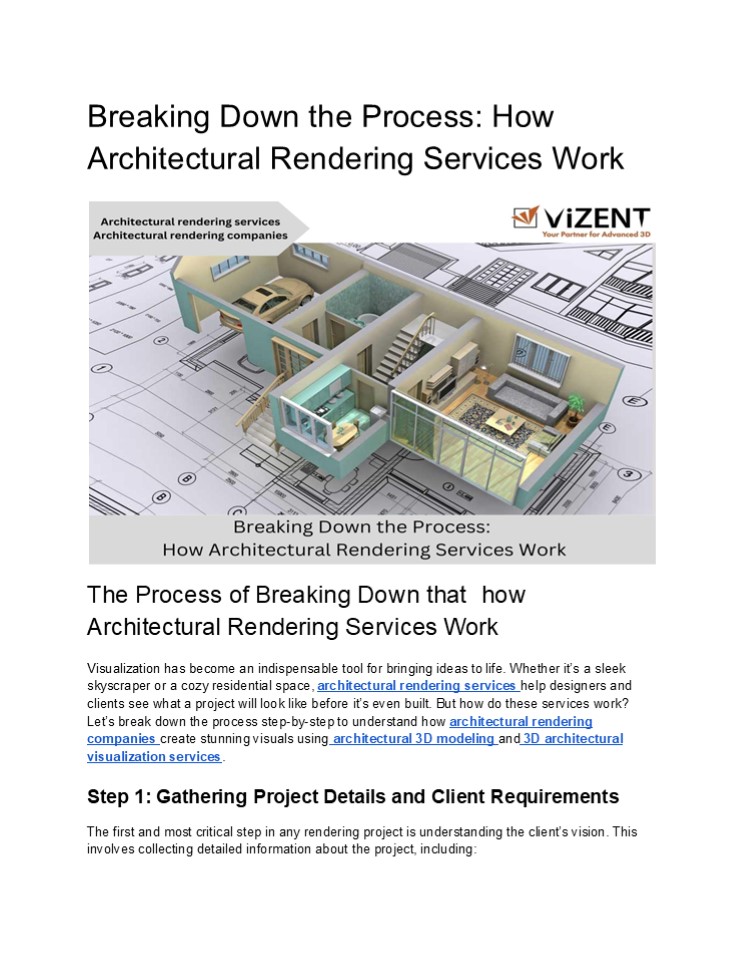
Title: Breaking Down the Process: How Architectural Rendering Services Work
1
Breaking Down the Process How Architectural
Rendering Services Work
The Process of Breaking Down that how
Architectural Rendering Services
Work Visualization has become an indispensable
tool for bringing ideas to life. Whether its a
sleek skyscraper or a cozy residential space,
architectural rendering services help designers
and clients see what a project will look like
before its even built. But how do these services
work? Lets break down the process step-by-step
to understand how architectural rendering
companies create stunning visuals using
architectural 3D modeling and 3D architectural
visualization services. Step 1 Gathering
Project Details and Client Requirements The first
and most critical step in any rendering project
is understanding the clients vision. This
involves collecting detailed information about
the project, including
2
- Blueprints or CAD drawings
- Design concepts or sketches
- Material specifications (e.g., flooring, wall
colors, furniture) - Lighting preferences and environmental context
- At this stage, architectural rendering companies
work closely with clients to align their
expectations and define the scope of the project.
Clear communication is essential to ensure the
final output matches the envisioned design. - Step 2 Creating the Base Architectural 3D Model
- Using the collected data, designers begin by
constructing a digital 3D model of the structure.
This is where architectural 3D modeling comes
into play. Advanced software like AutoCAD,
SketchUp, or Revit is used to create a detailed
framework that represents the projects
geometry, dimensions, and layout. - This base model serves as the skeleton for the
rendering process. It includes walls, doors,
windows, and other architectural elements,
providing a foundation for further refinement. - Step 3 Adding Textures and Materials
- Once the 3D model is complete, the next step is
to apply textures and materials to its surfaces.
This is where the project begins to look more
realistic. High-quality materials are selected to
match the clients specifications, such as - Polished wood for floors
- Glossy tiles for kitchens and bathrooms
- Concrete or stone for exteriors
3
- Step 5 Rendering the Scene
- Rendering is the process of transforming a 3D
model into high-quality images or videos.
Specialized rendering software like V-Ray,
Lumion, or Blender is used to generate
photorealistic visuals. This step involves
several computational processes, including - Anti-aliasing to smooth out edges and enhance
image quality - Post-processing effects like depth of field and
color grading - Depending on the complexity of the project,
rendering can take anywhere from a few hours to
several days. The final output may include static
images, 360-degree panoramas, or fully immersive
VR experiences. - Step 6 Reviewing and Refining
- After the initial renderings are completed,
architectural rendering companies present the
visuals to the client for feedback. This is an
iterative process where adjustments are made to
align the output with the clients expectations.
Changes might include - Modifying colors or materials
- Adjusting lighting for better clarity
- Adding or removing design elements
- This collaborative phase ensures that the client
is fully satisfied with the final product. - Step 7 Final Delivery
- Once all refinements are complete, the finalized
renderings are delivered to the client in their
preferred format. These deliverables may include
4
- By leveraging the latest advancements in
architectural 3D modeling, these companies ensure
accuracy, efficiency, and creativity in every
project. Their services bridge the gap between
concept and reality, making them essential
partners for architects, developers, and interior
designers. - Why Architectural Rendering Services Matter
- The value of architectural rendering lies in its
ability to simplify complex ideas and communicate
them effectively. Heres why these services are
indispensable - Clarity and Precision Renderings provide a clear
and detailed view of the project, reducing
misunderstandings and errors. - Enhanced Decision-Making Clients can make
informed choices about design elements,
materials, and layouts. - Improved Marketing High-quality visuals attract
potential buyers and investors, setting projects
apart from competitors. - Cost Savings Identifying issues early in the
design phase minimizes costly changes during
construction. - Conclusion
- The process of architectural rendering is both an
art and a science. From creating a base model to
delivering photorealistic visuals, every step is
designed to transform ideas into tangible
experiences. With the expertise of architectural
rendering companies and the power of 3D
architectural visualization services, clients can
see their visions come to life like never before.
Recommended

