

From Data Collection to Text Recognition: The OCR Training Dataset Journey PowerPoint PPT Presentation
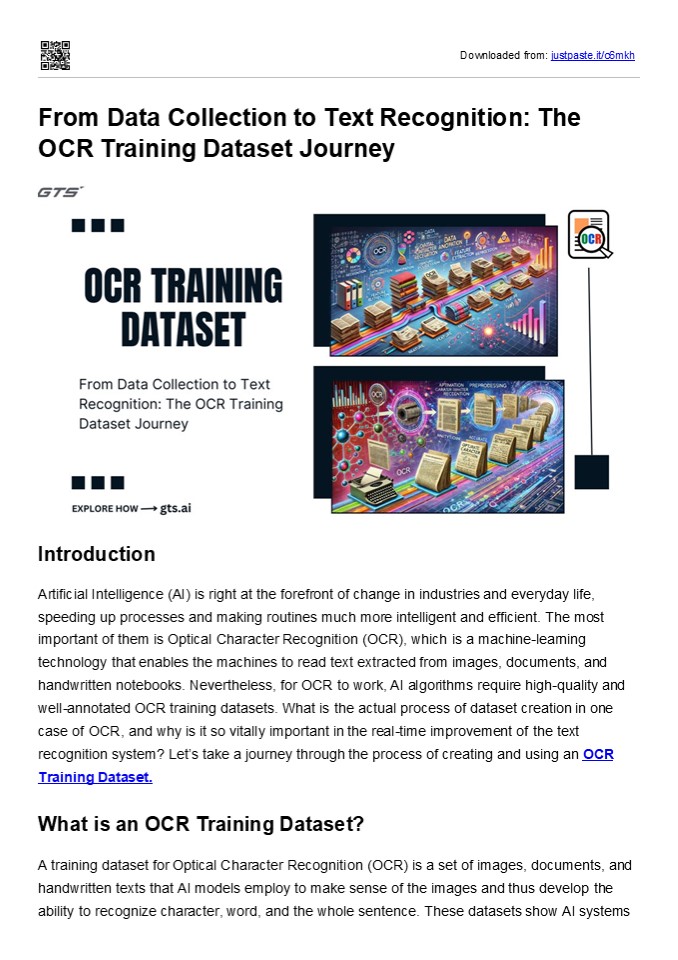
Title: From Data Collection to Text Recognition: The OCR Training Dataset Journey
1
Downloaded from justpaste.it/c6mkh
From Data Collection to Text Recognition The OCR
Training Dataset Journey
Introduction Artificial Intelligence (AI) is
right at the forefront of change in industries
and everyday life, speeding up processes and
making routines much more intelligent and
efficient. The most important of them is Optical
Character Recognition (OCR), which is a
machine-learning technology that enables the
machines to read text extracted from images,
documents, and handwritten notebooks.
Nevertheless, for OCR to work, AI algorithms
require high-quality and well-annotated OCR
training datasets. What is the actual process of
dataset creation in one case of OCR, and why is
it so vitally important in the real-time
improvement of the text recognition system? Lets
take a journey through the process of creating
and using an OCR Training Dataset. What is an
OCR Training Dataset? A training dataset for
Optical Character Recognition (OCR) is a set of
images, documents, and handwritten texts that AI
models employ to make sense of the images and
thus develop the ability to recognize character,
word, and the whole sentence. These datasets show
AI systems
2
- how to correctly interpret different fonts,
handwriting styles, and various kinds of text in
different settings. On a very basic level, the
quality of the dataset determines how reliable
and efficient the OCR technology is. - The Process of Building an OCR Training Dataset
- Data Collection Gathering Visual Information
- The beginning step of making an OCR dataset is
the visualization (-Image-Image) of variant data.
That may be - Printed Text Materials Books, newspapers, and
magazines have become a fantastic source of
printed texts that are used. - Handwritten documents are usually the ones that
AI has more trouble reading. Handwritten notes,
forms, and letters, thus, are very important
pieces of data in the dataset. - Street Signs and Labels Perfume labels, public
signs, plus such as product labels become a
significant sector thanks to the text they
provide. - In addition, one project was successful in
generating images of more than 30,000 different
ones, which consisted of the following 15,000
were printed, 10,000 were written, and 5,000 were
street signs and labels / product labels. - Text Recognition Annotating the Data
- When the images are collected, the following
action is to annotate them. That means the person
must carefully copy the text which is found in
the image since it is easier for the AI model to
identify words correctly. The process of
annotation additionally comprises - Identification of diverse handwriting styles,
fonts as well as text direction. - Besides the main text, the contextual information
such as the language used, the text format
(printed/handwritten), and other metadata should
also be added. - One of the examples is the aforementioned project
in which the team extracted data from 30,000
images and annotated them with the information
that is exclusively vital for the AI system, thus
it is an even more valuable dataset. - Quality Assurance Ensuring Accuracy
3
- followed to ensure that the transcriptions and
the tags are accurate. - Annotation Verification Random samples of the
images that were annotated are checked in order
to get accuracy. - Data Cleansing Those that are blurred, out of
context, and the ones that do not align to the
project standards are deleted. - Security Measures Privacy is safeguarded and
people only use data that is protected to comply
with legal standards. - For instance, in the OCR project, the 3,000 (10
of the full) images were closely checked in the
method, thus, making sure that only the
high-quality data was used in training. - Model Training and Testing
- OCR training data set the AI model is provided
and then the AI model is trained to distinguish
and understand text in all kinds of formats. This
model is evaluated in terms of its ability to
detect diverse types of writing (fonts,
handwritings, and languages). Consistent
modifications and corrections are done on the
dataset according to the model's performance,
thereby, making the OCR system cleverer with
time. - Real-World Applications of OCR Technology
- OCR has large and useful applications
- Enable Productivity and Privacy OCR allows for
the transformation of the text from scanned
papers, receipts, and forms these can be
automatically carried out by software without
the involvement of a human. - Enhance Accessibility If you are a visually
impaired person, an AI-based OCR system can
actually read out the text for you. - Digitization of Records OCR can handle a wide
range of manuscripts and legal text for the
process of digitization and archiving thus making
the retrieval of text very convenient. - Navigation Aid OCR is used in AI to read street
signs and give real-time driving directions to
humans. - The Future of OCR and AI
4
The progressive development in machine learning
and AI has made the OCR technology become more
precise and effective. A highly representative
OCR training dataset is paramount for
comprehending humans to a computer and to be able
to be implemented in a number of casual
situations. The end of the road is to create AI
that can deal with all kinds of textual images
on, for instance, a paper, a poster with writing
on it, or a street sign. Conclusion The Journey
of OCR Training Dataset How an OCR training
dataset is prepared from the collecting of data
to text recognition is vital to improving
artificial intelligence technology's ability to
handle visual information. Collecting different
kinds of visual data, paying great attention to
annotation, and keeping high standards of
quality, we can create AI models that are not
only trustworthy but also scalable to a wide
variety of text formats. Consequently, the
improvement will be a more clever, quicker, and
flexible OCR system that can transform businesses
and the daily lives of people. If you are one of
the people who want to develop their own OCR
model, then getting a high- quality annotated
training dataset is the very first stage that you
must pass through if you wish to unlock the full
power of AI-based text recognition. Conclusion
with GTS.AI
5
At Globose Technology Solutions (GTS.ai), we
specialize in leveraging advanced AI and machine
learning techniques to build scalable and
efficient OCR systems. By providing high- quality
annotated datasets and custom OCR solutions, we
help businesses unlock the full potential of text
recognition technology, transforming their
operations and user experiences.
Recommended

