

New Holland TK80A Tractor Service Repair Manual Instant Download PowerPoint PPT Presentation
Title: New Holland TK80A Tractor Service Repair Manual Instant Download
1
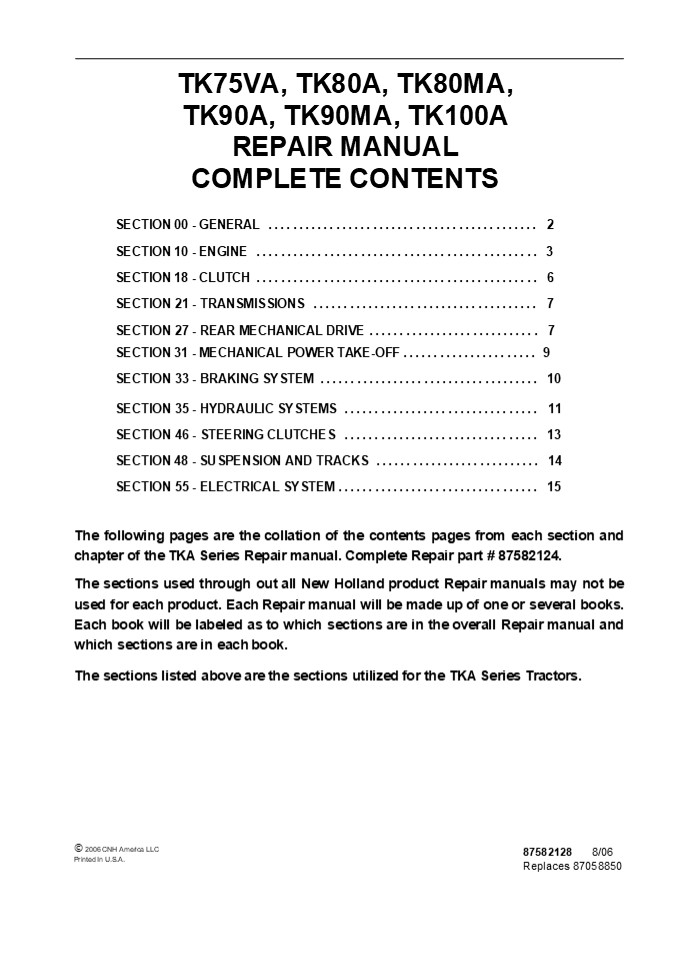
TK75VA, TK80A, TK80MA, TK90A, TK90MA, TK100A
REPAIR MANUAL COMPLETE CONTENTS
SECTION 00 - GENERAL .............................
............... 2 SECTION 10 - ENGINE
..............................................
3 SECTION 18 - CLUTCH ............................
.................. 6 SECTION 21 - TRANSMISSIONS
..................................... 7 SECTION
27 - REAR MECHANICAL DRIVE .......................
..... 7 SECTION 31 - MECHANICAL POWER TAKE-OFF
...................... 9 SECTION 33 - BRAKING
SYSTEM ....................................
10 SECTION 35 - HYDRAULIC SYSTEMS
................................ 11 SECTION 46 -
STEERING CLUTCHES ................................
13 SECTION 48 - SUSPENSION AND TRACKS
........................... 14 SECTION 55 -
ELECTRICAL SYSTEM ................................
. 15 The following pages are the collation of
the contents pages from each section and chapter
of the TKA Series Repair manual. Complete Repair
part 87582124. The sections used through out
all New Holland product Repair manuals may not be
used for each product. Each Repair manual will
be made up of one or several books. Each book
will be labeled as to which sections are in the
overall Repair manual and which sections are in
each book. The sections listed above are the
sections utilized for the TKA Series Tractors.
? 2006 CNH America LLC Printed In U.S.A.
87582128 8/06 Replaces 87058850
2
SECTION 00 - GENERAL - CHAPTER 1 SECTION 00 -
GENERAL Chapter 1 - General CONTENTS
Description Page General Instructions
..................................................
.......... 2 Important Notice ....................
........................................
2 Shimming .......................................
........................... 2 Rotating Shaft
Seals ............................................
............ 2 O-Rings ...........................
........................................
2 Sealers ........................................
............................ 2 Bearings
..................................................
................. 2 Spring Pins
..................................................
.............. 2 Precautionary Notice
..................................................
...... 3 Equipment Notice ........................
................................... 3 Spare Parts
Notice ...........................................
............... 3 General Notices
..................................................
.......... 3 Health and Safety ...................
...........................................
4 Health and Safety Precautions
................................................
4 General Workshop Tools and Equipment
..................................... 10 Legal
Aspects ..........................................
.................. 10 Lubricants and Greases
..................................................
. 10 Precautionary Statements ....................
.................................. 11 Personal
Safety ...........................................
.................... 11 Machine Safety
..................................................
............. 11 Safety ..........................
............................................
12 The Tractor ...................................
........................... 12 Driving the
Tractor ..........................................
.............. 12 Operating the Tractor
..................................................
.... 12 Operating the PTO ........................
................................ 13 Servicing the
Tractor ..........................................
............ 13 Diesel Fuel ......................
........................................ 14 ROPS
..................................................
................. 14 Ecology and the Environment
..................................................
15 Tightening Torques ...........................
................................ 16 Federal
Emissions Warranty ..............................
..................... 18 California Emission
Control Warranty Statement .......................
........... 19 Lubricants .......................
........................................ 21
Section
3
SECTION 00 - GENERAL - CHAPTER 1 GENERAL
INSTRUCTIONS
WARNING
- Thoroughly clean the shaft and ensure that the
shaft working surface is not damaged. - Place the sealing lip towards the fluid. In case
of a hydrodynamic lip, consider the shaft
rotation direction and orient grooves in order
that they deviate the fluid towards the inner
side of the seal. - Coat the sealing lip with a thin layer of
lubricant (oil rather than grease) and fill the
gap between the sealing lip and the dust lip of
double lip seals with grease. - Insert the seal into its seat and press it down
using a flat punch. Do not tap the seal with a
hammer or a drift. - Take care to insert the seal perpendicularly to
its seat while you are pressing it. Once the
seal is settled, ensure that it contacts the
thrust element, if required. - To prevent damaging the sealing lip against the
shaft, place a suitable protection during
installation.
All maintenance and repair work described in
this manual must be performed exclusively by NEW
HOLLAND service technicians in strict accordance
with the instructions given and using any
specific tools necessary.
WARNING
Anyone who performs the operations described
herein without strictly following the
instructions is personally responsible for
resulting injury or damage to property.
WARNING
The Manufacturer and all organizations belong-
ing to the Manufacturers distribution network,
including but not restricted to national,
regional or local distributors, will accept no
responsibility for personal injury or damage to
property caused by abnormal function of parts
and/or compo- nents not approved by the
Manufacturer, including those used for
maintenance and/or repair of the product
manufactured or marketed by the Manufacturer. In
any case, the product manufactured or marketed
by the Manufacturer is covered by no guarantee
of any kind against personal injury or damage to
property caused by abnormal function of parts
and/or components not approved by the
Manufacturer.
O-RINGS Lubricate the O-rings before inserting
them into their seats. This will prevent the
O-rings from roll over and twisting during
mounting, which will jeopardize sealing.
SEALERS Apply silicone/gasket eliminator over the
mating surfaces marked with an X. Before
applying the sealer, prepare the surface as
follows
IMPORTANT NOTICE All maintenance and repair
operations described in this manual should be
carried out exclusively by the authorized
workshops. All instructions detailed should be
carefully observed and special equipment
indicated should be used if necessary. Everyone
who carries out service operations described
without carefully observing these prescriptions
will be directly responsible of deriving damages.
- Remove possible scales using a metal brush.
- Thoroughly degrease the surfaces using one of
the following cleaning agents trichlorethylene,
diesel fuel or a water and soda solution.
BEARINGS It is advisable to heat the bearings to
80? to 90?C (176? to 194?F) before mounting them
on their shafts and cool them down before
inserting them into their seats with external
tapping.
SHIMMING At each adjustment, select adjusting
shims, measure them individually using a
micrometer and then sum up recorded values. Do
not rely on measuring the whole shimming set,
which may be incorrect, or on the rated value
indicated for each shim.
SPRING PINS When mounting split socket spring
pins, ensure that the pin notch is oriented in
the direction of the effort to stress the
pin. Spiral spring pins should not be oriented
during installation.
- ROTATING SHAFT SEALS
- To correctly install rotating shaft seals,
observe the following instructions - Let the seal soak into the same oil as it will
seal for at least half an hour before mounting.
4
https//www.ebooklibonline.com Hello dear
friend! Thank you very much for reading. Enter
the link into your browser. The full manual is
available for immediate download. https//www.eb
ooklibonline.com
5
SECTION 00 - GENERAL - CHAPTER 1 HEALTH AND
SAFETY CONTENTS Description Page HEALTH AND
SAFETY PRECAUTIONS ...............................
.......................... 5 ACIDS AND ALKALIS
..................................................
....................... 6 ADHESIVES AND SEALERS -
see Fire .........................................
................ 6 ANTIFREEZE - see Fire,
Solvents e.g. Isopropanol, Ethylene Glycol,
Methanol ....................... 6 ARC WELDING -
see Welding ......................................
........................... 7 BATTERY ACIDS - see
Acids and Alkalis ................................
........................ 7 BRAKE AND CLUTCH
FLUIDS (Polyalkylene Glycols) - see Fire
................................... 7 BRAZING -
see Welding ......................................
................................ 7 CHEMICAL
MATERIALS - GENERAL - see Legal Aspects
........................................ 7 DOS
..................................................
..................................... 7 DO NOTS
..................................................
................................. 8 CORROSION
PROTECTION MATERIALS - see Solvents, Fire
..................................... 8 DUSTS
..................................................
................................... 8 ELECTRIC
SHOCK ............................................
............................... 8 EXHAUST FUMES
..................................................
......................... 9 FIBER INSULATION -
see Dusts ........................................
....................... 9 FIRE - see Welding,
Foams, Legal Aspects .............................
......................... 9 FIRST AID
..................................................
................................ 9 FOAMS -
Polyurethane - see Fire ..........................
.................................... 9 FUELS -
see Fire, Legal Aspects, Chemicals - General,
Solvents ................................. 10
GAS CYLINDERS - see Fire .........................
........................................ 10
GENERAL WORKSHOP TOOLS AND EQUIPMENT
.............................................
11 LEGAL ASPECTS .................................
..........................................
11 LUBRICANTS AND GREASES ........................
........................................ 11
HEALTH AND SAFETY PRECAUTIONS Many of the
procedures associated with vehicle maintenance
and repair involve physical hazards or other
risks to health. This section lists,
alphabetically, some of these hazardous
operations and the materials and equipment
associated with them. The precautions necessary
to avoid these hazards are identified.
The list is not exhaustive and all operations and
procedures and the handling of materials, should
be carried out with health and safety in mind.
6
SECTION 00 - GENERAL - CHAPTER 1
ACIDS AND ALKALIS -- see Battery acids, e.g.
caustic soda, sulfuric acid. Used in batteries
and cleaning materials. Irritant and corrosive to
the skin, eyes, nose and throat. Causes
burns. Avoid splashes to the skin, eyes and
clothing. Wear suitable protective gloves and
goggles. Can destroy ordinary protective
clothing. Do not breathe mists. Ensure access to
water and soap is readily available for
splashing accidents.
Provide adequate ventilation and avoid skin and
eye contact. Follow manufacturers instructions.
Anaerobic, Cyanoacrylate and other Acrylic
Adhesives Many are irritant, sensitizing or
harmful to the skin. Some are eye
irritants. Skin and eye contact should be avoided
and the manufacturers instructions
followed. Cyanoacrylate adhesives (super glues)
must not contact the skin or eyes. If skin or
eye tissue is bonded, cover with a clean moist
pad and get medical attention. Do not attempt to
pull tissue apart. Use in well ventilated areas
as vapors can cause irritation of the nose and
eyes. For two-pack systems, see Resin based
adhesives/ sealers.
ADHESIVES AND SEALERS -- see Fire Highly
Flammable, Flammable, combustible. Generally
should be stored in No Smoking areas
cleanliness and tidiness in use should be
observed, e.g. disposable paper covering benches
should be dispensed from applicators where
possible contain- ers, including secondary
containers, should be labelled. Solvent based
Adhesives/Sealers - See Solvents. Follow
manufacturers instructions. Water based
Adhesives/Sealers Those based on polymer
emulsions and rubber lattices may contain small
amounts of volatile toxic and harmful chemicals.
Skin and eye contact should be avoided and
adequate ventilation provided during use. Follow
manufacturers instructions. Resin based
Adhesives/Sealers - e.g. epoxide and
formaldehyde resin based. Mixing should only be
carried out in well ventilated areas as harmful
or toxic volatile chemicals may be
released. Skin contact with uncured resins and
hardeners can result in irritation dermatitis
and absorption of toxic or harmful chemicals
through the skin. Splashes can damage the eyes.
Isocyanate (Polyurethane) Adhesives/ Sealers --
see Resin based Adhesives.
Individuals suffering from asthma or respiratory
allergies should not work with or near these
materials as sensitivity reactions can
occur. Any spraying should preferably be carried
out in exhaust ventilated booths, removing
vapors and spray droplets from the breathing
zone. Individuals working with spray
applications should wear supplied air
respirators.
ANTIFREEZE -- see Fire, Solvents e.g.
Isopropanol, Ethylene Glycol, Methanol. Highly
Flammable, Flammable, Combustible. Used in
vehicle coolant systems, brake air pressure
systems, screenwash solutions. Vapors given off
from coolant antifreeze (glycol) arise only when
heated. Antifreeze may be absorbed through the
skin in toxic or harmful quantities. Antifreeze
if swallowed is fatal and medical attention must
be found immediately.
7
SECTION 00 - GENERAL - CHAPTER 1
ARC WELDING -- see Welding.
The effects of excessive exposure to chemicals
may be immediate or delayed briefly experienced
or permanent cumulative superficial life
threatening or may reduce life-expectancy.
BATTERY ACIDS -- see Acids and Alkalis. Gases
released during charging are explosive. Never
use naked flames or allow sparks near charging
or recently charged batteries.
DOS Do remove chemical materials from the skin
and clothing as soon as practicable after
soiling. Change heavily soiled clothing and have
it cleaned. Do carefully read and observe hazard
and precaution warnings given on material
containers (labels) and in any accompanying
leaflets, poster or other instructions. Material
health and safety data sheets can be obtained
from Manufacturers. Do organize work practices
and wear protective clothing to avoid irritation
of the skin and eyes breathing
vapors/aerosols/dusts/fumes inadequate
container labelling fire and explosion
hazards. Do wash before job breaks before
eating, smoking, drinking or using toilet
facilities when handling chemical materials. Do
keep work areas clean, uncluttered and free of
spills. Do store according to national and local
regulations. Do keep chemical materials out of
reach of children.
BRAKE AND CLUTCH FLUIDS (Polyalkylene Glycols) --
see Fire. Combustible. Splashes to the skin and
eyes are slightly irritating. Avoid skin and eye
contact as far as possible. Inhalation of vapors
hazards do not arise at ambient temperatures
because of the very low vapors pressure.
BRAZING -- see Welding.
CHEMICAL MATERIALS - GENERAL -- see Legal
Aspects. Chemical materials such as solvents,
sealers, adhesives, paints, resin foams, battery
acids, antifreeze, brake fluids, oils and grease
should always be used with caution and stored
and handled with care. They may be toxic,
harmful, corrosive, irritant or highly
inflammable and give rise to hazardous fumes and
dusts.
8
SECTION 10 - ENGINE - CHAPTER 1 SECTION 10 -
ENGINE Chapter 1 - Engine CONTENTS
Description Page Specifications
..................................................
................ 4 Tightening Torques
..................................................
......... 24 Special Tools .......................
.........................................
26 Engine Cooling System Diagram
...............................................
30 Troubleshooting ...............................
............................... 31 Engine
Overhaul .........................................
.................... 35 Engine ...................
...............................................
35 Removal .......................................
...................... 35 Installation
..................................................
.......... 38 Compression Test ...................
.................................. 39 Disassembly
..................................................
........ 40 Assembly .............................
............................... 54 Mounting the
Balancing Device with Counter-rotating Weights
............... 54 Mounting the Tappets and
Drive Shaft With Main Bearing Caps, Bearings and
Thrust Rings .....................................
......... 55 Mounting the Rear Cover With Seal
and Engine Flywheel ................... 57 Seal
Installation .....................................
.................. 59 Mounting the Pistons
Complete With Rings, Pins, Connecting Rods, Big
End Caps and Bearings - Checking Protrusion
In Relation To Cylinder Block Face
.........................................
60 Synchronizing the Timing Gears
......................................... 61
Installing the Counter-rotating Weight Box to the
Oil Sump .................. 62 Installing the
Bosch Injection Pump .............................
......... 63 Installing the Cylinder Head Gasket
......................................
64 Installing and Tightening the Cylinder Head
............................... 64 Valve / Rocker
Arm Clearance Adjustment .........................
....... 65 Installing Fuel Injectors
..................................................
.. 65 Cooling System Belt Tension Adjustment
................................. 65 Checks,
Measurements and Repairs of Components
.............................. 66 Cylinder Block
..................................................
.......... 66
Section
10-1
9
SECTION 10 - ENGINE - CHAPTER 1
Description Page Crankshaft, Main Bearings and
Flywheel ..................................... 68
Crankshaft ......................................
..................... 68 Bearings
..................................................
........... 70 Flywheel ..........................
................................... 71 Connecting
Rods .............................................
............ 72 Pistons ..........................
........................................
73 Camshaft, Tappets and Valves
..............................................
76 Valves ........................................
....................... 76 Tappets
..................................................
............ 76 Camshaft .........................
.................................... 77 Cylinder
Head .............................................
............... 79 Valve Guides
..................................................
........... 80 Valve Seats In Cylinder Head
...............................................
83 Injector Sleeves ..............................
............................ 84 Cylinder Head
Bolts ............................................
........ 85 Counterweight Balancer
..................................................
. 86 Lubrication System Maintenance
............................................
87 Engine Oil Pump Servicing .....................
......................... 87 Low Oil Pressure
Indicator ........................................
...... 88 Cooling System Maintenance
...............................................
88 Radiator Servicing ............................
......................... 88 Testing Cooling
System Thermometer ...............................
..... 89 Replacing the Thermostat
..............................................
89 Drive Belts Tension Adjustment
.......................................... 89
Radiator .........................................
........................ 90 Removal
..................................................
........... 90 Installation ......................
......................................
92 Crankshaft Front Oil Seal .....................
............................. 93 Removal
..................................................
........... 93 Installation ......................
...................................... 96 Valve-
Rocker Arm Clearance .............................
................. 97 Rear Fuel Tank
..................................................
........ 100 Removal .............................
............................... 100 Installation
..................................................
......... 102 Front Fuel Tank ....................
......................................
103 Removal ......................................
...................... 103 Installation
..................................................
......... 104
Section
10
SECTION 10 - ENGINE - CHAPTER 1
Description Page Injectors .......................
.........................................
105 Removal ......................................
...................... 105 Installation
..................................................
......... 106 Bosch Injection Pump
..................................................
.. 107 Removal ...................................
......................... 107 Installation
..................................................
.......... 111 Timing ............................
.................................. 112 Air
Bleeding .........................................
................ 114 Timing Injection Pump Off
the Tractor ...................................
115 Installing the Injection Pump Onto the Engine
............................. 120 Turbocharged
Diesel Engine - TK75VA, TK90A, TK90MA, TK100A
Models .................................
121 Exhaust Pipe .................................
........................... 124 Removal
..................................................
.......... 124 Installation ......................
..................................... 124 Coolant
Pump .............................................
.............. 125 Removal .......................
.....................................
125 Installation .................................
.......................... 126 Disassembly
..................................................
....... 127 Assembly .............................
.............................. 127 Thermostatic
Valve ............................................
........... 128 Removal ..........................
..................................
128 Installation .................................
.......................... 129 Coolant Pump and
Alternator Drive Belt ............................
......... 130 Tension Adjustment
..................................................
. 130
Section
11
SECTION 10 - ENGINE - CHAPTER 1 SPECIFICATIONS
Engine, type
- Models TK75VA ...................................... 8035.25.921
- Models TK80A, TK80MA .............................. 8045.05R.921
- Models TK90A, TK90MA .............................. 8045.25.921
- Models TK100A ...................................... 8045.25L.921
Cycle .................................................. diesel, 4-stroke
Fuel injection ........................................... direct
Number of cylinders in line
- Models TK75VA ...................................... 3
- Models TK80A, TK80MA, TK90A, TK90MA, TK100A ...... 4
Piston diameter ......................................... 104 mm (4.0944 in)
Piston stroke ............................................ 115 mm (4.5275 in)
Total displacement
- Models TK75VA ...................................... 2931 cm3 (179 cu in)
- Models TK80A, TK80MA .............................. 3908 cm3 (238 cu in)
- Models TK90A, TK90MA .............................. 3908 cm3 (238 cu in)
- Models TK100A ...................................... 3908 cm3 (238 cu in)
Compression ratio
- Models TK80A, TK80MA .............................. 171 naturally aspirated
- Models TK75VA, TK90A, TK90MA, TK100A ............. 16.51 turbocharged
Maximum power
- Models TK75VA ...................................... 55.5 kw (net 76 hp)
- Models TK80A, TK80MA .............................. 58.5 kw (net 80 hp)
- Models TK90A, TK90MA .............................. 65.5 kw (net 90 hp)
- Models TK100A ...................................... 69 kw (net 94 hp)
Maximum power speed
- Models TK75VA ...................................... 2300 rpm
- Models TK80A, TK80MA .............................. 2500 rpm
- Models TK90A, TK90MA .............................. 2500 rpm
- Models TK100A ...................................... 2500 rpm
Maximum torque speed
- Models TK75VA ...................................... 1400 rpm
- Models TK80A, TK80MA .............................. 1500 rpm
- Models TK90A, TK90MA .............................. 1500 rpm
- Models TK100A ...................................... 1500 rpm
Number of main bearings ................................. 5
Sump pan .............................................. structural, cast iron
12
SECTION 10 - ENGINE - CHAPTER 1
Lubrication system .................................... forced, with gear pump
1st 50 hr (Break-in Engine Oil) ........................... 10W-40 - API SE/CC 10W-40
After 50 hr (AMBRA SUPER GOLD Engine Oil) ............. 15W-40 - Premium Multi-grade NH 330G
Pump drive ............................................ camshaft
Engine speed/oil pump speed ratio ........................ 21
Oil cleaning ............................................ mesh screen on oil pick- up and filter cartridge in delivery line
Normal oil pressure, warm engine running at max speed .....
TK75VA ............................................... ? 2 bar (29 psi)
TK80A, TK80MA ....................................... 2.9 to 3.9 bar (42 to 56 psi)
TK90A, TK90MA ....................................... ? 2 bar (29 psi)
TK100A ............................................... ? 4 bar (58 psi)
Pressure relief valve .................................... built into pump housing
Valve opening pressure ................................. 3.5 bar (50.8 psi)
Cooling system ....................................... water circulation
Radiator ............................................... 4-row vertical pipes with copper fins
Fan, attached to coolant pump pulley ...................... 4-blade in sheet metal
Coolant pump .......................................... centrifugal vane-type
Engine speed/coolant pump speed ratio ................... 11.403
Temperature control .................................... thermostat
Coolant thermometer ................................... colored scale divided into 3 sections
Temperature ranges corresponding to each section
- initial white section .................................. - middle green section (normal working conditions) ........ - final red section .................................... 30o to 65oC (86o to 149oF) 65o to 105oC (149o to 221oF) 105o to 115oC (221o to 239oF)
Rev counter/hourmeter ................................ Operating system ....................................... Hour counter calibrated for engine speed of ................ incorporated in control panel from gear on camshaft 1800 rpm
(continued)
13
SECTION 10 - ENGINE - CHAPTER 1 ENGINE OVERHAUL
- ENGINE
- Removal
- DANGER
- Lift and handle all heavy parts using suitable
lifting equipment. - Make sure that assemblies or parts are supported
by means of suitable slings and hooks. Make sure
that no one is standing in the vicinity of the
load to be lifted. - CAUTION
- Always use appropriate tools to align fixing
holes. NEVER USE YOUR FINGERS OR HANDS. - Carry out operation for clutch removal.
- Remove the rubber heat guard, 2, from the
support, 1.
7
3. Remove the retaining bolts, 1, and the
support, 2.
8
10-35
14
- SECTION 10 - ENGINE - CHAPTER 1
- Remove the retaining bolts and the right and
left-hand engine side guards. - Place a container for the coolant under the
sleeve, 1. - Detach the sleeve, 1, on the lower pipe and drain
off the coolant.
9
- Detach the sleeve, 1, on the radiator upper
piping. - Remove the retaining bolts and the radiator
upper support, 2.
10
9. Remove the piping, 1, and the sleeve, 2,
located on the lower part of the tank.
11
10-36
15
SECTION 10 - ENGINE - CHAPTER 1 10. Remove the
piping, 1, and, 2, located on the upper part of
the tank.
12
11. Detach the oil vapor breather pipes, 1, and
the turbocharger feed piping, 2, as applicable.
13
12. Remove the tow bar hook, 1, and the front
ballast, 2.
14
10-37
16
- SECTION 10 - ENGINE - CHAPTER 1
- Hitch the front suspension, 1, to a hoist. Remove
the suspension retaining pin, 2, on the support,
3, and remove the front suspension. - Hitch the front suspension support, 3, to a
hoist, remove the sump retaining bolts and
remove the support.
15
Installation To install the engine, proceed as
follows CAUTION Always use appropriate tools to
align fixing holes. NEVER USE YOUR FINGERS OR
HANDS.
16
- Apply the torque settings listed in the torque
table. - Hitch the front suspension support to a hoist and
install to the sump, securing in position with
the retaining bolts. - Hitch the front suspension to a hoist. Install on
the support and assemble the suspension
retaining pin. - Install the front ballast and tow bar.
- Install the oil vapor recovery piping and the
turbocharger feed piping (where removed). - Install the piping on the upper part of the tank.
- Install the piping and sleeve located on the
lower part of the tank.
- Install the upper tank support and tighten the
retaining bolts. - Install the radiator upper piping sleeve.
- Install the radiator lower piping sleeve.
- Fill up with coolant.
- Install the engine side guards and retaining
bolts. - Assemble the roll bar support and retaining
bolts. - Install the rubber heat guard on the support.
- Carry out the relative clutch assembly
operations. - Bleed the fuel system of air as described in this
section.
10-38
17
SECTION 10 - ENGINE - CHAPTER 1
Compression Test In case of poor engine
performance, in addition to checking the fuel
injection system (injection nozzles and
injection pump), also test the compression on
each cylinder.
- fit the dummy injector 380000617 in place of the
injector removed previously, interposing the
copper sealing washer - connect the compression test instrument
380000303 and take readings while turning the
engine over with the starter motor. - On engines in perfect working order, with the
sump oil at approximately 40 oC (104 oF) at sea
level (760 mm 29.9212 in, mercury) and at an
engine speed of 200 to 280 rpm, the compression
should be 25.5 to 27.5 bar (369.8 to 398.8 psi). - Test the compression on the other cylinders,
repeating steps 4- 5- 6- 7, bearing in mind that - The minimum permissible compression on a used
engine is 21.6 bar (313.2 psi). - The maximum permissible compression difference
between cylinders is 3 bar (43.5 psi). - Every 100 meters (109.36 yards) above sea level
corresponds to a reduction in compression by
approximately 1.
DANGER
Do not use matches, lighters, blowtorches or any
form of naked flame as a source of light when
inspecting the engine due to the presence of
inflammable fluids and vapor.
- Compression ratio
- The compression ratio is a measure of the
quantity of air drawn into the cylinder, and
provides an indication of the efficiency of the
sealing elements in the cylinder (piston rings
and valves). - Uniform compression in all the cylinders ensures
that they all perform an equal amount of work,
provided that each cylinder is injected with the
same quantity of fuel at the right time. - Low compression not only reduces engine perfor-
mance, it also causes incomplete fuel combustion
due to the lack of available combustion air. - The engine therefore gives poor performance with
excessive fuel consumption and, consequently,
exhaust smoke and restriction of the exhaust
passages. - As the compression ratio also varies with the
temperature of the engine ( cold engines produce
lower compression values than hot engines), the
compression should only be tested when the engine
is at normal operating temperature. - Compression should be tested using the compres-
sion test kit 380000303, as follows - run the engine until it reaches normal operating
temperature - switch off the engine
- disconnect the lead from the engine stop
electromagnet on the injection pump in order to
close the valve, and block the flow of fuel to
the injectors - remove the injector from the cylinder to be
tested - turn the engine over a few times with the starter
motor in order to expel any carbon residue
Considerations Uniform compression Although high
compression is important, it is more important
for smooth engine running that compres- sion is
uniform in all cylinders. Low compression
readings If extremely low pressure readings are
obtained on one cylinder it is advisable to
repeat the test. Before testing this time, pour
approximately one spoonful of engine oil into
the cylinder through the injector bore. Turn
over the engine a few times to distribute the oil
evenly over the cylinder walls, and then repeat
the test. If the second test readings are
significantly higher, suspect worn piston rings,
out-of-round or damaged pistons. If the second
test readings are not higher, the problem will
be the valves. On the other hand, if the second
test reading shows only a slight improvement,
the problem will be due to both the valves and
the rings.
10-39
18
Suggest If the above button click is invalid.
Please download this document first, and then
click the above link to download the complete
manual. Thank you so much for reading
19
SECTION 10 - ENGINE - CHAPTER 1
- Disassembly
- CAUTION
- Handle all parts carefully.
- Do not put your hands or fingers between parts.
Wear suitable safety clothing - safety goggles,
gloves and shoes. - Position the engine on a rotating stand
(380000301) using brackets (380000313). En- sure
the engine is secured. - Disconnect the turbocharger lube pipe, 1. Remove
the turbocharger along with the exhaust
manifold, 2.
17
- Remove retaining nuts, 1, and, 2, and the belt
tension adjustment bracket. - Remove the alternator lower bolt, 4.
- Remove the alternator, 3, and the belt, 5.
18
- Disconnect piping, 2, and 5, on the sediment
filter. - Remove the intake manifold, 1, and sediment
filter, 3. - Disconnect the piping and remove the manipula-
tor oil tank, 4, and bracket. - Remove the injection pump/injectors unions, 6,
and piping. - Remove the fuel filter, 7, connections and piping.
19
10-40
20
https//www.ebooklibonline.com Hello dear
friend! Thank you very much for reading. Enter
the link into your browser. The full manual is
available for immediate download. https//www.eb
ooklibonline.com
Recommended

