

How AI Is Shaping The Future Of Drug Discovery And Genomic Science PowerPoint PPT Presentation
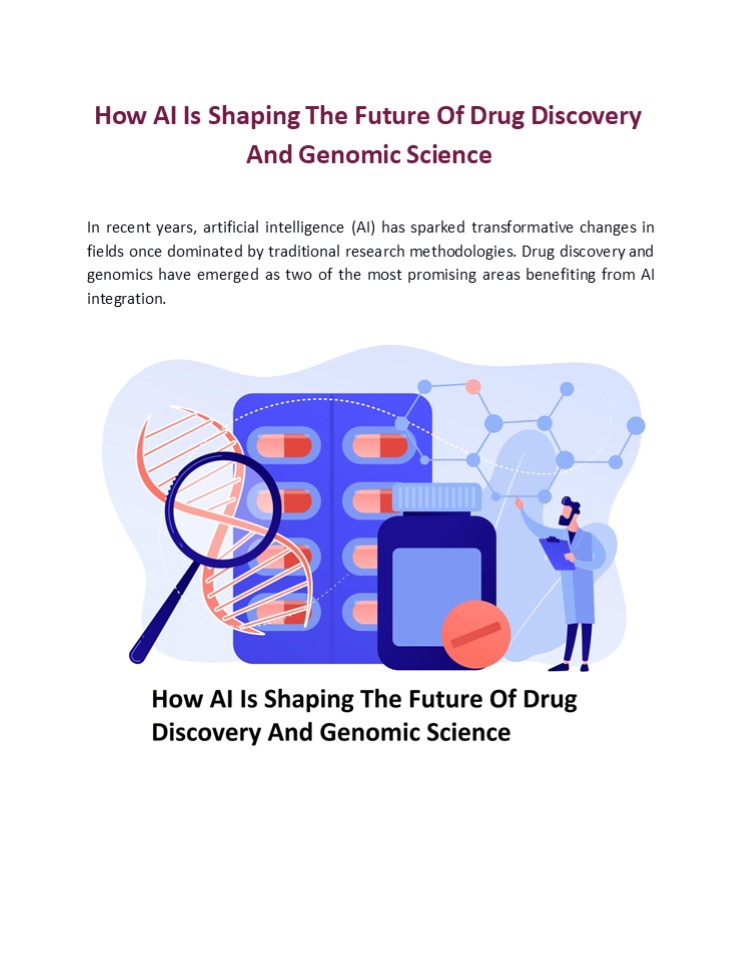
Title: How AI Is Shaping The Future Of Drug Discovery And Genomic Science
1
How AI Is Shaping The Future Of Drug Discovery
And Genomic Science
In recent years, artificial intelligence (AI) has
sparked transformative changes in fields once
dominated by traditional research methodologies.
Drug discovery and genomics have emerged as two
of the most promising areas benefiting from AI
integration.
2
With the global AI in the healthcare market
projected to grow at a compound annual growth
rate (CAGR) of 38.5 from 2024 to 2030, reaching
approximately 187.95 billion by 2030, the impact
of AI on drug discovery and genomic research is
both profound and accelerating. At the heart of
these advancements is generative AI, a technology
redefining how scientists identify drug
compounds, predict biological interactions, and
hasten genomics research. The Current Landscape
Of Drug Discovery And Genomic Research The usual
drug discovery process is extensive, frequently
taking over a decade and costing billions.
Genomic research, essential for personalized
medicine, faces similar challenges in terms of
time, cost, and accuracy. AI, and more
specifically generative AI, is alleviating these
challenges by offering new techniques that save
time and reduce costs. AIs entrance into
drug discovery has brought powerful data
processing capabilities, allowing researchers
to handle enormous datasets that were
previously unmanageable. In genomics, AI-driven
tools are helping scientists uncover patterns in
DNA, leading to breakthroughs in personalized
medicine. A 2023 report indicates that AI-driven
methods could reduce the drug discovery time by
nearly 50, allowing life-saving treatments to
reach the market much faster. Drug Discovery
With Generative AI Unlocking New
Potentials Generative AI is poised to
revolutionize drug discovery by accelerating the
initial stages of identifying viable drug
compounds. Unlike traditional AI, which relies on
patterns within existing data, generative AI
models like GANs (Generative Adversarial
Networks) and transformers create entirely new
data points based on learned patterns. In drug
discovery, this translates to the ability to
design novel molecules and compounds,
significantly expanding the pool of
potential therapeutics.
3
- Identifying New Drug Compounds
- Generative AI allows researchers to "imagine" new
molecules that could act as potential drug
candidates. Companies like Insilico Medicine are
leveraging AI models to design molecules with
properties tailored to specific disease targets.
A report by MarketsandMarkets predicts that the
AI-driven drug discovery market will reach 4.9
billion by 2028, indicating the growing reliance
on AI technologies to uncover drug compounds that
were previously beyond human reach. - Predicting Biological Interactions
- Beyond merely creating new compounds, generative
AI predicts how these compounds will interact
with biological systems. Artificial intelligence
(AI) models can predict the safety and efficacy
of drug candidates by mimicking molecular
interactions, which enables the early rejection
of those with low potential. In 2022, researchers
demonstrated that AI could predict protein-ligand
binding, a crucial aspect in drug development,
with a high degree of accuracy. - Accelerating Preclinical Testing
- AI helps streamline preclinical testing by
automating data analysis, identifying the most
promising compounds quickly, and reducing
the need for extensive laboratory tests.
Pfizer, for example, has employed AI to enhance
preclinical stages, resulting in a more efficient
drug development pipeline. - Genomic Research Transformed By AI
Precision And Personalization - Genomic research underpins personalized medicine,
aiming to tailor treatments to an individual's
genetic profile. AI has proven indispensable in
this field, enabling rapid analysis of complex
genetic data and making breakthroughs in
identifying genetic markers for diseases.
4
- Decoding Genomic Data Faster
- Genomic data sets are vast, containing millions
of data points for each individual. AI algorithms
process these volumes much faster than
traditional methods, drastically reducing the
time it takes to analyze genetic variations. In
fact, AI has cut sequencing times from weeks to
mere hours, allowing researchers to identify
genetic mutations linked to diseases such as
cancer, diabetes, and Alzheimer's more
efficiently. - Enhancing Precision Medicine
- With AI-driven genomics, researchers can develop
targeted treatments based on individual genetic
profiles. Generative AI plays a significant role
here, helping researchers simulate how different
genetic makeups might respond to various drugs.
According to a 2022 study published in Nature
Genetics, AI has boosted precision medicine
efficacy rates by approximately 35 due to more
accurate predictions in patient responses. - Identifying Disease Markers And Genetic Mutations
- AI algorithms can pinpoint disease markers
and mutations that increase susceptibility to
certain conditions. The technology is being used
to identify markers for early disease detection,
offering hope for interventions that could
mitigate or even prevent certain genetic
diseases. - Generative AI Shaping The Future Of Drug And
Genomic Research - The capabilities of generative AI are especially
promising in accelerating genomic studies. By
simulating mutations and gene expressions,
generative AI can predict potential health
impacts, assisting in early disease prevention.
As AI models evolve, their ability to decode
human DNA will unlock new layers of information
about hereditary diseases and treatment
responses, promising revolutionary changes in
healthcare.
5
- A 2023 McKinsey report emphasizes that AI has the
potential to generate annual savings of 200-300
billion in healthcare by improving
decision-making in drug discovery and genomics.
As generative AI models advance, these savings
are likely to increase, enabling pharmaceutical
companies and research institutions to invest
further in RD and bring life-saving solutions to
the market faster. - Key Benefits Of AI In Drug Discovery And Genomics
- Accelerated Discovery Process By automating data
analysis and generating predictive models, AI
reduces drug discovery timelines from years to
months. - Cost Efficiency By reducing the need for
physical trials and expediting chemical
identification, AI lowers the cost of medication
discovery. - Higher Success Rates Predictive modeling in AI
enables researchers to - identify the most promising compounds early,
improving the likelihood of successful outcomes
in clinical trials. - Personalized Treatment Options In genomics, AI
enables a deeper - understanding of genetic data, paving the way for
treatments tailored to each individual, which is
particularly valuable in oncology and rare
genetic diseases. - Ethical And Practical Considerations In AI-Driven
Drug Discovery - While AI offers unprecedented potential, ethical
considerations remain. The transparency of AI
models, patient privacy, and ensuring equitable
access to AI-driven treatments are crucial
factors to address. Additionally, as AI models
become more complex, there is a need for
regulatory oversight to ensure that AI-generated
compounds and genetic modifications adhere to
safety standards.
6
EnFuse Solutions Powering The Future Of Drug
Discovery And Genomic Research As a leading
provider of AI and data solutions, EnFuse
Solutions supports pharmaceutical companies and
genomic research institutions in implementing
cutting-edge technologies. Leveraging their
expertise in data annotation, AI model training,
and data management, EnFuse Solutions aids
clients in streamlining drug discovery pipelines
and enhancing genomic research accuracy. From
curating high-quality datasets for training
models to ensuring regulatory compliance, EnFuse
Solutions plays an integral role in the
AI-driven transformation of healthcare. Conclusio
n Embracing AI For A Healthier Future A new era
of medical progress is being ushered in by
AI-driven medication discovery and genetic
research. With generative AI at the helm,
identifying new drug compounds, predicting
biological interactions, and accelerating
genomics research are no longer distant goals but
present-day realities. The technology not only
promises faster drug development but also a more
personalized approach to treatment, with
substantial implications for patient care
worldwide. EnFuse Solutions stands at the
forefront of this transformation, offering
essential services to support the pharmaceutical
and healthcare sectors in their AI journeys.
7
For organizations looking to accelerate their RD
with data-driven insights and AI solutions,
EnFuse Solutions provides the expertise and
resources needed to lead in this innovative
field. Connect with EnFuse Solutions today to
harness the power of AI for your research
initiatives and contribute to a healthier, more
resilient future. By embracing AI, we are not
only advancing healthcare but also making strides
toward a future where medicine is faster, more
precise, and deeply personalized. Read More
Exploring The Creative Power Of Generative AI A
Deep Dive Into The World Of Neural Networks
Recommended

