

A Guide To Legal Regulations For Car Sun Films PowerPoint PPT Presentation
Title: A Guide To Legal Regulations For Car Sun Films
1
A Guide To Legal Regulations For Car Sun Films
Car owners frequently choose car sun films
because of its advantages, which include improved
privacy, heat reduction, and UV protection.
However, strict legal regulations, particularly
with regard to visible light transmission (VLT),
govern the usage of sun films in India. It is
essential to comprehend these rules in order to
guarantee adherence and prevent significant
penalties. The main features of Indias
automotive sun film regulations, which might have
strict enforcement, will be covered in this
tutorial. The basics of VLT regulations in
India Citing safety concerns, the Supreme Court
of India declared in 2012 that it was unlawful to
use sun films on vehicles. Vehicle windows must
meet certain Visible Light Transmission (VLT)
limits, as stipulated by the Bureau of Indian
Standards (BIS) and Rule 100 of the Central Motor
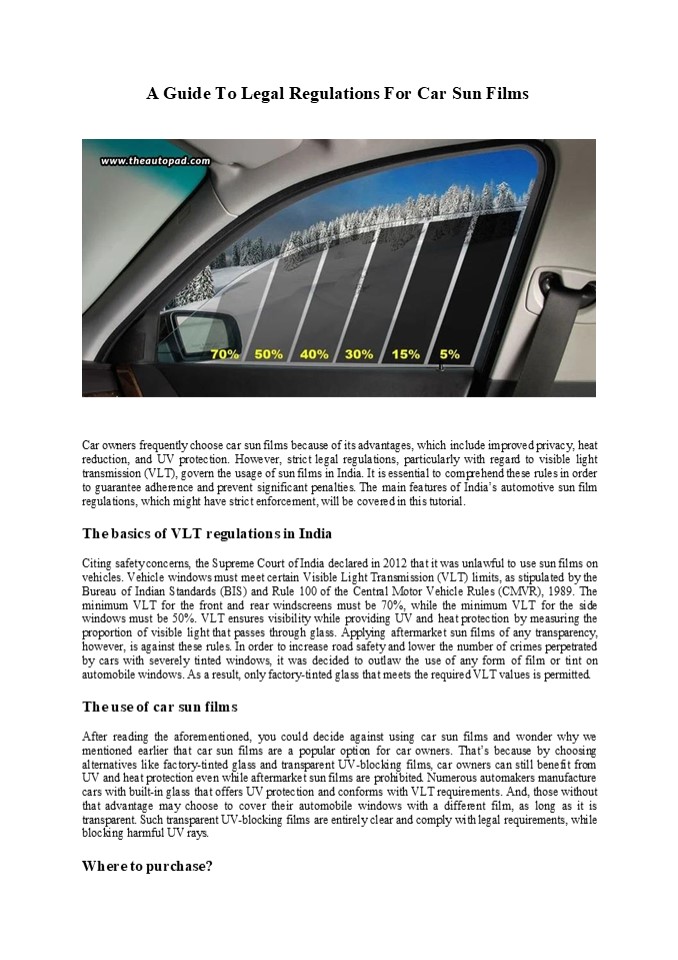
Vehicle Rules (CMVR), 1989. The minimum VLT for
the front and rear windscreens must be 70, while
the minimum VLT for the side windows must be 50.
VLT ensures visibility while providing UV and
heat protection by measuring the proportion of
visible light that passes through glass. Applying
aftermarket sun films of any transparency,
however, is against these rules. In order to
increase road safety and lower the number of
crimes perpetrated by cars with severely tinted
windows, it was decided to outlaw the use of any
form of film or tint on automobile windows. As a
result, only factory-tinted glass that meets the
required VLT values is permitted. The use of car
sun films After reading the aforementioned, you
could decide against using car sun films and
wonder why we mentioned earlier that car sun
films are a popular option for car owners. Thats
because by choosing alternatives like
factory-tinted glass and transparent UV-blocking
films, car owners can still benefit from UV and
heat protection even while aftermarket sun films
are prohibited. Numerous automakers manufacture
cars with built-in glass that offers UV
protection and conforms with VLT requirements.
And, those without that advantage may choose to
cover their automobile windows with a different
film, as long as it is transparent. Such
transparent UV-blocking films are entirely clear
and comply with legal requirements, while
blocking harmful UV rays. Where to purchase?
2
Autopad is one place you can visit if youre
persuaded enough to invest in transparent
UV-blocking films. In addition to meeting legal
requirements, Autopad sun films for car in
Jayanagar offer outstanding protection from heat
and UV radiation by combining cutting-edge
technology with premium materials. By lowering
glare and keeping the interior cooler, these
films guarantee a comfortable ride while
maintaining the vehicles visual appeal. Autopad
provides reliable options that are customized to
meet your needs, whether you want to improve
privacy, safeguard the interior of your car, or
prioritize your health. You can explore the range
of high-quality sun films at Autopad, and make
the smart choice for your car. How to stay
updated on regional regulations? Despite the
aforementioned, its crucial to always be aware
of any changes to local regulations through
official government channels or your states
official traffic police website. It can be
difficult to navigate the legalities of car sun
films in India. However, you can benefit from UV
and heat protection without incurring penalties
if you are aware of the rules and use compliance
solutions. When thinking about making changes to
your car, safety and legality should always come
first. Resource Read more
Recommended

