

New Holland W70BTC Wheel Loader Service Repair Manual Instant Download PowerPoint PPT Presentation
Title: New Holland W70BTC Wheel Loader Service Repair Manual Instant Download
1
1
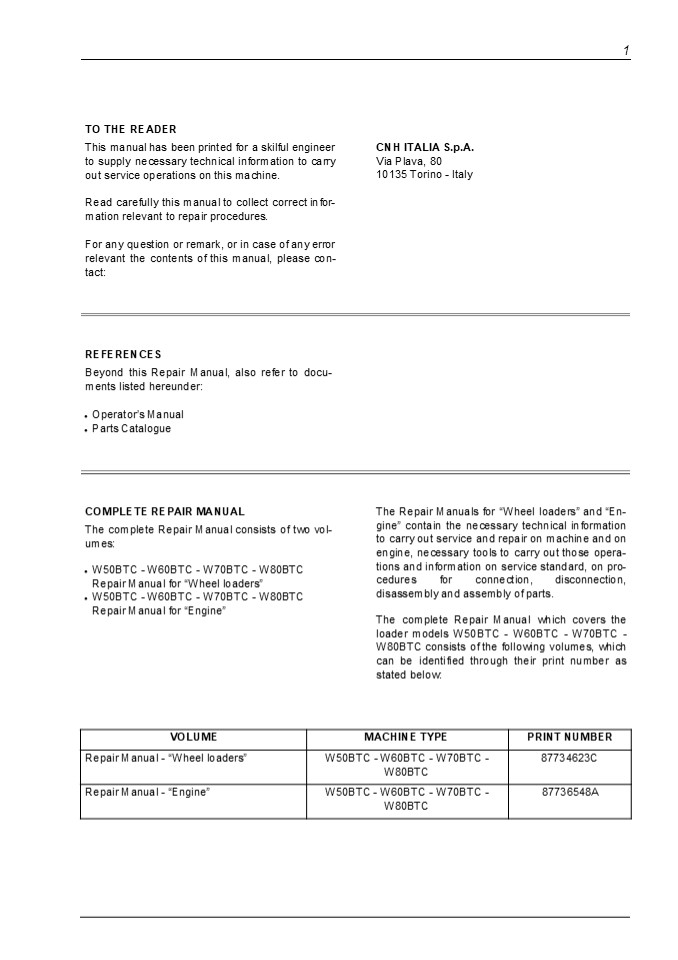
TO THE READER This manual has been printed for a
skilful engineer to supply necessary technical
information to carry out service operations on
this machine.
CNH ITALIA S.p.A. Via Plava, 80 10135 Torino -
Italy
Read carefully this manual to collect correct
infor- mation relevant to repair procedures. For
any question or remark, or in case of any error
relevant the contents of this manual, please con-
tact
- REFERENCES
- Beyond this Repair Manual, also refer to docu-
ments listed hereunder - Operators Manual
- Parts Catalogue
COMPLETE REPAIR MANUAL The complete Repair Manual
consists of two vol- umes
The Repair Manuals for Wheel loaders and En-
gine contain the necessary technical information
to carry out service and repair on machine and on
engine, necessary tools to carry out those opera-
tions and information on service standard, on
pro- cedures for connection, disconnection,
disassembly and assembly of parts.
- W50BTC - W60BTC - W70BTC - W80BTC
- Repair Manual for Wheel loaders
- W50BTC - W60BTC - W70BTC - W80BTC
- Repair Manual for Engine
The complete Repair Manual which covers the
loader models W50BTC - W60BTC - W70BTC - W80BTC
consists of the following volumes, which can be
identified through their print number as stated
below
VOLUME MACHINE TYPE PRINT NUMBER
Repair Manual - Wheel loaders W50BTC - W60BTC - W70BTC - W80BTC 87734623C
Repair Manual - Engine W50BTC - W60BTC - W70BTC - W80BTC 87736548A
2
2
TO PREVENT ACCIDENTS The majority of accidents
and injuries which occur in industry, on the
farm, at home or on the road, are caused by the
failure of some individual to follow simple and
fundamental safety rules or precautions. For this
reason MOST ACCIDENTS CAN BE PREVENTED by
recognizing the real cause and taking the
necessary precautions, before the accident
occurs. Regardless of the care used in design
and construction of any type of equipment, there
may be conditions that cannot be completely
safeguarded against, without interfering with
reasonable accessibility and efficient
operation. A careful operator and / or
technician is the best insurance against
accidents. The complete ob- servance of one
simple rule would prevent many thousands of
serious injuries each year. This rule is never
attempt to clean, lubricate or adjust a machine
while it is in motion.
S WARNING Before carrying out any maintenance
operation, adjustment and or repair on machines
equipped with attachments, controlled
hydraulically or mechanically, make sure that the
attachment is low- ered and safely set on the
ground. If it is necessary to have the equipment
partially or fully raised to gain access to
certain items, be sure the equipment is suitably
supported by means other than the hydraulic lift
cylinders, cable and /or mechanical device used
for controlling the equipment.
CNH S.p.A. Via Plava, 80 10135 Torino -
Italy All rights reserved. Reproduction of text
or illustrations, in whole or in part, is
strictly prohibited.
3
INDEX
- SECTION 00 - INTRODUCTION
- SAFETY INSTRUCTIONS ..............................
..................................................
............................................ 1 - GENERAL SAFETY INSTRUCTIONS ......................
..................................................
.................................. 2 - TECHNICAL SPECIFICATIONS.........................
..................................................
...................................... 12 - SECTION 10 - ENGINE
- DIESEL ENGINE ....................................
..................................................
..................................................
.. 1 - FUEL SYSTEM ......................................
..................................................
..................................................
... 2 - COLD START DEVICE (NORTH AMERICA)
..................................................
............................................. 5 - SECTION 25 - FRONT AXLES
- REMOVAL AND INSTALLATION .........................
..................................................
...................................... 1 - DIMENSIONS .......................................
..................................................
..................................................
.... 3 - TECHNICAL SPECIFICATIONS.........................
..................................................
........................................ 5 - OIL CHANGE.......................................
..................................................
..................................................
... 11 - DISASSEMBLY AND ASSEMBLY..........................
..................................................
.................................. 14 - DISC BRAKE ASSY (W50BTC)..........................
..................................................
............................... 14 - 5.1.2 BRAKE CALIPER ..............................
..................................................
............................................. 21 - DISK BRAKE ASSY (W60BTC, W70BTC, W80BTC)
..................................................
........................ 29
4
https//www.ebooklibonline.com Hello dear
friend! Thank you very much for reading. Enter
the link into your browser. The full manual is
available for immediate download. https//www.ebo
oklibonline.com
5
- INDEX
- REDUCTION GEAR (W50BTC)...........................
..................................................
.............................. 54 - REDUCTION UNIT (W60BTC, W70BTC, W80BTC)
..................................................
......................... 57 - WHEEL HUB (W50BTC)................................
..................................................
.................................... 61 - WHEEL HUB (W60BTC, W70BTC, W80BTC)................
..................................................
................... 70 - WHEEL SHAFT (W60BTC, W70BTC, W80BTC)
..................................................
.............................. 76 - DIFFERENTIAL SUPPORT .............................
..................................................
................................ 80 - DIFFERENTIAL ASSY ................................
..................................................
..................................... 88 - LIMITED SLIP DIFFERENTIAL ASSY ...................
..................................................
.......................... 94 - PINION............................................
..................................................
...............................................
101 - TROUBLESHOOTING ..................................
..................................................
.......................................... 107 - SPECIAL TOOLS.....................................
..................................................
...............................................
110 - SECTION 33 - BRAKE SYSTEM
- BRAKE SYSTEM DIAGRAM ............................
..................................................
......................................... 1 - STANDARD DIAGRAM (W50BTC).........................
..................................................
............................. 1 - STANDARD DIAGRAM (W60BTC, W70BTC, W80BTC)
..................................................
.................... 2 - HIGH SPEED DIAGRAM (W60BTC, W70BTC,
W80BTC)...........................................
....................... 3
6
- INDEX
- VARIABLE-DISPLACEMENT PISTON PUMP
..................................................
......................................... 22 - TECHNICAL SPECIFICATIONS..........................
..................................................
.............................. 23 - MAIN VALVES ......................................
..................................................
............................................. 24 - DISASSEMBLY.......................................
..................................................
........................................... 32 - ASSEMBLY..........................................
..................................................
.............................................. 51 - GEAR PUMP ........................................
..................................................
..................................................
.. 58 - TECHNICAL SPECIFICATIONS..........................
..................................................
.............................. 58 - COMPONENTS .......................................
..................................................
.......................................... 59 - DISASSEMBLY AND ASSEMBLY..........................
..................................................
........................... 60 - PRIORITY VALVE ...................................
..................................................
.................................................
63 - TECHNICAL SPECIFICATIONS..........................
..................................................
.............................. 63 - TRAVEL MOTOR.....................................
..................................................
.................................................
64 - TECHNICAL SPECIFICATIONS..........................
..................................................
.............................. 64 - MAIN COMPONENTS ..................................
..................................................
..................................... 66 - OPERATION.........................................
..................................................
............................................. 67 - REMOVAL ..........................................
..................................................
...............................................
70 - DISASSEMBLY AND ASSEMBLY..........................
..................................................
........................... 71
7
- INDEX
- SECTION 55 - ELECTRICAL SYSTEM
- ELECTRICAL DIAGRAMS..............................
..................................................
............................................ 1 - FUSES AND RELAYS .................................
..................................................
............................................. 17 - VOLTAGE AND CONTINUITY CHECK .....................
..................................................
............................... 20 - BATTERY...........................................
..................................................
..................................................
..... 21 - REPLACEMENT ......................................
..................................................
.......................................... 24 - BULBS ...........................................
..................................................
..................................................
......... 25 - TROUBLESHOOTING ..................................
..................................................
............................................ 29 - SECTION 82 - WORKING EQUIPMENT
- HYDRAULIC DIAGRAM................................
..................................................
.............................................. 2 - OPERATION ........................................
..................................................
..................................................
..... 3 - REMOVAL AND INSTALLATION .........................
..................................................
...................................... 4 - QUICK TOOL COUPLER................................
..................................................
............................................ 6 - COMPONENTS ......................................
..................................................
............................................. 7 - QUICK TOOL COUPLER CYLINDERS .....................
..................................................
.......................... 8 - BUCKET............................................
..................................................
..................................................
........ 9
8
SECTION 00 - INTRODUCTION
- SAFETY INSTRUCTIONS ..............................
..................................................
............................................ 1 - GENERAL SAFETY INSTRUCTIONS ......................
..................................................
.................................. 2 - TECHNICAL SPECIFICATIONS.........................
..................................................
...................................... 12
9
SECTION 00 - INTRODUCTION
1
1. SAFETY INSTRUCTIONS Carefully read the safety
rules contained herein and follow advised
precautions to avoid potential haz- ards and to
safeguard your safety and personal in-
tegrity. In this manual you will find the
following indications S WARNING This symbol
warns about the possibility of potential damages
to the machine that can involve the opera- tors
safety. S DANGER With specific warnings about
potential dangers for the operators or other
persons integrity directly or indirectly
involved. The non compliance with the warning
preceded by the above mentioned key-words
(WARNING and DANGER) can cause serious accidents
or even the death of the persons
involved. Moreover in the present Manual have
been given some instructions with texts in
italics, preceded by the words NOTE and CAUTION,
with following meanings for machine
protection NOTES it emphasizes and underlines
to the opera- tor the correct technique or
correct procedure to fol- low. S WARNING It
warns the operator of a possible hazard of
machine damage in case he does not follow a
determined pro- cedure. Your safety and that of
people around you depends on you. It is essential
that you understand this man- ual for the correct
operation, inspection, lubrication and
maintenance of this machine.
10
2
SECTION 00 - INTRODUCTION
2. GENERAL SAFETY INSTRUCTIONS Carefully read
this Manual before proceeding with maintenance,
repairs, refuelling or other machine
operations. Repairs have to be carried out only
by authorized and instructed staff specific
precautions have to be taken when grinding,
welding or when using mallets or heavy
hammers. Not authorized persons are not allowed
to repair or carry out maintenance on this
machine. Do not carry out any work on the
equipment without prior authori- zation. Ask your
employer about the safety instructions in force
and safety equipment. Nobody is allowed to seat
on the operators place during machine
maintenance unless he is a qualified operator
helping with the maintenance work. If it is
necessary to move the equipment to carry out
repairs or maintenance, do not lift or lower the
equip- ment from any other position than the
operators seat. Never carry out any operation on
the machine when the engine is running, except
when specifically indi- cated. Stop the engine
and ensure that all pressure is re- lieved from
hydraulic circuits before removing caps, covers,
valves, etc. All repair and maintenance
operations should be carried out with the
greatest care and attention. Service stairs and
platforms used in a workshop or in the field
should be built in compliance with the safety
rules in force. Any functional disorders,
especially those affecting the safety of the
machine, should therefore be recti- fied
immediately.
11
SECTION 00 - INTRODUCTION
3
2.1 EMERGENCY Be prepared for emergencies.
Always keep at dis- posal on the machine a first
aid kit and a fire extin- guisher. Make sure that
the fire extinguisher is serviced in accordance
with the manufacturers in- structions.
- EQUIPMENT
- Wear close fitting clothing and safety equipment
ap- propriate for the job - safety helmet
- safety shoes
- heavy gloves
- reflective clothing
- wet weather clothing.
- If the environment conditions make it necessary,
the following personal safety equipment should be
at hand - respirators (or dustproof masks)
- ear plugs or acoustic ears protections
- goggles with lateral shield or masks for eyes
pro- tection. - Do not wear rings, wristwatches, jewels,
unbuttoned or flapping clothing such as ties,
torn clothes, scarves, open jackets or shirts
with open zips which could get caught into moving
parts.
12
4
SECTION 00 - INTRODUCTION
2.3 PLACING THE MACHINE IN SAFE
CONDITIONS Before carrying out any repair
operation on this ma- chine, place it in safe
conditions. Move the machine to a level and firm
ground, away from any soft ground, excavations or
poorly shored cavity. Rest the bucket on the
ground. Place the direction-of-travel lever and
gearshift lever in neutral position. Immobilize
the machine by means of the parking brake. Stop
the engine and remove the starter switch key.
Release the hydraulic pressure by operating the
control levers in all directions. Place some
wedges under the wheels so as to pre- vent the
machine from moving. Make sure that the door and
the engine guard are correctly fastened and lock
the operators compart- ment door. Check that no
part of the machine is protruding onto the public
highway. If this cannot be avoided, install signs
in compliance with the relevant regulations.
13
SECTION 00 - INTRODUCTION
5
2.4 ENGINE - RADIATOR Never leave the engine run
in closed spaces without ventilation and not able
to evacuate toxic exhaust gases. Keep the exhaust
manifold and tube free from combustion
materials. Do not refuel with the engine running,
especially if hot, as this increases fire hazard
in case of fuel spill- age. Never attempt to
check or adjust the fan belts when the engine is
running. Never lubricate the machine with the
engine run- ning. Pay attention to rotary pieces
and do not allow to an- yone to approach to avoid
becoming entangled. If hands, clothes or tools
get caught in the fan blades or in the
transmission belt, this can cause amputa- tions,
violent tears and generate condition of serious
danger for this reason avoid touching or to come
close to all rotary or moving parts. A violent
jet of the coolant from the radiator can cause
damages and scalds. If you are to check the
coolant level, you have to shut off the engine
previously and to let cool down the ra- diator
and its pipes. Slowly unscrew the cap to re-
lease the inside pressure. If necessary, remove
the cap with hot engine, wear safety clothes and
equipment, then loosen the cap slowly to relieve
the pressure gradually. When checking the fuel,
oil and coolant levels, use exclusively explosion
proof classified lamps. If this kind of lamps are
not used fires or explosions may occur.
14
6
SECTION 00 - INTRODUCTION
2.5 HYDRAULIC SYSTEMS Splashes of fluids under
pressure can penetrate the skin causing serious
injuries. Avoid this hazard by relieving pressure
before dis- connecting hydraulic or other
lines. Relieve the residual pressure by moving
the hydrau- lic control levers several
times. Tighten all connections before applying
pressure. To protect the eyes wear a facial
shield or safety goggles. Protect your hands and
body from possible splashes of fluids under
pressure. Swallowing hydraulic oil is a severe
health hazard. When hydraulic oil has been
swallowed, avoid vom- iting, but consult a doctor
or go to a hospital. If an accident occurs, see a
doctor familiar with this type of injury
immediately. Any fluid penetrating the skin must
be removed with- in few hours to avoid serious
infections. Flammable splashes may originate
because of the heat near pipes with fluids under
pressure, with the result of serious scalds for
the persons hit. Do not weld or use torches near
pipes containing fluids or other flammable
materials. Pipes under pressure can accidentally
be pierced when the heat expands beyond the area
immediate- ly heated. Arrange for fire resistant
temporary shields to pro- tect hoses or other
components during welding. Have any visible
leakage repaired immediately. Escaping oil
pollutes the environment. Soak up any oil that
has escaped with a proper binding agent. Sweep up
binding agent and dispose of it separately from
other waste. Never search for leakages with the
fingers, but use a piece of cardboard and always
wear goggles. Never repair damaged piping always
replace it. Re- place hydraulic hoses immediately
on detecting any damage or leak. Always store
hydraulic oil in the original containers.
15
SECTION 00 - INTRODUCTION
7
HOSES AND TUBES Always replace hoses and tubes if
the cone end or the end connections on the hose
are damaged. When installing a new hose, loosely
connect each end and make sure the hose takes up
the designed position before tightening the
connections. Clamps should be tightened
sufficiently to hold the hose with- out crushing
and to prevent chafing. After hose replacement to
a moving component, check that the hose does not
foul by moving the component through the complete
range of travel. Be sure any hose which has been
installed is not kinked or twisted. Hose
connections which are damaged, dented, crushed or
leaking, restrict oil flow and the productiv- ity
of the components being served. Connectors which
show signs of movement from the original po-
sition have failed and will ultimately separate
com- pletely. A hose with a frayed outer sheath
will allow the water penetration. Concealed
corrosion of the wire rein- forcement will
subsequently occur along the hose length with
resultant hose failure. Ballooning of the hose
indicates an internal leakage due to structural
failure. This condition rapidly deteri- orates
and total hose failure soon occurs. Kinked,
crushed, stretched or deformed hoses gen- erally
suffer internal structural damage which can re-
sult in oil restriction, a reduction in the speed
of operation and ultimate hose failure. Free-movin
g, unsupported hoses must never be al- lowed to
touch each other or related working surfac- es.
This causes chafing which reduces hose
life. O-RINGS Replace O-rings, seal rings and
gaskets whenever they are disassembled. Never mix
new and old seals or O-rings, regardless of
condition. Always lubricate new seal rings and O-
rings with hydraulic oil before installation to
relevant seats. This will prevent the O-rings
from rolling over and twisting during mounting
which will jeopardize seal- ing.
16
8
SECTION 00 - INTRODUCTION
- BATTERY
- Batteries give off explosive gases.
- Never handle naked flames and unshielded light
sources near batteries, never smoke. - To prevent any risk of explosion, observe the
follow- ing instructions - when disconnecting the battery cables, always
dis- connect the negative (-) cable first - to reconnect the battery cables, always connect
the negative (-) cable last - never short-circuit the battery terminals with
metal objects - do not weld, grind or smoke near a battery.
Battery electrolyte causes severe burns. The
battery contains sulphuric acid. Avoid any
contact with the skin, eyes or clothing. - Antidote
- EXTERNAL rinse well with water, removing any
soiled clothing. - INTERNAL avoid vomiting. Drink water to rinse
your mouth. Consult a doctor. - EYES rinse abundantly with water for 15 minutes
and consult a doctor. - When the electrolyte of a battery is frozen, it
can explode if you attempt to charge the battery
or if you try to start the engine using a booster
battery. Always keep the battery charged to
prevent the electrolyte freezing. - Provide good ventilation when changing a battery
or using a battery in an enclosed space. Always
protect your eyes when working near a battery. - Never set tools down on the battery. They may in-
duce a short circuit, causing irreparable damage
to the battery and injuring persons. - Never wear metal necklaces, bracelets or watch-
straps when working on the battery. The metal
parts may induce a short circuit resulting in
burns. - Dispose of used batteries separately from other
waste in the interests of environmental
protection.
17
SECTION 00 - INTRODUCTION
9
- FLAMMABLE LIQUIDS
- When handling flammable liquids
- do not smoke
- keep away from unshielded light sources and na-
ked flames. - Fuels often have a low flash point and are
readily ig- nited. - Never attempt to extinguish burning liquids with
wa- ter. Use - dry powder
- with carbon dioxide
- with foam.
- Water used for extinguishing purposes would
vapor- ize instantaneously on contact with
burning sub- stances and spread burning oil, for
example, over a wide area. Water generates short
circuits in the elec- trical system, possibly
producing new hazards. - Stay away from open flames during refilling of
hy- draulic oil or fuel. - Fuel or oil splashes can cause slipping and
therefore accidents clean immediately and
accurately the ar- eas eventually smeared. - Always tighten the safety plugs of fuel tank and
hy- draulic oil tank firmly. - Never use fuel to clean the machine parts
eventually smeared with oil or dust. - Use a non-inflammable product for cleaning parts.
Always perform fuel or oil refilling in well
aired and ventilated areas. - During refuelling hold the pistol firmly and keep
it al- ways in contact with the filler neck until
the end of the refuelling, to avoid sparkles due
to static electricity. Do not overfill the tank
but leave a space for fuel ex- pansion.
18
Suggest If the above button click is invalid.
Please download this document first, and then
click the above link to download the complete
manual. Thank you so much for reading
19
10
SECTION 00 - INTRODUCTION
- TYRES
- Before inflating the tyres, always check the
condition of rims and the outer condition of
tyres to find out the presence of dents, cuts,
tears of reinforcement plies or other faults.
Before inflating a tyre, make sure that there are
no nearby persons, then position yourself at
tread side. - Make sure that the inflating pressure of tyres is
the same prescribed by manufacturer and that the
pres- sure of the right tyre corresponds to the
pressure of the left tyre. - Never use reconditioned rims because possible
welds, heat treatments or brazings not performed
correctly can weaken the wheels and cause follow-
ing damages or failures. Deflate the tyres before
their disassembly. - Before taking out possible jammed objects from
the rims, it is necessary to deflate the tyres.
Inflate tyres by means of a pistol complete with
extension and pressure switch of control. - CLEANING
- Clean the exterior of all components before
carrying out any form of repair. Dirt and dust
can reduce the efficient working life of a
component and lead to costly replacement. - Solvents should be checked that they are suitable
for the cleaning of components and also that they
do not risk the personal safety of the user. - Dirt from oil or grease and scattered tools or
faulty pieces are dangerous for persons, because
they can generate slipping or falls. - For the machine cleaning, use a jet of warm water
or steam under pressure and commercial
detergents. Never use fuel, petroleum or
solvents, because the first ones leave an oily
layer that favours the sticking of dust, while
solvents (even if weak) damage the paint and
favour the formation of rust. - Never use water jets or steam on sensors, connec-
tors or other electric components. - Prevent that the water jet penetrates inside the
cab.
20
https//www.ebooklibonline.com Hello dear
friend! Thank you very much for reading. Enter
the link into your browser. The full manual is
available for immediate download. https//www.ebo
oklibonline.com
Recommended

