

CASE IH FARMALL 95N Tractor Service Repair Manual Instant Download PowerPoint PPT Presentation
Title: CASE IH FARMALL 95N Tractor Service Repair Manual Instant Download
1
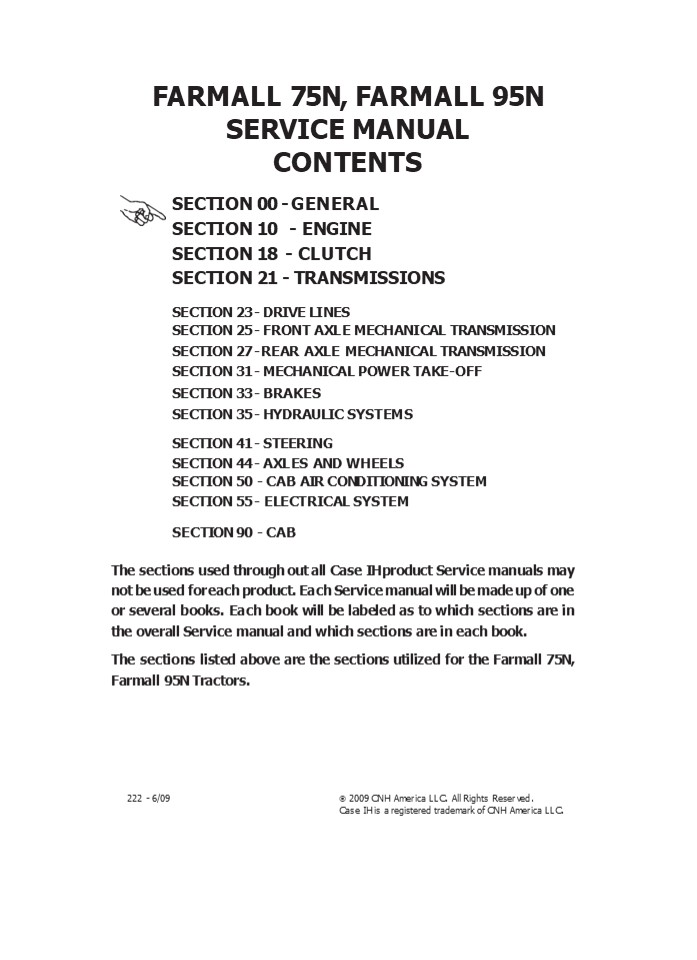
FARMALL 75N, FARMALL 95N SERVICE MANUAL CONTENTS
SECTION 00 - GENERAL SECTION 10 - ENGINE
SECTION 18 - CLUTCH SECTION 21 -
TRANSMISSIONS SECTION 23 - DRIVE LINES SECTION 25
- FRONT AXLE MECHANICAL TRANSMISSION SECTION 27
- REAR AXLE MECHANICAL TRANSMISSION SECTION 31 -
MECHANICAL POWER TAKE-OFF SECTION 33 -
BRAKES SECTION 35 - HYDRAULIC SYSTEMS SECTION 41
- STEERING SECTION 44 - AXLES AND WHEELS SECTION
50 - CAB AIR CONDITIONING SYSTEM SECTION 55 -
ELECTRICAL SYSTEM SECTION 90 - CAB The sections
used through out all Case IH product Service
manuals may not be used for each product. Each
Service manual will be made up of one or several
books. Each book will be labeled as to which
sections are in the overall Service manual and
which sections are in each book. The sections
listed above are the sections utilized for the
Farmall 75N, Farmall 95N Tractors.
? 2009 CNH America LLC. All Rights Reserved. Case
IH is a registered trademark of CNH America LLC.
222 - 6/09
2
SECTION 00 - GENERAL - CHAPTER 1
1
SECTION 00 - GENERAL Chapter 1 -
General CONTENTS
Description Page General Instructions
..................................................
.......... 2 Important Notice ....................
........................................
2 Battery ........................................
............................ 2 Shimming
..................................................
................ 2 Rotating Shaft Seals
..................................................
...... 2 O- Ring Seals ..........................
.................................... 2 Sealing
Compounds ........................................
................. 2 Bearings .....................
..............................................
2 Spring Pins ....................................
............................ 3 Spare Parts
..................................................
.............. 3 Notes for Equipment
..................................................
...... 3 Important Notes .........................
................................... 3 Moving the
Tractor with the Battery Removed
................................... 3 Safety
Regulations ......................................
....................... 4 Safety Symbols
..................................................
........... 4 To Prevent Accidents
..................................................
...... 4 General Guidelines ......................
................................... 4 Start Up
..................................................
................. 6 Engine .......................
.............................................
6 Electrical Systems .............................
............................. 6 Hydraulic Systems
..................................................
........ 6 Wheels and Tires ......................
..................................... 6 Removal
and Installation .................................
.................... 6 Tractor Refuelling
..................................................
............ 7
Section
3
2
SECTION 00 - GENERAL - CHAPTER 1
- GENERAL INSTRUCTIONS
- IMPORTANT NOTICE
- All maintenance and repair work described in this
manual must be performed exclusively by CASE IH
service technicians, in strict accordance with
the instructions given and using any specific
tools necessary. - Anyone performing the operations described herein
without strictly following the instructions is
personally re- sponsible for any eventual injury
or damage to property. - BATTERY
- Before carrying out any kind of service operation
disconnect and isolate the battery negative lead,
unless other- wise requested for specific
operations (e.g operations that require the
engine running). Once the specific opera- tion
has been completed, disconnect the lead in order
to complete the operation. - SHIMMING
- For each adjustment operation, select adjusting
shims and measure individually using a
micrometer, then add up the recorder values Do
not rely on measuring the entire shimming set,
which may be incorrect, or the rated value
indicated for each on shim. - ROTATING SHAFT SEALS
- For correct rotating shaft seal installation,
proceed as follows - before assembly, allow the seal to soak in the
oil it will be sealing for at least thirty
minutes - thoroughly clean the shaft and check that the
working surface on the shaft is not damaged - position the sealing lip facing the fluid with
hydrodynamic lips, take into consideration the
shaft rotation direc- tion and position the
grooves so that they will deviate the fluid
towards the inner side of the seal - smear the sealing lip with a thin layer of
lubricant (use oil rather than grease) and fill
the gap between the sealing lip and the dust lip
on double lip seals with grease - insert the seal in its seat and press down using
a flat punch do not tap the seal with a hammer
or mallet
4
https//www.ebooklibonline.com Hello dear
friend! Thank you very much for reading. Enter
the link into your browser. The full manual is
available for immediate download. https//www.eb
ooklibonline.com
5
- SECTION 00 - GENERAL - CHAPTER 1 3
- SPRING PINS
- When fitting split socket elastic pins, ensure
that the pin notch is positioned in the direction
of the force required to stress the pin. - Spiral spring pins do not require special
positioning. - SPARE PARTS
- Use genuine parts only.
- Only genuine spare parts guarantee the same
quality, duration and safety as they are the same
parts that are assembled during production. - Only genuine parts can offer this guarantee.
- When ordering spare parts, always provide the
following information - tractor model (commercial name) and frame number
- engine type and number
- part number of the ordered part, which can be
found in the Spare Parts Catalogue used for
order process- ing. - NOTES FOR EQUIPMENT
- The tools that CASE IH propose and illustrate in
this manual are - specifically researched and designed for use with
CASE IH vehicles - necessary to make reliable repair
6
4
SECTION 00 - GENERAL - CHAPTER 1
SAFETY REGULATIONS
SAFETY SYMBOLS The following keywords with
regards to safety are used throughout this
manual DANGER, used with the safety alert symbol
(fig- ure 1) indicates a hazardous situation
which, if not avoided, will result in death or
serious injury. The col- or associated with
Danger is RED. M1169A WARNING, used with the
safety alert symbol (fig- ure 1), indicates a
hazardous situation which, if not avoided, could
result in death or serious injury. The color
associated with Warning is ORANGE.
M1170A CAUTION, used with the safety alert symbol
(fig- ure 1), indicates a hazardous situation
which, if not avoided, could result in minor or
moderate injury. The color associated with
Caution is YELLOW. M1171A
- 1
- Do not carry out repair operations with someone
sitting in the drivers seat, unless the person
is a trained technician who is assisting with
the op- eration in question. - Do not operate the vehicle or use any of the im-
plements from different positions, other than the
drivers seat. - Do not carry out operations on the vehicle with
the engine running, unless specifically
indicated. - Stop the engine and ensure that all pressure is
relieved from hydraulic circuits before removing
caps, covers, valves, etc. - All repair and maintenance operations must be
carried out using extreme care and attention. - Service steps and platforms used in a workshop
or in the field should be built in compliance
with the safety rules in force. - Disconnect the batteries and label all controls
to indicate that the vehicle is being serviced.
Block the machine and all equipment which should
be raised. - Do not check or fill fuel tanks, accumulator
batter- ies, nor use starting liquid when
smoking or near naked flames, as these fluids
are inflammable. - Brakes are inoperative when manually released
for repair or maintenance purposes use blocks
or similar devices to control the machine in
these conditions.
TO PREVENT ACCIDENTS Most accidents or injuries
that occur in workshops are the result of non-
observance of simple and fun- damental safety
regulations. For this reason, IN MOST CASES
THESE ACCIDENTS CAN BE AVOIDED by foreseeing
possible causes and con- sequently acting with
the necessary caution and care. Accidents may
occur with all types of vehicle, regard- less of
how well it was designed and built. A careful and
judicious service technician is the best
guarantee against accidents. Precise observance
of the most basic safety rule is normally
sufficient to avoid many serious
accidents. DANGER. Never carry out any cleaning,
lubrication or maintenance operations when the
engine is run- ning.
GENERAL GUIDELINES
- Carefully follow specified repair and mainte-
nance procedures.
- Do not wear rings, wristwatches, jewelry,
unbut- toned or loose articles of clothing such
as ties, torn clothing, scarves, open jackets
or shirts with open zips that may remain
entangled in moving parts. It is advised to wear
approved safety cloth- ing, e.g non- slip
footwear, gloves, safety goggles, helmets, etc.
7
SECTION 00 - GENERAL - CHAPTER 1 5
- The fuel nozzle should always be in contact with
the filling aperture maintain this contact until
the fuel stops flowing into the tank to avoid
possible sparks due to static electricity build-
up. - Only use specified towing points for towing the
vehicle. Connect parts carefully make sure that
all pins and/or locks are secured in position be-
fore applying traction. Never remain near the
towing bars, cables or chains that are operating
under load. - Transport vehicles that cannot be driven using a
trailer or a low- loading platform trolley, if
avail- able. - When loading or unloading the vehicle from the
trailer (or other means of transport), select a
flat area capable of sustaining the trailer or
truck wheels. Firmly secure the vehicle to the
truck or trailer and lock the wheels in the
position used by the carrier. - Electric heaters, battery- chargers and
similar equipment must only be powered by
auxiliary power supplies with efficient ground
insulation to avoid electrical shock hazards. - Always use suitable hoisting or lifting devices
when raising or moving heavy parts. - Take extra care if bystanders are present.
- Never pour petrol or diesel oil into open, wide
or low containers. - Never use gasoline, diesel oil or other inflam-
mable liquids as cleaning agents use non- in-
flammable, non toxic commercially available sol-
vents. - Wear safety goggles with side guards when
cleaning parts with compressed air. - Limit the air pressure to a maximum of 2.1 bar,
according to local regulations. - Do not run the engine in confined spaces without
suitable ventilation. - Do not smoke, use naked flames, or cause sparks
in the area when fuel filling or handling highly
inflammable liquids. - Never use naked flames for lighting when work-
ing on the machine or checking for leaks. - All movements must be carried out carefully when
working under, on or near the vehicle.
- Wear protective equipment helmets, goggles and
special footwear. - When carrying out checks with the engine run-
ning, request the assistance of an operator in
the drivers seat. The operator must maintain
visual contact with the service technician at
all times. - If operating outside the workshop, position the
vehicle on a flat surface and lock in position.
If working on a slope, lock the vehicle in
position. Move to a flat area as soon as is
safely possible. - Damaged or bent chains or cables are unreliable
do not use them for lifting or towing. Always use
suitable protective gloves when handling chains
or cables. - Chains should always be safely secured make
sure that the hitch- up point is capable of
sustain- ing the load in question. Keep the area
near the hitch- up point, chains or cables
free of all by- standers. - Maintenance and repair operations must be car-
ried out in a CLEAN and DRY area. Eliminate any
water or oil spillage immediately. - Do not create piles of oil or grease- soaked
rags as they represent a serious fire hazard.
Always store rags in a closed metal container. - Before starting the tractor or its attachments,
check, adjust and block the operators seat. Also - check that there are no persons within the
vehicle or implement range of action. - Empty pockets of all objects that may fall unob-
served into the vehicle parts. - In the presence of protruding metal parts, use
protective goggles or goggles with side guards,
helmets, special footwear and gloves. - When welding, use protective safety devices
tinted safety goggles, helmets, special overalls,
gloves and footwear. All persons present in the
area where welding is taking place must wear
tinted goggles. NEVER LOOK DIRECTLY AT THE
WELDING ARC WITHOUT SUITABLE EYE PROTECTION. - Metal cables tend to fray with repeated use al-
ways use suitable protective devices (gloves,
goggles, etc.) when handling cables. - Handle all parts with great care. Do not put your
hands or fingers between moving parts. Always
wear suitable safety clothing - safety goggles,
gloves and shoes.
8
SECTION 10 - ENGINE - CHAPTER 1
1
SECTION 10 - ENGINE Chapter 1 - Engine (Model
95N) CONTENTS
Description Page Specifications
..................................................
................ 4 Torque ........................
..............................................
12 Special Tools .................................
............................... 14 Sectional
Views ............................................
.................. 15 Description and Operation
..................................................
... 19 Exhaust Gas Recirculation System (EGR)
.................................... 19
Troubleshooting ..................................
............................ 20 Overhaul
..................................................
.................. 24 Engine .....................
.............................................
24 Removal .......................................
...................... 24 Installation
..................................................
.......... 28 Disassembly ........................
.................................. 30 Removing
the Crankshaft Front Seal ........................
............. 32 Removing the Crankshaft Rear
Seal ..................................... 35
Assembly .........................................
................... 41 Fitting the Connecting
Rod- Piston Assembly .............................
.... 46 Fitting the Piston Connecting Rod
Assemblies In the Cylinder Liners .............
47 Big End Cap Assembly .........................
........................... 48 Fitting the
Thermostat Valve .................................
............... 49 Fitting the Cylinder Head
..................................................
. 49 Fitting the Injectors .......................
................................. 51 Fitting the
Rocker Arm Assembly ..............................
.............. 51 Fitting the Timing Gear
..................................................
.. 52 Fitting the Injection Pump
..................................................
54 Fitting the Additional Counterweights
........................................
54 Fitting the Hydraulic Pump Drive Gear
.......................................
55 Fitting the Timing Gear Casing
..............................................
56 Fitting the Crankshaft Rear Seal
............................................
56 Fitting the Flywheel ..........................
............................. 56 Fitting the Oil
Pump .............................................
.......... 57 Fitting the Oil Sump
..................................................
..... 58
Section
9
2
SECTION 10 - ENGINE - CHAPTER 1
Description Page Fitting the Crankshaft Front
Seal ............................................
58 Fitting the Crankshaft Front Pulley
...........................................
58 Fitting the Cooling System Union
............................................
58 Fitting the Coolant Pump ......................
............................. 59 Fitting the Fan-
alternator Pulley ................................
............ 59 Fitting the Auxiliary Member
Drive Belt .......................................
61 Fitting the Exhaust Manifold - Turbine
.......................................
61 Fitting the Injector Feed Pipes
..............................................
61 Fitting the Fuel Pump - Feed Pipes
......................................... 61
Fitting the Pipes Between the Fuel Supply and
Injection Pumps, Pre-heating System and Tappet
Cover .......................................
62 Fitting the Starter Motor .....................
............................... 62 Checks,
Measurements and Repairs .........................
................... 63 Crankcase, Cylinder Liners
.................................................
63 Crankshaft ....................................
........................... 66 Connecting Rods
..................................................
....... 68 Bushings ..............................
............................... 68 Checking
Connecting Rods ..................................
........... 69 Checking Twisting
..................................................
... 69 Checking Bending ..........................
........................... 69 Pistons
..................................................
................ 70 Normal Dimensions (mm) Piston
Data ....................................
70 Measuring the Piston Diameter
..........................................
71 Piston Pins ...................................
........................ 71 Conditions for
Correct Pin- Piston Coupling .....................
........... 72 Piston Rings .....................
..................................... 72 Valves
and Camshaft .....................................
................. 74 Dimensions (mm) of Valves
and Valve Guides .............................
74 Decarbonizing, Checking and Grinding Valves
............................. 74 Valve Springs
..................................................
.......... 76 Tappets ............................
.................................. 76 Camshaft
..................................................
........... 77 Cylinder Head .....................
.......................................
78 Checking the Cylinder Head Mating Surface
............................... 78 Cylinder Head
Thickness ........................................
....... 78 Cylinder Head Hydraulic Seal Check
..................................... 78
Section
10
SECTION 10 - ENGINE - CHAPTER 1
3
Description Page Low Oil Pressure Indicator
.................................................
79 Functional Checks .............................
........................ 79 Oil Filter
..................................................
............... 79 Replacement ...................
...................................... 79 Cooling
System ...........................................
................ 80 Radiator .....................
............................................
80 Flushing and Checks ...........................
........................ 80 Coolant Thermometer
..................................................
... 80 Check .....................................
.......................... 80 Thermostat Valve
..................................................
....... 80 Replacement ...........................
.............................. 80 Crankshaft -
Front Seal .......................................
............ 81 Disassembly ......................
.................................... 81 Assembly
..................................................
.......... 82 Crankshaft - Rear Seal
..................................................
. 83 Disassembly .................................
......................... 83 Assembly
..................................................
.......... 84 Adjusting Valve/Rocker Arm
Clearance ......................................
86 Injectors ....................................
............................. 88 Removal
..................................................
........... 88 Installation ......................
...................................... 90 Bosch
Injection Pump ...................................
.................. 91 Removal ....................
.........................................
91 Installation ..................................
.......................... 93 Timing
..................................................
............. 94 Fuel Circuit Air Bleeding
................................................
96 Coolant Pump ..................................
.......................... 97 Removal
..................................................
........... 97 Installation ......................
......................................
98 4-Cylinder Coolant Pump and Generator Drive
Belt ............................ 99 Tension
Adjustment .......................................
............. 99
Section
11
SECTION 10 - ENGINE - CHAPTER 1
15
SECTIONAL VIEWS
MIF1096A
1
Engine view
12
16 SECTION 10 - ENGINE - CHAPTER 1
Oil
path under pressure Oil return path under
gravity MIF1098A
2
Engine lubrication diagram
Forced- circulation lubrication is
accomplished by the following components
- oil pressure control valve incorporated in the
cooler assembly - by- pass valve to cut off clogged oil
filter, incorporated in the cooler assembly - cartridge oil filter.
- oil pump, housed at the front of the crankcase,
driven by the grooved bushing keyed onto the
shank of the crankshaft - water / oil cooler, housed in the crankcase
13
SECTION 10 - ENGINE - CHAPTER 1 17
Coolant
recirculating in the engine Coolant entering the
pump MIF1099A
3
Cooling diagram
The forced circulation, closed- circuit engine
cooling system is composed of the following
components - a lubricating oil cooler
- a centrifugal coolant pump housed at the front of
the crankcase - a thermostat valve governing coolant circulation.
14
18 SECTION 10 - ENGINE - CHAPTER 1
MIF1102A
4
Additional counterweight diagram
- Retaining bolts
- Support
- Retaining bolts
- Gear
- Balancing weight
- Half bearings
- Counter- shaft
- Gear
- Ring
10. O--ring
15
SECTION 10 - ENGINE - CHAPTER 1
19
DESCRIPTION AND OPERATION
EXHAUST GAS RECIRCULATION SYSTEM (EGR) On the
TIER 3 version, the exhaust cam profile has been
modified to permit partial opening of the related
valve during the inlet phase (exhaust gas
recircula- tion EGR) with the consequent re-
introduction of some of the exhaust gases into
the engine cylinders. The exhaust gases can be
partially redirected into the cylinders in order
to reduce the maximum combustion temperature
values which are responsi- ble for the
production of nitrogen oxide (NOx). The exhaust
gas recirculation system (EGR), reducing the
temperature of combustion by decreasing the
concentration of oxygen in the combustion
chamber, is therefore an effective system to
control emissions of NOx.
The internal EGR system is not provided with any
electronically controlled elements the system is
always on. Its configuration needs no additional
elements such as control valves, pipes or heat
exchangers. The exhaust cam (B) in addition to
the main lobe has another lobe (see sect. A- A,
fig. 5) with respect to the configuration
without EGR. The additional lobe, during the
inlet phase of the cylinder under examination,
permits briefly opening the exhaust valve
generating recirculation due to the exhaust
gases returning caused by the lower pressure
created in the inlet phase inside the cylinder.
5
Camshaft view B. Exhaust valve cam.
A. Inlet valve cam.
16
24
SECTION 10 - ENGINE - CHAPTER 1
OVERHAUL
Operation 10 001 10 ENGINE Removal DANGER Lift
and handle all heavy parts using suitable
lifting equipment. Make sure that assemblies or
parts are supported by means of suitable slings
and hooks. Ensure that no- one is in the
vicinity of the load to be lifted. CAUTION Use
suitable tools to align the holes. NEVER USE
FINGERS OR HANDS.
- Remove the cab as described in opera- tion 90
150 10. - Extract the fixing pin and remove the ballast
(1) unscrew the retaining screws and retrieve
the ballast support (2). - Carry out operation 23 101 26 Propeller shafts
and guard, only removal (see Sect. 23). - Unscrew the plug and drain the front transmis-
sion casing (prescribed quantity 44 liters).
6
25628
7
5. Disconnect the pipes (1 and 2) of the
transmission oil cooler and of the front axle
differential lock.
8
17
SECTION 10 - ENGINE - CHAPTER 1
25
6. Disconnect the transmission oil cooler pipes
(1) and the front axle differential lock pipe
(2).
9
7. Unscrew the retaining bolts of the pipe (1)
delivering oil to the pump and the bolts
retaining the pipe (2) to the filter support.
10
8. Loosen the related clamps and remove the
sleeve (2) from the pipe (1) and remove the
transmission oil inlet pipe together with the
above- mentioned sleeve.
11
9. Unscrew the fixing clamps and disconnect the
pipes (1 and 2) from the cooler, the sleeve (4)
between the air filter and the turbocharger and
the oil vapor recirculation pipe (3).
12
18
26 SECTION 10 - ENGINE - CHAPTER 1 10. Disconnect
the secondary tank fuel level connection (1) and
the clogged air filter pressure switch
connection.
13
11. Disconnect the steering hydraulic cylinder
control pipes (1).
14
- Unscrew the fixing clamps and detach the upper
- and lower (2) sleeves from the engine radiator.
15
13. Unhook the catch and extract the transmission
oil radiator (1).
16
19
SECTION 10 - ENGINE - CHAPTER 1
27
14. Disconnect the pipes (1) of the air-
conditioning system from the related condenser.
17
15. Unscrew the fixing screws, loosen the related
clamp and detach the pipe (1) joining the tanks
main to secondary.
18
- Unscrew the fixing screw and detach the bracket
- locking the engine radiator.
19
- Position a fixed stand under the transmission-
clutch casing. - Connect the engine to the hoist using a chain and
make it take up the strain. - Unscrew the bolts (1) securing the engine to the
transmission- clutch casing and detach
the engine assembly and front axle.
20
20
- 28 SECTION 10 - ENGINE - CHAPTER 1
- Set up two fixed stands one under the axle
support at the rear and the other under the front
side. - Unscrew the bolts (1) on both sides and separate
the engine from the axle- support assembly with
the radiators. - Rest the engine on an adequate support.
- Installation
- To install the engine, proceed as follows
- CAUTION
Use suitable tools to align the holes. NEVER USE
FINGERS OR HANDS.
21
- Respect the tightening torques prescribed on
page 12. - Connect the engine, with chains, to the hoist.
- Refit the engine to the front axle- support
assembly with the radiator and cooler. - Before refitting the engine to the clutch box
carefully clean the mating surfaces and apply
sealing compound (2 mm diameter), according to
the diagram shown Section 21, Chapter 1, page
34. - Position the engine on the clutch casing and
secure it with the specific bolts. - Position and secure the retaining bracket
between the radiator and engine. - Secure the pipe joining the main tank to the
secondary one. - Position and secure the guard between the
radiator and engine. - Connect the air- conditioning system pipes to the
condenser. - Insert the transmission oil radiator into its
seat and secure it. - Connect and secure the top and bottom sleeves to
the engine radiator. - Connect the steering cylinder control piping.
21
SECTION 10 - ENGINE - CHAPTER 1
29
- Connect the electrical connections of the
secondary tank fuel level and clogged air filter. - Position and secure the connecting pipes of the
cooler, turbocharger, air filter and oil vapor
recirculation. - Position and connect the transmission oil inlet
pipe. - Position and secure the pipes of the transmission
oil filter support. - Connect the transmission oil cooler and front
axle differential lock pipes. - Carry out operation 23 101 26 Propeller shafts
and guard, only installation (see Sect. 23). - Connect the cooler and front axle differential
lock pipes. - For models fitted with brakes on the front axle
it is necessary to fill the relevant tank (see
sect. 00, page 6 for the prescribed product and
quantity) and bleed the braking system (see
sect. 33). - Screw the plug on the rear transmission casing
and fill up with oil (see sect. 00, page 6 for
the prescribed product and quantity). - Position and secure the ballast support.
- Position and secure the ballast.
- Install the cab as described in opera- tion 90
150 10.
22
30 SECTION 10 - ENGINE - CHAPTER 1 Operation 10
001 54 Disassembly The figures refer to the
F4CE9484MJ602 versions of 71 kW (97 hp) mod.
95V and 95N. WARNING Handle all parts with great
caution. Do not put your hands or fingers
between parts. Wear the prescribed safety
clothing, including goggles, gloves and safety
footwear.
- Remove the engine as described in opera- tion 10
001 10, proceed as follows. - Drain off the engine oil by removing the plug
from the sump and the oil filler plug. - Detach the fan unit from the fan pulley.
- To be able to fit the bracket 380000661 (for
fixing the engine to the overhaul stand) to the
crankcase, it is necessary to remove the wiring - from the left- hand side of the engine.
MIF1103A
22
- To be able to fit the bracket 380000661 to the
crankcase on the right- hand side, remove
the starter motor (5), oil filter (3), clamp
(4), and turbine oil return pipe (1). - Fix the gearbox to the rotating stand 380000301.
Detach the oil delivery pipe (2).
MIF1104A
23
23
SECTION 10 - ENGINE - CHAPTER 1 31
- Remove the intake manifold (2).
- Disconnect the engine oil vapor recovery pipe
from the blow- by (3). - Remove the tappet covers (1).
MIF1105A
- Remove the pipes with the quick- fit coupling (6)
and (8). - Remove the piping from the LDA system (5).
- Remove the fuel filter (7).
- Remove the heater (4).
- Remove the control unit for the heater (10).
- Remove the fuel filter support (9).
- Remove the injector feed pipe (4) from the
injection pump (3). - Remove the brackets on the cylinder head of the
pipe assembly (1), (2) and (6). - Replace fuel supply pump (5).
24
MIF1107A
25
- Detach the fuel pipe assembly (1) from the
injectors. - Remove the fuel outlet pipe (2) from the
injectors removing the screw (3) and the seal
(4).
MIF1108A
26
24
32 SECTION 10 - ENGINE - CHAPTER 1
- Remove the screws (2) and the turbine (1).
- Remove the exhaust manifold (3).
- Remove the belt (3, fig. 28) of the auxiliary
members by loosening the tightener.
MIF1109A
27
- Remove the alternator (6), fan pulley (2) and the
tightener (8). Remove the support (1) of the
pulley (2) and the oil cooler (7). - Remove the coolant pump (5).
- Remove the engine cooling system fitting (4)
from the crankcase. - NOTE The coolant pump (5) cannot be overhauled.
It must be replaced if there is any irregular
operation.
MIF1110A
28
27. Lock the flywheel to stop it turning, remove
the fixing screws (1) from the pulley (2).
MIF1111A
29
- Removing the crankshaft front seal (Op. 28. to
32.) - Apply tool 380000665 (4) on the front tang (2) of
the crankshaft. - Perforate the inner seal (1) with a drill bit (?
3.5 mm) through the guide holes of the tool (4),
for a depth of 5 mm. - Secure the tool 380000665 (4) to the seal (1)
with the screws (3) provided. - Extract the seal (1) by screwing down the screw
(5).
MIF0916A
30
25
SECTION 10 - ENGINE - CHAPTER 1 33
32. Fit the tie rod (3) of the tool 380000669 to
the outer seal (1) as shown in the figure 31 and
with the lever (4), extract it from the front
cover (2).
MIF0917A
31
33. Turn the engine over, take out the screws (2)
and remove the oil sump (1).
MIF1117A
32
34. Take out the screws (2) and remove the oil
pump (1). NOTE The oil pump (1) cannot be
overhauled. It must be replaced if there is any
irregular operation.
MIF1112A
33
35. Using the pin (1), lock the additional
counter- weights (2) at the T.D.C. Unscrew the
retaining bolts (3) and remove the additional
counterweights (2).
MIF1113A
34
26
34 SECTION 10 - ENGINE - CHAPTER 1
36. Before removing the injection pump, do the
timing and lock the engine flywheel with cylinder
no.1 at T.D.C. as indicated on page 10, using
tools 380000988 and 380000732. Then loosen the
bolt (2), remove the L spacer (1) and lock the
screw (2) in order to keep the pump in time with
the engine flywheel. NOTE Keep the L spacer
with the pump casing.
MIF0920A
35
37. Remove the three nuts (2) (3) (5) securing
the injection pump (1) to the crankcase (4) and
extract it from its housing.
MIF0922A
36
- Remove the screws (2) fixing the engine flywheel
- to the crankshaft.
MIF1115A
37
- Screw two pins (2) of the appropriate length into
the holes in the crankshaft (3). - Extract the engine flywheel (1) so it can be
slung with the lift and put it away in a
specific container.
MIF1116A
38
27
SECTION 10 - ENGINE - CHAPTER 1 35
- Removing the crankshaft rear seal (Op. 41. to
44.) - Extract the seal, fitting the tool 380000663 (3)
on the rear shank (1) of the crankshaft. - Perforate the inner seal (5) with a drill bit (?
3.5 mm) through the guide holes of the tool (3),
for a depth of 5 mm. - Secure the tool 380000663 (3) to the seal (5) by
screwing down the screws (2) supplied. - Extract the seal (5) by screwing down the screw
(4).
MIF0927A
39
45. Take out the screws (2) and remove the timing
gear box (1), retrieving the injection pump
gear. NOTE Note down the assembly position of
the screws (2) as they have different sizes.
MIF1125A
40
46. Take out the screws (1) and remove the gears
(3) and (4) from the camshaft (2).
MIF1118A
41
47. Take out the bolts (1) and remove the
hydraulic pump drive gear (2).
MIF1119A
42
28
36 SECTION 10 - ENGINE - CHAPTER 1 48. For each
cylinder, remove the rocker arm assembly (1)
loosen the adjuster nuts (3), unscrew the
adjusters (4) and take out the screws (2).
MIF0933A
43
49. Extract the injectors (2) with tool 380000671
(1).
MIF0934A
44
50. Take out the screws (1) fixing the head to
the crankcase.
1 MIF1120A
45
51. After fitting the brackets (1) and (2) hook
the metal cables and detach the cylinder head
from the crankcase with the hoist. NOTE After
removing the cylinder head, remove the brackets
(1) and (2).
MIF1121A
46
29
SECTION 10 - ENGINE - CHAPTER 1 37
52. Valves are removed with tool 380000302 (1),
applying pressure on the cap (3) so that, by
compressing the springs (4), it is possible to
remove the cotters (2). Then remove the plate
(3), springs (4). Repeat this operation on all
valves (5).
MIF1122A
47
53. Remove the intake manifold cover and extract
the oil seals (1) fitted on the valve stems. To
remove the valves, turn the head over.
MIF1123A
NOTE Mark the inlet and exhaust valves before
removing them.
48
NOTE The inlet valves differ from the exhaust
valves in the size of the head and there being
an additional reference mark (1) on the stem. A
Inlet valve. B Exhaust valve.
MIF0948A
49
54. Remove the thermostat valve (2) from the
governor body (1) taking out the screws (3).
MIF1124A
50
30
38 SECTION 10 - ENGINE - CHAPTER 1
- Take out the screws (1) securing the connecting
rod caps (2) and remove them. - Extract the pistons together with the connecting
rods from the top of the crankcase. - NOTE Keep the half bearings in their respective
housings since, if they are used, they must be
mounted in the position found upon disassembly.
MIF0938A
51
57. Remove the rings (1) from the piston (3) with
the pliers 380000221 (2).
MIF0950A
52
58. The piston pin (1) retaining snap rings (2)
should be removed using a marking tool (3).
MIF0951A
53
59. Take out the screws (1) and remove the main
bearing caps (2).
MIF1126A
54
31
MORE MANUALS https//www.ebooklibonline.com/
Suggest If the above button click is invalid.
Please download this document first, and then
click the above link to download the complete
manual. Thank you so much for reading
32
SECTION 10 - ENGINE - CHAPTER 1 39
60. The penultimate main bearing cap (1) and the
related mounting have the half bearing (2)
equipped with a shoulder. Remove the pistons
with the connecting rods. NOTE Note down the
assembly position of the top and bottom half
bearings since, if they are reused, they must be
mounted in the position found upon disassembly.
MIF0940A
55
61. Using tool 380000362 (1) and a hoist, remove
the crankshaft (2) from the crankcase.
MIF1127A
56
- Remove the main half bearings (1).
- Take out the screws (2) and remove the oil
nozzles (3).
MIF0942A
57
64. Take out the screws (1) and remove the plate
(3) retaining the camshaft (2). NOTE Note down
the assembly position of the plate (3).
MIF1128A
58
33
https//www.ebooklibonline.com Hello dear
friend! Thank you very much for reading. Enter
the link into your browser. The full manual is
available for immediate download. https//www.eb
ooklibonline.com
Recommended

