

The importance of VLT For Car Sun Films PowerPoint PPT Presentation
Title: The importance of VLT For Car Sun Films
1
The importance of VLT For Car Sun Films
Car sun films are frequently commended for their
ability to keep vehicles cool and shield
passengers from the harmful UV rays of the sun.
However, their use in India has sparked debates,
confusion, and misconceptions due to varying
regulations. Although many people believe that
car sun films are necessary for comfort and
safety, it is crucial for all car owners to be
aware of the legal framework around them. This
guide explores the laws pertaining to visible
light transmission (VLT) limitations for
automobile windscreens and windows, which you
should be aware of in order to stay
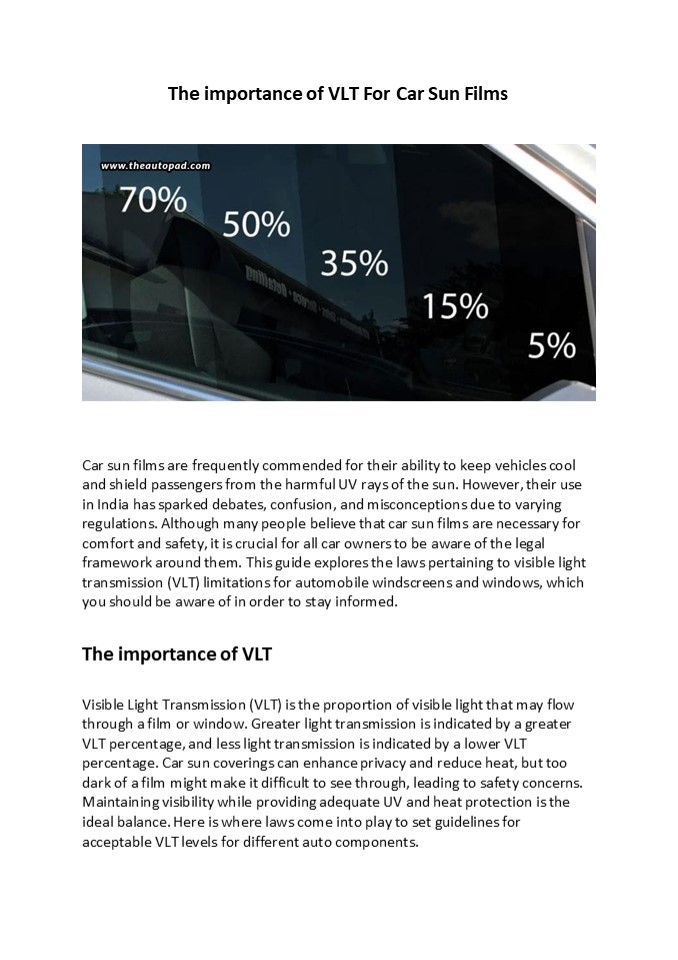
informed. The importance of VLT Visible Light
Transmission (VLT) is the proportion of visible
light that may flow through a film or window.
Greater light transmission is indicated by a
greater VLT percentage, and less light
transmission is indicated by a lower VLT
percentage. Car sun coverings can enhance privacy
and reduce heat, but too dark of a film might
make it difficult to see through, leading to
safety concerns. Maintaining visibility while
providing adequate UV and heat protection is the
ideal balance. Here is where laws come into play
to set guidelines for acceptable VLT levels for
different auto components.
2
Legal regulations for sun films in India The
Central Motor Vehicle Rules (CMVR), 1989, as well
as a significant Supreme Court decision in 2012,
are the two main sources of Indias sun film
rules. As per the Central Motor Vehicles Rules
(CMVR), 1989, side windows must have a minimum
VLT of 50 and front and rear windscreens must
have a minimum VLT of 70. These recommendations
offer minimal UV and heat protection while
guaranteeing sufficient visibility. Crucially,
these restrictions do not apply to any
aftermarket coatings or films they only apply to
the glass itself. The Supreme Court of India
ruled in 2012 that it was illegal to apply any
kind of aftermarket solar film on automobile
windscreens and windows. The courts ruling was
predicated on the idea that dark films could
compromise security by blocking the view inside
the car, which would make unlawful activity
easier. According to the order, no substance,
including sun films with any VLT percentage, may
be placed to the windowpanes of a vehicle.
However, glass that has been coloured in a
factory using specified VLT levels is
permitted. The role of manufacturers and
RTOs Car manufacturers usually install
factory-tinted glass that complies with the
Central Motor Vehicles Rules (CMVR), 1989, in
order to meet VLT criteria. This guarantees that
the necessary safety and visibility standards are
upheld without requiring aftermarket adjustments.
Car owners can check the VLT levels of their
vehicle windows at authorized centres or Regional
Transport Offices (RTOs) for added assurance.
These facilities employ specialized equipment to
verify compliance, assisting drivers in
abstaining from fines by following
rules. Upholding these standards improves
passenger comfort and safety while also
guaranteeing legal compliance. Enforcement
challenges Despite the Supreme Courts
unambiguous decision, different Indian states and
cities have different laws in place. How
thoroughly these rules are applied depends on a
number of factors, including public awareness,
local law
3
enforcement priorities, and regional climate
conditions. Speaking about Bangalore, a city
renowned for its high car density and tech-savvy
populace, sun protection laws are strictly
enforced. To make sure that the Supreme Court
decision and CMVR rules are being followed,
traffic police frequently perform inspections.
Many Bangalore residents look for ways to lower
the heat and glare inside their cars because of
the citys warm temperature. An increasingly
common substitute are transparent UV-blocking
films that dont change the VLT percentage of
windows. These coatings offer protection from
heat and hazardous radiation while adhering to
legal regulations. Autopad sun films to the
rescue Autopads sun films provide legal
compliance while providing the ideal solution for
Bangalores climate. These films offer the best
protection and comfort because they are made to
filter the harmful UV rays and reduce heat
without affecting the VLT percentage of windows.
They keep car interiors cooler, which lowers the
need for air conditioning and improves fuel
efficiency. They are perfect for the warm city
weather. Their translucent design satisfies
Bangalores strict enforcement criteria while
guaranteeing clarity and visibility. These sun
films for car in Jayanagar thus make driving in
Bangalore safer, more comfortable, and
ecologically beneficial without raising any legal
issues by fusing cutting-edge technology with
legal compliance. Making prudent choices and
keeping up with sun film rules can guarantee that
you abide by the law while still taking advantage
of the benefits of UV protection, reduced heat,
and improved comfort. To protect your health and
keep your car in accordance with Indian laws,
pick solutions that put safety, legality, and
efficacy first. Resource Read more
Recommended

