

BOBCAT 974 SKID STEER LOADER Service Repair Manual Instant Download PowerPoint PPT Presentation
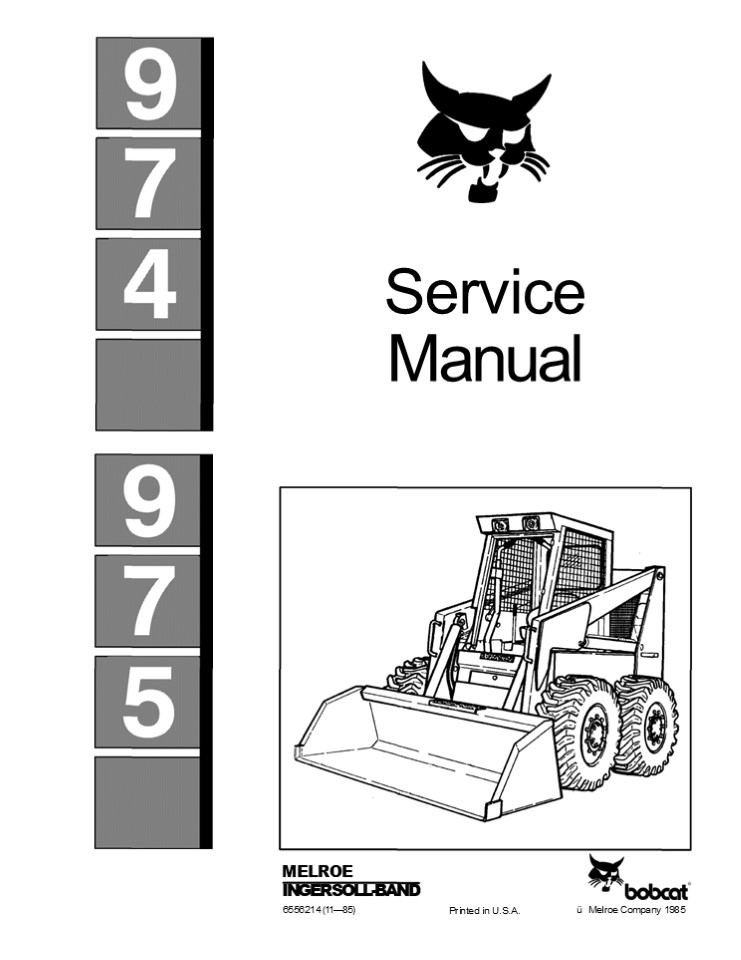
Title: BOBCAT 974 SKID STEER LOADER Service Repair Manual Instant Download
1
Service
Manual
MELROE INGERSOLL-BAND 6556214 (1185)
Printed in U.S.A.
ü Melroe Company 1985
2
MAINTENANCE SAFETY
WARNING Instructions are necessary before operating or servicing machine. Read and understand the Operation Maintenance Manual, Operators Handbook and signs (decals) on machine. Follow warnings and instructions in the manuals when making repairs, adjustments or servicing. Check for correct function after adjustments, repairs or service. Untrained operators and failure to follow instructions can cause injury or death. W-2003-0903 Instructions are necessary before operating or servicing machine. Read and understand the Operation Maintenance Manual, Operators Handbook and signs (decals) on machine. Follow warnings and instructions in the manuals when making repairs, adjustments or servicing. Check for correct function after adjustments, repairs or service. Untrained operators and failure to follow instructions can cause injury or death. W-2003-0903 Instructions are necessary before operating or servicing machine. Read and understand the Operation Maintenance Manual, Operators Handbook and signs (decals) on machine. Follow warnings and instructions in the manuals when making repairs, adjustments or servicing. Check for correct function after adjustments, repairs or service. Untrained operators and failure to follow instructions can cause injury or death. W-2003-0903
Safety Alert Symbol This symbol with a warning statement, means Warning, be alert! Your safety is involved! Carefully read the message that follows. Safety Alert Symbol This symbol with a warning statement, means Warning, be alert! Your safety is involved! Carefully read the message that follows. Safety Alert Symbol This symbol with a warning statement, means Warning, be alert! Your safety is involved! Carefully read the message that follows. Safety Alert Symbol This symbol with a warning statement, means Warning, be alert! Your safety is involved! Carefully read the message that follows.
CORRECT B-10731a CORRECT B-11103 CORRECT B-7469 CORRECT B-7469
Never service the Bobcat Skid- Steer Loader without instructions. Use the correct procedure to lift or lower operator cab. Cleaning and maintenance are required daily. Cleaning and maintenance are required daily.
WRONG B-11799 WRONG B-15231 WRONG B-15280 WRONG B-15280
Have good ventilation when welding or grinding painted parts. Wear dust mask when grinding painted parts. Toxic dust and gas can be produced. Avoid exhaust fume leaks which can kill without warning. Exhaust system must be tightly sealed. Disconnecting or loosening any hydraulic tubeline, hose, fitting, component or a part failure can cause lift arms to drop. Do not go under lift arms when raised unless supported by an approved lift arm support device. Replace it if damaged. Never work on loader with lift arms up unless lift arms are held by an approved lift arm support device. Replace if damaged. Never modify equipment or add attachments not approved by Bobcat Company. Never work on loader with lift arms up unless lift arms are held by an approved lift arm support device. Replace if damaged. Never modify equipment or add attachments not approved by Bobcat Company.
WRONG B-6590 WRONG B-6580 WRONG B-6589 WRONG B-6589
Stop, cool and clean engine of flammable materials before checking fluids. Never service or adjust loader with the engine running unless instructed to do so in the manual. Avoid contact with leaking hydraulic fluid or diesel fuel under pressure. It can penetrate the skin or eyes. Never fill fuel tank with engine running, while smoking or when near open flame. Keep body, jewelry and clothing away from moving parts, electrical contact, hot parts and exhaust. Wear eye protection to guard from battery acid, compressed springs, fluids under pressure and flying debris when engines are running or tools are used. Use eye protection approved for type of welding. Keep rear door closed except for service. Close and latch door before operating the loader. Lead-acid batteries produce flammable and explosive gases. Keep arcs, sparks, flames and lighted tobacco away from batteries. Batteries contain acid which burns eyes or skin on contact. Wear protective clothing. If acid contacts body, flush well with water. For eye contact flush well and get immediate medical attention. Lead-acid batteries produce flammable and explosive gases. Keep arcs, sparks, flames and lighted tobacco away from batteries. Batteries contain acid which burns eyes or skin on contact. Wear protective clothing. If acid contacts body, flush well with water. For eye contact flush well and get immediate medical attention.
Maintenance procedures which are given in the Operation Maintenance Manual can be performed by the owner/ operator without any specific technical training. Maintenance procedures which are not in the Operation Maintenance Manual must be performed ONLY BY QUALIFIED BOBCAT SERVICE PERSONNEL. Always use genuine Bobcat replacement parts. The Service Safety Training Course is available from your Bobcat dealer. Maintenance procedures which are given in the Operation Maintenance Manual can be performed by the owner/ operator without any specific technical training. Maintenance procedures which are not in the Operation Maintenance Manual must be performed ONLY BY QUALIFIED BOBCAT SERVICE PERSONNEL. Always use genuine Bobcat replacement parts. The Service Safety Training Course is available from your Bobcat dealer. Maintenance procedures which are given in the Operation Maintenance Manual can be performed by the owner/ operator without any specific technical training. Maintenance procedures which are not in the Operation Maintenance Manual must be performed ONLY BY QUALIFIED BOBCAT SERVICE PERSONNEL. Always use genuine Bobcat replacement parts. The Service Safety Training Course is available from your Bobcat dealer. MSW02-0805
3
FOREWORD This manual provides instruction for
proper routine servicing and adjustment of the
Bobcat, and detailed overhaul instructions of the
power train, loader hydraulic/hydrostatic system
and general mainframe components.
PR EV ENT IV E MAINTENANCE
Refer to the Owner's Manual for general operating
instructions (Starting Procedure, Daily Checks,
Bucket Operation, Minor Maintenance, etc.).
HYDRAU LIC SYSTEM
- A general inspection of the following items
should be made whenever the machine has undergone
service or repair - Check hydraulic fluid level, engine oil level and
fuel supply. - Inspect for anv sign of fuel, oil or hydraulic
fluid leaks. - Lubricate the machine.
HYD ROSTAT IC SVSTEM
4. Inspect air cleaner system for damage or
leaks. Check element and make replacement, if
necessary.
6. Check alternator drive belt for condition and
tension.
MECHANICAL TRANSM ISSION
7. Check for loose drive chains.
8. Check tires for wear and pressure.
9. Check the Bob-Tach attachment for condition.
lnspect the wedges for damage or wear.
MAIN FRAME
10. Inspect safety items for condition (ROPS
Guard, Seat Belt, Safety Treads, Lights, etc.).
11. Make a visual inspection for loose or broken
parts or connections.
12. Operate the loader, checking all
functions. Advise the owner if any of the above
items are in need of repair.
ELECTR ICA L SYSTEM
ENGINE SERVICE (974 Perkins)
COBT ENTS
ALPHABETICAL INDEX . . . . . . ELECTRICAL
SYSTEM ....
.
. .
.
. 10
.
. 6
ENGINE SERVICE (975 John Deere)
ENGINE SERVICE 974 (PERKINS) ............ . 7
ENGINE SERVICE 975 (JOHN DEERE) HYDROSTATIC SYSTEM
............ . 8
TECHNICAL DATA
....... .
.
. 2
HYDRAULIC SYSTEM
MAIN FRAME
. 4 1
MECHANICAL TRANSMISSION
ALPHABETICAL INDEX
PREVENTIVE MAINTENANCE
.
TECHNICAL DATA
. .
. 9
974/975 Loader Service Manual
4
https//www.ebooklibonline.com Hello dear
friend! Thank you very much for reading. Enter
the link into your browser. The full manual is
available for immediate download. https//www.ebo
oklibonline.com
5
- SAFETY INSTRUCTIONS
- SAFETV IS YOUR RESPONSIBILITY
- The Bobcat Loader is a highly maneuverable and
compact machine. In operation, it is rugged and
useful under a wide variety of conditions. This
presents an operator with hazards which are
common for off highway, rough terrain
applications but are not unique for use of Bobcat
loaders. The loader has an internal combustion
engine with resultant heat and exhaust. All
exhaust gases can kill so the loader must be used
with adequate ventilation. The loader must not be
used in an area with explosive dusts or gases or
so that the engine exhaust can contact flammable
material. The loader has a spark arrestor muffler
which is required for operation in certain areas. - The dealer recommends the capabilities and
restrictions of the loader and attachments for
each application. The dealer demonstrates the
safe operation of the loader according to the
manufacturer's instructional materials which are
also available to all operators. The dealer can
also identify unsafe modifications or use of
unapproved attachments. The attachments and
buckets are designed for rated capacity and
secure fastening to the loader. For each model
loader, the user must check with the dealer or
manufacturers literature to identify each bucket
or attachment for safe loads of materials of
specified densities. - The following publications provide information on
the safe use of the loader and attachments - The Delivery Report is used to check whether
complete instructions have been given to the new
owner. - The Operator's Manual delivered with wery loader
gives operating information as well as routine
maintenance and service. - Every loader has machine signs (or decals) which
instruct on the safe care and operation of the
loader. The complete signs and their location are
shown in the Operator's Manual. All signs are
available from your Bobcat dealer. - The loader has a plastic Operator Handbook
fastened to the operator cab It has brief
instructions always available to the operator.
The handbook is available from your Bobcat
dealer. - The Service Manual and Parts Manual are optional
manuals from your Bobcat dealer for use by
mechanics to do shop- type service and repair
work.
This Service Manual was written to give the
service personnel instructions on the safe
service of the Bobcat loader. READ AND UNDERSTAND
THIS SERVICE MANUAL BEFORE SERVICE YOUR BOBCAT.
Thia notice identifies procedures which must be
followed to avoid damage to the
loader. â-2019-O284 974. 975 Loader Service
Manual
6
- SAFE OPERATION NEEDS A CtUALIFIED OPERATOR
- A QUALIFIED OPERATOR MUST DO THE FOLLOWING
- UNDERSTA ND THE WRITTEN INSTRUCTIONS, RULES AND
REGULATIONS - The written instructions from Melroe Company
include the delivery report, loader operator's
handbook and manual, attachment manual and
machine signs (decals). - Check the rules and regulations at your loc
ation. The rules may include an employers work
safety requirements. Regulations may identify a
ha zard sueh as utilit y sup ply line. - HAVE TRAINING WITH ACTUAL OPERATION
- Operator training must consist of a demonstration
and verbal instruction. This training is given by
the Bobcat dealer before the loader is delivered. - The new operator should start in an area without
bystanders and use all the controls until he can
control the loader at full use under the
conditions for his work area. - KNOW THE WORK CONDITIONS
- For each material to be handled, the operator
must know how to avoid exceeding the rated
operating capacity of the loader. For example, he
must know whether he can safely take a full load
or just part of a bucket load when handling a
certain loose mater ial with a given bucket.
7
PREVENTIVE MAINTENANCE
PR EV ENTIVE MAINTENANCE
Paragraph Page Number Number 111 17 141 122 1
22 115 16 15 112 18 19 17 121 114 18 16
1J4 19 130 118 133 119 113 18 116 110 1
18 111 115 110 117 110 119 111 120 114 1
24 116
AIR INLET SYSTEM, ENGINE BOBTACH CLUTCH,
ADJUSTMENT OF CONTROL LEVER LOCK COOLING SYSTEM,
ENGINE CRANKCASE VENT TOBE
......
...
. . ........
ELECTRICAL SYSTEM MAINTENANCE ENGINE MAINTENANCE
(General) FAN BELT, ADJUSTMENT OF FILTER SCREEN,
TO CLEAN 100 MESH ... FINAL DRIVE CHAIN
.
.
FLUSHING THE COOLING SYSTEM FUEL
SPECIFICATIONS FUEL SYSTEM CHARGING FUEL SYSTEM
(General) FUEL SYSTEM SERVICE, 974 FUEL SYSTEM
SERVICE, 975
.....
FUEL TANK, REMOVAL OF ........
HYDRAULIC FLUID ........ HYDRAULIC FLUID, TO
CHECK, ADD OR REPLACE ............. HYDRAULIC/HYDR
OSTATIC SYSTEM
127
117
(General) ............... (General) ............... 123 116
HYDRAULIC RESERVOIR, REMOVAL OF HYDRAULIC RESERVOIR, REMOVAL OF 128 118
HYDRAULIC RESERVOIR REMOVAL OF WATER OR HYDRAULIC FLUID HYDRAULIC RESERVOIR REMOVAL OF WATER OR HYDRAULIC FLUID 126 1J 7
HYDRAULIC SYSTEM LEAKS, HYDRAULIC SYSTEM LEAKS,
TO CHECK FOR 129 118
HYDROSTATIC TRANSMISSION 132 119
INTRODUCTION 11 11
LUBRICATION 139 121
OIL AND FILTER REPLACEMENT, ENGINE 110 17
Ol L COOLER .............. 131 119 Ol L COOLER .............. 131 119 Ol L COOLER .............. 131 119 Ol L COOLER .............. 131 119
REAR GRI LL AND ENG INE COVER ROPS AND SKID PLATE
AREA, CLEANING SERV ICE INTERVALS SIDE PANEL
(Fender) REMOVAL OF
13 17 12 14 15 136 138 J37 135 134 140
14 16 13 14 14 J21 121 121 120 1J9 121
TILTING THE ROPS (Operator Enclosure) ... TIRE
MAINTENANCE TIRE REPLACEMENT TIRE ROTATION
TIRES TO TRANSPORT WHEEL NUTS
8
1 1 INTRODUCTION
t\,,.t
Serial Number
'
23602 51
For your safety. this warning is on the loader
and in the manual. It will give warning of
actions or danger which can cause personal
injury.
B-2628
C-2 I85
Fig. 1 1
9 7 4 9 7 5 Serial NO Loc a tion
Fig . 1 2 974 Engine S/N Loc a tion Iearly )
This notice shows important procedures which
must be followed to prevent damage to the loader.
,.. .., ".
Engine Number Location
1 1 . 2 Serial Number Identification It is
important to make correct reference to the
serial number of the loader when making repairs
or ordering parts. Early or later made models
(iden- tification made by Lot ) sometimes
use different parts, or it may be necessary
to use a different procedure in doing a specific
job.
Fig . 1 3
9 7 4 En gine Serial Number Loc a t ion I c urren
t )
1 1.3 Loader Serial Number The loader serial
number plate location is inside left upright
(Fig. 1 1 ) . The serial number is made up
as follows M 1 1001
Production Sequence
_at_
Engine Number Location
Plant Location
Model, Engine Version
_
1 1.4 Engine Serial Number For the location of
the engine serial number, see figure 1 2, 1 3
or 1 4.
1 1 . 5 Pre-Delivery Inspection The purpose of
the pre-delivery inspec- tion is to make sure
that the loader is in correct operating
condition when it comes to the dealer and
before it is delivered to the customer.
O !
A-2142
Fig. 1 4
9 7 5 En gme Serb al Number Loc aI ion
974/975 Loader Service Manual
Revised Ju"ne 79
-1I-
9
The pre-delivery inspection also lets the factory
know when something is wrong with the loader so
that action can be taken to prevent the problem
from happening in the future.
All items on the inspection form (Fig.
15) must be completed according to
specifications in this manual.
One copy of the completed form is to be mailed to
the attention of Quality Control, Melroe Division.
Fig. 15
Pre-Delivery Inspection
11.6 30 Hour Inspection The 30 hour inspection
must be completed soon after the first 30 hours
of loader operation.
The purpose of the 30 hour inspection is as
follows (1) For adjustment and inspection after
first work period.
(2) To correct wrong maintenance and operating
methods.
Fig. 16
30 Hour Inspection
(3) For demonstration of correct service
procedures to customer.
All items on the 30 hour inspection form (Fig. I
6) must be completed by the mechanic according
to specifications in the manual.
When the 30 hour inspemion has been completed,
the form must be signed by the mechanic
completing the inspection, the dealer and owner
or operator.
One copy of the completed form is for the owner
of the loader. Another copy is to be sent to the
attention of Service Department, Melroe Division.
The remainder copy is for the Dealer.
974/975 Loader Service Manual
-12-
10
SERVICE SCHEDULE Maintenance work must be done
regularly. Failure to do so will result in damage
to the loader or engine. The service schedule is
a guide for correct maintenance of the Bobcat
loader. Do not change from this service
schedule unless to increase frequency of
intervals when the Bobcat loader is operated in
very hot, cold, dusty or corrosive conditions.
BOBCAT SERVICE SCHEDULE
HOURS
10 100 250 600 1000
ITEM SERVICE REQUIRED SERVICE REQUIRED SERVICE REQUIRED SERVICE REQUIRED SERVICE REQUIRED SERVICE REQUIRED SERVICE REQUIRED 10 100 250 600 1000
Engine Oil Check and add oil as necessary. Check and add oil as necessary. Check and add oil as necessary. Check and add oil as necessary. Check and add oil as necessary. Check and add oil as necessary. Check and add oil as necessary.
Engine Cooling System Check coolant level in radiator. Add coolant when low. Remove any foreign material from radiator grill area. Check coolant level in radiator. Add coolant when low. Remove any foreign material from radiator grill area. Check coolant level in radiator. Add coolant when low. Remove any foreign material from radiator grill area. Check coolant level in radiator. Add coolant when low. Remove any foreign material from radiator grill area. Check coolant level in radiator. Add coolant when low. Remove any foreign material from radiator grill area. Check coolant level in radiator. Add coolant when low. Remove any foreign material from radiator grill area. Check coolant level in radiator. Add coolant when low. Remove any foreign material from radiator grill area.
Air Cleaner Indicator Replace element when red ring shows in window. Replace element when red ring shows in window. Replace element when red ring shows in window. Replace element when red ring shows in window. Replace element when red ring shows in window. Replace element when red ring shows in window. Replace element when red ring shows in window.
Fuel Bowl Check for sediment or water. Drain off water and sediment, if necessary. Check for sediment or water. Drain off water and sediment, if necessary. Check for sediment or water. Drain off water and sediment, if necessary. Check for sediment or water. Drain off water and sediment, if necessary. Check for sediment or water. Drain off water and sediment, if necessary. Check for sediment or water. Drain off water and sediment, if necessary. Check for sediment or water. Drain off water and sediment, if necessary.
All Pivot Pins Add lubricant to all fittings until extra grease shows. Add lubricant to all fittings until extra grease shows. Add lubricant to all fittings until extra grease shows. Add lubricant to all fittings until extra grease shows. Add lubricant to all fittings until extra grease shows. Add lubricant to all fittings until extra grease shows. Add lubricant to all fittings until extra grease shows.
Tires Check the air pressure, and any damage to tires. Check the air pressure, and any damage to tires. Check the air pressure, and any damage to tires. Check the air pressure, and any damage to tires. Check the air pressure, and any damage to tires. Check the air pressure, and any damage to tires. Check the air pressure, and any damage to tires.
Hydraulic Reservoir Level Add correct fluid as necessary. Add correct fluid as necessary. Add correct fluid as necessary. Add correct fluid as necessary. Add correct fluid as necessary. Add correct fluid as necessary. Add correct fluid as necessary.
Wheel Nuts Tighten loose nuts to correct torque. Tighten loose nuts to correct torque. Tighten loose nuts to correct torque. Tighten loose nuts to correct torque. Tighten loose nuts to correct torque. Tighten loose nuts to correct torque. Tighten loose nuts to correct torque.
Hydraulic Hoses Check for damage and leaks and replace. Check for damage and leaks and replace. Check for damage and leaks and replace. Check for damage and leaks and replace. Check for damage and leaks and replace. Check for damage and leaks and replace. Check for damage and leaks and replace.
Fan and Alternator Belt Check the belt tension and adjust as necessary. Check the belt tension and adjust as necessary. Check the belt tension and adjust as necessary. Check the belt tension and adjust as necessary. Check the belt tension and adjust as necessary. Check the belt tension and adjust as necessary. Check the belt tension and adjust as necessary.
Battery Check water level and inspect cables. Check water level and inspect cables. Check water level and inspect cables. Check water level and inspect cables. Check water level and inspect cables. Check water level and inspect cables. Check water level and inspect cables.
Final Drive Chaincase Check fluid level, when low add fluid by removing side cover and fill to check plug level. Check fluid level, when low add fluid by removing side cover and fill to check plug level. Check fluid level, when low add fluid by removing side cover and fill to check plug level. Check fluid level, when low add fluid by removing side cover and fill to check plug level. Check fluid level, when low add fluid by removing side cover and fill to check plug level. Check fluid level, when low add fluid by removing side cover and fill to check plug level. Check fluid level, when low add fluid by removing side cover and fill to check plug level.
Engine Oil and Filter Element Change engine oil and filter. Change engine oil and filter. Change engine oil and filter. Change engine oil and filter. Change engine oil and filter. Change engine oil and filter. Change engine oil and filter.
Cylinder Head Nuts (9 74) Tighten to correct torque. Adjust valves. Tighten to correct torque. Adjust valves. Tighten to correct torque. Adjust valves. Tighten to correct torque. Adjust valves. Tighten to correct torque. Adjust valves. Tighten to correct torque. Adjust valves. Tighten to correct torque. Adjust valves.
Final Drive Chains Check for correct tension and adjust as needed. Check for correct tension and adjust as needed. Check for correct tension and adjust as needed. Check for correct tension and adjust as needed. Check for correct tension and adjust as needed. Check for correct tension and adjust as needed. Check for correct tension and adjust as needed.
Hoses and Clamps Inspect and tighten as necessary. Inspect and tighten as necessary. Inspect and tighten as necessary. Inspect and tighten as necessary. Inspect and tighten as necessary. Inspect and tighten as necessary. Inspect and tighten as necessary.
Pr im a ry ( 1 O M i c r o n ) Hydraulic Filter Replace element. Replace element. Replace element. Replace element. Replace element. Replace element. Replace element.
Spark Arrestor Muffler Clean spark chamber. Clean spark chamber. Clean spark chamber. Clean spark chamber. Clean spark chamber. Clean spark chamber. Clean spark chamber.
Secondary Hyd. Filters Replace elements. Replace elements. Replace elements. Replace elements. Replace elements. Replace elements. Replace elements.
Fuel Filter(s) Install new system. filter element(s) and vent air from
Crankcase Vent Tube (PCV) Valve Remove and clean. Remove and clean. Remove and clean. Remove and clean. Remove and clean. Remove and clean. Remove and clean.
Fluid Level in Reduction Gear Housing Check fluid level and add correct oil and fill to check plug level as needed. Check fluid level and add correct oil and fill to check plug level as needed. Check fluid level and add correct oil and fill to check plug level as needed. Check fluid level and add correct oil and fill to check plug level as needed. Check fluid level and add correct oil and fill to check plug level as needed. Check fluid level and add correct oil and fill to check plug level as needed. Check fluid level and add correct oil and fill to check plug level as needed.
Hydraulic Oil Reservoir Slide skid plate open. Remove drain plug and remove condensation. Slide skid plate open. Remove drain plug and remove condensation. Slide skid plate open. Remove drain plug and remove condensation. Slide skid plate open. Remove drain plug and remove condensation. Slide skid plate open. Remove drain plug and remove condensation. Slide skid plate open. Remove drain plug and remove condensation. Slide skid plate open. Remove drain plug and remove condensation.
Engine Cooling System Drain and flush cooling system. Refill with water and, for protection from freezing. add anti-freeze as needed. Drain and flush cooling system. Refill with water and, for protection from freezing. add anti-freeze as needed. Drain and flush cooling system. Refill with water and, for protection from freezing. add anti-freeze as needed. Drain and flush cooling system. Refill with water and, for protection from freezing. add anti-freeze as needed. Drain and flush cooling system. Refill with water and, for protection from freezing. add anti-freeze as needed. Drain and flush cooling system. Refill with water and, for protection from freezing. add anti-freeze as needed. Drain and flush cooling system. Refill with water and, for protection from freezing. add anti-freeze as needed.
Reduction Gear Housing Drain the fluid, fill to check plug level with correct fluid. Drain the fluid, fill to check plug level with correct fluid. Drain the fluid, fill to check plug level with correct fluid. Drain the fluid, fill to check plug level with correct fluid. Drain the fluid, fill to check plug level with correct fluid. Drain the fluid, fill to check plug level with correct fluid. Drain the fluid, fill to check plug level with correct fluid.
Final Drive Chaincase Drain the fluid and flush. Fill to check plug level with correct fluid. Drain the fluid and flush. Fill to check plug level with correct fluid. Drain the fluid and flush. Fill to check plug level with correct fluid. Drain the fluid and flush. Fill to check plug level with correct fluid. Drain the fluid and flush. Fill to check plug level with correct fluid. Drain the fluid and flush. Fill to check plug level with correct fluid. Drain the fluid and flush. Fill to check plug level with correct fluid.
Hydraulic Fluid Drain the fluid and fill to check plug level with correct fluid. Drain the fluid and fill to check plug level with correct fluid. Drain the fluid and fill to check plug level with correct fluid. Drain the fluid and fill to check plug level with correct fluid. Drain the fluid and fill to check plug level with correct fluid. Drain the fluid and fill to check plug level with correct fluid. Drain the fluid and fill to check plug level with correct fluid.
Starter Wicks (97 5) Add lubrication. Use 1OW oil. Add lubrication. Use 1OW oil. Add lubrication. Use 1OW oil. Add lubrication. Use 1OW oil. Add lubrication. Use 1OW oil. Add lubrication. Use 1OW oil. Add lubrication. Use 1OW oil.
IMPORTANT NOTE See 30 Hour Inspection on page
974/975 Loader Service Manual
Revised June 79
-1 3-
11
13 R EAR DOOR AND ENGINE COVER
The rear door is opened by pulling out on the
handle and turning it (Fig. 17). Pull the door
fully open. The rear door weight is 453 lbs. (205
kg).
Locking Latch
The top engine cover is removed by releasing the
two rubber fasteners at the cab end of the cover
(Fig. 18 1-9) then slide it to the rear. The
cover will slide to the rear so the ROPS can be
tilted on model 975 loaders. The muffler must be
removed to remove the engine œver. The engine
cover weight is 73 Ibs. (33 kg).
Fig. 17
Opening Rear Door
14 R EMOVA L 0 F SIDE PANEL (FENDER) Remove the
two fastening nuts and bolts from the fender (one
at a each end). Remove the fender. The fender
weight is 35 lbs. (15 kg).
J 5 TILTING THE ROPS (Operator Enclosure)
(Fig. 110)
Fig. 18
Remov ing Engine Cover (974)
The ROPS on the Bobcat Loader can be tilted to
provide access when servicing.
15.1 Tilting ROPS Forward (1) Lower
attachment to the ground. Slide operator's seat
to the rear, and set throttle about 3 inches
ahead of the left steering lever. Connect the
seat belt together.
(2) Release rubber fasteners and slide top engine
œver back several inches.
Fig. 19
Removing Engine Cover (975)
974/975 Loader Service Manual
-14-
12
- Remove rear pins from both sides of enclosure.
(Momentarily activate the cab tilt switch if pins
are hard to remove.) - Activate tilt switch and tilt the enclosure.
Check control levers when tilting to make sure
that they are clear. - 15) Lower safety leg above tilt cylinder until
it is against the cylinder rod. Lower
enclosure until its weight is supported by safety
leg (Fig. 1 11 ) . - 1 5. 2 To Lower ROPS
- l1) Tilt forward enough to remove weight
from safety leg. Move leg up nto storage
position. - (2T Move throttle lever and directional
control levers so that they do not hit enclosure
as it is lowered, then activate switch to lower
the enclosure.
Pin
B-1677 R
// Hour Meter
C-1999
Tilt Switch
A-21o9
Fig. 110 Tilting ROPS Enclosure
13 T Replace mounting pins when enclosure is
fully lowered. Secure pins with lock pins. (4)
Slide top engine cover forward and hold with
rubber fasteners. J 6 CONTROL LEVER LOCK A
control lever lock keeps the operating levers in
neutral position, so they can not be moved by
accident while operating the engine during
service. To install the lock \ 1 ) Tilt the
ROPS. 12) Put the hook of the bolt through
the tab on the floor (Fig. 1 1 2, Item 1 ).
SafeW Leg t
13) Lift the centering arm. Put the bolt
through the hole in the centering arm (Fig. 1
1 2, Item 2). (4) Install the wing nut on the
bolt. The control lever lock must be installed if
engine is to be operated during service.
Tilt Cylinder
17 TO CLEAN PLATE AREA Clean ROPS and
ROPS AND SKID
A-2088
foot pedal area
Fig. 1 11 Safety Leg
frequently to remove dirt and foreign material.
Keep machine clean to prevent a fire from
starting. 1 7.1 To Open the Skid Plate
- ( 1 ) Remove bolt from the hole of retaining bar
at the rear of the skid plate. - Install the removal tool (fastened inside the
rear grill) on the skid plate (Fig. 1 1 31. - Fasten a chain to the tool and fasten other end
to a tree or post. - Slowly move the machine forward until the skid
plate is fully open against the stop.
Fig. 112 Control Lever Lock
974/975 Loader Service Manual
Revised June 79
13
(5) Remove all foreign material from the
machine. 17.2 To Close the Skid Plate l1)
Turn the Bobcat around, fasten the chain to
the tool and slowly move the machine backward
until the plate is closed. (2) Remove the tool
and install retaining bolt.
Skid Plate
NOTE
Always install the rear pins aher ROPS is lowered
and before operating Bobcat.
Skid Removal Tool
1 8 ENG INE MAINT ENANCE (General)
B- 1912R
18.1 Starting the Engine
Fig. 113 Removing Skid Plate
- Put throttle lever in full open position.
- Operate starter switch.
Ad528
For cold weather starting see 722.10 "Cold
Weather Starting Aid".
18.2 Engine Oil Check
( 1) Check oil level every eight hours of
operation. T2T Oil level on new Bobcats should be
checked every 2 to 4 hours during the first 50
hours of operation. (3) Oil level must always be
kept between the "Full" and "Low" marks on the
dipstick (Fig. 1 141.
18.3 Specifications
RECOMMENDED SAE VISCOSITY NUMBER (LUBRICATION
OILS FOR ENGINE CRANKCASE) C -34 -29 -23 -18
-13 -7 -1 4 10 15 21 27 32 38
Fig. 114 Engine Oil D ipstick
PI-2358
SAE 10W- 10W- 30/4 PI-2358
SAE PI-2358
SAE PI-2358
SAE PI-2358
PI-2358
SAE PI-2358
SAE PI-2358
SAE PI-2358
SAE 2OW 2OW /20 PI-2358
SAE /20 PI-2358
SAE 1OW /20 PI-2358
/20 PI-2358
F -30 -2O -10 0 10 20 3O 40 SO 60
70 80 9O 100 TEMPERATURE RANGE ANTICIPATED
BEFORE NEXT OIL CHANGE (GASOLINE USE API
CLASSIFICATION SE) (DIESEL USE API
CLASSIFICATION CD)
974/975 Loader Service Manual
-16-
Revised June 79
14
19 CRANKCASE VENT TUBE The crankcase vent tube
must be cleaned every 50 hours of
operation. Remove tube and clean with solvent. A
brush and air pressure can be uæd to aid in
cleaning.
110 REPLACEMENT OF ENGINE OIL AND FILTER Engine
oil and filter require replacement every 100
hours of operation. In extremely hot, cold, dirty
or œrrosive œnditions, ma ke oil and filter
replacement more frequently. Start engine and
allow it to reach operating temperature before
making replacement of
Replacement of engine oil and filter (1) Remove
crankcase drain plug (located at the end of
crankcase drain hose)(F "
Fig. 115 Engine 011 0rain
- Remove engine oil filter cartridge.
- Clean filter sealing surfaæ.
- Apply small amount of new oil to sealing surface
of filter and install on engine. - Allow oil to flow from crankcase for about five
minutes, then replace drain plLI9 - Fill to Full" mark on dipstick (Fig. 114). Do
not overfill. Capacity is 8 quarts (7,5 litres)
with filter replacement. - Start engine and run for about five minutes.
Check for leaks around filter. - Stop engine. Check oil level and add oil as
necessary. - NOTE Do not overfill, as this will cause oil
foaming, oil consumption. high engine
temperature, and oil leaks at the engine seals.
111 ENGINE AIR INLET SYSTEM (Air Cleaner) Correc
t maintenance of air inlet system is necessary
for long engine life. A small leak in the system
can destroy an engine within minutes. Do not
overservice! Service only when red ring appears
in condition indicator window.
111.1 Air Cleaner Service (Fig. 116) (1)
Remove element by loosening retainer bar. Wipe
filter can clean with a soft cloth.
NOTE Do not use air pressure dirt œn be forced
into the engine.
Fig. 116 Removing Air Cleaner Element
974/975 Loader Service Manual
-17-
15
(2) Install new element carefully and reassemble.
DRAIN COOLANT
(3) Press in button, located at bottom of
condition indicator, to retram red ring from
sight window (Fig. 117). 111.2 Air Inlet
System Service
REFILL WITH WATER
When inspect follows
servicing air cleaner, carefully all of the
air inlet system as
( 1) Check all tightness.
connemions for
OPERATE ERP NE UNTIL HOT
(2) If the air cleaner body has been dented,
check for separations in seams and/or holes
(3) Check hoses for cracks.
f4) lnspect intake manifold for cracks and
manifold gasket for damage or looseness.
onnio coowNT
(5) If adjustment does nor correct the problem,
make replacement of necessary immediately.
parts
112 ENGINE COOLING SYSTEM
REFILL WITH RADIATOR CLEANER
Keep the coolant at the correct level or engine
overheati 9
- fesult.
Remove the radiator filler cap only when the
coolant temperature is below boiling point. Then
loosen the cap lightly to the stop to relieve
pressure before completely removing cap.
OPERATE ENG NE UNTIL HOT
Put the Bobcat on a level surface. Carefully
remove radiator cap and check coolant level. If
coolant level is below midway between core and
filler neck, add clean water or anti-freeze as
necessary to maintain protection of the cooling
system. The capacity of the cooling system is 19
U.S. quarts ( 18 litres).
DRAIN
The cooling system is pressurized (6-1/4 to 7-1/2
PSI f43 to 52 kPa) ) so all components and
connections must be in good condition for correct
operation. Loss of pressure will result in
overheating and loss of coolant.
FLUSH WITH CLEAN WATER
The radiator grill area must be kept clear for
good cooling. Use air or water pressure on the
outside of radiator to force debris out of core.
When using air pressure wear eye protection
to prevent injury from debris. Do not use water
on a hot engine or in any fertilizer application.
REFILL WITH COOLANT
t
113 FLUSHING THE COOLING SYSTEM
ADD COLD TIONER
At least one time each year, the complete cooling
system must be flushed and filled again with
clean coolant and conditioner.
Fig. 118 Flushing Cooling System 974/975 Loader
Service Manual
Use flushing procedure on next page (Fig. 118)
-18-
16
(1) Open drains on engine block (Fig. 119
1211 to let the coolant out.
20) and on the radiator (Fig.
NOTE t2)
On the 975 take off the hose at oil cooler to
remove coolantlFig. 120A). Close both drains and
fill the system with clean water.
Never put hot water into a cold engine or cold
water into a hot engine. The head or the cylinder
block can crack. DO NOT run the engine
without coolant in the radiator and cylinder
block.
Fig. 119 Engine Coolant Drain (974)
/3) Start the engine and run it until hot to
loosen rust or sediment. (4) Stop engine and
open drains
immediately, while rust and sediment is still in
suspension.
15) Close both drains again and fill cooling
system with a solution of radiator cleaner
and water.
iICooIer Remove Hose To Let Coolant Out
(61 Start engine and run until hot. (7) Stop
engine and open drains again. T8I Close both
drains and fill cooling
system with clean water. Run engine until
hot. Stop engine and open drains. (9) Close
drains and fill cooling system to midway between
filler neck and baffle in radiator tank.
Fig.120A Oil Cooler (975)
Fig. 120 Engine Coolant Drain (975)
Use clean soft" water. For protection in
freezing temperatures, use ethylene glycol type
anti-freeze. For use in non-freezing temperature,
use a summer coolant conditioner. Soft
water" is water that has little or no minerals in
it. Excessive minerals in the coolant can cause
corrosion or rusting, and can restrict the flow
of coolant causing reduced efficiency and damage
to the engine.
B2596
114 ADJUSTMENT OF FAN BELT
- Fig. 121 Radiator Coolant 0 rain
- Keep the fan belt in adjustment.
- A loose fan belt will result in unnecessary wear
of the belt. A loose belt can also cause the
engine to overheat by not properly turning the
water pump or a low charging rate of the
generator. - If adjustment is over-tight, the bearings in the
water pump and generator will overload. To make
adjustment of the fan belt (Fig. 122) - Loosen the generator adjusting bolt.
- Make adjustment of belt tension by moving
generator towards or away from the engine. Make
adjustment so the belt will move 1/2" (12,7 mm)
between sheaves. - 13) Tighten the screw.
When a new belt has been installed, recheck
movement after eight hours operation. Make
adjustment if necessary.
Fig. 122 can Belt Adjunment 974. 975
Loader Service Manual
Revised Jan.79
-19-
17
115 FUEL SYSTEM (General)
NEVER FILL WITH FUEL WHEN ENGINE IS HOT (Fig.
123). Fig. 123 Never Fuel A Hot Engi ne
The fuel fill point is located on the right side
of the Bobcat, behind the front tire.
Fig. 124 Fuel Filters
116 FUEL SPECIFICATIONS
..
Use clean No. 1-D or No, 2D diesel fuel. (See
chart below.)
- .
Type of Loader Operation
Air Temperature
Diesel Fuel Grade No.
Light load, low speed, considerable idling.
Above 80OF. Below 80F.
2-D 1-D
Above 40F. Below 40F.
Intermediate and heavy load, high speed, minimum
of idling.
2-D 1-D
At altitudes above 5,000 feet.
All
1-D
117 974 FUEL SYSTEM SERVICE
Fig. 125 Water Trap Sedimen t B owl
The engine is equipped with a primary and
secondary fuel filter located on the right side
of the engine (Fig. 124). A water trap and
sediment bowl is also installed next to the fuel
pump on the left side of the engine (Fig.
125). Remove contents of the water trap bowl
whenever water can be seen at the bottom. To
replace fuel filter elements (1) Carefully
clean filter housing area.
- Loosen and remove retaining screws of both
primary and secondary filters (Fig. 126, Item
1). - Remove filter cartridges and 0-ring seals.
- Clean water trap and fuel bowl.
- Install new filters and O-ring seals of identical
type. Hold firmly in position while tightening
retaining screw. DO NOT overtighten!
Element
Water Trap
Water ra Fig. 126 Fuel Filter Parts
1469
(6) After filters are reassembled, it is
necessary to remove air from the fuel system. See
Changing the fuel system below.
974/975 Loader Service Manual
-110
18
118 CHARGING FUEL SYSTEM To remove air from the
fuel system
Loosen vent screw located near
(1)
top of governor control lever (Fig. 127, Item I).
Loosen vent screw located on
(2)
the side of fuel pump (Fig. 127, Item 2). (3)
Loosen and remove fuel outlet pipe assembly on
top Of filter cover (Fig. 128).
Operate priming lever on fuel
(4)
pump (Fig. 129) to force fuel
lih
and air bubbles through vent points.
Fig. 127 Removing Air rrom nection Pump
more air bubbles
(5l When no
come from all vent points, tighten vent screws in
the following order
Fuel filter outlet pipe assembly (Fig.
128). Fuel pump vent screw (Fig. 127, Item 2)a
Governor vent screw (Fig. 127, Item 1).
a.
b.
c.
Loosen fitting at fuel injection pump inlet (Fig.
127, Item 3). Operate priming lever again until
no air bubbles can be seen ooming from
(6)
7)
threads.
ir priming lever does not pump fuel turn engine
one complete revolution. Retighten fitting at
injection pump inlet. Loosen fitting on injector
end of each high pressure fuel line (four places)
NOTE
(8)
(9)
(Fig. 130). (10) Set throttle to full open
position and operate starter until no air bubbles
flow from loosened fittings.
i,. 1ZB Removing Air From Filters
111) Retighten fitting. Engine is now ready to
start. 119 975 FUEL SYSTEM SERVICE 119.1 Fuel
Pump
the engine camSh6ft. This pump supplies fuel to
the filter and injector pump at 3-1/2 to 4-1/2
psi (idle speed). Diagnosing Malfunctions
Before making replacement of the pump when fuel
does not flow (or only a small amount flows),
check the following items
.
Priming
upward
primer left in the
Hand
Fig. 130 Removing Air r rom I njectors
Fig. 129 Fuel Putt\p
position.
974/975 Loader Service Manual
-111-
19
Restriction in fuel line. Loose or damaged
connections.
fuel
line
The fuel pump is defemive, if correct fuel flow
is not present. Make replacement of the fuel pump.
Removal (1) Disconnem the pump inlet and outlet
pipes (Fig. 131). (2j Remove the engine oil
tJipstick and tube from engine.
(3) Remove mounting bolts, and remove pump from
engine block.
Fig. 1-31 Fuel Pump Dipstick
Repair The fuel pump is not designed for repair.
If pump is defective, install a new one.
- Installation
- Clean the engine block pad and install pump.
- Install oil dipstick and tube to engine.
- Connem the fuel pipes.
(4) Remove air from the fuel system (See page
113).
Fig. 132 Fuel Filter Parts
1-19.2 Fuel Filter A combination first and
second stage filter element is contained in the
sediment bowl as a complete assembly (Fig. 132).
The filter should be changed whenever a tune-up
or an overhaul has been performed on the
engine and as often as necessary between tune-ups.
To release filter retaining spring, press inward
on the outside finger tab and squeeze tabs
together to disengage the top hook of the spring.
Pull filter off and push the new filter over
spring pin. Hook bottom of the filter retaining
spring first and the top hook last (Fig. J33).
Fig. 133 Removing Fuel Filter
974/975 Laader Service Manual
-112-
20
119.3 To Charge Fuel System
Escaping diesel fuel under pressure can have
sufficient force to penetrate the skin,
causing serious personal injury. Before
disconnecting lines be sure all connections
are tight and that lines, pipes and hoses are
not damaged. Fluid escaping from a small hole can
be almost invisible. Use a piece of cardboard
or wood, rather than hands, to search for
suspected leaks.
F ig. 134 Ven ting Ai r From Fi Iter
I f injured by escaping fluid, see a doctor at
once. Serious infection or reaction can develop
if proper medical treatment is not administered
immediately.
119.4 Remove of Air From Fuel System Fig.
135 Venti ng I njectors When fuel filter is
removed or if the Bobcat has run o ut of fuel,
remove air from fuel filter after refueling
before operating engine. To remove air, loosen
fi lter vent pl ug near top o f the filter (F ig.
34, Itern 1). Operate primer lever (Fig. 134,
Item 2) on fuel pump untiI most of the a ir
bubbles in filter are gone and fuel flows from
the plug. Tighten the plug with primer lever in
down position. NOTE If the primer does not
pump fuel and no resistance is felt at upper
portion of lever stroke, turn engine one
revolution with the starter. Always return
priming lever to fully down position after
priming.
If the engine misses aher removing air from
filter and wiII not run smoothIy, charge the
entire fuel system. First charge the filter. Then
loosen high pressure fuel pipe on one or more
injectors (F ig. 135) using two wrenches. With
hand throttle hal f way forward turn engine with
starter until fuel without foam flows from loose
connections (the engine may start). Tighten the
connections using two wrenches. Charge the other
injectors until the engine runs smoothIy.
974/975 Loader Service Manual
-113-
21
120 REMOVAL OF FUEL TANK
- To remove the fuel tank
- Remove ROPS tsee Page 5 1).
- Disconnect clutch linkage rod.
- Disconnect control pedal linkages. Remove floor
and foot pedal assembly. - Discon nect fuel level gauge electrical wire.
- Disconnect fuel tank filler hose and engine fuel
hoses. - Remove tank fasteners.
- Remove plug to let the fuel out of tank.
- Lift tank out of machine. The tank weight is 40
lbs. ( 18 kg) when empty.
Starter
Fig. 136 Starter Fuse (974)
/ t Fuse . .
121 ELECTR ICAL SYSTEM MAINTENANCE
The Bobcat is equipped with a 12 volt electrical
system using two 12 volt batteries.
\... " ..... ..,.,..,..... . ..
. .....A-2142 Fig. 137
Staner Fuse (975)
The electrical system is protected by three
fuses, Mo 40 AMP and one 30 AMP. One is
are
located in the wiring harness above the starter
(F ig. 136 137). The other Mo located behind
the dash panel (Fig. 138).
If a fuse is burned out it is an indication that
the electrical system is overloaded. Find and
correct the problem before operating the machine.
Look for a broken wire or broken insulation. Repl
ace fuses with a fuse of equal rating only. Check
wiring connections for tightness and look for
worn insulation. Correct wiring defects
immediately. General maintenance of the electr
ical system is as follows ( 1) C he ck
electrolyte level in battery and fill as
needed with disti fled water. (2) Check
battery cables for corrosion. Remove acid
corrosion with soda and water solution. Cover
connections with grease to prevent corrosion.
Fuses
(3) Check generator drive belt for tension. Make
adjustment like figure 116 Fan Belt Adjustment.
(4) Check the condition of the wiring to
the warning indicators (HYD RO/HOT, LUBE/HOT,
and ENG/HOT). Check if the indicator lights are
working.
Fig. 138 Dash Panel Fuses
974/975 Loader Service Manual
-114-
22
- Check indicators by
- Turn ignition switch to on.
- Disconnect wires for indicator switches. HYDRO
(hydraulic oil temperature) switch (Fig.
1391, and ENG tengine water temperaturel switch
is located on top of engine head (Fig. 140 B
141).
131 Ground the wires against the frame. If
indicator lights are on, all circuits are good.
Fig. 140 Engine Temp. Switch (974)
Fig. 139 Hydrostatic Temp. Switch
141 LUBE (engine oil pressured indicator
should be on when the ignition switch is turned
on.
If any of the indicators still have light while
engine is running stop engine immediately.
This is an indication of a malfunction in the
system. Refer to troubleshooting section on
page 33.
Fig. 141 Engine Temp. Sender (975)
122 ADJUSTMENT OF CLUTCH/BRAKE The clutch/brake
is located next to the tilt hydraulic pedal (Fig.
142). The clutch/brake pedal disengages the
hydrostatic and hydraulic system from the engine
and engages the brake. NOTE Make sure the
clutch/brake is disengaged when starting a
cold engine. Engage the clutch/brake pedal at
a slow rate to prevent damage to the hydrostatic
system. Make sure you follow the clutch/brake
pedal adjustment in the proper order to prevent
damage to the thrust bearing, clutch and parking
brake (Fig. 143). (1I Move the belly pan to
the rear of the Bobcat (See Section on Skid Plate
Area Page 17). 121 Lift the Bobcat off the
floor and put two jackstands under the front and
two jackstands under the rear of the Bobcat.
974, 975 Loader Service Manual
Revised Jan. 79
-115-
23
f3) Remove the right side panel (See Section on
Side Panel Fender Removal Page 141.
Clutck/Brake Pedal
Locking Bar
(4) Disconnect the spring at the clutch/brake
pedal (Item 1).
Connects to Brake
(5) Turn the adjustment screw out (Item 2) until
it is even with the lock nut.
AdjustmentTube
Connects to Clutch Brake Skaft Bar
- Loosen the leh brake rod as much as possible
(Item 3). - Fig.1C Clutch/Brake Adiustment
- Loosen the lock nut on the
- clutch linkage rod (Item 4) an use the adjustment
tube to position the clutch/brake pedal 0.50 to
0.75 (12,7 to 19,05 mm) from the rear of the
Cut-Out" in the floor pa0el (Item 5). Tighten
the lock nuts.
(8) Attach the spring at the clutch/brake pedal.
The clutch/brake pedal should touch the locking
bar.
(9) The clutch is now adjusted. Start the Bobcat
and push the clutch/brake pedal all the way
forward and hold.
(10) Push both steering levers forward and hold.
Let the clutch/brake pedal up at a slow rate
until the wheels just start to move. Lock the
clutch/brake with the lock bar.
(11) Stop the engine.
(121 Take out all the extra movement of the brake
linkage using the left brake linkage adjustment
(Item 3?,.
(13) Tighten the adjustment screw (Item 2) to
1ake out any remaining movement and tighten the
lock nuts.
(14) Install the side panel.
(15) Remove the jackstands and lower the Bobcat.
(16) Install the belly pan.
974. 975 Loader Service Manual
Added Jan. 79
-115a-
24
122.1 Clutch/Brake Spring When the
clutch/brake pedal does not stay fully back, be
sure to check that there is a spring installed.
A . 8.25 (209,55 mm) 3/16 (4,762 Hole
To check for a loose or missing spring, use the
following procedure
i
Cotter tn A-2632
Hooks To Control Valve Support Fig. 143a
Clutch/Brake Pedal
Raise the ROPS. If the holes are drilled on the
clutch/brake pedal and the control valve plate,
install a 3/16 (4,762 mm) cotter pin into the
hole of the clutch/brake pedal. Connect the
spring (P/N 6591126) to the eye of the cotter pin
and to the control valve plate.
Safety glasses or goggles are always needed for
eye protection from fluids under
pressure, flying debris or loose material when
engine is running or tools are used. Failure to
obey warnings can cause injury or
death. W-2019-0284
Fig. 1 43b
Control Valve Support Plate
If there are no holes drilled in the clutch/brake
pedal or the control valve plate, drill a 3/16
(4,762 mm) hole in the clutch/brake pedal at the
dimension shown in figure 143a and install
cotter pin. Drill a .25 (6,35 mm) hole in the
control valve plate at the dimension shown in
figure 143b. Connect the spring (P/N 6591126).
Lower the ROPS.
NOTE The hooked ends of the spring may have to
be bent togethar so it will stay hooked at both
ends.
974/975 Loader Service Manual
Revised July 84
-1 15b-
25
123 HYDRAULIC/HYDROSTATIC SYSTEM (General)
COLORS Yellow Normal Yellow/Red Warning Red
Service Required A -2441
Always keep hydraulic and hydrostatic parts
clean. Clean outside of all assemblies before
beginning repairs. Use plugs and caps to cover
open ports. Dirt can quickly damage the
system. 1-2021-0284
In very cold conditions t0F. (-18C.) or less)
keep loader in a warm place. Extra time must be
taken for system to get to operating temperature.
Cold oil becomes thick and will not move easily.
LOSS OF OIL FLOW TO HYDROSTATIC PUMP WILL CAUSE
DAMAGE IN LESS THAN 60 SECONDS.
Fig. 1 44 Hydraulic Filter Condition Indicator
1-24 HYDRAULIC FLUID The Bobcat hydraulic fluid
reservoir, when delivered new, contains factory
installed Clark hydraulic/hydrostatic fluid. This
fluid is recommended for use in temperatures
ranging from below freezing to very hot climate
conditions. 125 HYDRAULIC FLUID FILTERS 97 5s
S/N 11001 Below and early 974s have one 10
micron filter and a Hydro indicator light.
If flow is stopped tnrough the 10 micron
filter, the Hydro indicator light will come on
and oil will not get to hydrostatic pump and
motors. Stop the Bobcat and replace the 10 micron
filter.
If the indicator light is not working properly or
on 975s S/N 11001 Above and later 974s, this
condition (no oil flow through filter) can be
identified by a very rough or slow hydrostatic
drive action. 975s S/N 11001 Above and later
974s also has two filter (10 Micron). Filters
are located in front of each hydrostatic pump
(Fig. 1 45 or 145a). Replace the small 10
micron filters every 250 hours or when the main
10 micron filter has broken open or has other
failure.
B-6135
Fig. 145a Secondary Hydraulic Filters ICurrent
Models) Replace main filter element within
the first 1OO hours and thereafter as conditions
indicate. Water in the fluid will also stop the
flow through the filter. To replace the
filter (1) Open the rear grill. 2) Clean area
around filter container. 3) Loosen filter
container retaining bolt (Fig. 146, Item 1). (4)
Remove the tiiter container and element (Fig.
146, Items 2 and 3). (51 Clean and inspect all
gaskets, seals and the container before
installation. Replace gaskets and/or seals if
damaged. T6) Install new element and assemble
container.
974/975 Loader Service Manual
-1 16-
Revised July 84
26
- Install container to base. Make sute the Oring
seal is in place. Tighten retainer bolt to 12
ft.-lbs. (16,27 Nm) torque. - Start the engine and check filter area for
leaks. Tighten if necessary to correct leakage. - 126 H YDR A ULIC RESERVOIR R E MOVAL OF
WATER OR HYDRAULIC FLUID - Water must be removed from the reservoi r at
regular intervals. Water will cause the filter
element to break and aliow unfiltered oil
to enter the hydrostatic system. UNFILTERED
OIL WILL DAMAG E THE HYDROSTATIC PUMPS AND
MOTORS WITH IN MINUTES. - To remove water from hydraulic reservoir
- Slide skid plate open (See page 16).
- Put Bobcat on an incline so that the right side
is higher than the left. Let machine stay in
this position for at least four hours. - Remove plug from left end of reservoir. Let
fluid flow out until only pure hydraulic oil
flows. - Replace plug and skid plate.
- 127 HYDRAULIC FLUID TO CHECK, ADD OR REPLACE
Recommended

