

Comprehensive Role of AI in Digital Transformation Across Industries PowerPoint PPT Presentation
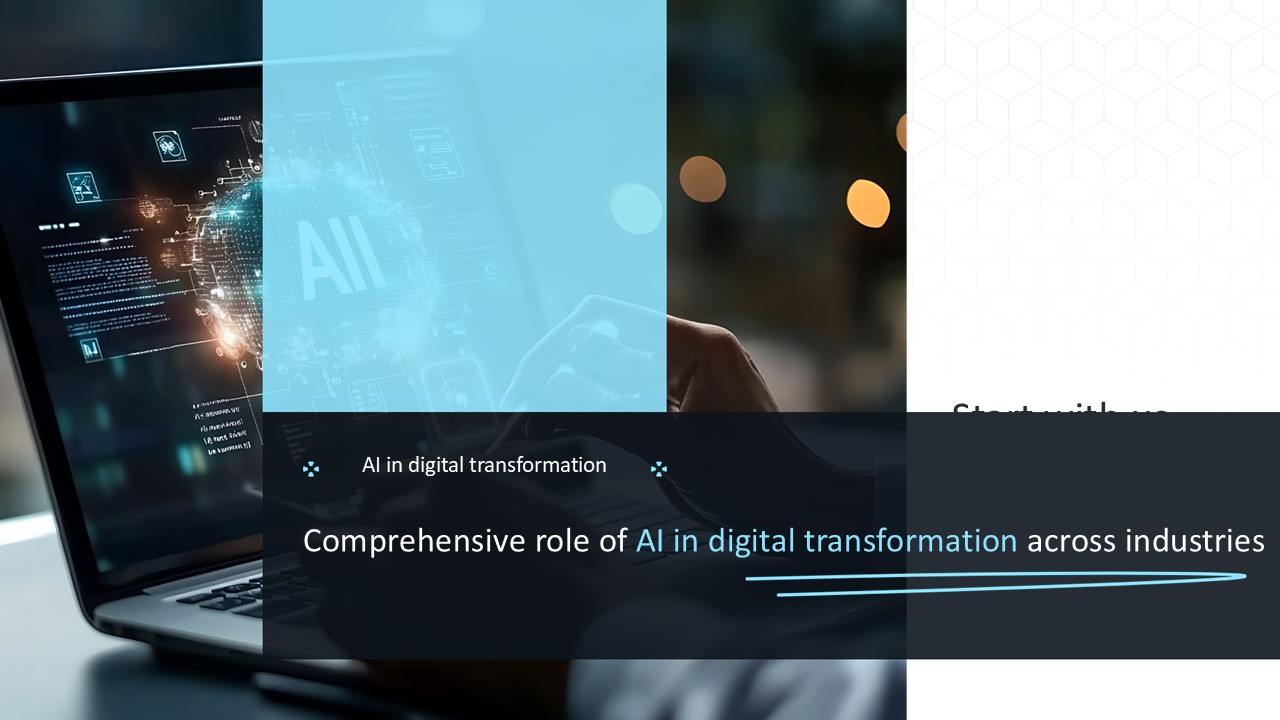
Title: Comprehensive Role of AI in Digital Transformation Across Industries
1
Start with us
AI in digital transformation
Comprehensive role of AI in digital
transformation across industries
2
(No Transcript)
3
Quick summary
Want to know what role does AI play in digital
transformation across industries? Lets read our
blog and understand the comprehensive role of AI
technologies like predictive analytics, machine
learning, and edge computing in digital
transformation so businesses can achieve
real-time insights and efficiency at scale.
Besides that, explore how AI integration helps
your business scale and stay ahead of the curve.
However, the challenge isnt new! But it is an
increasingly pressing one! With deep implications
for how businesses across industries navigate to
adopt a modern take on business operations where
AI ML development services are fundamentally
changing how we work and live. Organizations know
they need to address the challenges, but most of
them struggle. Our research shows that most
organizations achieve less than one-third of the
impact expected from the recent investment in
digital transformation.
So, what can organizations across industries do
to beat the odds and achieve sustainable digital
transformation with human-AI ingenuity?
4
How AI drives digital transformation across
industries
AI ML services seamlessly integrate advanced
components like machine learning, NLP, predictive
analytics, and autonomous systems across
industries. By automating complex processes,
enhancing decision-making, and personalizing
customer experiences, AI accelerates growth,
improves efficiency, and fosters innovation. As
diverse industries embed AI at scale, they
integrate newer capabilities, creating a
data-driven ecosystem. So, lets explore the
comprehensive role of AI in different industries
and how it changes day-to-day business operations.
5
AI in healthcare
Digital marketing service providers have been
playing an essential role in modernizing the
healthcare industry as they help integrate
AI-enabled technologies across healthcare
administrative and patient-centric functions to
improve patient care and operational efficiency.
AI-powered diagnostics are enabling faster, more
accurate disease detection, while NLP processes
vast medical data to uncover insights.
Predictive analytics helps forecast patient
outcomes and optimize resource allocation.
Considering these benefits, the global AI in the
healthcare market is booming and is expected to
reach 187.95 billion by 2030. With these
technologies, healthcare providers can deliver
personalized treatments, reduce costs, and
enhance the overall patient experience, offering
a new approach to precision medicine.
6
How AI is modernizing the healthcare industry
AI-powered diagnostics
Clinical decision support
Faster more accurate disease detection, such as
in radiology and pathology.
AI tools analyzing patient data to assist doctors
in making informed decisions.
Drug discovery
Personalized medicine
AI models accelerating the identification of
potential drug candidates.
Tailored treatment plans based on AI analysis of
patient data and genetics.
Supply chain optimization
Predictive analytics
AI predicting demand, improving inventory
management, and reducing waste.
Forecasting disease outbreaks and patient
outcomes for proactive care.
Remote patient monitoring
Robot-assisted surgeries
AI-powered devices continuously track patient
vitals and send alerts when necessary.
Enhancing precision and reducing recovery time
through AI-guided surgical robots.
Mental health support
Virtual health assistants
AI-powered apps and tools offering personalized
cognitive behavioral therapy (CBT).
AI-driven chatbots and voice assistants improving
patient engagement and support.
7
AI in finance and banking
AI is improving the efficiency of the finance and
banking sector by streamlining daily operations.
AI ML services with machine learning algorithms
detect fraudulent activities in real-time, while
AI-driven chatbots provide 24/7 customer support.
Predictive analytics optimize risk management and
personalize financial services. Recent reports
state that the adoption of AI in finance and
banking could reduce costs by up to 25 by 2030.
With these technologies, financial institutions
can offer more accurate insights, faster
processing times, and improved customer
experiences, driving large-scale digital
transformation in the industry.
8
How AI is modernizing finance and banking industry
Fraud detection
Loan underwriting
Machine learning models analyze transaction
patterns to identify fraudulent activities.
AI automates the loan approval process, reducing
turnaround time and enhancing accuracy.
Regulatory compliance
Automated customer service
NLP helps automate the process of complying with
financial regulations and reporting.
AI chatbots and virtual assistants enhance
customer support and query resolution.
Trading algorithms
Credit scoring
AI-driven algorithms analyze market trends and
execute trades at optimal moments.
AI-based systems analyze alternative data sources
for more accurate credit assessments.
Wealth management
Personalized financial advice
AI tools provide personalized portfolio
management recommendations for investors.
AI uses customer data to recommend tailored
financial products and services.
Operational efficiency
Risk management
AI reduces manual workloads by automating
repetitive processes, cutting operational costs.
Predictive analytics models assess potential
risks and help mitigate financial exposure.
9
AI in logistics and transportation
The best digital transformation company offers
ample opportunities to the logistics and
transportation industry by integrating machine
learning, predictive analytics, and autonomous
systems to optimize routes, enhance fleet
management, and reduce operational costs. AI
algorithms predict traffic patterns, improve
delivery timelines, and reduce fuel consumption,
while autonomous vehicles and drones are
modernizing last-mile delivery. On the other
hand, AI-powered packers and movers app
development is also helping businesses to reduce
operational costs.
According to McKinsey, AI could improve logistics
efficiency by up to 30. With AI, companies
achieve real-time data-driven insights, automate
routine tasks, and enhance customer experience.
It helps drive a smarter, more efficient
transportation ecosystem that scales with demand.
10
How AI is modernizing logistics and transportation
Route optimization
Automated warehousing
AI analyzes traffic data to determine the
fastest, most fuel-efficient routes.
AI-driven robots streamline picking, packing, and
sorting in warehouses.
Fleet management
Autonomous vehicles
AI optimizes fleet scheduling, improving delivery
times and reducing operational costs.
AI-powered trucks and drones are transforming
freight and last-mile delivery.
Smart logistics hubs
Predictive maintenance
AI-powered systems enable seamless coordination
at distribution centers.
AI monitors fleet health, predicting and
preventing breakdowns before they occur.
Driver assistance systems
Supply chain visibility
AI enhances safety and efficiency with autonomous
driving features and vehicle monitoring.
AI offers real-time insights into supply chain
operations, enhancing decision-making.
Customer experience
Demand forecasting
AI chatbots and real-time tracking provide
transparent, responsive communication for
consumers.
AI predicts demand fluctuations, helping
businesses manage inventory and reduce
overstocking.
11
AI in education
Leading AI and ML development company in the USA
is changing the dynamics of the edtech industry
by integrating advanced technologies like machine
learning, natural language processing (NLP), and
intelligent tutoring systems. This progress
enables personalized learning experiences,
adaptive assessments, and automated grading,
significantly improving educational outcomes. The
best digital transformation solution providers
are improving student engagement, optimizing
curriculum, and allowing real-time data analytics
to track student progress with AI-driven
platforms.
According to a report by HolonIQ, the global AI
in education market is expected to reach 25.7
billion by 2030. As AI scales, it is creating a
more efficient, accessible, and customized
educational ecosystem for all.
12
How AI is modernizing education industry
Personalized learning
Curriculum optimization
AI customizes lessons to individual learning
styles and progress.
AI helps educators design more effective and
engaging curricula.
Language learning
Intelligent tutoring systems
AI-based apps provide interactive, personalized
language instruction.
AI-powered tutors provide on-demand, personalized
support to students.
Student engagement
Automated grading
AI-driven gamification and interactive tools
boost student participation.
AI systems expedite grading, offering instant
feedback to students.
Virtual classrooms
Learning analytics
With real-time interaction and content delivery,
AI offers remote learning flexibility.
AI tracks student performance, identifying areas
for improvement in real-time.
Administrative automation
Adaptive assessments
AI streamlines administrative tasks, improving
operational efficiency.
AI customizes assessments based on individual
student capabilities and needs.
13
Original Source-
https//www.agileinfoways.com/blogs/ai-in-digital-
transformation/
For More Blogs-
https//www.agileinfoways.com/blogs
The End
Our Contact Details -
1 470-772-5053
Florida (Fort Lauderdale)
inquiry_at_agileinfoways.com
4905 NW 105th Dr, Coral Springs, FL 33076
Recommended

