

New Holland CR940 Combine Harvesters Service Repair Manual Instant Download PowerPoint PPT Presentation
Title: New Holland CR940 Combine Harvesters Service Repair Manual Instant Download
1
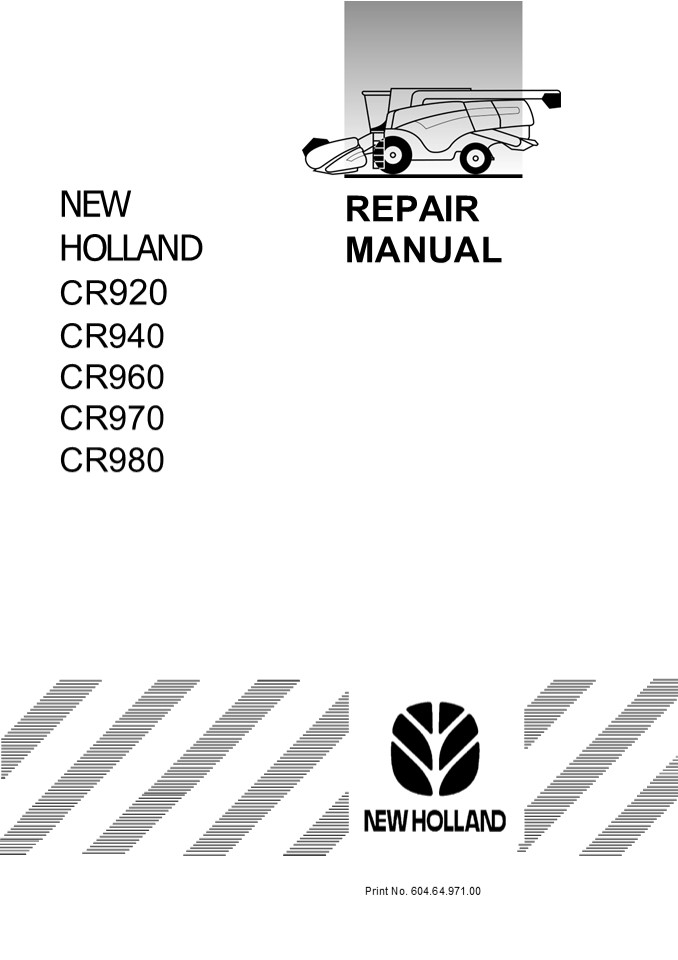
REPAIR MANUAL
NEW HOLLAND CR920 CR940 CR960 CR970 CR980
Print No. 604.64.971.00
2
CR920 - CR940 - CR960 - CR970 CR980 COMBINES REPA
IR MANUAL
SECTIONS GENERAL INFORMATION ENGINE
...................................
...................... 10 LIVE PTO
..................................
...................... 14 TRANSMISSION
............................ .....................
. 21 FRONT MECHANICAL DRIVE ...............
...................... 25 HYDROSTATIC DRIVE
...................... ......................
29 BRAKES AND CONTROLS ..................
...................... 33 HYDRAULIC SYSTEMS
..................... ......................
35 TOWING HOOKS BALLASTING ...........
...................... 37 STEERING AXLE
........................... ......................
41 SUSPENSION TRACKS ...................
...................... 48 CLIMATE CONTROL
........................ ......................
50 ELECTRICAL SYSTEM ......................
...................... 55 PRODUCT FEEDING
........................ ......................
60 THRESHING ...............................
...................... 66 SEPARATION
.............................. ...................
... 72 CLEANING SYSTEM ........................
...................... 74 GRAIN STORAGE
.......................... ......................
80 ACCESSORIES .............................
...................... 88 PLATFORM, CAB,
BODYWORK AND DECALS ...................... 90
S
E
R
V
I
C
E
3
GENERAL INFORMATION
1
SECTION 00 - GENERAL INFORMATION CONTENTS
Section 00 000
Description Page Foreword ........................
.............................................
2 Part and Accessories ...........................
................................ 2 Precautionary
Statements .......................................
................ 3 Personal Safety
..................................................
.............. 3 Machine Safety
..................................................
.............. 3 Safety Precautions
..................................................
........... 3 Personal Considerations
..................................................
...... 3 Equipment Considerations
..................................................
..... 4 General Considerations ...................
......................................
5 Operational Considerations .....................
................................. 5 Antifreeze
(See Fire, Solvents, i.e., Isopropanol, Ethylene
Glycol, Methanol) ............ 7 Battery Acids
(See Acids and Alkalis) ..........................
................... 7 Brake and Clutch Linings
and Pads (See Legal Aspects) .....................
........ 7 Brazing (See Welding)
..................................................
........ 7 Chemical Materials - General (See
Legal Aspects) ..................................
7 Clutch Linings and Pads (See Brake and Clutch
Linings and Pads) ....................
8 Corrosion Protection Materials (See Solvents,
Fire) ................................. 8
Cutting (See Welding) ............................
.............................. 8 Dewaxing (See
Solvents and Fuels - Kerosene) ...................
................. 8 Dusts .......................
..................................................
8 Electric Shock ................................
................................. 8 Exhaust Fumes
..................................................
.............. 9 Fiber Insulation (See Dusts)
..................................................
... 9 Fire (See Welding, Foams, Legal Aspects)
......................................... 9
First Aid ........................................
.............................. 9 Foams-
Polyurethane (See Fire) ..........................
........................ 9 Fuels (See Fire, Legal
Aspects, Chemicals - General, Solvents)
.................... 10 Gas Cylinders (See Fire)
..................................................
.... 10 General Workshop Tools and Equipment
........................................
10 High-Pressure Air, Lubrication and Oil Test
Equipment .............................. 11
Legal Aspects ....................................
............................ 11 Lubricants and
Greases ..........................................
.............. 11 Paints (See Solvents and
Chemical Materials - General) ....................
........ 11 Solder (See Welding)
..................................................
........ 11 Product Identification
..................................................
....... 15 Standard Torque Data for Hydraulic
Tubes and Fittings ............................
18 Pipe Thread Fitting Torque ...................
................................. 19 Installation
of ORFs (O-ring Flat Faced) Fittings
.................................. 19
Lubrication ......................................
............................ 20 Sealants
..................................................
.................. 23
604.64.971.00 - 05 - 2003
4
https//www.ebooklibonline.com Hello dear
friend! Thank you very much for reading. Enter
the link into your browser. The full manual is
available for immediate download. https//www.eb
ooklibonline.com
5
2
GENERAL INFORMATION
FOREWORD Appropriate service methods and correct
repair procedures are essential for the safe,
reliable operation of all equipment, as well as
the personal safety of the individual performing
the repair. This Repair Manual provides
troubleshooting, overhaul, and pressure-testing
instructions using recommended procedures and
equipment. Follow- ing these instructions will
ensure the safe, efficient, and timely
completion of the service or repair. There are
numerous variations in procedures, techniques,
tools, and parts for servicing machines, as well
as in the skill of the individual doing the work.
This manual cannot possibly anticipate all such
variations and provide advice or cautions as to
each. Accordingly, anyone who departs from the
instruc- tions provided in this manual must
first establish that their personal safety, the
safety of others, and the integrity of the
machine will not be compromised by the choice of
methods, tools or parts. The manual is divided
into sections which are subdivided into
chapters Each chapter contains information on
general operating principles, detailed
inspection, overhaul and, where applicable,
specific troubleshooting, special tools, and
specifications. Any reference in this manual to
right, left, rear, front, top, or bottom is as
viewed from the operators seat, looking toward
the normal direction of travel. All data and
illustrations in this manual are subject to
variations in build specification. This
information was correct at the time of issue,
but New Holland policy is one of continuous
improvement, and, the right to change
specifications, equipment, or design at any
time, without notice, is reserved.
released by NEW HOLLAND. The installation and or
use of such products could have a negative effect
upon the design characteristics of your machine
and thereby affect its safety. NEW HOLLAND is
not liable for any damage caused by the use of
NON GENUINE NEW HOLLAND parts and accessories.
ABOUT IMPROVEMENTS New Holland is continually
striving to improve its products. We must,
therefore, reserve the right to make
improvements or changes when it becomes
practical and possible to do so, without
incurring any obligation to make changes or
additions to the equipment sold previously. ALL
SPECIFICATIONS ARE SUBJECT TO CHANGE WITHOUT
NOTICE. PART AND ACCESSORIES Genuine NEW HOLLAND
parts and accessories have been specifically
designed for NEW HOLLAND MACHINES. We would like
to point out that NON GENUINE parts and
accessories have not been examined
and 604.64.971.00 - 05 - 2003
6
GENERAL INFORMATION
3
SAFETY PRECAUTIONS Practically all service work
involves the need to drive the combine. The
operators manual, supplied with each combine,
contains detailed safety precautions relating to
driving, operating, and servicing the combine.
These precautions are as applicable to the
service technician as they are to the operator
and should be read, understood and practiced by
all personnel. Prior to undertaking any
maintenance, repair, overhaul, dismantling or
reassembly operations, whether within a workshop
facility or in the field, consideration should
be given to factors that may have an effect upon
safety, not only upon the mechanic carrying out
the work, but also upon bystanders.
PRECAUTIONARY STATEMENTS PERSONAL
SAFETY Throughout this manual and on machine
decals, you will find precautionary statements
(DANGER, WARNING, and CAUTION) followed by
specific instructions. These precautions are
intended for the personal safety of you and
those working with you. Please take the time to
read them.
DANGER
This word DANGER indicates an immediate
hazardous situation that, if not avoided, will
result in death or serious injury. The color
associated with Danger is RED.
WARNING
PERSONAL CONSIDERATIONS The wrong clothes or
carelessness in dress can cause accidents. Be
sure to wear suitable clothing when servicing
equipment. Some jobs require special protective
equipment be sure to use protective equipment
when required.
This word WARNING indicates a potentially
hazardous situation that, if not avoided, could
result in death or serious injury. The color
associated with Warning is ORANGE.
CAUTION
This word CAUTION indicates a potentially
hazardous situation that, if not avoided, may
result in minor or moderate injury. It may also
used to alert against unsafe practices. The color
associated with Caution is YELLOW.
Skin Protection Used motor oil may cause skin
cancer. Follow work practices that minimize the
amount of skin exposed and length of time used
oil stays on your skin.
Eye Protection The smallest eye injury may cause
loss of vision. Injury can be avoided by wearing
eye protection when engaged in chiselling,
grinding, discing, welding, and painting.
FAILURE TO FOLLOW THE DANGER,
WARNING, AND CAUTION INSTRUCTIONS
MAY RESULT IN SERIOUS BODILY INJURY OR DEATH.
MACHINE SAFETY
Breathing Protection Fumes, dust, and paint spray
are unpleasant and harmful. These can be avoided
by wearing respiratory protection.
The additional precautionary statement
(IMPORTANT) is followed by specific
instructions. This statement is intended for
machine safety.
IMPORTANT The word IMPORTANTis used to inform
the reader of something he needs to know to
prevent minor machine damage if a certain
procedure is not followed.
Hearing Protection Loud noise may damage your
hearing, and the greater the exposure the worse
the damage. If the noise is excessive, wear ear
protection.
INFORMATION NOTE Instructions used to identify
and present supplementary information.
Lifting Protection Avoid injury by correctly
handling components. Make sure you are capable
of lifting the object. If in doubt get help.
604.64.971.00 - 05 - 2003
7
4
GENERAL INFORMATION
Hand Protection It is advisable to use a
protective cream before work to prevent
irritation and skin contamination. After work
clean your hands with soap and water. Solvents
such as mineral spirit and kerosene may harm the
skin.
Compressed Air The pressure from a compressed-air
line often exceeds 100 PSI (690 kPa). It is
perfectly safe if used correctly. Any misuse may
cause injury. Never use compressed air to blow
dust, filing, and dirt away from your work area
unless the correct type of nozzle is
fitted. Compressed air is not a cleaning agent
it will only move dust from one place to
another. Look around before using an air hose as
bystanders may get grit into their eyes, ears,
or skin.
Foot Protection Substantial or protective foot
wear with reinforced toe caps will protect your
feet from falling objects. Additionally,
oil-resistant soles will help to avoid slipping.
Special Clothing For certain work it may be
necessary to wear flame or acid-resistant
clothing.
Hand Tools Many cuts, abrasions and injuries are
caused by defective tools. Never use the wrong
tool for the job, as this generally leads either
to an injury, a poor job, or damaged
equipment. When removing or replacing hardened
pins, use a copper or brass drift rather than a
hammer. For dismantling, overhaul, and assembly
of major and sub-components, always use the
Special Service Tools recommended. These will
reduce the work effort, labor time, and the
repair cost.
EQUIPMENT CONSIDERATIONS Machine Guards Before
using any machine, check to ensure that the
machine guards are in position and serviceable.
These guards not only prevent parts of the body
or clothing coming in contact with the moving
parts of the machine, but also ward off objects
that might fly off the machine and cause injury.
Electricity Electricity has become so familiar in
day to day usage, that its potentially dangerous
properties are often overlooked. Misuse of
electrical equipment can endanger life. Before
using any electrical equipment particularly
portable appliances - make a visual check to make
sure that the wiring is not worn or frayed and
that the plugs and sockets are intact. Make sure
you know where the nearest isolating switch for
your equipment is located.
Lifting Devices Always ensure that lifting
equipment, such as chains, slings, lifting
brackets, hooks and eyes, are thoroughly checked
and in good condition before use. If in doubt of
weight capacity, select stronger equipment than
is necessary. Never stand under a suspended load
or raised implement.
604.64.971.00 - 05 - 2003
8
GENERAL INFORMATION
5
GENERAL CONSIDERATIONS Solvents Use cleaning
fluids and solvents that are known to be safe.
Certain types of fluids can cause damage to
components such as seals and can cause skin
irritation. Solvents should be checked that they
are suitable not only for the cleaning of
components and individual parts, but also that
they do not affect the personal safety of the
user.
OPERATIONAL CONSIDERATIONS Stop the engine, if at
all possible, before performing any
service. Place a warning sign on the combine
which, due to service or overhaul, would be
dangerous to start. Disconnect the battery leads
if leaving such a unit unattended. Do not
attempt to start the engine while standing
beside the combine or attempt to bypass the
safety start switch. Avoid prolonged running of
the engine in a closed building or in an area
with inadequate ventilation as exhaust fumes are
highly toxic. Always turn the radiator cap to the
first stop to allow pressure in the system to
dissipate when the coolant is hot. Never work
beneath a combine which is on soft ground.
Always take the unit to an area which has a hard
working surface, preferably concrete. If it is
found necessary to raise the combine for ease of
servicing or repair, make sure that safe and
stable supports are installed beneath axle
housings, casings, etc., before starting
work. Use ladders or working platforms when
servicing those areas of a combine that are not
within easy reach.
Housekeeping Many injuries result from tripping
over or slipping on objects or material left
lying around by a careless worker. Prevent these
accidents from occurring. If you notice a
hazard, remove the hazard. A clean, hazard-free
place of work improves the surroundings and
daily environment for everybody.
Fire Fire has no respect for persons or property.
The destruction that a fire can cause is not
always fully realized. Everyone must be
constantly on guard. Extinguish matches, cigars,
and cigarettes before throwing them away. Work
cleanly, disposing of waste material into proper
containers. Locate the fire extinguishers and
find out how to operate them. Do not panic -
warn those near and raise the alarm. Do not allow
or use an open flame near the combine fuel tank,
battery, or component parts.
WARNING
Do not use your hand to check for leaks. Use a
piece of cardboard or paper to search for leaks.
Stop the engine and relieve pressure before
connecting or disconnecting lines. Tighten all
connections before starting the engine or
pressurizing lines. If any fluid is injected into
the skin, obtain medical
First Aid In the type of work that mechanics are
engaged in, dirt, grease, and fine dusts settle
upon the skin and clothing. If a cut, abrasion
or burn is disregarded it may become infected
within a short time. Seek medical aid
immediately.
attention immediately or gangrene may result.
WARNING
Cleanliness Cleanliness of the combine hydraulic
system is essential for optimum performance.
When carrying out service and repairs, plug all
hose ends and component connections to prevent
dirt entry. Clean the exterior of all components
before carrying out any form of repair. Dirt and
abrasive dust can reduce the efficiency and
working life of a component and lead to costly
replacement. Use of a high-pressure washer or
steam cleaner is recommended.
Escaping hydraulic/diesel fluid under pressure
can penetrate the skin causing serious injury.
Before loosening any hoses or tubes connecting
implements to remote control valves, etc., switch
off the engine, remove all pressure in the lines
by operating levers several times. This will
remove the danger of personal injury by oil
pressure.
604.64.971.00 - 05 - 2003
9
6
GENERAL INFORMATION
ACIDS AND ALKALIS (SEE BATTERY ACIDS, I.E.,
CAUSTIC SODA, SULPHURIC ACID) Used in batteries
and cleaning materials. Irritating and corrosive
to the skin, eyes, nose and throat. Causes
burns. Avoid splashes to the skin, eyes, and
clothing. Wear suitable protective gloves and
goggles. Can destroy ordinary protective
clothing. Do not breathe mists. Ensure access to
water and soap is readily available for
splashing accidents.
Prior to pressure testing, make sure all hoses
and connectors of the combine and the test
equipment are in good condition and tightly
sealed. Pressure readings must be taken with the
gauges specified. The correct procedure should
be rigidly observed to prevent damage to the
system or the equipment, and to eliminate the
possibility of personal injury. Always lower
equipment to the ground when leaving the
combine. Beware of overhead power, electric or
telephone cables when travelling. Do not park or
attempt to service a combine on an incline. If
unavoidable, take extra care and block all
wheels. Observe recommended precautions as
indicated in this Repair Manual when dismantling
the air conditioning system as escaping
refrigerant can cause frostbite. Prior to
removing wheels and tires from the combine,
check to determine whether additional ballast
(liquid or weights) has been added. Seek
assistance and use suitable equipment to support
the weight of the wheel assembly. When inflating
tires, beware of over inflation - constantly
check the pressure. Over inflation can cause
tires to burst and result in personal injury.
ADHESIVES AND SEALERS (SEE FIRE)
CAUTION
Highly flammable, combustible.
Generally should be stored in NO SMOKING areas
cleanliness and tidiness while in use should be
observed, i. e., from applications where
possible, disposable paper should be dispensed
to cover benches. Containers, including
secondary contain- ers, should be
labelled. Solvent-Based Adhesives/Sealers (See
Solvents) Follow manufacturers Instructions
Water-Based Adhesives/Sealers Those based on
polymer emulsions and rubber lattices may
contain small amounts of volatile toxic and
harmful chemicals. Skin and eye contact should be
avoided, and adequate ventilation provided
during use. Follow manufacturers Instructions
HEALTH AND SAFETY PRECAUTIONS Many of the
procedures associated with vehicle maintenance
and repair involve physical hazards or other
risks to health. This section lists,
alphabetically, some of these hazardous
operations, materials and equipment associated
with them. The precautions necessary to avoid
these hazards are identified. The list is not
inclusive all operations, procedures, and
handling of materials should be carried out with
health and safety in mind.
Resin-Based Adhesive/Sealers (i.e., Epoxide and
Formaldehyde Resin Based) Mixing should only be
carried out in well-ventilated areas as harmful
or toxic volatile chemicals may be
released. Skin contact with uncured resins and
hardeners can result in irritation, dermatitis,
and absorption of toxic, or harmful chemicals
through the skin. Splashes can damage the
eyes. Provide adequate ventilation avoid skin
and eye contact. Follow manufacturers
instructions.
604.64.971.00 - 05 - 2003
10
SECTION 10 - ENGINE - CHAPTER 1
1
SECTION 10 - ENGINE Chapter 1 - 7.5L
Engine CONTENTS
Section 10 000
Description Page Specifications
........................ .........................
............... 2 Tightening Torques
.................... .............................
........... 8 Special Tools ......................
... ........................................
9 Troubleshooting .......................
........................................
11 Description and Operation ..............
....................................... 15 Engine
Overhaul - Introduction ..........
.......................................
22 Injection Pump Timing Check ...........
.......................................
23 Overhaul .............................
.......................................
27 Cylinder Head, Valves and Related Parts .
....................................... 27 Engine
Front Cover and Timing Gears ...
....................................... 40 Oil
Pan ..............................
.......................................
45 Flywheel .............................
....................................... 46 Rear
Cover Plate .....................
....................................... 48 Oil
Pump .............................
....................................... 50 Oil
Pressure Relief Valve ...............
.......................................
52 Camshaft ............................
.......................................
53 Camshaft Bearings ....................
.......................................
54 Pistons ..............................
.......................................
56 Connecting Rod Bush Replacement .....
.......................................
58 Cylinder Block Overhaul ...............
.......................................
60 Cylinder Bore .........................
.......................................
61 Sleeving - Boring and Honing ...........
.......................................
62 Installing Piston Assembly Into Block ....
....................................... 65
Crankshaft ...........................
....................................... 66 Front
Crankshaft Cassette Oil Seal Replacement
................................. 71 Engine
Compression Test ..............
....................................... 77
10 001
10 101 10 106 10 102 10 103 10 102 10 102 10
102 10 106
10 105
10 105
10 103 10 003 10 001
604.64.971.00 - 05 - 2003
11
SECTION 10 - ENGINE - CHAPTER 1
15
DESCRIPTION AND OPERATION
2
The 7.5 Litre engine is a 6-cylinder turbocharged
and aftercooled, having a bore of 111.8 mm
(4.4") and a stroke of 127 mm (5.0") which
generates a displacement of 7.5L (456 in3). The
engine uses a mechanical or electronically
controlled in line injection pump depending on
model and has been designed to meet current
emission regulations and must only be serviced
by an authorized service agent. For a detailed
description and operation of the fuel system,
reference must be made to the Fuel System
chapter in this Section of the manual. All
engines feature cross flow cylinder heads, with
the inlet and exhaust manifolds on opposite
sides of the cylinder head. The fuel and air
combustion process, takes place in the specially
designed bowl in the crown of the pistons.
Cylinder Block Assembly
The cylinder block is an alloy cast iron with
deep cylinder skirts, and water jackets for
cooling the cylinders. The cylinder bores are
machined integral with the cylinder block,
during the manufacturing process. Cylinders are
in line and vertical and numbered 1 to 6 from
the front to the rear of the engine. They can be
bored oversize for the fitment of sleeves, which
are available in service. The oil pan is the
reservoir for the engine oil lubrication system
and a cast iron front cover on the front of the
engine covers the timing gear assembly.
604.64.971.00 - 05 - 2003
12
16
SECTION 10 - ENGINE - CHAPTER 1
Cylinder Head Assembly The cylinder head
incorporates an inlet and exhaust valve per
cylinder with the valve rocker arm shaft
assembly bolted to the cylinder block through the
cylinder head. Cylinder head retaining bolts are
evenly spaced with a six point pattern around
each cylinder, this ensures an even clamping
load across the cylinder head area. The intake
and exhaust manifolds are bolted to the head,
the intake manifold is mounted on the right hand
side of the engine, with the diesel injectors
mounted outside the rocker cover. The exhaust
manifold is mounted on the left hand side of the
engine. Water outlet connections and thermostats
being attached to the front of the cylinder
block. Valve guides are integral in the cylinder
head, and valves with oversize stems are
available in service. Special replaceable
sintered iron valve seats are pressed into each
valve port during manufacture and oversize valve
seats also available in service. All valves are
fitted with positive valve rotators and valve
stem oil seals. Valve clearance is maintained by
adjustment of the self locking adjusting screw,
mounted in each of the rocker arms. Camshaft
Assembly The camshaft runs in 5 replaceable
bearings. The camshaft drive gear is in mesh
with and driven by the camshaft idler gear which
is driven by the crankshaft timing
gear. Camshaft end thrust is controlled by a
thrust plate bolted to the block, and located
between the camshaft gear and the front camshaft
journal. A helical gear is mounted on the rear of
the camshaft, and drives the engine oil
lubrication pump mounted forward of the flywheel.
3
396- E- 16 TI
4
Crankshaft Assembly The crankshaft is supported
in the cylinder block by 7 main bearings. The
crankshaft is manufactured from steel with
machined finished crank webs End thrust is
controlled by a thrust bearing incorporated in
the center main bearing of the crankshaft. An
external damper is fitted to the crankshaft
pulley to ensure smooth running operation. Front
and rear crankshaft oil sealing is effected by
cassette type seals that are designed for long
and durable service life.
5
604.64.971.00 - 05 - 2003
13
SECTION 10 - ENGINE - CHAPTER 1
17
Connecting Rods Connecting rods Teepee (wedge)
shaped at the small end have been designed to
reduce the reciprocating weight at the piston
end. The connecting rods are of a heavy beam
construction and are assembled as a matched set
to each engine. They are retained in position by
the connecting rod big end cap and secured by
two bolts per rod. The small end of the
connecting rod is fitted with a replaceable
bronze bushing, through which the free floating
piston pin is fitted. The steel pin being held in
place within the piston by two snap rings.
6
Pistons Pistons are constructed of an aluminium
silicon alloy with an iron insert for the top
ring. The combustion chamber being recessed into
the piston crowns. Each piston has two
compression rings and one oil control ring, to
reduce friction and increase positive sealing.
All rings are located above the piston pin. A
Engines with Electronically Controlled Injection
Pump B Engines with Mechanically Controlled
Injection Pump
7
Manifolds The cross flow design aluminium intake,
and cast iron exhaust manifolds, are on opposite
sides of the cylinder head. This is designed to
maintain balanced heat distribution within the
cylinder head. The configuration of the
manifolds also ensures minimum heat transfer to
the intake manifold. A grid heater is fitted to
the intake manifold to assist in cold starting
of the engine when coolant water temperature is
below 30C.
8
604.64.971.00 - 05 - 2003
14
18
SECTION 10 - ENGINE - CHAPTER 1
Timing Gears The crankshaft timing gear is heated
and press fitted on to the front of the
crankshaft, to a high degree of accuracy during
manufacturing. This enables precise timing being
maintained during the life of the engine. The
crankshaft gear, 2, drives the idler gear, 3,
which is attached to the front of the cylinder
block. The idler gear then drives the camshaft
gear, 1, and the injection pump gear, 4. The
camshaft gear is bolted to the front of the
camshaft, and is keyed to maintain position of
the gear on the camshaft.
4
1
.
..
..
2
3 P396- E- 36
9
Lubrication System
10
Engine Lubrication System
Lubrication of the engine, Figure 10, is
maintained by a rotor type oil pump mounted in
the rear of the engine block, forward of the
flywheel on the left hand side of the engine.
TA6010058
11
604.64.971.00 - 05 - 2003
15
SECTION 10 - ENGINE - CHAPTER 1
19
The oil pump is driven from the rear of the
camshaft and draws oil from the engine oil pan
through a tube and screen assembly.
12
A spring loaded relief valve is integral with the
dummy oil filter head mounted on the left hand
side of the engine block and prevents over
pressurisation of the system.
3
396- E- 18
TI
13
The spin on type oil filter is mounted at the
rear of the engine.
14
604.64.971.00 - 05 - 2003
16
20
SECTION 10 - ENGINE - CHAPTER 1
Oil flows from the filter to the main oil
gallery, which runs the length of the cylinder
block and also intersects the camshaft follower
chamber. The main gallery supplies oil to the
crankshaft main bearings, connecting rods and
both big and small ends. The underside of the
pistons and pins, are lubricated by oil pressure
jets mounted adjacent to each main journal
housing. The camshaft drive gear bushing is
pressure lubricated through a drilled passage
from the front main bearing. The gear has small
oil passages machined on both sides allowing
excess oil to escape.
396- E- 26 TI
15
An intermittent flow of oil is directed to the
valve rocker arm shaft assembly via a drilled
passage in the cylinder block. This is located
vertically above No.1 camshaft bearing, 1, and
aligns to a hole in the cylinder head. The
rotation of the camshaft allows a controlled
intermediate flow of lubrication.
1
396- E- 16
TI
16
Timing gears are lubricated by splashed oil from
the cam follower chamber, and the pressure
lubricated camshaft drive gear bushing.
P396- E- 36
17
604.64.971.00 - 05 - 2003
17
SECTION 10 - ENGINE - CHAPTER 1
21
The turbocharger is supplied with oil from the
oil filter support housing, 1, mounted on the
left hand side of the engine.
18
The fuel injection pump is pressure lubricated
from a port, 1, on the right hand side of the
engine block. The fuel pump is either
electronically controlled using an electronic
control unit, Figure 19 or mechanically
controlled depending on model build, Figure 20.
19
20
604.64.971.00 - 05 - 2003
18
Suggest If the above button click is invalid.
Please download this document first, and then
click the above link to download the complete
manual. Thank you so much for reading
19
22
SECTION 10 - ENGINE - CHAPTER 1
ENGINE OVERHAUL - INTRODUCTION In the following
procedures and illustrations the engine is shown
removed from the vehicle however there are
certain operations that can be performed with
the engine installed. Where it is necessary to
remove the engine use a suitable hoist or
overhead gantry and standard engineering
procedures. Removal of the engine is described
in Section 10, Chapter 3 of this
manual. Dismantle the engine following
conventional techniques and by referring to the
appropriate overhaul sections of this chapter.
Always refer to the specification section as
necessary. NOTE Where it is necessary to remove
additional items to gain access to the
components on the engine Refer to Chapter 3
Remove and Replace, 7.5L Engine. NOTE All
gaskets, seals, and O rings must be replaced
during re-assembly. Where new sealant is to be
applied refer to Engine Specifications.
For concerns relating to the fuel system refer to
the Fuel System chapter in this manual. On
engines fitted with the electronically
controlled fuel injection pump refer to the
Engine Fault Codes chapter in the electrical
section of the manual.
Operations or repairs that can be performed with
the engine still in the vehicle.
- Front timing cover, Pump drive gear and idler
gear. Removal of engine is required in order to
remove and replace the camshaft timing gear. - Front pulley and damper assembly.
- Cylinder head and associated inlet and exhaust
components. - Fuel injection pump removal and timing.
- Water pump, thermostat, components .
- Oil pump relief valve.
- Turbocharger.
and associated
604.64.971.00 - 05 - 2003
20
https//www.ebooklibonline.com Hello dear
friend! Thank you very much for reading. Enter
the link into your browser. The full manual is
available for immediate download. https//www.eb
ooklibonline.com
Recommended

