

2002 Harley Davidson Touring Service Repair Manual Instant Download (# 99483-02) PowerPoint PPT Presentation
Title: 2002 Harley Davidson Touring Service Repair Manual Instant Download (# 99483-02)
1
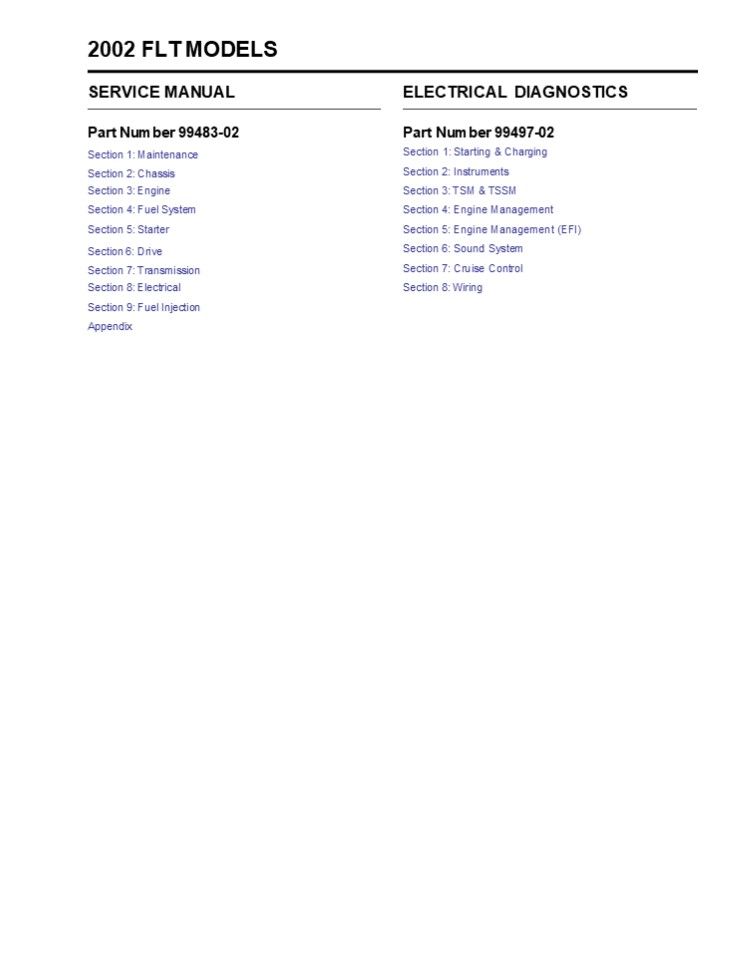
2002 FLT MODELS
SERVICE MANUAL
ELECTRICAL DIAGNOSTICS
Part Number 99483-02 Section 1
Maintenance Section 2 Chassis Section 3 Engine
Section 4 Fuel System Section 5 Starter Section
6 Drive Section 7 Transmission Section 8
Electrical Section 9 Fuel Injection Appendix
Part Number 99497-02 Section 1 Starting
Charging Section 2 Instruments Section 3 TSM
TSSM Section 4 Engine Management Section 5
Engine Management (EFI) Section 6 Sound
System Section 7 Cruise Control Section 8 Wiring
2
MAINTENANCE
1
Table Of Contents
- SUBJECT PAGE NO.
- Troubleshooting . . . . . . . . . . . . . . . . .
. . . . . . . . . . . . . . . . . . . . . . . . .
. . . . . . 1-1 - Shop Practices . . . . . . . . . . . . . . . . .
. . . . . . . . . . . . . . . . . . . . . . . . .
. . . . . . . 1-5 - Tool Safety . . . . . . . . . . . . . . . . . . .
. . . . . . . . . . . . . . . . . . . . . . . . .
. . . . . . . . 1-7 - Scheduled Maintenance Table . . . . . . . . . . .
. . . . . . . . . . . . . . . . . . . . . . . .
. 1-9 - Scheduled Maintenance Procedures . . . . . . . .
. . . . . . . . . . . . . . . . . . . . . . .
. 1-14
3
HOME TROUBLESHOOTING
1.1
GENERAL
- Ignition timing incorrect due to faulty ignition
coil, ignition module or sensors (MAP, CMP, CKP
and/or BAS). - Engine lubricant too heavy (winter operation).
- NOTE
- Always disengage clutch for cold weather starts.
- Sticking or damaged valve or push rod wrong
length. - Primary cam sprocket spline sheared or missing
spacer. - Starts Hard
The following check list of possible operating
troubles and their probable causes will be
helpful in keeping your motorcy- cle in good
operating condition. More than one of these con-
ditions may be causing the trouble and all should
be carefully checked.
?WARNING
WARNING
The troubleshooting section of this manual is
intended solely as a guide to diagnosing
problems. Carefully read the appropriate sections
of this manual before perform- ing any work.
Improper repair and/or maintenance could result
in death or serious injury.
- Spark plugs in bad condition, have improper gap
or are partially fouled. - Spark plug cables in bad condition.
- Battery nearly discharged.
- Loose wire connection at one of the battery
terminals, - ENGINE ignition coil or plug between ignition
sensor and module. - 5. Carburetor controls not adjusted correctly.
- Water or dirt in fuel system and carburetor.
- Intake air leak.
- Fuel tank vent hose and vapor valve plugged, or
carbu- retor fuel line closed off and restricting
fuel flow. - Enrichener valve inoperative.
Starter Motor Does Not Operate or Does Not Turn
Engine Over
- Ignition/Light Key Switch not in IGNITION
position. - Engine Stop switch in the OFF position.
- Discharged battery, loose or corroded connections
(solenoid chatters). - Bank Angle Sensor tripped and Ignition/Light Key
Switch not cycled to OFF and then back to
IGNITION. - Starter control circuit, relay or solenoid
faulty. - Electric starter shaft pinion gear not engaging
or over- running clutch slipping.
9.
- Engine lubricant too heavy (winter operation).
- NOTE
- Always disengage clutch for cold weather starts.
- Ignition not functioning properly (possible
sensor fail- ure). - Faulty ignition coil.
- Valves sticking.
- Starts But Runs Irregularly or Misses
Engine Turns Over But Does Not Start
- Spark plugs in bad condition or partially fouled.
- Spark plug cables in bad condition and leaking.
- Spark plug gap too close or too wide.
- Faulty ignition coil, module and/or sensor.
- Battery nearly discharged.
- Damaged wire or loose connection at battery
terminals, ignition coil, or plug between
ignition sensor and mod- ule. - Intermittent short circuit due to damaged wire
insulation. - Water or dirt in fuel system, carburetor or
filter. - Fuel tank vent system plugged or carburetor vent
line closed off.
- Fuel tank empty.
- Fuel supply valve turned to OFF.
- Fouled spark plugs.
- Engine flooded with gasoline as a result of over
use of enrichener. - Fuel valve or filter clogged.
- Vacuum hose to automatic fuel supply valve
discon- nected, leaking or pinched. - Discharged battery, loose or broken battery
terminal connections. - Loose wire connection at coil, battery or plug
between ignition sensor and module. - Spark plug cables in bad condition and shorting,
cable connections loose, or cables connected to
wrong cylin- ders.
- Carburetor controls misadjusted.
- Damaged carburetor.
- Loose or dirty ignition module connector at
crankcase.
2002 FLT Maintenance 1-1
4
https//www.ebooklibonline.com Hello dear
friend! Thank you very much for reading. Enter
the link into your browser. The full manual is
available for immediate download. https//www.ebo
oklibonline.com
5
- HOME
- Faulty MAP, CKP and/or CMP Sensors.
- Incorrect valve timing.
- Weak or broken valve springs.
- Damaged intake or exhaust valve.
- A Spark Plug Fouls Repeatedly
- Stabilizer links worn or loose.
- Rubber mounts loose or worn.
- Rear fork pivot shaft nuts loose.
- Front engine mounting bolts loose.
- Check Engine Lamp Illuminates During Operation
- Fault detected. Check for trouble codes.
- Fuel mixture too rich or enrichener left out too
long. - Incorrect spark plug for the kind of service.
- Piston rings badly worn or broken.
- Valve guides or seals badly worn.
LUBRICATION SYSTEM
Pre-Ignition or Detonation (Knocks or Pings)
Oil Does Not Return To Oil Pan
- Fuel octane rating too low.
- Faulty spark plugs.
- Incorrect spark plug for the kind of service.
- Excessive carbon deposit on piston head or in
combus- tion chamber. - Ignition timing advanced due to faulty sensor
inputs (MAP, CKP, CMP).
- Oil pan empty.
- Oil pump not functioning.
- Restricted oil lines or fittings.
- Restricted oil filter.
- O-ring damaged or missing from oil pump/crankcase
junction (also results in poor engine
performance).
Engine Uses Too Much Oil Or Smokes Excessively
Overheating
- Insufficient oil supply or oil not circulating.
- Insufficient air flow over engine.
- Heavy carbon deposit.
- Ignition timing retarded due to faulty MAP, CKP
and/or CMP Sensors. - Leaking valve.
- Oil pan overfilled.
- Restricted oil return line to pan.
- Restricted breather operation.
- Restricted oil filter.
- Piston rings badly worn or broken.
- Valve guides or seals worn.
- O-ring damaged or missing from oil pump/crankcase
junction (also results in poor engine
performance).
Valve Train Noise
- Low oil pressure caused by oil feed pump not
function- ing properly or oil passages
obstructed. - Faulty hydraulic lifters.
- Bent push rod.
- Incorrect push rod length.
- Rocker arm binding on shaft.
- Valve sticking in guide.
- Chain tensioner spring or shoe worn.
Engine Leaks Oil From Case, Push Rods, Hoses, Etc.
- Loose parts.
- Imperfect seal at gaskets, push rod cover,
washers, etc. - Restricted oil return line to pan.
- Restricted breather hose to air cleaner.
- Restricted oil filter.
- Oil pan overfilled.
- Rocker housing gasket (bottom) installed upside
down.
Excessive Vibration
- Wheels and/or tires worn or damaged.
- Engine/transmission/vehicle not aligned properly.
- Primary chain badly worn or links tight as a
result of insufficient lubrication or
misalignment. - Engine to transmission mounting bolts loose.
- Upper engine mounting bracket loose.
- Ignition timing incorrect/poorly tuned engine.
- Internal engine problem.
- Broken frame.
Low Oil Pressure
- Oil pan underfilled.
- Faulty low oil pressure switch.
- Oil pump O-ring(s) damaged or missing.
- Oil pressure relief valve stuck in open position.
- Ball missing from cam support plate.
1-2 2002 FLT Maintenance
6
- HOME
- High Oil Pressure
- Oil pan overfilled.
- Oil pressure relief valve stuck in closed
position.
Jumps Out Of Gear
- Shifter rod improperly adjusted.
- Shifter drum improperly adjusted or damaged.
- Shifter engaging parts (inside transmission)
badly worn and rounded. - Shifter forks bent.
- Damaged gears.
ELECTRICAL SYSTEM
Alternator Does Not Charge
Clutch Slips
- Module not grounded.
- Engine ground wire loose or broken.
- Faulty regulator-rectifier module.
- Loose or broken wires in charging circuit.
- Faulty stator and/or rotor.
- Clutch controls improperly adjusted.
- Insufficient clutch spring tension.
- Worn friction discs.
Clutch Drags Or Does Not Release
Alternator Charge Rate Is Below Normal
- Clutch controls improperly adjusted.
- Lubricant level too high in primary chaincase.
- Primary chain badly misaligned.
- Clutch discs warped.
- Insufficient clutch spring tension.
- Weak or damaged battery.
- Loose connections.
- Faulty regulator-rectifier module.
- Faulty stator and/or rotor.
Clutch Chatters 1. Friction discs or steel discs
worn or warped.
- Speedometer Operates Erratically
- Contaminated speedometer sensor (remove sensor
and clean off metal particles). - Loose connections.
BRAKES
CARBURETOR
Brake Does Not Hold Normally
- Master cylinder reservoir low on fluid.
- Brake system contains air bubbles.
- Master or wheel cylinder piston worn or parts
damaged. - Brake pads contaminated with grease or oil.
- Brake pads badly worn- friction material 0.04
inch (1.02 mm) thick or less. - Brake disc badly worn or warped.
- Brake fades due to heat build up brake pads
dragging or excessive braking. - Brake drags insufficient brake pedal free play.
Carburetor Floods
- Dirt or other foreign matter between valve and
its seat. - Inlet valve sticking.
- Inlet valve and/or valve seat worn or damaged.
- Float misadjusted.
- Leaky or damaged float.
- Excessive pumping of hand throttle grip.
- See TROUBLESHOOTING CHART in Section 4.
TRANSMISSION
HANDLING
Transmission Shifts Hard
Irregularities
- Clutch dragging slightly.
- Primary chaincase overfilled with lubricant.
- Corners worn off shifter clutch dogs.
- Shifter return spring bent or broken.
- Bent shifter rod.
- Shifter forks sprung.
- Transmission lubrication too heavy (winter
operation).
- Improperly loaded motorcycle. Non-standard
equipment on the front end such as heavy radio
receivers, extra lighting equipment or luggage
tends to cause unstable handling. - Incorrect air suspension pressure.
- Damaged tire(s) or improper front-rear tire
combination. - Irregular or peaked front tire tread wear.
2002 FLT Maintenance 1-3
7
HOME
- Tire and wheel unbalanced.
- Rims and tires out-of-round or eccentric with
hub. - Rims and tires out-of-true sideways.
- Shock absorber improperly adjusted.
- Worn engine stabilizer links.
- Damaged rear engine isolation mounts.
- Swing arm pivot shaft nut improperly tightened or
assembled.
- Incorrect tire pressure.
- Shock absorber not functioning normally.
- Loose wheel axle nuts. Tighten to recommended
tight- ness. - Excessive wheel hub bearing play.
- Improper vehicle alignment.
10. Steering head bearings improperly adjusted.
Correct adjustment and replace pitted or worn
bearings and races.
1-4 2002 FLT Maintenance
8
HOME SHOP PRACTICES
1.2
REPAIR NOTES
Operate the vehicle to perform any final check or
adjust- ments. If all is correct, the vehicle
is ready to go back to the customer.
General maintenance practices are given in this
section. All special tools and torque values are
noted at the point of use and all required parts
or materials can be found in the appro- priate
PARTS CATALOG. Safety Safety is always the most
important consideration when per- forming any
job. Be sure you have a complete understanding of
the task to be performed. Use common sense. Use
the proper tools. Dont just do the job do the
job safely. Removing Parts Always consider the
weight of a part when lifting. Use a hoist
whenever necessary. Do not lift heavy parts by
hand. A hoist and adjustable lifting beam or
sling are needed to remove some parts. The
lengths of chains or cables from the hoist to the
part should be equal and parallel, and should be
posi- tioned directly over the center of the
part. Be sure that no obstructions will interfere
with the lifting operation. Never leave a part
suspended in mid-air. Always use blocking or
proper stands to support the part that has been
hoisted. If a part cannot be removed, verify that
all bolts and attaching hardware have been
removed. Check to see if any parts are in the way
of the part being removed. When removing hoses,
wiring or tubes, always tag each part to ensure
proper installation.
Checking Torques on Fasteners with Lock
Patches To check the torque on a fastener that
has a lock patch
- Set the torque wrench for the lowest setting in
the speci- fied torque range. - Attempt to tighten fastener to set torque. If
fastener does not move and lowest setting is
satisfied (torque wrench clicks), then the proper
torque has been maintained.
REPAIR AND REPLACEMENT PROCEDURES
Hardware and Threaded Parts Install helical
thread inserts when inside threads in castings
are stripped, damaged or not capable of
withstanding speci- fied torque. Replace bolts,
nuts, studs, washers, spacers and small com- mon
hardware if missing or in any way damaged. Clean
up or repair minor thread damage with a suitable
tap or die. Replace all damaged or missing
lubrication fittings. Use Teflon tape on pipe
fitting threads. Wiring, Hoses and Lines Replace
hoses, clamps, electrical wiring, electrical
switches or fuel lines if they do not meet
specifications.
Cleaning If you intend to reuse parts, follow
good shop practice and thoroughly clean the parts
before assembly. Keep all dirt out of parts the
unit will perform better and last longer. Seals,
fil- ters and covers are used in this vehicle to
keep out environ- mental dirt and dust. These
items must be kept in good condition to ensure
satisfactory operation. Clean and inspect all
parts as they are removed. Be sure all holes and
passages are clean and open. After cleaning,
cover all parts with clean lint-free cloth, paper
or other mate- rial. Be sure the part is clean
when it is installed. Always clean around lines
or covers before they are removed. Plug, tape or
cap holes and openings to keep out dirt, dust and
debris. Disassembly and Assembly Always assemble
or disassemble one part at a time. Do not work on
two assemblies simultaneously. Be sure to make
all necessary adjustments. Recheck your work when
finished. Be sure that everything is done.
Instruments and Gauges Replace broken or
defective instruments and gauges. Replace dials
and glass that are so scratched or discolored
that reading is difficult.
Bearings Anti-friction bearings must be handled
in a special way. To keep out dirt and abrasives,
cover the bearings as soon as they are removed
from the package. Wash bearings in a
non-flammable cleaning solution. Knock out packed
lubricant inside by tapping the bearing against a
wooden block. Wash bearings again. Cover bearings
with clean material after setting them down to
dry. Never use compressed air to dry
bearings. Coat bearings with clean oil. Wrap
bearings in clean paper.
2002 FLT Maintenance 1-5
9
HOME Be sure that the chamfered side of the
bearing always faces the shoulder (when bearings
installed against shoulders). Lubricate bearings
and all metal contact surfaces before pressing
into place. Only apply pressure on the part of
the bearing that makes direct contact with the
mating part. Always use the proper tools and
fixtures for removing and installing
bearings. Bearings do not usually need to be
removed. Only remove bearings if necessary.
Gears Always check gears for damaged or worn
teeth. Remove burrs and rough spots with a honing
stone or crocus cloth before installation.
Lubricate mating surfaces before pressing gears
on shafts.
Shafts If a shaft does not come out easily, check
that all nuts, bolts or retaining rings have been
removed. Check to see if other parts are in the
way before using force. Shafts fitted to tapered
splines should be very tight. If shafts are not
tight, disassemble and inspect tapered splines.
Dis- card parts that are worn. Be sure tapered
splines are clean, dry and free of burrs before
putting them in place. Press mat- ing parts
together tightly. Clean all rust from the
machined surfaces of new parts. Part
Replacement Always replace worn or damaged parts
with new parts.
Bushings Do not remove a bushing unless damaged,
excessively worn or loose in its bore. Press out
bushings that must be replaced. When pressing or
driving bushings, be sure to apply pres- sure in
line with the bushing bore. Use a bearing/bushing
driver or a bar with a smooth, flat end. Never
use a hammer to drive bushings. Inspect the
bushing and the mated part for oil holes. Be sure
all oil holes are properly aligned.
CLEANING
Gaskets Always discard gaskets after removal.
Replace with new gas- kets. Never use the same
gasket twice. Be sure that gasket holes match up
with holes in the mating part. If a gasket must
be made, be sure to cut holes that match up with
the mating part. Serious vehicle damage can occur
if any flange holes are blocked by the gasket.
Use material that is the right type and thickness.
Part Protection Before cleaning, protect rubber
parts (such as hoses, boots and electrical
insulation) from cleaning solutions. Use a
grease-proof barrier material. Remove the rubber
part if it cannot be properly protected.
Cleaning Process Any cleaning method may be used
as long as it does not result in parts damage.
Thorough cleaning is necessary for proper parts
inspection. Strip rusted paint areas to bare
metal before repainting.
Lip Type Seals Lip seals are used to seal oil or
grease and are usually installed with the sealing
lip facing the contained lubricant. Seal
orientation, however, may vary under different
applica- tions. Seals should not be removed
unless necessary. Only remove seals if required
to gain access to other parts or if seal dam- age
or wear dictates replacement. Leaking oil or
grease usually means that a seal is damaged.
Replace leaking seals to prevent overheated
bearings. Always discard seals after removal. Do
not use the same seal twice.
Rust or Corrosion Removal Remove rust and
corrosion with a wire brush, abrasive cloth, sand
blasting, vapor blasting or rust remover. Use
buffing crocus cloth on highly polished parts
that are rusted.
Bearings Remove shields and seals from bearings
before cleaning. Clean bearings with permanent
shields and seals in solution. Clean open
bearings by soaking them in a petroleum clean-
ing solution. Never use a solution that contains
chlorine. Let bearings stand and dry. Do not dry
using compressed air. Do not spin bearings while
they are drying.
O-Rings (Preformed Packings) Always discard
O-rings after removal. Replace with new O- rings.
To prevent leaks, lubricate the O-rings before
installa- tion. Apply the same type of lubricant
as that being sealed. Be sure that all gasket,
O-ring and seal mating surfaces are thoroughly
clean before installation.
1-6 2002 FLT Maintenance
10
HOME TOOL SAFETY
1.3
AIR TOOLS
PUNCHES/CHISELS
- Always use approved eye protection equipment when
performing any task using air-operated tools. - On all power tools, use only recommended
accessories with proper capacity ratings. - Do not exceed air pressure ratings of any power
tools. - Bits should be placed against work surface before
air hammers are operated. - Disconnect the air supply line to an air hammer
before attaching a bit. - Never point an air tool at yourself or another
person. - Protect bystanders with approved eye protection.
- Never use a punch or chisel with a chipped or
mush- roomed end dress mushroomed chisels and
punches with a file.
- Hold a chisel or a punch with a tool holder if
possible. - When using a chisel on a small piece, clamp the
piece firmly in a vise, and chip toward the
stationary jaw. - Wear approved eye protection when using these
tools. - Protect bystanders with approved eye protection.
SCREWDRIVERS
- Dont use a screwdriver for prying, punching,
chiseling, scoring, or scraping. - Use the right type of screwdriver for the job
match the tip to the fastener. - Dont interchange POZIDRIV, PHILLIPS, or REED
AND PRINCE screwdrivers. - Screwdriver handles are not intended to act as
insula- tion dont use on live electrical
circuits. - Dont use a screwdriver with rounded edges
because it will slip redress with a file.
WRENCHES
- Never use an extension on a wrench handle.
- If possible, always pull on a wrench handle and
adjust your stance to prevent a fall if something
lets go. - Never cock a wrench.
- Never use a hammer on any wrench other than a
Strik- ing Face wrench. - Discard any wrench with broken or battered
points. - Never use a pipe wrench to bend, raise, or lift a
pipe.
RATCHETS AND HANDLES
PLIERS/CUTTERS/PRYBARS
- Periodically clean and lubricate ratchet
mechanisms with a light grade oil. Do not
replace parts individually ratchets should be
rebuilt with the entire contents of ser- vice
kit. - Never hammer or put a pipe extension on a ratchet
or handle for added leverage. - Always support the ratchet head when using socket
extensions, but do not put your hand on the head
or you may interfere with the action of its
reversing mechanism. - When breaking loose a fastener, apply a small
amount of pressure as a test to be sure the
ratchets gear wheel is engaged with the pawl.
- Plastic or vinyl covered pliers handles are not
intended to act as insulation dont use on live
electrical circuits. - Dont use pliers or cutters for cutting hardened
wire unless they were designed for that purpose. - Always cut at right angles.
- Dont use any prybar as a chisel, punch, or
hammer.
HAMMERS
- Never strike one hammer against a hardened
object, such as another hammer. - Always grasp a hammer handle firmly, close to the
end. - Strike the object with the full face of the
hammer. - Never work with a hammer which has a loose head.
- Discard hammer if face is chipped or mushroomed.
- Wear approved eye protection when using striking
tools. - Protect bystanders with approved eye protection.
SOCKETS
- Never use hand sockets on power or impact
wrenches. - Select the right size socket for the job.
- Never cock any wrench or socket.
2002 FLT Maintenance 1-7
11
- HOME
- Select only impact sockets for use with air or
electric impact wrenches. - Replace sockets showing cracks or wear.
- Keep sockets clean.
- Always use approved eye protection when using
power or impact sockets.
STORAGE UNITS
- Dont open more than one loaded drawer at a time.
Close each drawer before opening up another. - Close lids and lock drawers and doors before
moving storage units. - Dont pull on a tool cabinet push it in front of
you. - Set the brakes on the locking casters after the
cabinet has been rolled to your work.
1-8 2002 FLT Maintenance
12
HOME SCHEDULED MAINTENANCE TABLE
1.4
The scheduled maintenance table beginning on this
page lists the maintenance requirements for
Touring model motor- cycles. If you are familiar
with the procedures, just reference the table for
the recommended maintenance interval as well as
the required specifications. On the other hand,
if more information is needed, simply turn to
page 14 for the start of more detailed service
procedures. For your added conve- nience, the
adjacent chart lists the part numbers of the
required lubricants.
Lubricant Part Number
Engine Oil See Table 1-1.
Front Fork Oil Hydraulic Fork Oil, Type E, H-D Part No. 99884-80/16 oz.
Silicone Brake Fluid D.O.T. 5 Hydraulic Brake Fluid, H-D Part No. 99902-77/12 oz.
Transmission Lubricant Semi-Synthetic Transmission Lubricant, Part Nos. 98853-96/case qt., 98852-96/case gal.
Chaincase Lubricant Primary Chaincase Lubricant, Part Nos. 99887-84/qt., 99886-84/gal.
Clutch and Throttle Cable Lubricant Super Oil, Part No. 94968-85TV
Steering Head Bearing Lubricant Special Purpose Grease, Part No. 99857-97/cartridge
Electrical Contact Lubricant Electrical Contact Grease, Part No. 99861-90
SCHEDULED MAINTENANCE TABLE SCHEDULED MAINTENANCE TABLE SCHEDULED MAINTENANCE TABLE SCHEDULED MAINTENANCE TABLE SCHEDULED MAINTENANCE TABLE SCHEDULED MAINTENANCE TABLE SCHEDULED MAINTENANCE TABLE SCHEDULED MAINTENANCE TABLE SCHEDULED MAINTENANCE TABLE SCHEDULED MAINTENANCE TABLE SCHEDULED MAINTENANCE TABLE SCHEDULED MAINTENANCE TABLE SCHEDULED MAINTENANCE TABLE SCHEDULED MAINTENANCE TABLE SCHEDULED MAINTENANCE TABLE SCHEDULED MAINTENANCE TABLE SCHEDULED MAINTENANCE TABLE SCHEDULED MAINTENANCE TABLE SCHEDULED MAINTENANCE TABLE SCHEDULED MAINTENANCE TABLE SCHEDULED MAINTENANCE TABLE SCHEDULED MAINTENANCE TABLE SCHEDULED MAINTENANCE TABLE SCHEDULED MAINTENANCE TABLE
P r e r i d e 1 1 1 1 2 2 2 2 3 3 3 3 4 4 4 4 5
P r e r i d e 1 2 5 7 0 2 5 7 0 2 5 7 0 2 5 7 0 2 5 7 0
P r e r i d e 0 5 0 5 0 5 0 5 0 5 0 5 0 5 0 5 0 5 0 5 0
P r e r i d e 0 0 0 0 0 0 0 0 0 0 0 0 0 0 0 0 0 0 0 0 0
P r e r i d e 0 0 0 0 0 0 0 0 0 0 0 0 0 0 0 0 0 0 0 0 0
Service P r e r i d e mi mi mi mi mi mi mi mi mi mi mi mi mi mi mi mi mi mi mi mi mi Service
Operation P r e r i d e 1 1 2 2 2 3 3 4 4 4 5 5 6 6 6 7 7 8 Data
P r e r i d e 1 4 8 2 6 0 4 8 2 6 0 4 8 2 6 0 4 8 2 6 0
P r e r i d e 6 0 0 0 0 0 0 0 0 0 0 0 0 0 0 0 0 0 0 0 0
P r e r i d e 0 0 0 0 0 0 0 0 0 0 0 0 0 0 0 0 0 0 0 0 0
P r e r i d e 0 0 0 0 0 0 0 0 0 0 0 0 0 0 0 0 0 0 0 0 0
P r e r i d e km km km km km km km km km km km km km km km km km km km km km
Battery I I I I I I I I I I I I I I I I I I I I I Visual inspection only.
Engine Oil () I R I R I R I R I R I R I R I R I R I R I R Oil level Separate HOT and COLD checks per procedure. Oil capacity 4 qt. (3.8 L) per chart in proce- dure.
Engine Oil Filter () R R R R R R R R R R R Hand tighten 1/2-3/4 turn after gasket contact.
R Replace or change I Inspect, and if necessary, adjust, clean or replace L Lubricate with specified lubricant
X Perform T Tighten to proper torque () Also perform prior to storage or annually
2002 FLT Maintenance 1-9
13
HOME
P r e r i d e 1 1 1 1 2 2 2 2 3 3 3 3 4 4 4 4 5
P r e r i d e 1 2 5 7 0 2 5 7 0 2 5 7 0 2 5 7 0 2 5 7 0
P r e r i d e 0 5 0 5 0 5 0 5 0 5 0 5 0 5 0 5 0 5 0 5 0
P r e r i d e 0 0 0 0 0 0 0 0 0 0 0 0 0 0 0 0 0 0 0 0 0
P r e r i d e 0 0 0 0 0 0 0 0 0 0 0 0 0 0 0 0 0 0 0 0 0
Service P r e r i d e mi mi mi mi mi mi mi mi mi mi mi mi mi mi mi mi mi mi mi mi mi Service
Operation P r e r i d e 1 1 2 2 2 3 3 4 4 4 5 5 6 6 6 7 7 8 Data
P r e r i d e 1 4 8 2 6 0 4 8 2 6 0 4 8 2 6 0 4 8 2 6 0
P r e r i d e 6 0 0 0 0 0 0 0 0 0 0 0 0 0 0 0 0 0 0 0 0
P r e r i d e 0 0 0 0 0 0 0 0 0 0 0 0 0 0 0 0 0 0 0 0 0
P r e r i d e 0 0 0 0 0 0 0 0 0 0 0 0 0 0 0 0 0 0 0 0 0
P r e r i d e km km km km km km km km km km km km km km km km km km km km km
Primary Chain Tension I I I I I I I I I I I Deflection Cold 5/8-7/8 in. (15.9-22.2 mm) Hot 3/8-5/8 in. (9.5-15.9 mm)
Primary Chain Lubricant R R R R R R R R R R R Lubricant capacity 32 oz (946 mL) Part No.s 99887-84 (qt) 99886-84 (gal)
Clutch Adjustment X X X X X X X X X X X Free play at adjuster screw 1/2-1 turn Free play at hand lever 1/16-1/8 in. (1.6-3.2 mm)
Transmission Lubricant () R I R I R I R I R I R I R I R I R I R I R Lubricant level Dipstick at FULL with motorcycle level and filler plug resting on threads. Lubricant capacity 20-24 oz (590-710 mL) Part No.s 98853-96 (cs-qt), 98852-96 (cs-gal) Transmission drain plug torque 14-21 ft-lbs (19-28 Nm). Filler plug torque 25-75 in-lbs (2.8-8.5 Nm)
Tire Condition and Pressure I I I I I I I I I I I I I I I I I I I I I I See Table 1-3.
Wheel Spokes I I I I I I I I I I I Spoke nipple torque 40-50 in-lbs (4.5-5.6 Nm)
R Replace or change I Inspect, and if necessary, adjust, clean or replace L Lubricate with specified lubricant
X Perform T Tighten to proper torque () Also perform prior to storage or annually
1-10
2002 FLT Maintenance
14
HOME
P r e r i d e 1 1 1 1 2 2 2 2 3 3 3 3 4 4 4 4 5
P r e r i d e 1 2 5 7 0 2 5 7 0 2 5 7 0 2 5 7 0 2 5 7 0
P r e r i d e 0 5 0 5 0 5 0 5 0 5 0 5 0 5 0 5 0 5 0 5 0
P r e r i d e 0 0 0 0 0 0 0 0 0 0 0 0 0 0 0 0 0 0 0 0 0
P r e r i d e 0 0 0 0 0 0 0 0 0 0 0 0 0 0 0 0 0 0 0 0 0
Service P r e r i d e mi mi mi mi mi mi mi mi mi mi mi mi mi mi mi mi mi mi mi mi mi Service
Operation P r e r i d e 1 1 2 2 2 3 3 4 4 4 5 5 6 6 6 7 7 8 Data
P r e r i d e 1 4 8 2 6 0 4 8 2 6 0 4 8 2 6 0 4 8 2 6 0
P r e r i d e 6 0 0 0 0 0 0 0 0 0 0 0 0 0 0 0 0 0 0 0 0
P r e r i d e 0 0 0 0 0 0 0 0 0 0 0 0 0 0 0 0 0 0 0 0 0
P r e r i d e 0 0 0 0 0 0 0 0 0 0 0 0 0 0 0 0 0 0 0 0 0
P r e r i d e km km km km km km km km km km km km km km km km km km km km km
Steering Head Bearing Swing-By X X X X X X See Section 2.
Lubricate Steering Head Bearings L L L L L L L L L L Lubricate through neck fitting with Special Purpose Grease, Part No. 99857- 97 (cartridge)
Disassemble, In- Lubricant Part No. 99857- 97 (cartridge) See Section 2.
spect and Repack Steering Head X Lubricant Part No. 99857- 97 (cartridge) See Section 2.
Bearings Lubricant Part No. 99857- 97 (cartridge) See Section 2.
Brake Fluid Reservoir Level and Condition () I I I I I I I I I I I D.O.T. 5 Brake fluid Part No.s 99902- 77 (12 oz), 99901-77 (gal)
Brake Pad Linings and Discs I I I I I I I I I I I I I I I I I I I I I Minimum brake pad thickness 0.04 in. (1.02 mm)
Drive Belt I I I I I I I I I I I I I I I I I I I I I I On ground without rider 5/16-3/8 in. (7.9-9.5 mm) in bottom strand with 10 lb. (4.5 kg) upward force
Rear Shock Absorbers I I I I I I I I I I I See Section 2.
Air Cleaner I I I I I I I I I I I I I I I I I I I I I Air cleaner cover screw torque 36-60 in-lbs (4-7 Nm)
Fuel Lines I I I I I I I I I I I I I I I I I I I I I Check for leaks.
Fuel Tank Filter I I Hex fitting torque 18 ft-lbs (24 Nm)
Enrichener Control I I I I I I I I I I I I I I I I I I I I I I
R Replace or change I Inspect, and if necessary, adjust, clean or replace L Lubricate with specified lubricant
X Perform T Tighten to proper torque () Also perform prior to storage or annually
2002 FLT Maintenance
1-11
15
HOME
P r e r i d e 1 1 1 1 2 2 2 2 3 3 3 3 4 4 4 4 5
P r e r i d e 1 2 5 7 0 2 5 7 0 2 5 7 0 2 5 7 0 2 5 7 0
P r e r i d e 0 5 0 5 0 5 0 5 0 5 0 5 0 5 0 5 0 5 0 5 0
P r e r i d e 0 0 0 0 0 0 0 0 0 0 0 0 0 0 0 0 0 0 0 0 0
P r e r i d e 0 0 0 0 0 0 0 0 0 0 0 0 0 0 0 0 0 0 0 0 0
Service P r e r i d e mi mi mi mi mi mi mi mi mi mi mi mi mi mi mi mi mi mi mi mi mi Service
Operation P r e r i d e 1 1 2 2 2 3 3 4 4 4 5 5 6 6 6 7 7 8 Data
P r e r i d e 1 4 8 2 6 0 4 8 2 6 0 4 8 2 6 0 4 8 2 6 0
P r e r i d e 6 0 0 0 0 0 0 0 0 0 0 0 0 0 0 0 0 0 0 0 0
P r e r i d e 0 0 0 0 0 0 0 0 0 0 0 0 0 0 0 0 0 0 0 0 0
P r e r i d e 0 0 0 0 0 0 0 0 0 0 0 0 0 0 0 0 0 0 0 0 0
P r e r i d e km km km km km km km km km km km km km km km km km km km km km
Throttle Cables IL IL IL IL IL IL IL IL IL IL IL Lubricant Part No. 94968- 85TV- 1/4 fl. oz. Handlebar clamp screw torque 60-80 in-lbs (6.8-9.0 Nm) Switch housing screw torque 35-45 in-lbs (4-5 Nm)
Spark Plugs I I R I R I R I R I R Plug type HD-6R12 Plug gap 0.038-0.043 in. (0.97-1.09 mm) Plug torque 12-18 ft-lbs (16-24 Nm)
Electrical Components I I I I I I I I I I I I I I I I I I I I I I Check for proper operation.
Engine Idle Speed I I I I I I I I I I I Idle speed 950-1050 rpm
Rear Swingarm Pivot Shaft Nuts I I I I I I Pivot nut torque 40-45 ft-lbs (54-61 Nm)
Fasteners (Critical Torque) T T T T T T Verify tightness.
Engine Mounts and Stabilizer Link I I I I I Verify tightness.
Front Fork Oil () R R Fork oil (Type E) Part No. 99884- 80 (16 oz)
Road Test X X X X X X X X X X X X X X X X X X X X X -
R Replace or change I Inspect, and if necessary, adjust, clean or replace L Lubricate with specified lubricant
X Perform T Tighten to proper torque () Also perform prior to storage or annually
1-12
2002 FLT Maintenance
16
HOME NOTES
2002 FLT Maintenance
1-13
17
HOME SCHEDULED MAINTENANCE PROCEDURES 1.5
BATTERY
f1641x3x
At every scheduled service interval, inspect the
battery as follows
- Battery top must be clean and dry. Dirt on the
top of the battery may cause the battery to
self-discharge at a faster than normal rate. - Inspect battery screws, clamps, and cables for
break- age, loose connections and corrosion.
Clean clamps. Coat terminals with grease. - Inspect battery for discoloration, raised top, or
warped case which may indicate battery has been
overheated or overcharged. - Inspect the battery case for cracks or leaks.
- NOTE
For charging information, see Section 8.9
BATTERY, BAT- TERY CHARGING.
ENGINE OIL/ENGINE OIL FILTER
Figure 1-1. Remove Engine Oil Filter
At the 1000 mile (1,600 km) service interval, and
at every 5000 mile (8,000 km) service interval
thereafter, change the engine oil and engine oil
filter as follows NOTE If the motorcycle is
ridden hard, under dusty conditions, or in cold
weather, the oil and filter should be changed
more often.
7. Lubricate gasket with clean engine oil and
install new oil filter on filter mount. Hand
tighten oil filter 1/2-3/4 turn after gasket
first contacts filter mounting surface. Do NOT
use OIL FILTER WRENCH (HD-42311) for oil filter
installation. NOTE Use of the Premium 10 micron
synthetic media oil filter is highly recommended,
Part No. 63798-99 (Chrome) or 63731- 99 (Black).
- Ride vehicle until engine is at normal operating
tempera- ture. - Locate oil filler plug/dipstick on right side of
vehicle at top of transmission case. To remove
the oil filler plug, pull steadily while moving
plug back and forth. - Locate oil drain plug at front left side of the
oil pan. Remove the oil drain plug and allow oil
to drain com- pletely. - Inspect the oil drain plug O-ring for cuts, tears
or signs of deterioration. Replace as necessary. - Remove the oil filter as follows
- Install engine oil drain plug and tighten to
14-21 ft-lbs (19-28 Nm). - With vehicle resting on jiffy stand, add 3-1/2
quarts (3.3 liters) engine oil as specified in
Table 1-1. Use the proper grade of oil for the
lowest temperature expected before the next oil
change.
Table 1-1. Recommended Engine Oils
- Obtain the OIL FILTER WRENCH (HD-42311). The
- tool allows easy removal of the oil filter
without risk of damage to the crankshaft position
sensor or cable. - Place the jaws of the wrench over the oil filter
with the tool oriented vertically. See Figure
1-1. - Using a 3/8 inch drive with a 4 inch extension,
turn wrench in a counterclockwise direction. Do
not use with air tools. - 6. Clean the oil filter mount flange of any old
gasket mate- rial.
Harley-Davidson Type Viscosity Harley- Davidson Rating Lowest Ambient Temperature Cold Weather Starts Below 50F (10C)
HD Multi-grade SAE 10W40 HD 360 Below 40F (4C) Excellent
HD Multi-grade SAE 20W50 HD 360 Above 40F (4C) Good
HD Regular Heavy SAE 50 HD 360 Above 60F (16C) Poor
HD Extra Heavy SAE 60 HD 360 Above 80F (27C) Poor
1-14
2002 FLT Maintenance
18
HOME
COLD CHECK HOT CHECK f1254b3x
Figure 1-2. Engine Oil Dipstick
CAUTION
?WARNING
WARNING
- Oil level cannot be accurately measured on a cold
engine. For preride inspection, with motorcycle
leaning on jiffy stand on level ground, oil
should register on dip- stick between arrows when
engine is cold. Do NOT add oil to bring the level
to the FULL mark on a COLD engine. - Perform engine oil level COLD CHECK as follows
- With the vehicle resting on the jiffy stand on
level ground, wipe off the dipstick and insert it
back into the oil pan with the plug pushed
completely into the fill spout. - Remove the dipstick and note the level of the
oil. Oil level should register between the two
arrows on the dipstick. See Figure 1-2. If oil
level is at or below the lower arrow, add only
enough oil to bring the level between the two
arrows on the dipstick. - Perform engine oil level HOT CHECK as follows
To protect against shock and accidental start-up
of vehi- cle, disconnect the negative battery
cable before pro- ceeding. Inadequate safety
precautions could result in death or serious
injury.
- Unthread bolt and remove battery negative cable
(black) from battery negative (-) terminal. - See Figure 1-3. Using a T27 TORX drive head,
remove four screws to free the primary chain
inspection cover from the primary chaincase
cover. - Check the primary chain tension. Push on the
upper strand to verify that it has free up and
down movement midway between the engine
compensating sprocket (front) and the clutch
sprocket (rear). - Table 1-2. Primary Chain Adjustment
(Free Play) Inches Millimeters
COLD ENGINE 5/8-7/8 inch 15.9-22.2 mm
HOT ENGINE 3/8-5/8 inch 9.5-15.9 mm
- Ride vehicle until engine is at normal operating
tem- perature. - With the vehicle resting on the jiffy stand on
level ground, allow engine to idle for 1-2
minutes. Turn engine off. - Wipe off the dipstick and insert it back into the
oil pan with the plug pushed completely into the
fill spout. - Remove the dipstick and note the level of the
oil. Add only enough oil to bring the level to
the FULL mark on the dipstick. See Figure 1-2. Do
not overfill.
f1209a6x
1
4
3
12. Start engine and carefully check for oil
leaks around drain plug and oil filter.
Clutch Inspection Cover 2 5
Primary Chain Inspection Cover
PRIMARY CHAIN
At the 1000 mile (1,600 km) service interval, and
at every 5000 mile (8,000 km) service interval
thereafter, inspect the primary chain tension and
adjust if necessary. Proceed as follows 1.
Remove seat. See Section 2.21 SEAT, REMOVAL.
Drain Plug
Figure 1-3. Primary Chaincase Cover
2002 FLT Maintenance
1-15
19
HOME
PRIMARY CHAIN LUBRICANT
f1841x6x Top Center Nut Chain Inspection Cover
Opening
At the 1000 mile (1,600 km) service interval, and
at every 5000 mile (8,000 km) service interval
thereafter, replace the primary chain lubricant
as follows
- Using a T40 TORX drive head, remove magnetic
drain plug at bottom of primary chaincase cover.
Drain lubri- cant into suitable container. See
Figure 1-3. - Clean drain plug. Apply Loctite Pipe Sealant with
Teflon 565 to threads and install plug back into
primary chain- case cover. If drain plug has
accumulated a lot of debris, inspect the
condition of chaincase components. - Using a T27 TORX drive head, remove five screws
(with captive washers) to free clutch inspection
cover from pri- mary chaincase cover. - Pour 32 ounces (946 ml) of Harley-Davidson
PRIMARY CHAINCASE LUBRICANT through the clutch
inspection cover opening, Part No. 99887-84
(quart) or Part No. 99886-84 (gallon). See Figure
1-5.
Figure 1-4. Primary Chaincase Cover
CAUTION
- Measure the free play to be sure that it falls
within the ranges specified for a hot or cold
engine. See Table 1-2. - If the chain is too tight or too loose, then
adjustment is necessary. Proceed as follows - Locate the chain tensioner assembly and loosen
the top center nut a maximum of two turns. See
Fig- ure 1-4. - Raise or lower the chain tensioner assembly as
necessary to obtain the specified free play. - NOTE
- As chains stretch and wear, they run tighter at
one spot than another. Always adjust the free
play at the tightest spot in the chain. - NOTE
- Replace the primary chain if it is worn to the
point where it cannot be properly adjusted.
Do not overfill the primary chaincase with
lubricant. Overfilling may cause rough clutch
engagement, incom- plete disengagement, clutch
drag and/or difficulty in finding neutral at
engine idle.
5. Remove quad ring from groove in primary
chaincase cover. Wipe all lubricant from the quad
ring and inspect for cuts, tears or signs of
deterioration. Replace as nec- essary.
Primary Chaincase Cover Lubricant
Level f1508b6x
CAUTION
Do not adjust the primary chain tighter than
specified. Running a chain that is too tight will
result in excessive wear. NOTE Allowing the chain
to run loose will cause the motorcycle to jerk
when running at low speed resulting in excessive
chain and sprocket wear. c. Tighten the top
center nut of the chain tensioner assembly to
21-29 ft-lbs (29-39 Nm). 7. Align holes in new
gasket with holes in the primary chaincase cover.
Using a T27 TORX drive head, install four screws
to secure primary chain inspection cover to
primary chaincase cover. Alternately tighten
screws to 84-108 in-lbs (10-12 Nm) in a crosswise
pattern.
Figure 1-5. Fill Primary Chaincase With Lubricant
1-16
2002 FLT Maintenance
20
HOME
CLUTCH ADJUSTMENT
f1440x6x
Jam Nut
At the 1000 mile (1,600 km) service interval, and
at every 5000 mile (8,000 km) service interval
thereafter, adjust the clutch as follows
Rubber Boot
CAUTION
Cable End
Perform the clutch adjustment with the motorcycle
at room temperature. The clearance at the
adjuster screw will increase as the powertrain
temperature increases. If adjuster screw is
adjusted while the powertrain is hot, clearance
at push rod bearing could be insufficient with
powertrain cold and clutch slippage could
occur. NOTE Perform adjustment procedure whenever
clutch components are replaced during normal
servicing. Repeat adjustment after 500 miles (800
km) of use.
Cable Adjuster
Figure 1-6. Clutch Cable Adjuster Mechanism
Adjust for 1/16-1/8 inch (1.6-3.2 mm) gap
between ferrule and bracket
Clutch Cable
- Stand vehicle upright and level.
- Using a T27 TORX drive head, remove five screws
(with captive washers) to free clutch inspection
cover from pri- mary chaincase cover. - See Figure 1-6. Slide rubber boot off cable
adjuster. Holding cable adjuster with 1/2 inch
wrench, loosen jam nut using a 9/16 inch wrench.
Back jam nut away from cable adjuster. Move
adjuster toward jam nut to intro- duce a large
amount of free play at hand lever. - See Figure 1-8. Loosen locknut on clutch adjuster
screw. To take up all free play in push rods,
turn screw inward (clockwise) until lightly
seated.
Ferrule f1421x6x
Clutch Lever Bracket
Figure 1-7. Adjust Clutch Free Play
- Swab all lubricant from the quad ring groove.
Install quad ring in primary chaincase cover with
the nubs con- tacting the ring groove walls. - NOTE
- If lubricant is not thoroughly removed from both
the quad ring and groove, compression of the ring
during installation of the clutch inspection
cover can cause lubricant to be squeezed to the
outboard side of the ring groove, resulting in
some temporary weepage around the inspection
cover. - Using a T27 TORX drive head, install five screws
(with captive washers) to secure clutch
inspection cover to the primary chaincase cover.
Alternately tighten screws to 84-108 in-lbs
(10-12 Nm) in the pattern shown in Figure 1-3.
Clutch Adjuster Screw
f1509b6x
?WARNING
WARNING
When adding lubricant, do not allow dirt, debris
or other contaminants to enter the primary
chaincase. Exercise caution so that lubricant
does not contact rear wheel, tire and brake
components. Such contact can adversely affect
traction and may lead to loss of vehicle control,
which could result in death or serious injury.
Locknut
Figure 1-8. Clutch Assembly
2002 FLT Maintenance
1-17
21
HOME
- Back out adjuster screw 1/2 to 1 turn. While
holding adjuster screw with an allen wrench,
tighten locknut to 72-120 in-lbs (8-14 Nm). - Squeeze clutch lever to maximum limit three times
to set ball and ramp release mechanism. - Turn cable adjuster away from jam nut until slack
is elim- inated at hand lever. Pull clutch cable
ferrule away from clutch lever bracket to check
free play. Turn cable adjuster as necessary to
obtain 1/16 to 1/8 inch (1.6 - 3.2 mm) free play
between end of cable ferrule and clutch lever
bracket, as shown in Figure 1-7. - Hold adjuster with 1/2 inch wrench. Using 9/16
inch wrench, tighten jam nut against cable
adjuster. Cover cable adjuster mechanism with
rubber boot. - Remove quad ring from groove in primary chaincase
cover. Wipe all lubricant from the quad ring and
inspect for cuts, tears or signs of
deterioration. Replace as nec- essary.
5281
Clutch Release Cover
Filler Plug
Figure 1-9. Transmission Case (Right Side)
OMF50 O-Ring
- Swab all lubricant from the quad ring groove.
Install quad ring in primary chaincase cover
with the nubs con- tacting the ring groove
walls. - Using a T27 TORX drive head, install five screws
(with captive washers) to secure clutch
inspection cover to the primary chaincase cover.
Alternately tighten screws to 84-108 in-lbs
(10-12 Nm) in the pattern shown in Figure 1-3.
TRANSMISSION LUBRICANT
At the 1000 mile (1,600 km) service interval, and
at every 5000 mile (8,000 km) service interval
thereafter, replace the transmission lubricant as
follows
Figure 1-10. Transmission Lubricant Filler
Plug/Dipstick
- Remove the filler plug from the clutch release
cover on the right side of the transmission case.
See Figure 1-9. Check the O-ring for tears, cuts
or general deterioration. Replace as necessary.
See Figure 1-10. - Locate transmission drain plug on the right side
of the oil pan. Remove the magnetic plug and
drain the transmis- sion lubricant into a
suitable container. - Remove any foreign material from the drain plug.
Check the O-ring on the drain plug for tears,
cuts or general deterioration. Replace as
necessary. - Install the transmission lubricant drain plug and
tighten to 14-21 ft-lbs (19-28 Nm).
- Fill the transmission with 20-24 oz. (590-710 ml)
of transmission lubricant or until the lubricant
level on the dipstick of the filler plug is at
the F(ULL) mark with the motorcycle in a level,
upright position and the filler plug resting on
the threads. Use only Harley-Davidson
TRANSMISSION LUBRICANT, Part No. 98853-96 - (case/quarts), or Part No. 98852-96
(case/gallons). - Install the transmission filler plug/dipstick in
the clutch release cover. Tighten the plug to
25-75 in-lbs (2.8-8.5 Nm).
TIRES
?WARNING
WARNING
At every scheduled service interval, inspect the
tires as fol- lows 1. Inspect each tire for
punctures, cuts, breaks, and wear. Replace tires
before they reach the tread wear indicator bars,
which indicates that 1/32 inch (0.79 mm) tread
pat- tern depth remains.
When adding lubricant, do not allow dirt, debris
or other contaminants to enter the transmission
case. Exercise caution so that lubricant does not
contact rear wheel, tire and brake components.
Such contact can adversely affect traction and
may lead to loss of vehicle control, which could
result in death or serious injury.
1-18
2002 FLT Maintenance
22
HOME 2. Check tire pressure. Table 1-3. Tire
Pressure (Cold)
Steering Head Grease Fitting f1439x2x
DUNLOP TIRES ONLY FRONT FRONT REAR REAR
DUNLOP TIRES ONLY PSI BARS PSI BARS
Solo Rider 36 2.5 36 2.5
Rider One Passenger 36 2.5 40 2.8
?WARNING
WARNING
Do not inflate tires beyond the maximum inflation
pres- sure specified on tire sidewall.
Overinflation can lead to tire failure while
vehicle is in operation, which could result in
death or serious injury.
WHEEL SPOKES
Figure 1-11. Steering Head Bearing Grease Fitting
If vehicle has laced wheels, inspect spoke
tightness at every 5000 mile (8,000 km) service
interval. Proceed as follows 1. Raise wheel off
the ground.
BRAKE FLUID
At the 1000 mile (1,600 km) service interval, and
at every 5000 mile (8,000 km) service interval
thereafter, inspect the brake fluid condition and
level. Proceed as follows
CAUTION
If nipples require more than one full turn to
tighten spoke, remove tire to check that spoke
protrusion has not damaged tube. 2. Lightly tap
each spoke with a spoke wrench. Loose spokes will
sound dull and must be tightened. Tighten spokes
to 40-50 in-lbs (4.5-5.6 Nm). If more than a few
spokes are loose, true the entire wheel following
the pro- cedure under Section 2.6 TRUING LACED
WHEEL.
CAUTION
To prevent dirt from entering the master cylinder
reser- voir, thoroughly clean the cover before
removal.
- Remove two Phillips screws from cover of master
cylin- der reservoir. Remove cover (with gasket). - Stand the vehicle upright so that the master
cylinder res- ervoir is in a level position.
Fluid level should be 1/ 8 inch (3.2 mm) from the
top. Add fluid as necessary.
STEERING HEAD BEARINGS
NOTE Use only D.O.T. 5 SILICONE HYDRAULIC BRAKE
FLUID, Part No. 99902-77 (12 oz.) or Part No.
99901-77 (gallon).
At the 1,000 mile (1,600 km) service interval,
and every 10,000 miles (16,000 km) thereafter,
check the swing-by fol- lowing the checking
procedure under Section 2.15 STEER- ING HEAD
BEARINGS. At every 5,000 mile (8,000 km) service
interval, grease the steering head bearings using
Special Purpose Grease, Part No. 99857-97. Turn
handlebar full right to access the grease fitting
at the left side of the steering head. Connect
grease gun to fitting and inject grease until it
exudes from top and bottom of steering head. See
Figure 1-11. Disassemble the steering head every
50,000 miles (80,000 km) and inspect the bearings
for burnelling, scoring, or other damage. Replace
and/or repack the bearings as required. See
Section 2 for more information.
3. Install cover (with gasket) on the master
cylinder reser- voir. Install two Phillips screws
and tighten to 6-8 in-lbs (0.7-0.9 Nm).
?WARNING
WARNING
Whenever the brake system is serviced, it should
be tested on dry, clean pavement at slow speeds
before put- ting the motorcycle into regular
service. Improperly ser- viced brakes can lead to
an accident that could result in death or serious
injury.
2002 FLT Maintenance
1-19
23
HOME BRAKE PAD LININGS AND DISCS
Transmission Sprocket
Rear Wheel Sprocket
At every scheduled service interval, inspect the
brake pad linings and discs as follows Brake Pad
Linings If brake pad friction material is worn to
0.04 inch (1.02 mm) or less, replace the entire
set of pads.
10 lbs. (4.5 kg) of Force
?WARNING
WARNING
See Table 1-4.
For correct and safe brake operation, brake pads
must be replaced in sets at the same time.
Mismatched brake pads could lead to an accident
resulting in death or seri- ous injury.
f1652x6x
Figure 1-12. Check and Adjust Belt Deflection
Brake Discs The minimum brake disc thickness is
stamped on the side of the disc. When checking
the brake pads and discs, inspect the brake hoses
for correct routing and any signs of damage.
- Using a bungee cord, tie the muffler to the lower
saddlebag support rail. - Loosen TORCA clamp between rear header pipe and
muffer. - Remove two bolts (with lockwashers) to detach
muf- fler from the lower saddlebag support rail. - Remove bungee cord to release muffler from lower
saddlebag support rail.
DRIVE BELT
5. Standing on right side of vehicle, remove
E-clip from groove at end of axle. Loosen cone
nut, and then snug to 15-20 ft-lbs (20-27 Nm).
See Figure 1-13.
- At every scheduled service interval, inspect the
drive belt for damage and check belt adjustment
as follows - Remove left side saddlebag. See Section 2.22 SAD-
DLEBAG, REMOVAL. - Check deflection at the tightest spot in the belt
with the transmission in neutral and the
motorcycle cold. Use the BELT TENSION GAUGE (Part
No. HD-35381) to apply - 10 lbs. (4.5 kg) of force at the midpoint of the
bottom belt strand. See Figure 1-12. Belt
deflection should be within the range specified
in Table 1-4. - Table 1-4. Belt Deflection on the Ground
6. If belt is too tight, move to step 7 to
increase belt deflec- tion. If belt is too loose,
reduce belt deflection as described below
- Rotate weld nut on left side of axle in a
clockwise direction. - Check belt deflection. Use the BELT TENSION GAUGE
(Part No. HD-35381) to apply 10 lbs. (4.5 kg) of
force at the midpoint of the bottom belt strand.
Belt deflection should be within the range
specified in Table 1-4. - If belt is still too loose, repeat steps 6(a)
through - 6(b). If belt is now too tight, move to step 7.
Orientation Inches Millimeters
On Ground Without Rider 5/16 - 3/8 7.9 - 9.5
On Ground With Rider 11.5 inches (292 mm) Between Shock Eyelets 1/4 - 5/16 6.4 - 7.9
7. If belt is too tight, increase belt
deflection as follows
- Using a hydraulic center stand, raise motorcycle
so that the rear wheel is off the ground. - Rotate weld nut on left side of axle in a
counter- clockwise direction. - Push wheel forward slightly so that adjuster cam
just contacts weld nub on both sides of rear
swing- arm. See Figure 1-13. - Lower hydraulic center stand so that the
motorcycle is on the ground.
If belt deflection is within specification,
install left side saddlebag. If adjustment is
necessary, proceed to step 3.
- Remove right side saddlebag. See Section 2.22
SAD- DLEBAG, REMOVAL. - Remove right side muffler as follows
a. Open worm drive clamps to remove heat shield
from rear header pipe in front of muffler.
1-20
2002 FLT Maintenance
24
HOME
RIGHT SIDE
LEFT SIDE
Reduce Belt Deflection
Increase Belt Deflection
Cone Nut
Weld Nub
Weld Nut
E-Clip
Weld Nub
Adjuster Cam
8398
8407
Figure 1-13. Move Rear Wheel Forward Until
Adjuster Cams Just Contact Weld Nubs
- Check belt deflection. Use the BELT TENSION GAUGE
(Part No. HD-35381) to apply 10 lbs. (4.5 kg) of
force at the midpoint of the bottom belt strand.
Belt deflection should be within the range
specified in Table 1-4. - If belt is still too tight, repeat steps 7(a)
through - 7(e). If belt is now too loose, move to step 6.
- Using a bungee cord, tie muffler to lower
saddlebag support rail. Install muffler on rear
header pipe. Place TORCA clamp into position
between rear header pipe and muffler. - Tighten the two bolts (with lockwashers) to
fasten the muffler to the lower saddlebag support
rail.
CAUTION
8. Holding weld nut on left side of axle, tighten
cone nut on right side to 95-105 ft-lbs
(128.8-142.4 Nm).
Verify that the exhaust pipes do not contact the
vehicle frame or any mounted components. Contact
will cancel the effect of the rubber isolation
mounts and transmit vibration to the rider via
the vehicle frame.
NOTE If the axle moves during tightening of the
cone nut, then the the belt deflection procedure
must be restarted.
- Verify that exhaust pipes are in alignment and do
not contact the vehicle frame or mounted compo-
nents. - Tighten the TORCA clamp to 45-60 ft-lbs (61-81
Nm). - Open worm drive clamps and install heat shield on
rear header pipe. Position clamp so that screw is
on the outboard side in the most accessible
position.
- Recheck belt deflection to verify that it is
still within spec- ification. - If the belt deflection is not within
specification, loosen cone nut and then snug to
15-20 ft-lbs (20-27 Nm) before returning to step
6. - With the flat side out, install new E-clip in
groove on right side of axle. - Install right side muffler as follows
CAUTION
NOTE TORCA muffler clamps have eliminated the
need for silicone or graphite tape during
assembly. To ensure sealing integrity of muffler
clamps and prevent the possibility of leakage,
Har- ley-Davidson recommends that TORCA clamp
assemblies be discarded and replaced each time
they are removed.
Verify that the heat shields do not contact the
vehicle frame or any mounted components. Contact
will cancel the effect of the rubber isolation
mounts and transmit vibration to the rider via
the vehicle frame. g. Remove bungee cord from
muffler.
a. Slide new TORCA clamp onto free end of rear
header pipe.
12. Install saddlebags. See Section 2.22
SADDLEBAG, INSTALLATION.
2002 FLT Maintenance
1-21
25
Suggest For more complete manuals. Please go to
the home page. https//www.ebooklibonline.com If
the above button click is invalid. Please
download this document first, and then click the
above link to download the complete manual. Thank
you so much for reading
26
HOME
f1650x4x
Cylinder Head Breather Bolt
Breather Tube
O-Ring
Cover Bracket
T27 Torx Screw
Air Cleaner Cover
Gasket
Gasket
Filter Element
Backplat
Recommended

