

Transforming Patient Care with Next-Gen Medical Device Software Development PowerPoint PPT Presentation
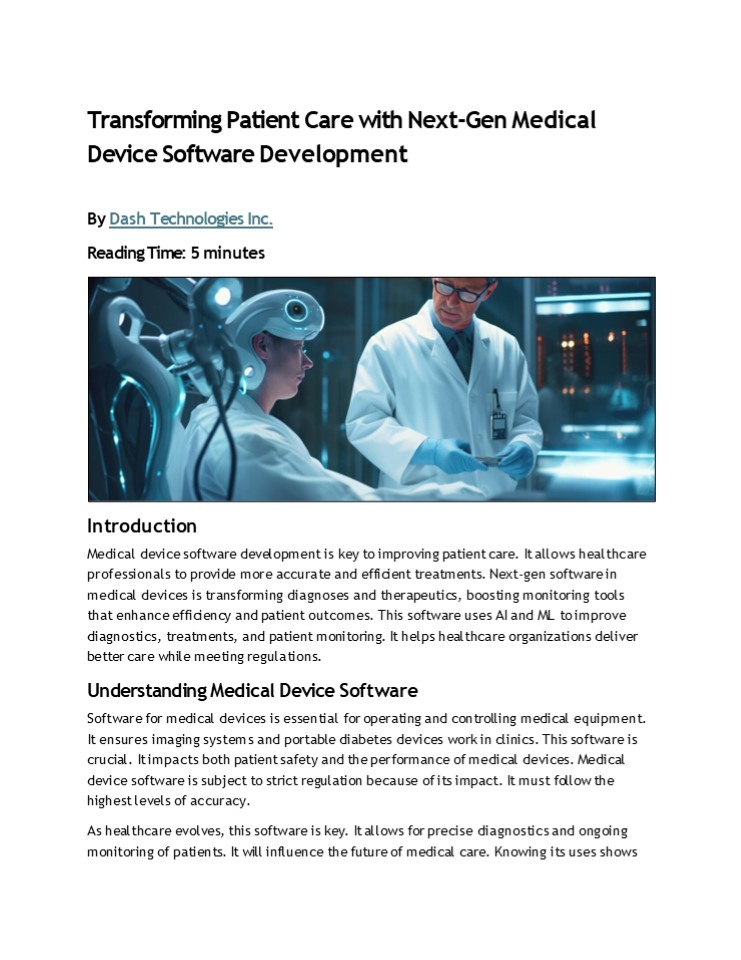
Title: Transforming Patient Care with Next-Gen Medical Device Software Development
1
Transforming Patient Care with Next-Gen Medical
Device Software Development By Dash Technologies
Inc. Reading Time 5 minutes
Introduction Medical device software development
is key to improving patient care. It allows
healthcare professionals to provide more accurate
and efficient treatments. Next-gen software in
medical devices is transforming diagnoses and
therapeutics, boosting monitoring tools that
enhance efficiency and patient outcomes. This
software uses AI and ML to improve diagnostics,
treatments, and patient monitoring. It helps
healthcare organizations deliver better care
while meeting regulations. Understanding Medical
Device Software Software for medical devices is
essential for operating and controlling medical
equipment. It ensures imaging systems and
portable diabetes devices work in clinics. This
software is crucial. It impacts both patient
safety and the performance of medical devices.
Medical device software is subject to strict
regulation because of its impact. It must follow
the highest levels of accuracy. As healthcare
evolves, this software is key. It allows for
precise diagnostics and ongoing monitoring of
patients. It will influence the future of medical
care. Knowing its uses shows
2
- how it improves patient care and healthcare.
Various types of medical device software exist.
These items serve specific functions, as some of
them are listed below - Software as a Medical Device (SaMD)
- Software as a Medical Device (SaMD) is the term
for medical software that runs on its own without
the need for hardware. It includes diagnostic
software, mobile health apps, and clinical
decision-support systems. Developers create these
for smartphones and the cloud. SaMD differs from
traditional devices. It has no hardware. For
example, in-vitro diagnostics includes software. - Internet of Medical Things (IoMT)
- The Internet of Medical Things (IoMT) is a
network of healthcare devices and applications.
They connect to healthcare systems via the
Internet, enabling communication between
machines. IoMT supports remote monitoring tools,
wearables, and data analysis platforms, which
improve patient care. Additionally, it makes
telemedicine possible, which increases
availability and decreases trips to the
sanitarium. - Embedded Software
- Most medical devices, like pacemakers and
infusion pumps, must have embedded software to
ensure their safe and effective operation. Most
MedTech healthcare solutions must fit within
specific hardware with time and space
constraints. On the other hand, embedded software
is also embedded in everyday devices, including
telephones, security systems, and healthcare
apps. It is vital for tasks like patient
monitoring and medical imaging. - Clinical Information Systems
- Clinical Information Systems (CIS) manage patient
data. They are medical technology solutions that
improve workflows and accuracy. CIS decreases
errors, and patient data is instantly accessible.
It works with hospital systems, improving
communication, decisions, and safety. - Latest Medical Devices Transforming Patient Care
- New medical devices are making healthcare better.
They make the approach more accurate, efficient,
and patient-focused. Doctors can now diagnose,
treat, and check health in innovative ways.
According to The Business Research Company, the
global market for medical devices will grow to
863.2 billion in 2030.
3
- Here are three devices that are paving the way
for the future of healthcare - Diagnostic Devices
- Diagnostics is the most fascinating development
in medical equipment. There are emerging
technologies that can identify any illness with
unparalleled precision, - from Alzheimers to Cancer.
- Liquid biopsies, for instance, are novel blood
diagnostics that can identify tumor - cells or their DNA in the blood. They promise to
detect cancer earlier than ever before and are
less invasive and more convenient than tissue
biopsies. - AI is also used as a diagnostic tool. AI can help
doctors identify cancers in medical imaging more
rapidly and precisely. Developing software for
medical devices is - crucial to building trustworthy AI systems.
- Therapeutic Devices
- Patient care is also being significantly impacted
by new treatment technologies. Robotic surgical
equipment, for instance, enables doctors to carry
out intricate surgeries more precisely and
safely. Additionally, these technologies shorten
recovery times and lessen patient discomfort. - The pacemaker is another example of an ionic
advance in therapy. The device that controls
heartbeats is implanted. The gadget is compact
and has a small, multi- year-long battery supply.
Heart failure and arrhythmias are among the
additional heart problems that pacemakers cure.
Device advancement has been greatly aided by
MedTech healthcare solutions. They are more
successful in treating complicated cardiac
problems. - Monitoring Devices
- Patient care is being improved by new gadgets
like fitness trackers and smartwatches. They help
with early problem diagnosis and health
management by monitoring vital signs, exercise,
and sleep. - The Continuous Glucose Monitor (CGM), a novel
monitoring tool, takes a blood glucose reading
once per minute. Patients with diabetes can
better manage their - disease because of this technology. Software for
medical devices is essential to their
development. It must offer user-friendly
interfaces for monitoring and controlling
patients health.
4
Key Phases in Medical Device Software
Development Medical device software must be safe,
functional, and compliant. So, its development is
a structured process. Each phase, starting from
planning to post-launch, is crucial. It creates
reliable devices that improve patient care.
Heres an overview of this lifecycle.
- Concept and Planning
- It defines a medical devices goals and sets
requirements. It includes threat operation
reviews to concentrate on patient safety, paving
the way for the development of Medical Device
Software. - Design and Development
- Developers must design the system architecture
and code. Also, plan the UI. They must also meet
requirements, improve the user experience, and
adhere to established medical software
development practices. - Verification and Validation
- Verification checks whether the software meets
the design specs, and validation
5
- checks whether it works as expected in real-life
scenarios. Ensuring regulatory compliance is
important. - Testing
- Testers examine the software for bugs, security
excrescencies, and usability issues. Ensures the
device meets all safety and quality standards. - Post-Launch Support and Maintenance
- Updates and compliance with regulations keep the
device working. They also help in advancing
patient care. - Roadblocks in Developing Medical Device Software
- Medical device software development has unique
challenges. We must address them to ensure
patient safety and effective care. Each step is
critical to the success of medical technologies.
Includes ensuring compliance with complex
regulations and integrating various systems.
Below are some challenges found in the
development process - Software Compliance
- The biggest challenge is meeting regulations.
This is crucial for the safety, function, and
reliability of medical devices, which directly
affects how patients are treated. - Data Privacy
- The biggest challenge is keeping patient data
confidential. This is vital to ensuring - trust and improving the patients experience.
- Custom Solutions
- Developing custom software for specific
healthcare needs is a challenging task. However,
it is vital to improve treatment accuracy and
provide personalized care.
6
How Medical Equipment is Advancing Patient Care
- Medical technology is revolutionizing patient
care, making it efficient and accessible.
Software development in medicine boosts
innovation, enhancing the quality of life and
results for patients. Heres how medical
equipment is improving care - Reduced Costs
- Medical Device Software solutions make medical
processes quicker, less invasive, and more
efficient. Patients now stay in the hospital for
shorter periods and recover faster, and this
software cuts costs. Creating this software is
vital for these advancements. - Improved Quality of Life
- New devices not only improve lives but also help
manage chronic diseases. Take wearables, for
example. They allow patients to stay active while
managing their health. Medical device software
provides instant data and customized care.
7
- Increased Access to Care
- Telemedicine and remote monitoring are game
changers for patients in hard-to- reach areas.
They can access care without traveling. These
medical device software solutions enable virtual
meetings and connect patients and doctors. - DASH Technologies Advancing Patient Care with
Next-Gen Medical Device Software - At Dash Technologies, we specialize in medical
device software development, delivering next-gen
embedded solutions that advance patient care. Our
expertise in custom software development ensures
that healthcare organizations receive tailored
solutions designed to improve operational
efficiency, enhance patient safety, and support
better health outcomes. - Using advanced technologies such as AI/ML,
regulatory compliance, and expert engineering, we
create innovative, reliable software that powers
medical devices and systems. Contact us to
develop cutting-edge medical device software
tailored to your needs. - About Dash
- Dash Technologies Inc.
- Were technology experts with a passion for
bringing concepts to life. By leveraging a
unique, consultative process and an agile
development approach, we translate business
challenges into technology solutions. Get in
touch. - Read More
Recommended

