

Evolution of Industrial Furnace Market: Greener, Smarter, Better PowerPoint PPT Presentation
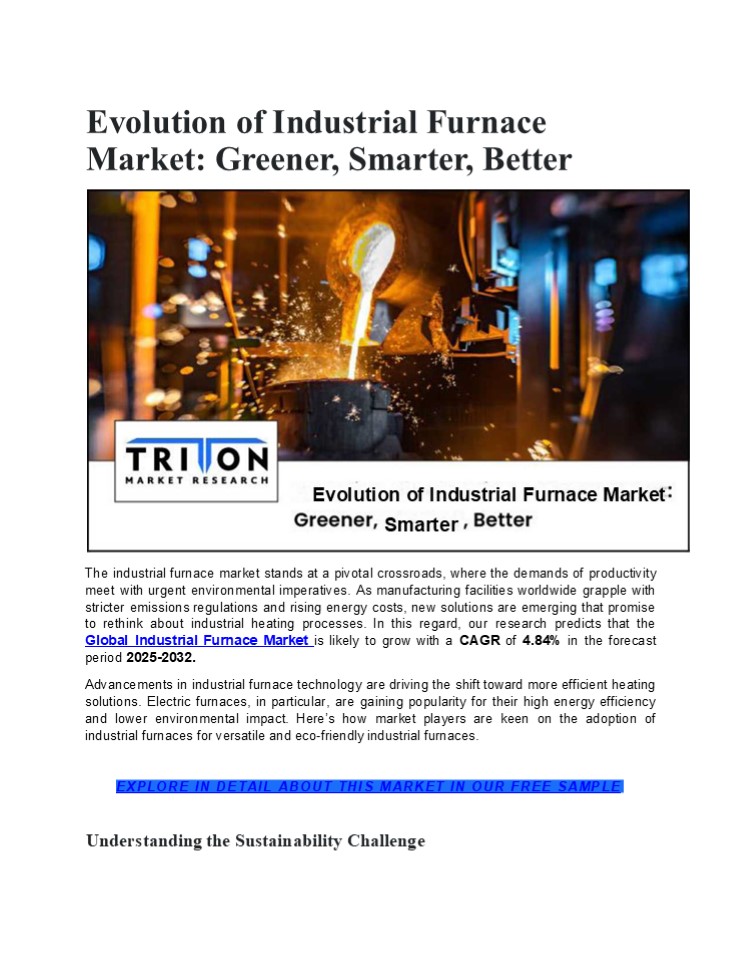
Title: Evolution of Industrial Furnace Market: Greener, Smarter, Better
1
Evolution of Industrial Furnace Market Greener,
Smarter, Better
Evolution of Industrial Furnace Market
Smarter
The industrial furnace market stands at a pivotal
crossroads, where the demands of productivity
meet with urgent environmental imperatives. As
manufacturing facilities worldwide grapple with
stricter emissions regulations and rising energy
costs, new solutions are emerging that promise to
rethink about industrial heating processes. In
this regard, our research predicts that the
Global Industrial Furnace Market is likely to
grow with a CAGR of 4.84 in the forecast period
2025-2032. Advancements in industrial furnace
technology are driving the shift toward more
efficient heating solutions. Electric furnaces,
in particular, are gaining popularity for their
high energy efficiency and lower environmental
impact. Heres how market players are keen on the
adoption of industrial furnaces for versatile and
eco-friendly industrial furnaces.
EXPLORE IN DETAIL ABOUT THIS MARKET IN OUR FREE
SAMPLE
Understanding the Sustainability Challenge
2
Traditional industrial furnaces, while reliable
workhorses of manufacturing, have long been
associated with significant energy consumption
and greenhouse gas emissions. In fact, industrial
heating processes account for approximately 20
of global energy consumption. In steel
manufacturing alone, furnaces can consume up to
75 of a plants total energy usage. These
statistics, therefore, demonstrate the urgent
need for more sustainable solutions, leading to a
demand for industrial furnaces. ArcelorMittals
Hamburg facility is setting a benchmark for
sustainable steel production. Currently powered
by natural gas, its Direct Reduced Iron (DRI)
furnace is paving the way for a green
transformation, with plans to transition to green
hydrogen in the near future. Our site is the
most energy-efficient production plant at
ArcelorMittal" says Dr. Uwe Braun, CEO of
ArcelorMittal Hamburg. With the new,
hydrogen-based DRI plant we are now planning, we
will raise steel production to a completely new
level as part of our Europe-wide ambition to be
carbon neutral by 2050. This initiative
showcases how sustainability can reshape heavy
industries for a cleaner future. Industrial
Furnace Market Innovative Solutions in Energy
Efficiency Modern furnace design has evolved
dramatically, incorporating sophisticated heat
recovery systems and advanced insulation
materials. The emergence of hybrid heating
technologies represents the most noteworthy
development in sustainable furnace operation.
These systems combine different heating methods -
such as induction and resistance heating - to
optimize energy usage based on specific process
requirements. Let us see how leading market
players are improving the functionality of
furnaces SMS group and SSAB are collaborating to
revolutionize steel production in Sweden with a
cutting-edge electric arc furnace (EAF) as part
of SSABs decarbonization efforts. Key features
of the project Massive Scale A 190-ton
AC-EAF, one of the largest in the world
Fossil-Free Steel Enables SSABs transition to
low-emission production Seamless
Integration Smoothly shifts from traditional to
electric steelmaking High-Quality Output
Delivers premium liquid steel efficiently This
project cements SMS and SSAB as leaders in
sustainable, future-ready steelmaking.
3
An innovative approach has been demonstrated by
Japanese manufacturer Nippon Steel, which has
implemented regenerative burner systems that
capture and reuse waste heat. This technology has
shown the potential to reduce fuel consumption by
up to 50 in some applications while
significantly lowering NOx emissions. Another
notable advancement comes from German
manufacturer Schwartz GmbH, which has developed a
series of vacuum furnaces utilizing advanced
thermal insulation and precise temperature
control systems. Their latest models have shown a
40 reduction in energy consumption while
maintaining or even improving product quality.
CONNECT WITH OUR EXPERTS FOR A SIMPLIFIED
ANALYSIS!
The Digital Revolution in the Electric Arc
Furnaces (EAF) The integration of Industrial
Internet of Things (IIoT) technology is
transforming furnace operations from traditional
heat approaches to precise, data-driven
processes. Computer vision AI is revolutionizing
steelmaking, particularly in Electric Arc
Furnaces (EAF), by providing real-time insights
for optimized operations. Key features include
Precise control over the melting process
Real-time monitoring of temperature, charge
composition, and energy consumption Enhanced
efficiency and resource utilization Advanced
visual analytics for continuous performance
evaluation These capabilities enable improved
operational performance, reduced costs, and
better decision-making in manufacturing, driving
the transformation towards Industry
4.0. Similarly, electric arc furnaces have taken
automation a step further with its Digital Twin
technology for reheating furnaces. A digital twin
of a furnace is a virtual representation that
mirrors its physical counterpart in real time. By
integrating sensors, IoT, and advanced analytics,
the twin continuously monitors performance,
predicts maintenance needs, and identifies
inefficiencies. This proactive approach reduces
downtime and optimizes operations. By leveraging
Ansys digital twin technology alongside its
structural, fluid dynamics, and optimization
tools, RAUCH has enhanced the monitoring of its
furnace crucible. This approach effectively
lowers the risk of furnace malfunctions by
continuously assessing performance and
identifying potential issues before they lead to
failure.
4
Companies like RAUCH, Siemens, and GE have used
digital twins for industrial equipment, including
furnaces, enhancing reliability and
sustainability. These innovations are
transforming manufacturing and maintenance
strategies across industries. Future Prospects
for the Industrial Furnace Market The future of
industrial furnaces lies in the convergence of
these technologies. While these advances come
with significant initial investment costs, the
long-term benefits in terms of reduced operating
costs, improved product quality, and
environmental compliance make them increasingly
attractive to forward-thinking manufacturers. The
transformation of industrial furnaces from
energy-intensive necessities to smart,
sustainable assets represents more than just
technological progress - its a crucial step
toward a more sustainable manufacturing
future. Grab a Quick Read to Know Key Furnace
Types
FAQs Q.1) What is the highest-temperature
industrial furnace? Answer MRF offers furnaces
designed to operate continuously at ultra-high
temperatures of 3000C (5430F), a threshold that
few materials can withstand. For these extreme
conditions, the furnaces utilize hot zones made
from specialized materials like Graphite or
Tungsten, which are capable of enduring such
intense heat. Q.2) How long does an industrial
furnace last? Answer The lifespan of an
industrial furnace typically ranges from 15 to 30
years, depending on factors like usage,
maintenance, and operating conditions. Regular
upkeep and timely repairs can help extend its
operational life and efficiency.
Recommended

