

The Power of Industrial Automation Services PowerPoint PPT Presentation
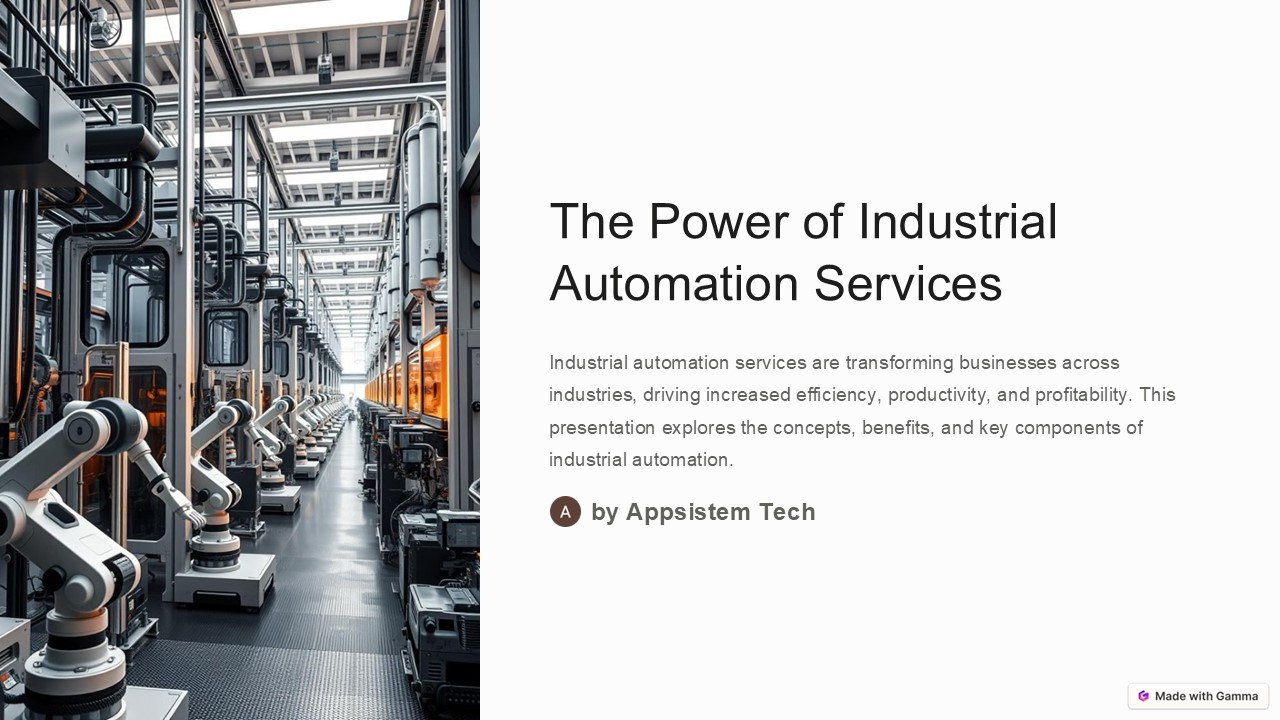
Title: The Power of Industrial Automation Services
1
The Power of Industrial Automation Services
Industrial automation services are transforming
businesses across industries, driving increased
efficiency, productivity, and profitability. This
presentation explores the concepts, benefits, and
key components of industrial automation.
by Appsistem Tech
2
Introduction to Industrial Automation
What is It?
How It Works
Industrial automation is the use of technology to
automate tasks in manufacturing and other
industrial processes.
Industrial automation systems rely on sensors,
controllers, robots, and software to perform
tasks autonomously or with minimal human
intervention.
3
Defining Industrial Automation
Automation of Tasks
Data Collection and Analysis
1
2
Replacing manual labor with automated systems for
repetitive or complex tasks.
Using sensors to collect data on processes,
enabling real-time monitoring and optimization.
Integration of Systems
3
Connecting different machines and processes to
improve communication and efficiency.
4
The Benefits of Industrial Automation
Efficiency Productivity
Quality Consistency
Automated systems minimize human error, leading
to consistent product quality.
Automation reduces downtime, increases
throughput, and optimizes resource utilization.
Cost Reduction Wastage
Automation reduces labor costs, minimizes
material waste, and optimizes production
processes.
5
Increased Efficiency and Productivity
Faster Production Cycles
Optimized Resource Utilization
Automated systems can operate at higher speeds,
reducing lead times and increasing output.
Automation allows for efficient allocation of
resources, minimizing downtime and maximizing
productivity.
Reduced Downtime
Automated systems can operate continuously with
minimal interruptions, improving overall
efficiency.
6
Improved Quality and Consistency
Precision
Data-Driven Improvement
Automated systems perform tasks with high
accuracy and consistency, minimizing defects.
Real-time data analysis identifies areas for
improvement and optimizes production processes.
1
2
3
Repeatability
Automation ensures that every product is made to
the same standard, enhancing quality consistency.
7
Reduced Costs and Wastage
Labor Costs
Material Waste
Production Costs
Automation reduces reliance on manual labor,
leading to lower labor costs.
Automated systems optimize material usage,
reducing waste and material costs.
Automation streamlines processes, reducing
overall production costs and increasing
profitability.
8
Enhanced Safety and Compliance
Safety
1
Ergonomics
2
Automation reduces the need for workers to
perform hazardous or repetitive tasks.
Compliance
3
Automated systems can be programmed to comply
with safety regulations and industry standards.
9
Key Components of Industrial Automation
Sensors
1
Collect data on process parameters like
temperature, pressure, and flow.
Controllers
2
Process data from sensors, make decisions, and
send instructions to actuators.
Actuators
3
Control physical processes, such as opening
valves, moving robots, or adjusting speeds.
10
Sensors and Instrumentation
1
2
Temperature Sensors
Pressure Sensors
Monitor and control temperatures in various
industrial processes.
Measure pressure levels in tanks, pipes, and
other equipment.
3
4
Flow Sensors
Level Sensors
Measure the rate of fluid flow in pipelines and
other applications.
Monitor the level of liquids or solids in tanks,
silos, or other containers.
Recommended

