

Decentralized Containerized Packaged Water and Wastewater Treatment Systems Market PowerPoint PPT Presentation
Title: Decentralized Containerized Packaged Water and Wastewater Treatment Systems Market
1
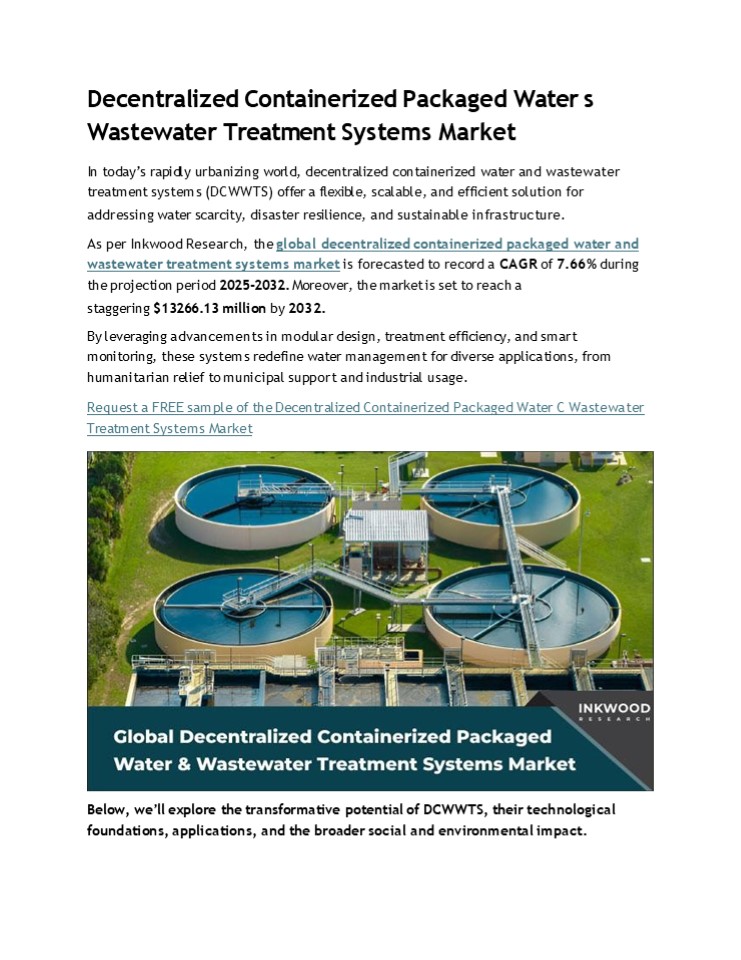
Decentralized Containerized Packaged Water s
Wastewater Treatment Systems Market In todays
rapidly urbanizing world, decentralized
containerized water and wastewater treatment
systems (DCWWTS) offer a flexible, scalable, and
efficient solution for addressing water scarcity,
disaster resilience, and sustainable
infrastructure. As per Inkwood Research, the
global decentralized containerized packaged water
and wastewater treatment systems market is
forecasted to record a CAGR of 7.66 during the
projection period 2025-2032. Moreover, the market
is set to reach a staggering 13266.13 million by
2032. By leveraging advancements in modular
design, treatment efficiency, and smart
monitoring, these systems redefine water
management for diverse applications, from
humanitarian relief to municipal support and
industrial usage. Request a FREE sample of the
Decentralized Containerized Packaged Water C
Wastewater Treatment Systems Market
Below, well explore the transformative potential
of DCWWTS, their technological foundations,
applications, and the broader social and
environmental impact.
2
What Are Decentralized Containerized Systems?
Definition s Overview DCWWTS are compact,
self-contained water and wastewater treatment
facilities housed in shipping containers or
similar structures, offering plug-and-play
deployment. Unlike centralized systems requiring
significant infrastructure, DCWWTS units can be
placed close to water demand areas. This
localization minimizes transport needs, reduces
energy consumption, and enhances accessibility to
clean waterespecially in remote or underserved
regions. For rural, off-grid, or
disaster-stricken areas, DCWWTS provides a robust
alternative. These systems are quick to deploy,
adaptable to various treatment requirements, and
can incorporate renewable energy sources such as
solar power to enhance sustainability and reduce
operational costs. Technological Backbone
Advanced Filtration and Membrane Solutions DCWWTS
owe much of their success to innovative
filtration and membrane technologies. These
systems integrate processes like membrane
bioreactors (MBR), nanofiltration (NF), and
reverse osmosis (RO), each designed to target
specific contaminants with high efficacy. MBR,
for example, offers superior filtration,
transforming highly polluted water into potable
quality when combined with post-treatment
technologies like RO. The use of advanced
polymers and fouling-resistant membranes extends
lifespan and reduces the need for maintenance,
which is essential for systems deployed in
challenging environments. Smart sensors and
real-time monitoring enable these systems to
optimize energy and water use, adjust treatment
levels based on contamination load, and predict
maintenance needs. As these monitoring systems
reduce operational costs, DCWWTS become even more
feasible for broader applications, providing a
long-term, cost-effective solution for water
treatment. Stay up-to-date with whats trending
in the Global Decentralized Containerized
Packaged Water and Wastewater Treatment Systems
Market Expansion in Emerging Regions
Asia-Pacific DCWWTS Market The Asia-Pacific is
projected to be the fastest-growing market for
decentralized containerized water and wastewater
treatment systems, with a significant CAGR of
8.84 anticipated from 2025 to 2032. (source
Inkwood Research) This surge is largely driven by
countries like Indonesia, India, and China, where
rapid urbanization, industrial growth, and rising
populations are creating an urgent demand for
3
- efficient, sustainable water management
solutions, especially in areas lacking
centralized infrastructure. - Several notable projects and initiatives are
propelling this growth - In Indonesia, DEWATS (Decentralized Wastewater
Treatment Systems) have been successfully
deployed in areas like Alam Jaya, Tangerang, and
the Kelempok Mekarsari Jaya small-scale industry
cluster in Denpasar, Bali. These locations have
adopted community-based sanitation (CBS) systems
to tackle urgent - sanitation needs in densely populated and
industrial zones. - India is also advancing with decentralized water
treatment projects, such as - the Ullalu Upanagara CBS program in Bangalore and
the DEWATS installation at Aravind Eye Hospital
in Pondicherry. The Consortium for DEWATS
Dissemination Society (CDD) in Bangalore is
further expanding the reach of these systems
across the country by working with a network of
partners. - China has embraced similar innovations, with
successful implementations at institutions like
the Sino-German College of Technology in - Shanghai and Wenzhou University in Zhejiang
Province. - These projects not only provide practical
wastewater treatment solutions but also integrate
environmental sustainability into educational
settings, underscoring the regions commitment to
sustainable development. - Kindly click here to view the LinkedIn post
related to this market The Role of DCWWTS in
Climate Adaptation and Disaster Response - With increasing climate volatility, there is a
heightened need for resilient water - infrastructure. DCWWTS offers a crucial advantage
here, especially in disaster scenarios where
access to potable water is immediately
compromised. These systems can be - quickly deployed to provide clean water in
emergency shelters or field hospitals, addressing
the immediate needs of affected populations. - Additionally, climate change has intensified
water scarcity across many regions. DCWWTS
contribute to climate adaptation efforts by
facilitating localized, drought-resistant water
solutions. By recycling wastewater and purifying
available water sources, they support - sustainable water usage and enhance resilience
against future water shortages. - DCWWTS Market Industrial and Municipal Use
Cases - For industries with high water consumption or
complex wastewater needs, DCWWTS offer tailored,
on-site solutions that minimize dependency on
municipal water systems and
4
reduce discharge costs. Mining operations,
agricultural processing, and manufacturing plants
are increasingly adopting these systems to meet
strict environmental standards while maintaining
efficient operations. Furthermore, municipal
applications benefit from DCWWTS as they can
address growing urban populations without the
extensive investment required for
centralized infrastructure expansions. Municipalit
ies in developing countries or rapidly urbanizing
regions can deploy these systems as interim
solutions, providing clean water to underserved
communities while longer-term infrastructure
projects progress. This flexibility makes DCWWTS
a strategic investment for both public and
private sectors seeking rapid, reliable, and
sustainable water treatment options. Social s
Environmental Impact Empowering Communities and
Reducing Footprints Beyond addressing water
scarcity and providing resilience, DCWWTS have
profound social implications. For example,
decentralized systems can enable
community-managed water treatment in areas where
government resources are stretched thin. Such
community- driven initiatives foster local
stewardship of water resources, support public
health, and empower communities to maintain their
water sources. Environmentally, DCWWTS systems
lower the carbon footprint associated with
water distribution by localizing treatment
facilities. The integration of renewable energy
not only reduces emissions but also makes these
systems viable for remote areas
without consistent electricity access. By
treating and reusing water at the source, these
systems contribute to circular water economies
and significantly decrease the environmental
impact associated with traditional water and
wastewater management. Concluding Reflections
Sustainable, Decentralized, and
Community-Centric As global water demand rises
and climate-induced water challenges intensify,
DCWWTS present a sustainable solution that
combines technology, flexibility, and resilience.
From providing disaster relief to enabling water
independence for communities and industries,
these systems are more than a technological
advancementthey represent a fundamental shift
toward a decentralized, community-driven approach
to water management. The growth trajectory of
DCWWTS suggests a promising future where clean
water access is no longer a privilege tied to
centralized infrastructure but a right accessible
through smart, adaptable technology. With
continued innovation and supportive policies,
decentralized
5
containerized systems can drive transformative
change, ensuring water security for generations
to come. Explore the market insights in this
YouTube video by clicking here
Recommended

