

Automotive Batteries - Technology, Trends, and Challenges PowerPoint PPT Presentation
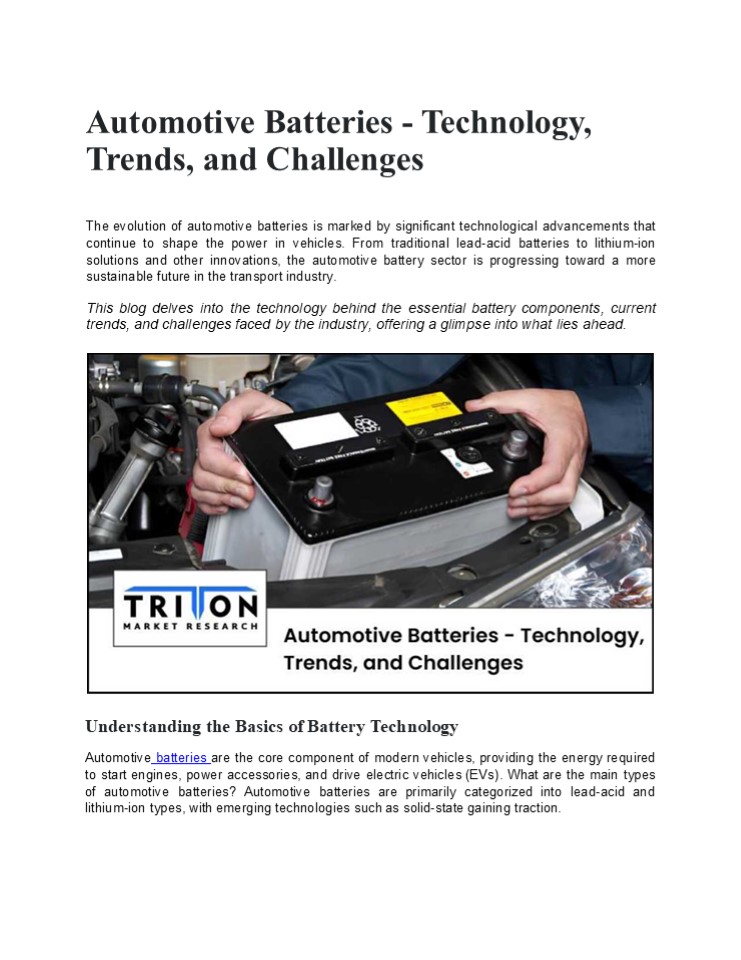
Title: Automotive Batteries - Technology, Trends, and Challenges
1
Automotive Batteries - Technology, Trends, and
Challenges
The evolution of automotive batteries is marked
by significant technological advancements that
continue to shape the power in vehicles. From
traditional lead-acid batteries to lithium-ion
solutions and other innovations, the automotive
battery sector is progressing toward a more
sustainable future in the transport
industry. This blog delves into the technology
behind the essential battery components, current
trends, and challenges faced by the industry,
offering a glimpse into what lies ahead.
Understanding the Basics of Battery
Technology Automotive batteries are the core
component of modern vehicles, providing the
energy required to start engines, power
accessories, and drive electric vehicles (EVs).
What are the main types of automotive batteries?
Automotive batteries are primarily categorized
into lead-acid and lithium-ion types, with
emerging technologies such as solid-state gaining
traction.
2
Lead-acid batteries, a long-standing choice, are
cost-effective and reliable, making them ideal
for traditional internal combustion engine (ICE)
vehicles. However, their relatively low energy
density and limited lifespan pose challenges. On
the other hand, lithium-ion batteries, known for
their high energy density and performance, have
become the standard for EVs due to their ability
to store more energy in a lighter package.
Emerging technologies, such as solid-state and
flow batteries, promise even greater efficiency
and safety, signaling a transformative shift in
battery design. In the context of battery charge
and discharge cycles, batteries rely on chemical
reactions to store and release energy. The
capacity and output of a battery depend on
factors such as its chemistry, size, and
operating conditions. External influences,
including temperature, charging habits, and usage
patterns, also play a crucial role in determining
a batterys performance and lifespan. To optimize
battery functionality and longevity, Battery
Management Systems (BMS) have become
indispensable. These systems monitor and regulate
various aspects of battery operation, ensuring
safety, efficiency, and performance. Advanced BMS
features, such as thermal management and
state-of-charge estimation, help prevent
overheating and overcharging while extending the
overall lifespan of the battery. Thus, BMS plays
a pivotal role in maintaining the health of EV
batteries and ensuring seamless integration with
the vehicles powertrain. Current Trends in
Automotive Battery Development The automotive
industry is undergoing a profound transformation
driven by the growing adoption of electric
vehicles. For instance, the global demand for
automotive lithium-ion batteries surged by 65 in
2022, reaching approximately 550 GWh, according
to the International Energy Agency. This
significant increase was driven by the expansion
of electric passenger car sales, with new EV
registrations rising by 55 year-over-year in
2022. An important aspect of automotive batteries
is the duration. But how long do automotive
batteries typically last? The lifespan of an
automotive battery varies based on type and
usage, with lead-acid batteries lasting 3-5 years
and lithium-ion batteries offering 8-10 years or
more. Hence, researchers are exploring solutions
to address more challenges of EV adoption, such
as reducing charging times and increasing energy
density. Faster-charging batteries, capable of
replenishing energy in minutes rather than hours,
are already being developed. Simultaneously,
improvements in energy efficiency and density are
enabling EVs to travel greater distances on a
single charge, addressing a key concern for
consumers.
3
Sustainability is another critical focus, with
innovations in battery recycling and material
reuse helping to minimize environmental
impact. Active Efforts by Market
Contenders Industry players, including
established manufacturers and ambitious startups,
are shaping the future of automotive batteries
through continuous innovation. Companies such as
Tesla, CATL, and Panasonic are leading the charge
in developing high-performance batteries for EVs.
Collaboration between the automotive and
technology sectors has also led to groundbreaking
advancements in automotive batteries. For
instance, on January 10, 2025, SAIC and CATL
announced an expanded partnership to develop EV
batteries that are swappable and collaborate in
global markets. SAIC will produce EVs using
CATLs swappable batteries, while CATL will
provide battery leasing and swapping services,
introducing a model that separates battery
ownership from vehicle sales. Similarly, Sila
Nanotechnologies, a US-based company, is
transforming the electric vehicle (EV) sector
with advanced battery materials designed to
improve performance and sustainability. Their
silicon anode technology enhances the energy
density of lithium-ion batteries by up to 20,
enabling a 15-20 increase in the driving range
or the development of smaller, lighter battery
designs. What are the challenges involved in
Automotive Batteries? Despite the remarkable
progress, several challenges remain in the
development and deployment of automotive
batteries. Cost is a significant barrier,
with raw material prices, particularly for
lithium, cobalt, and nickel, fluctuating due to
supply chain constraints and growing demand.
Economies of scale in production are crucial to
making EV batteries more affordable for
consumers, but achieving this requires
substantial investments in manufacturing
infrastructure. Environmental and safety
concerns also demand attention. The disposal and
recycling of used batteries pose ecological
challenges, as improper handling can lead to
hazardous waste. Fires and battery malfunctions,
though rare, highlight the importance of rigorous
safety measures in battery design and
manufacturing. Additionally, the extraction of
raw materials used in batteries has a significant
environmental impact, underscoring the need for
more sustainable practices. Infrastructure
limitations further complicate the widespread
adoption of EVs. While charging networks are
expanding rapidly, many regions still lack the
necessary coverage to support EV users.
Compatibility issues between charging stations
and vehicle models add another layer of
complexity. Moreover, the increased energy demand
on electrical grids raises questions about the
ability of current infrastructure to support
large-scale electrification.
4
Future of Automotive Batteries
The future of automotive batteries is driven by
innovation and the growing need for
sustainability. Advances in chemical composition
in a battery are expected to deliver higher
energy densities, faster charging, and longer
lifespans. Researchers are exploring renewable
energy sources for battery production, reducing
the environmental footprint of manufacturing
processes. Innovations in lifecycle management,
such as second-life applications and efficient
recycling methods, promise to enhance the
sustainability of batteries. Integration with
smart technology is another promising avenue.
Vehicle-to-grid (V2G) technology represents a
significant step towards a more interconnected
and sustainable energy system. Enhanced user
interfaces and connectivity features are also
expected to improve the overall experience for EV
owners, making battery management more intuitive
and user-friendly. Policy and market forces will
play a critical role in shaping the trajectory of
automotive batteries. Governments and
organizations worldwide are implementing
legislation to promote the adoption of clean
energy vehicles. Consumer behavior will also be
instrumental, as growing awareness of
environmental issues and the demand for
sustainable alternatives drive innovation and
adoption. As the world transitions towards a
cleaner and more sustainable future, automotive
batteries will remain at the forefront of this
transformation. FAQs Q.1 What advancements are
being made in battery recycling? Answer- Research
into recycling methods is improving efficiency,
enabling the recovery of valuable materials such
as lithium and cobalt for reuse. Q.2 How do
different battery types affect vehicle
performance? Answer- Lithium-ion batteries offer
superior energy density and performance, making
them ideal for EVs, while lead-acid batteries
remain cost-effective for traditional vehicles.
Recommended

