

Simple or Complex: How Do You Design Custom Socks That Sell? PowerPoint PPT Presentation
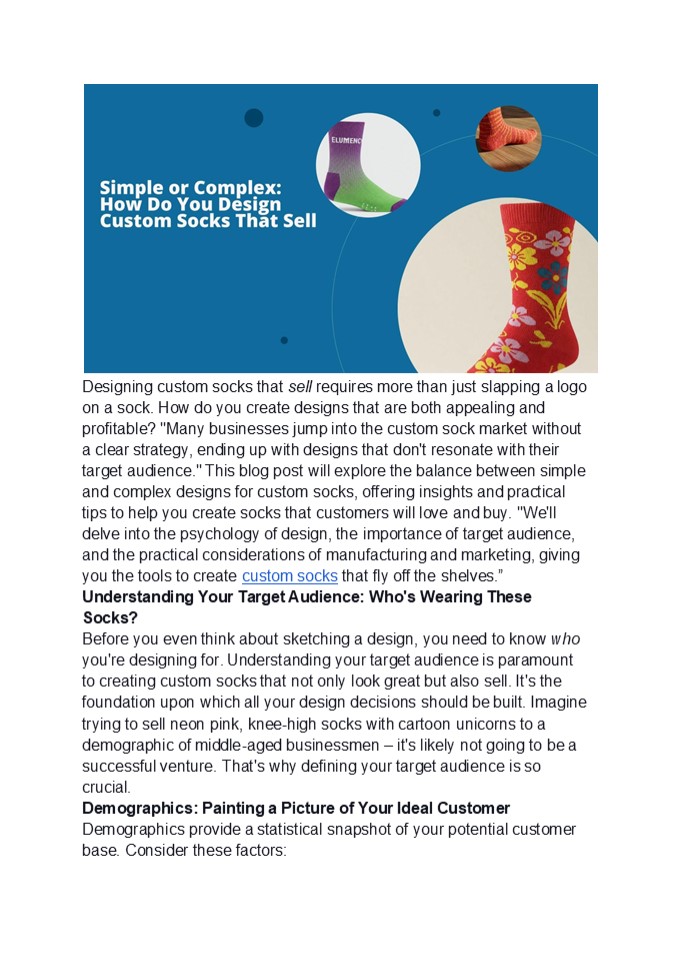
Title: Simple or Complex: How Do You Design Custom Socks That Sell?
1
Designing custom socks that sell requires more
than just slapping a logo on a sock. How do you
create designs that are both appealing and
profitable? "Many businesses jump into the custom
sock market without a clear strategy, ending up
with designs that don't resonate with their
target audience." This blog post will explore the
balance between simple and complex designs for
custom socks, offering insights and practical
tips to help you create socks that customers will
love and buy. "We'll delve into the psychology of
design, the importance of target audience, and
the practical considerations of manufacturing and
marketing, giving you the tools to create custom
socks that fly off the shelves. Understanding
Your Target Audience Who's Wearing These
Socks? Before you even think about sketching a
design, you need to know who you're designing
for. Understanding your target audience is
paramount to creating custom socks that not only
look great but also sell. It's the foundation
upon which all your design decisions should be
built. Imagine trying to sell neon pink,
knee-high socks with cartoon unicorns to a
demographic of middle-aged businessmen it's
likely not going to be a successful venture.
That's why defining your target audience is so
crucial. Demographics Painting a Picture of Your
Ideal Customer Demographics provide a statistical
snapshot of your potential customer base.
Consider these factors
2
- Age Are you targeting teenagers, young adults,
professionals, or a more mature demographic? Age
significantly influences style preferences.
Younger audiences might be drawn to trendy,
vibrant designs, while older demographics might
prefer classic or more subtle patterns. Think
about the difference between a custom sock design
aimed at Gen Z versus Baby Boomers. - Gender While many sock designs can be unisex,
considering gender can be important, especially
if you're offering specific styles or fits. Are
you designing for men, women, or both? This can
influence color choices, patterns, and even the
type of sock (e.g., crew, ankle, etc.). For
example, a custom sock line designed for women
might feature more delicate patterns and pastel
colors, while a men's line might focus on bolder
designs and darker hues. - Interests What are your target audience's
hobbies and passions? Are they sports
enthusiasts, outdoor adventurers, gamers,
artists, or book lovers? Tapping into these
interests with your custom sock designs can
create a strong connection with your target
audience. Imagine custom socks featuring a
favorite sports team's logo or a design inspired
by a popular video game these would resonate
strongly with specific interest groups. - Style Preferences Understanding your target
audience's general style preferences is
essential. Do they prefer minimalist designs,
bold patterns, classic styles, or something more
avant-garde? Researching current fashion trends
and analyzing what your target audience is
already wearing can provide valuable insights.
Are they drawn to bright, vibrant colors or more
muted, sophisticated tones? Do they prefer
geometric patterns or more organic, flowing
designs? - Example Let's say you're targeting young adults
(18-25) interested in fitness and streetwear.
Your custom sock designs might feature bold
geometric patterns, vibrant colors, and
performance-enhancing materials. - Occasion The Right Socks for the Right Time
- The intended use of your custom socks is another
critical factor. - Sports Performance-driven socks for athletes
require specific features like moisture-wicking
materials, arch support, and reinforced heels and
toes. Designs for sports socks often
3
- incorporate team logos, colors, or motivational
phrases. Think about custom socks designed for
runners versus those designed for basketball
players they'll have different features and
potentially different design aesthetics. - Everyday Wear Socks for everyday wear prioritize
comfort and style. Designs can range from simple
and classic to trendy and fashionable. Consider
the climate and typical activities of your target
audience when choosing materials and designs.
Custom socks for everyday wear offer a great
opportunity to express personal style. - Special Events Custom socks can be a fun and
unique way to commemorate special events like
weddings, birthdays, or holidays. Designs for
these occasions often incorporate personalized
elements like dates, names, or themed graphics.
Imagine custom socks with a wedding date
embroidered on them or socks featuring
holiday-themed patterns. - Promotional Purposes Custom socks are a popular
promotional item for businesses and
organizations. Designs for promotional socks
typically feature company logos, slogans, or
brand colors. The goal is to create a memorable
and wearable advertisement. - Example If you're designing custom socks for a
marathon, you'll need to focus on performance
features and incorporate elements related to
running, like a stylized marathon logo or
motivational quotes. - Price Point Balancing Design and Budget
- The complexity of your custom sock design will
directly impact the production cost and,
therefore, the price you can charge. - Simple Designs Lower Costs Simple designs,
like solid colors with a small logo or basic
stripes, are generally less expensive to produce.
This allows you to offer more competitive
pricing. - Complex Designs Higher Costs Intricate designs
with multiple colors, detailed graphics, or
specialized knitting techniques will cost more to
produce. You'll need to factor these costs into
your pricing strategy. - The Art of Simplicity Less is Often More
- In the world of custom socks, sometimes less
really is more. While intricate designs can be
captivating, there's a unique power in
simplicity. A well-executed simple design can be
just as effective, if not more so,
4
- than a complex one. Think of it like a classic
little black dress timeless, versatile, and
always stylish. The same principle applies to
custom socks. - Benefits of Simple Designs Why Simplicity Sells
- Simplicity offers several compelling advantages
when it comes to designing custom socks for sale - Cost-effectiveness Simpler designs are generally
less expensive to produce. Fewer colors, less
complex knitting patterns, and easier
manufacturing processes all contribute to lower
production costs. This translates to higher
profit margins for you and more competitive
pricing for your customers. Imagine the
difference in cost between a sock with a single,
knitted-in logo versus a sock with a complex,
all-over print. - Faster Production Simpler designs typically have
quicker turnaround times. This is because they
require less intricate knitting or printing
processes. Faster production means you can
fulfill orders more quickly, respond to market
demands more efficiently, and get your custom
socks into the hands (or rather, onto the feet)
of your customers faster. If you're launching a
limited-edition collection or need to restock
quickly, simplicity is your ally. - Broader Appeal Minimalist designs can attract a
wider audience. Not everyone is drawn to bold,
complex patterns. Simple, clean designs have a
universal appeal that transcends age, gender, and
style preferences. A classic striped sock or a
solid color with a subtle logo can appeal to a
much larger customer base than a sock with a
niche design. This broader appeal translates to
increased sales potential. - Easy Brand Recognition Simple logos and patterns
are easily recognizable and memorable. This is
crucial for building brand awareness and creating
a loyal customer base. Think of iconic logos like
the Nike swoosh or the Adidas three stripes
they're simple, yet instantly recognizable. The
same principle applies to your custom sock
designs. A simple, well-designed logo or pattern
will stick in your customers' minds and reinforce
your brand identity. - Examples of Successful Simple Designs
Inspiration in Simplicity
5
- Here are some examples of simple custom sock
designs that have proven successful - Solid colors with a small logo This is a classic
and versatile option. Choose a high-quality sock
material in a popular color and add a small,
embroidered, or knitted-in logo for subtle
branding. These socks are perfect for everyday
wear and can be easily paired with any outfit. - Stripes or geometric patterns Stripes and
geometric patterns are timeless and visually
appealing. They can be used to create a variety
of different looks, from sporty and athletic to
classic and preppy. Experiment with different
stripe widths, color combinations, and geometric
shapes to create unique and eye-catching designs. - Two-tone color combinations Using just two
colors can create a striking and impactful
design. Choose colors that complement each other
and create a visually appealing contrast. This
approach is simple yet effective and can be used
to create both classic and modern looks. - Tips for Effective Simple Designs Making
Simplicity Shine - Even though the designs are simple, there are
still crucial elements to consider - Focus on high-quality materials Even the
simplest design will look and feel luxurious if
it's made from high-quality materials. Choose
soft, comfortable, and durable yarns that will
stand up to wear and tear. The feel of the sock
is just as important as the look. - Choose a color palette that complements your
brand or message Color is a powerful tool.
Select colors that align with your brand identity
and evoke the emotions you want to convey. A
well-chosen color palette can elevate even the
simplest design. - Ensure clear and legible branding If you're
incorporating a logo or brand name, make sure
it's clear, legible, and appropriately sized.
Avoid overly large or cluttered logos that can
detract from the overall design. Subtlety and
clarity are key. - Embracing Complexity When Details Matter
- While simplicity has its merits, there are times
when embracing complexity in your custom sock
designs is the right move. Intricate details,
vibrant colors, and unique patterns can create
socks that are truly eye-catching and
unforgettable. Think of them as wearable works of
6
- art, showcasing your creativity and appealing to
a specific niche or target audience. - Benefits of Complex Designs Standing Out from
the Crowd Complex designs offer distinct
advantages, especially when you want your custom
socks to make a statement - Unique and Eye-Catching Intricate designs are
guaranteed to make your socks stand out from the
crowd. They grab attention and spark
conversation. In a market saturated with simple
designs, complex socks offer a breath of fresh
air, attracting customers who are looking for
something different and unique. Imagine a pair of
socks featuring a detailed landscape scene or a
vibrant, abstract design they're sure to turn
heads. - Creative Expression Complex designs allow for
greater artistic freedom. You can unleash your
creativity and explore a wider range of patterns,
colors, and imagery. This is your chance to push
the boundaries of sock design and create
something truly original. Think of custom socks
as a canvas for your art the more complex the
design, the more room you have to express your
artistic vision. - Niche Appeal Detailed designs can cater to
specific interests or fandoms. If you're
targeting a niche market, complex designs can be
a powerful way to connect with your audience and
build brand loyalty. Imagine custom socks
featuring characters from a popular video game or
a design inspired by a specific musical genre
these would resonate strongly with fans of those
niches. - Examples of Successful Complex Designs
Inspiration in Detail Here are some examples of
complex custom sock designs that have proven
successful - Detailed character illustrations Custom socks
featuring detailed illustrations of popular
characters, animals, or even custom portraits can
be incredibly appealing. These designs require a
high level of artistry and technical skill, but
the results can be truly stunning. - Photorealistic prints Thanks to advancements in
printing technology, it's now possible to create
custom socks with photorealistic prints. Imagine
socks featuring a picture of your pet, a favorite
travel destination, or even a custom photograph
the possibilities are endless.
7
- Intricate patterns and textures Complex
patterns, such as paisley, floral designs, or
geometric tessellations, can add a touch of
sophistication and elegance to your custom socks.
Experiment with different textures and knitting
techniques to create socks that are not only
visually appealing but also tactilely
interesting. - Tips for Effective Complex Designs Mastering the
Details Creating complex custom sock designs
requires careful planning and attention to
detail. Here are some key tips to keep in mind - Use high-resolution artwork For complex designs,
- high-resolution artwork is essential. This will
ensure that your design is crisp, clear, and free
from pixelation. Blurry or - low-resolution artwork will result in a
poor-quality final product. - Consider the sock's construction and how the
design will look when stretched Socks are
stretchy garments. It's crucial to consider how
your design will look when the sock is stretched
and worn. Avoid placing critical elements of your
design in areas that are prone to distortion.
Test your designs on a sample sock to ensure they
look good both flat and stretched. - Work with a manufacturer experienced in complex
designs Not all sock manufacturers have the
expertise and equipment to handle complex
designs. Choose a manufacturer that has a proven
track record of producing high-quality custom
socks with intricate details. Ask for samples of
their previous work and discuss your design
requirements in detail. - Finding the Balance Striking the Right Chord
- The most successful custom sock designs often
find a sweet spot between simplicity and
complexity. It's not always an "either/or"
situation. Think of it like composing music
sometimes a simple melody is all you need, while
other times, a complex orchestration creates a
richer and more captivating experience. The key
is to understand when to lean into simplicity,
when to embrace complexity, and how to combine
them effectively. - Combining Simplicity and Complexity A Symphony
of Design Incorporating simple elements within a
complex design, or vice-versa, can create
visually interesting and commercially viable
custom socks. This approach allows you to cater
to a wider audience while still offering
8
- unique and eye-catching options. Here are some
ways to achieve this balance - Simple Logo within a Complex Pattern Imagine a
custom sock featuring an intricate geometric
pattern or a detailed illustration. Now, subtly
incorporate a small, clean logo within the
design. This approach allows you to showcase your
brand while still offering a visually appealing
and complex design. The logo acts as a point of
focus within the larger pattern, drawing the eye
without overwhelming the overall design. - Complex Design Element on a Simple Background
Consider a solid-colored sock with a single,
complex design element, such as a detailed
character illustration or a photorealistic print.
This approach allows the complex design to take
center stage while keeping the overall look clean
and uncluttered. The simplicity of the background
allows the intricate design to pop and become the
focal point. - Simple Color Palette with Complex Textures You
could have a sock with a simple two-tone color
combination but utilize complex knitting
techniques to create interesting textures. This
adds a layer of visual interest without making
the design overly busy. The texture provides a
tactile and visual experience that enhances the
overall appeal of the sock. - Modular Designs Create custom socks with
interchangeable elements. For example, you could
offer different cuff designs that can be combined
with various foot patterns. This allows customers
to personalize their socks and create unique
combinations. This approach offers both
simplicity (individual elements) and complexity
(multiple combinations). - The Power of Color Painting Emotions with Hues
- Color plays a crucial role in how a custom sock
design is perceived. It can influence the
perceived complexity, evoke emotions, and attract
specific target audiences. - Simple Color Palettes Using a limited color
palette (2-3 colors) can create a clean and
minimalist look. This approach is often effective
for highlighting a specific logo or pattern. The
simplicity of the colors allows the design
elements to stand out.
9
- Complex Color Palettes Using a wider range of
colors can create a vibrant and eye-catching
design. However, it's important to use colors
strategically and ensure they complement each
other. Too many colors can make the design feel
cluttered and overwhelming. Careful consideration
of color harmony and balance is crucial. - Color Psychology Different colors evoke
different emotions. Red is often associated with
passion and energy, while blue is associated with
calmness and trust. Consider the message you want
to convey with your custom socks and choose
colors accordingly. Understanding the psychology
of color can help you create designs that
resonate with your target audience on an
emotional level. - Contrast Using contrasting colors can make your
design pop and grab attention. However, too much
contrast can be jarring. Finding the right
balance is key. Consider the overall aesthetic
you're aiming for and use contrast to enhance,
not overwhelm your design. - Testing and Iteration The Voice of the Customer
- No matter how great you think your custom sock
designs are, the ultimate test is how they are
received by your target audience. Testing and
iteration are essential for gauging the appeal of
your designs and making necessary adjustments. - Focus Groups Gather a small group of individuals
who represent your target audience and show them
your designs. Ask for their feedback on the
colors, patterns, and overall aesthetic. This
provides valuable insights into what your target
audience likes and dislikes. - Surveys Create online surveys to gather feedback
from a larger group of people. Include images of
your custom sock designs and ask questions about
their appeal, price point, and likelihood of
purchase. Surveys allow you to collect
quantitative data and identify trends in customer
preferences. - A/B Testing If you're selling your custom socks
online, consider A/B testing different designs.
Show different versions of your socks to
different segments of your audience and track
which designs perform best in terms of clicks,
conversions, and sales. This
10
- data-driven approach allows you to optimize your
designs based on actual customer behavior. - Social Media Feedback Share your custom sock
designs on social media platforms and ask for
feedback from your followers. Pay attention to
comments, likes, and shares to gauge the level of
interest in your designs. Social media provides a
direct line of communication with your target
audience and allows you to gather real-time
feedback. - Manufacturing Considerations From Design to
Reality - Your brilliant custom sock design is just the
first step. Turning that vision into a tangible
product requires careful consideration of
manufacturing processes. Understanding sock
construction, material selection, printing
techniques, and how to effectively communicate
with your manufacturer are all crucial for
bringing your dream socks to life. - Sock Construction The Foundation of Your Design
- The type of sock construction you choose
significantly impacts your design possibilities.
Each style has its own characteristics and
limitations - Crew Socks These are classic, versatile socks
that extend up to the mid-calf. They offer a
large canvas for designs and are suitable for a
wide range of activities, from everyday wear to
sports. Crew socks are a popular choice for
custom designs due to their versatility and ample
space for showcasing patterns, logos, and
intricate artwork. Imagine a pair of crew socks
featuring a detailed landscape scene or a bold,
geometric pattern the possibilities are vast. - Ankle Socks These socks cover the ankle and are
ideal for athletic wear or warmer weather. While
they offer less design space than crew socks,
they can still be customized with logos, simple
patterns, or color combinations. Ankle socks are
a great option for subtle branding or for designs
that emphasize comfort and functionality. Think
of custom ankle socks with a small embroidered
logo for a sports team or a simple striped
pattern for everyday wear. - No-Show Socks These socks are designed to be
invisible when worn with shoes. They offer
minimal design space, typically limited to a
small logo or a simple pattern on the toe or
heel. No-show
11
- socks are a popular choice for casual wear and
are often used for subtle branding. Imagine
custom no-show socks with a small, woven logo
inside the cuff or a simple color accent on the
heel. - Knee-High Socks Extending up to or just below
the knee, these socks offer the largest canvas
for designs. They are often used for athletic
wear, fashion statements, or specialty purposes.
Knee-high socks provide ample opportunity for
complex designs, including - all-over prints, detailed character
illustrations, or intricate patterns. Picture
custom knee-high socks featuring a full-length
portrait or a vibrant, gradient color scheme. - Material Selection The Feel and Look of Your
Socks - The materials you choose for your custom socks
will directly affect their look, feel, comfort,
and durability. Consider these factors - Cotton A popular choice for its softness,
breathability, and affordability. Cotton socks
are comfortable for everyday wear and are
suitable for a wide range of designs. However,
cotton can absorb moisture, so it may not be the
best option for - high-performance athletic socks.
- Polyester A synthetic fiber known for its
durability, - moisture-wicking properties, and colorfastness.
Polyester socks are a good choice for athletic
wear and designs that require vibrant colors.
They are also less prone to shrinking and
wrinkling than cotton. - Nylon Another durable synthetic fiber often used
in sock blends. Nylon adds strength and
elasticity to socks, making them ideal for
performance wear. It is also resistant to
abrasion and can help extend the lifespan of your
custom socks. - Wool A natural fiber known for its warmth,
insulation, and moisture-wicking properties. Wool
socks are a great choice for cold weather and
outdoor activities. However, wool can be more
expensive than other materials and may require
special care. - Spandex/Elastane These fibers are added to sock
blends to provide stretch and elasticity. They
help the socks conform to the shape of the foot
and prevent sagging. A small percentage of
spandex or elastane can significantly improve the
fit and comfort of your custom socks.
12
- The material you choose will influence the
texture, drape, and overall appearance of your
custom sock design. For example, a design printed
on a cotton sock will have a different look and
feel than the same design printed on a polyester
sock. - Printing Techniques Bringing Your Design to Life
- Different printing techniques offer varying
levels of detail, color vibrancy, and durability.
Here are some common methods used for custom
socks - Knitting The design is woven directly into the
sock during the knitting process. This technique
offers excellent durability and a seamless look.
However, it is limited in terms of color
complexity and fine details. Knitting is ideal
for simple logos, patterns, and color
combinations. - Sublimation The design is printed onto a special
transfer paper and then heat-pressed onto the
sock. This technique allows for full-color,
all-over prints with high levels of detail.
However, sublimation is typically limited to
polyester or polyester-blend socks. - Digital Printing Similar to sublimation, digital
printing allows for full-color, all-over prints.
It can be used on a wider range of materials,
including cotton and blends. However, it may not
be as durable as knitting or sublimation for
certain designs. - The printing technique you choose will depend on
the complexity of your design, the materials
you're using, and your budget. - Working with a Manufacturer Communicating Your
Vision Effectively communicating your design
vision to your manufacturer is crucial for
ensuring that your custom socks are produced to
your specifications. Here are some tips - Provide high-resolution artwork Use vector files
(AI, EPS, SVG) or high-resolution raster files
(PSD, JPG, PNG) for your designs. This will
ensure that your design is clear and crisp when
it is translated onto the sock. - Create detailed mockups Provide your
manufacturer with detailed mockups of your custom
sock designs, showing the placement of logos,
patterns, and colors. Include close-up views of
intricate details.
13
- Specify materials and colors Clearly specify the
type of sock construction, materials, and colors
you want to use. Provide Pantone color codes for
accurate color matching. - Communicate clearly Clearly explain your design
vision, including any specific requirements or
preferences. Don't hesitate to ask questions and
seek clarification. - Request samples Before placing a large order,
request samples of your custom sock designs from
the manufacturer. This will allow you to review
the quality, fit, and overall appearance of the
socks and make any necessary adjustments. - Marketing and Sales Getting Your Socks on Feet
- You've designed incredible custom socks, they're
manufactured to perfection, now it's time to get
them on people's feet! Effective marketing and
sales strategies are crucial for turning your
creative designs into a successful business.
Think of it as the final touch, the presentation
that makes your custom socks irresistible. - Branding and Packaging The First Impression
Matters - Branding and packaging play a significant role in
how your custom socks are perceived. They create
the first impression and communicate the value of
your product. - Branding Your brand is more than just a logo
it's the personality and story behind your custom
socks. Develop a brand identity that resonates
with your target audience. Consider your brand's
name, logo, color palette, and overall aesthetic.
What message do you want to convey? Are your
socks fun and quirky, sophisticated and elegant,
or sporty and performance-driven? Your branding
should be consistent across all your marketing
materials, from your website to your packaging.
Imagine a custom sock brand that focuses on
sustainability their branding might incorporate
earthy tones, recycled materials, and messaging
that emphasizes - eco-consciousness.
- Packaging The packaging is the first thing your
customers will see, so make it count. It's an
opportunity to reinforce your brand and enhance
the unboxing experience. Consider custom
packaging that reflects the style and quality of
your custom socks. This could be anything from a
simple branded sock wrapper to a more elaborate
gift box. Think about the unboxing experience is
14
- it exciting and memorable? Does the packaging
protect the socks during shipping? Does it
communicate the value of the product? For
example, a luxury custom sock brand might use
elegant gift boxes with magnetic closures, while
a more casual brand might opt for eco-friendly
pouches. Adding a personal touch, like a
handwritten thank you note or a small gift, can
also go a long way in building customer loyalty. - Online and Offline Sales Channels Reaching Your
Customers Choosing the right sales channels is
essential for reaching your target audience and
maximizing your sales potential. - Online Sales Channels
- Your Own Website Having your own e-commerce
website gives you complete control over your
branding, messaging, and customer experience. It
allows you to showcase your custom sock designs
in the best possible light and build direct
relationships with your customers. - Online Marketplaces Platforms like Etsy, Amazon,
and eBay can provide access to a large audience
of potential customers. However, you'll need to
compete with other sellers and may have less
control over your branding. - Social Media Platforms Social media platforms
like Instagram, Facebook, and TikTok can be used
to promote your custom socks and drive traffic to
your online store or marketplace listings.
Utilize visually appealing content and engaging
social media campaigns. - Offline Sales Channels
- Retail Stores Partnering with local boutiques,
specialty stores, or sporting goods stores can
give your custom socks valuable shelf space and
reach a wider audience. - Pop-Up Shops Setting up pop-up shops at events,
markets, or festivals can be a great way to
generate buzz and sell your custom socks directly
to customers. - Trade Shows Attending trade shows related to
fashion, apparel, or your specific niche can
connect you with retailers and distributors.
15
- Corporate Partnerships Collaborating with
businesses or organizations to create custom
socks for their employees or clients can be a
lucrative sales channel. - The best approach often involves a combination of
online and offline sales channels. Consider your
target audience, budget, and resources when
choosing your sales strategy. - Promotional Strategies Spreading the Sock Love
- Promoting your custom sock designs is essential
for generating awareness and driving sales. Here
are some effective promotional strategies - Social Media Marketing Utilize visually
appealing content, run targeted ad campaigns, and
engage with your followers on social media
platforms. Showcase your custom sock designs in
creative ways, run contests and giveaways, and
collaborate with influencers. - Influencer Marketing Partner with relevant
influencers to promote your custom socks to their
followers. Choose influencers whose audience
aligns with your target market. - Content Marketing Create valuable content
related to socks, fashion, or your specific
niche. This could include blog posts, articles,
videos, or infographics. Share this content on
your website and social media platforms to
attract potential customers. - Email Marketing Build an email list and send
regular newsletters to your subscribers. Promote
new custom sock designs, offer exclusive
discounts, and share updates about your brand. - Public Relations Reach out to journalists,
bloggers, and media outlets to get coverage for
your custom socks. Highlight unique designs,
interesting stories, or charitable partnerships. - Paid Advertising Run paid advertising campaigns
on social media platforms and search engines to
reach a wider audience. Target your ads based on
demographics, interests, and keywords. - Collaborations Partner with other brands or
organizations to cross-promote your custom socks.
This could involve co-creating limited-edition
designs or offering bundled products. - Events and Sponsorships Sponsor local events or
participate in relevant trade shows to promote
your custom socks and connect with potential
customers.
16
- Referral Programs Encourage your existing
customers to refer new customers by offering
incentives or discounts. - Step Up Your Sock Game with EverLighten
- Designing custom socks that sell is a blend of
art and business. It requires understanding your
target audience, finding the right balance
between simple and complex designs, considering
manufacturing limitations, and implementing
effective marketing strategies. By following the
tips and insights shared in this blog, you're
well on your way to creating custom socks that
not only look great but also fly off the shelves. - Ready to take your custom sock dreams to the next
level? Connect with EverLighten today! We're your
one-stop shop for creating high-quality,
custom-designed socks. We offer - 100 Customization Design every detail of your
socks, from the colors and patterns to the
materials and logo placement. - 100 Quality Check We meticulously inspect every
pair of socks to ensure they meet our high
standards of quality and craftsmanship. - Free Design Help Our expert design team is here
to assist you with bringing your sock vision to
life. We can offer creative suggestions and
technical guidance. - Worldwide Delivery We ship your custom socks
anywhere in the world, making it easy to reach
your target audience, no matter where they are. - 24/7 Support Our dedicated customer support team
is available around the clock to answer your
questions and provide assistance. - Unlimited Revisions We'll work with you until
your sock design is absolutely perfect. We offer
unlimited revisions to ensure your complete
satisfaction. - Low MOQ (Minimum Order Quantity) We offer
flexible minimum order quantities, making it
possible for businesses of all sizes to create
custom socks. - Contact EverLighten today to get started on your
custom sock project! - FAQs
- 1. What file formats do you accept for custom
sock designs?
17
- We generally accept vector files (AI, EPS, SVG)
or high-resolution raster files (PSD, JPG, PNG).
Our design team can also help you prepare your
files for manufacturing. - What is the typical turnaround time for custom
sock orders? Production time varies depending on
the complexity of the design, order quantity, and
current production schedules. We will provide you
with a personalized estimate after reviewing your
design and order details. - What are the minimum order quantities for custom
socks? EverLighten offers low minimum order
quantities, making it accessible for businesses
of all sizes to create custom socks. Contact us
to discuss your specific needs and order volume. - Can I order samples of my custom sock designs
before placing a full order? - Yes, we highly recommend ordering samples before
placing a large order. This allows you to review
the quality, fit, and overall appearance of your
custom socks and make any necessary adjustments. - What are the different printing techniques
available for custom socks? - We offer a variety of printing techniques,
including knitting, sublimation, and digital
printing. The best technique for your design will
depend on the complexity, materials, and desired
look. Our team can advise you on the best option
for your specific needs.
Recommended

