

Fuel Cell Stack Recycling & Reuse Market: Powering Green Energy PowerPoint PPT Presentation
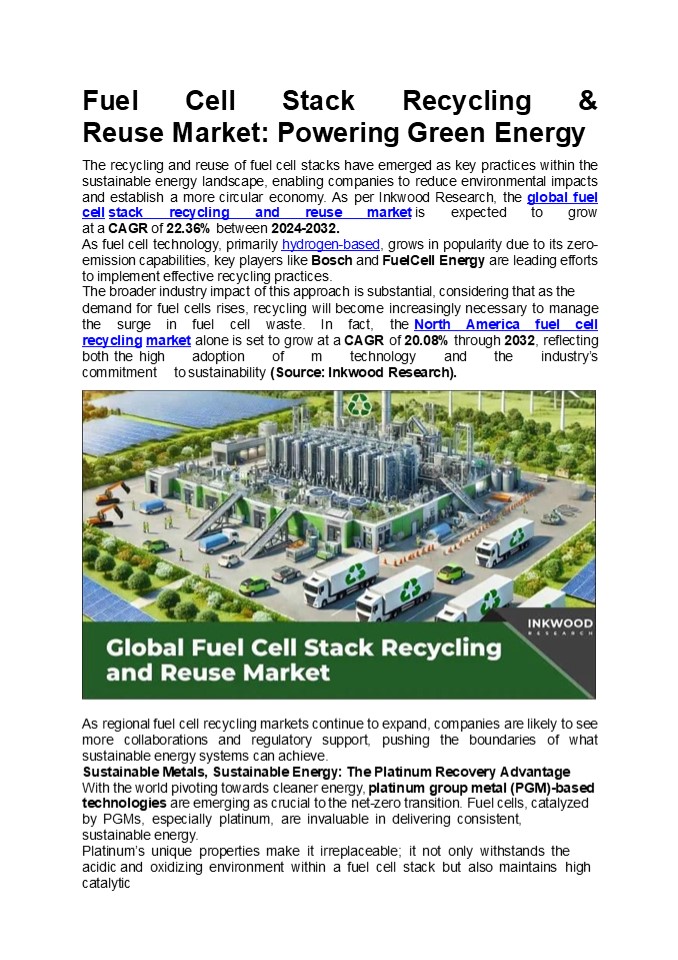
Title: Fuel Cell Stack Recycling & Reuse Market: Powering Green Energy
1
Fuel Cell Stack Recycling Reuse
Market Powering Green Energy The recycling and
reuse of fuel cell stacks have emerged as key
practices within the sustainable energy
landscape, enabling companies to reduce
environmental impacts and establish a more
circular economy. As per Inkwood Research, the
global fuel cell stack recycling and
reuse market is expected
to grow at a CAGR of 22.36 between
2024-2032. As fuel cell technology, primarily
hydrogen-based, grows in popularity due to its
zero- emission capabilities, key players like
Bosch and FuelCell Energy are leading efforts to
implement effective recycling practices. The
broader industry impact of this approach is
substantial, considering that as the demand for
fuel cells rises, recycling will become
increasingly necessary to manage the surge in
fuel cell waste. In fact, the North
America fuel cell recycling market alone is
set to grow at a CAGR of 20.08 through 2032,
reflecting both the high adoption of
m technology and the industrys
commitment to sustainability (Source
Inkwood Research).
As regional fuel cell recycling markets continue
to expand, companies are likely to see more
collaborations and regulatory support,
pushing the boundaries of what
sustainable energy systems can achieve. Sustainabl
e Metals, Sustainable Energy The Platinum
Recovery Advantage With the world pivoting
towards cleaner energy, platinum group metal
(PGM)-based technologies are emerging as crucial
to the net-zero transition. Fuel cells, catalyzed
by PGMs, especially platinum, are invaluable
in delivering consistent, sustainable
energy. Platinums unique properties make it
irreplaceable it not only withstands the
acidic and oxidizing environment within a
fuel cell stack but also maintains high
catalytic
2
activity over the systems lifetime,
ensuring both durability and efficiency
for sustainable energy applications. Leading
players in the global market have made
significant strides in this area by setting
up programs that recover over 95 of
the platinum in fuel cells. In fact,
Bosch has already initiated a buyback
program with Hylane, a company that rents
hydrogen trucks, allowing the former to
recycle these stacks and ensure that
valuable metals are reintegrated into the
supply chain, further supporting a circular
economy model. On the other hand, as the
industry continues to push toward
efficiency, artificial intelligence (AI) and
robotics are also playing pivotal roles in
optimizing recycling workflows. By integrating
AI-based predictive maintenance and robotic
automation, companies can streamline disassembly
processes, sort materials with high precision,
and conduct quality checks at unprecedented
speeds. Stay up-to-date with whats trending in
the Global Fuel Cell Stack Recycling and Reuse
Market These technologies not only improve
recovery rates for precious metals but also
ensure that fuel cell stacks are reused
and recycled with maximum environmental and
economic efficiency. Lets explore this in-depth
Fuel Cell Stack Recycling Reuse Market The
Role of AI and Robotics Advancements in
artificial intelligence (AI) and robotics are
transforming the fuel cell recycling industry
by making processes more efficient, precise,
and scalable. A noteworthy example is the
collaboration between IBM and FuelCell Energy,
which aims to use AI-driven predictive models to
improve the longevity and performance of fuel
cells. IBM is developing a Foundation Model
that can predict fuel cell performance and
degradation over time by analyzing data from
operational parameters. This predictive modeling
reduces the need for traditional, labor-intensive
testing and accelerates the optimization of
fuel cell performance, ultimately
extending their lifecycle and minimizing
waste. Robotics, in parallel, is enhancing
the efficiency of fuel cell stack assembly
and disassembly processes. For instance,
the Fraunhofer Institutes H2FastCell project
employs a robotic duo capable of assembling
400 individual fuel cells in 13 minutes, a
speed that drastically reduces the production
time compared to traditional manual methods. This
system uses advanced sensors and AI-powered
quality control to detect and adjust for even
minute deviations in the cells, ensuring both
precision and consistency. Such innovations have
laid the groundwork for a sustainable hydrogen
economy by enabling high-throughput recycling and
reducing the likelihood of defective cells being
scrapped. Kindly click here to view the LinkedIn
post related to this market How Companies
Benefit from Fuel Cell Recycling Reuse
Exploring the Economic Environmental
Advantages Fuel cell recycling offers a
compelling economic advantage by mitigating the
volatility of raw material costs, particularly
for precious metals. Through the recovery and
reuse of valuable components, companies can
reduce their dependency on newly mined
resources, leading to more stable supply chains.
Lets delve into these advantages below
3
- Through recycling initiatives, companies
using recycled platinum can cut down on
mining-associated emissions and lower the
raw material costs in production,
establishing a more resilient and sustainable
supply chain. - Additionally, by integrating AI-driven monitoring
and robotic automation, enterprises can realize
savings in production and labor costs, which
can be especially valuable for high-volume
applications in transportation and energy
storage. - Moreover, adopting these recycling and reuse
practices enhances corporate social
responsibility (CSR) profiles, providing
companies with a competitive edge in an
environmentally conscious market. - Businesses implementing sustainable
practices in fuel cell recycling can
differentiate themselves by showcasing
their commitment to green energy
solutions, thereby strengthening brand
loyalty and improving stakeholder relations. - Future of Fuel Cell Stack Recycling A Circular
Economy in Action - With growing investments and innovations in
recycling technology, the fuel cell industry
is steadily moving toward a circular
economy model. The advancements made by
companies like Bosch, Fraunhofer IPA, and
FuelCell Energy exemplify the potential for
industrial-scale recycling to support a
self-sustaining supply chain. - Not only does this reduce environmental
impact, but it also promotes sustainable
growth within the industry by lowering
dependence on newly mined materials and
enabling the reuse of key components. This shift
toward a circular economy in fuel cell technology
is expected to accelerate as more industries
adopt hydrogen fuel cells as a clean energy
alternative. - In all, the integration of AI, robotics,
and recycling practices in fuel cell
technology demonstrates a robust approach to
building a sustainable future, highlighting
the critical role of a circular economy in
advancing clean energy initiatives. Through - ongoing innovation and strategic
partnerships, enterprises can drive
meaningful environmental progress, setting an
inspiring new standard for sustainability in
the global fuel cell stack recycling and reuse
market.
Recommended

