

Unveiling the Power of Forecasting: A Glimpse into Applications Across Industries PowerPoint PPT Presentation
Title: Unveiling the Power of Forecasting: A Glimpse into Applications Across Industries
1
Unveiling the Power of Forecasting A Glimpse
into Applications Across Industries Introduction
In a world where uncertainty is the only
constant, the ability to predict future trends
and outcomes has become more critical than ever.
Forecasting, a powerful tool rooted in data
analysis and predictive modelling, has evolved
into an indispensable asset for businesses and
industries across the globe. In this blog, we
delve into the concept of forecasting and explore
its wide-ranging applications that shape
decision-making processes in various
sectors. Understanding Forecasting At its core,
forecasting involves making informed predictions
about future trends based on historical data and
analysis. This process leverages statistical
models, machine learning algorithms, and data
patterns to generate insights that help
organizations plan for the future. The accuracy
and reliability of forecasting depend on the
quality and quantity of data available, as well
as the sophistication of the models
employed. Methods of Forecasting Unravelling
the Choices Forecasting plays a crucial role in
decision-making across industries. Organizations
rely on different forecasting methodsqualitative,
quantitative, and machine learningto predict
trends, optimize resources, and enhance strategic
planning. Lets explore the distinctions,
applications, and efficiencies of these
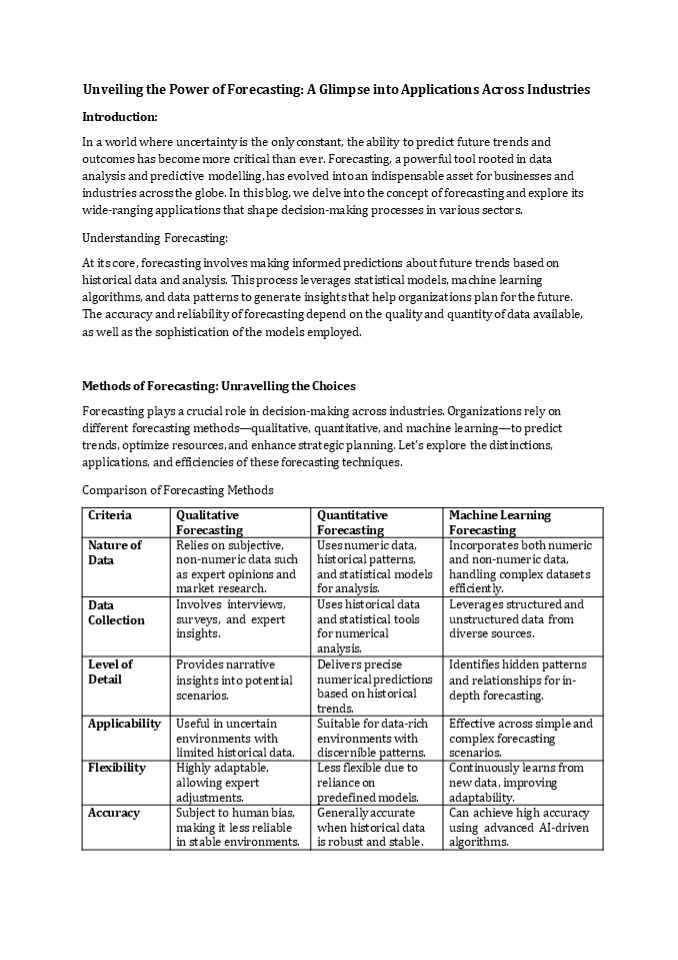
forecasting techniques. Comparison of Forecasting
Methods
Criteria Qualitative Forecasting Quantitative Forecasting Machine Learning Forecasting
Nature of Data Relies on subjective, non-numeric data such as expert opinions and market research. Uses numeric data, historical patterns, and statistical models for analysis. Incorporates both numeric and non-numeric data, handling complex datasets efficiently.
Data Collection Involves interviews, surveys, and expert insights. Uses historical data and statistical tools for numerical analysis. Leverages structured and unstructured data from diverse sources.
Level of Detail Provides narrative insights into potential scenarios. Delivers precise numerical predictions based on historical trends. Identifies hidden patterns and relationships for in- depth forecasting.
Applicability Useful in uncertain environments with limited historical data. Suitable for data-rich environments with discernible patterns. Effective across simple and complex forecasting scenarios.
Flexibility Highly adaptable, allowing expert adjustments. Less flexible due to reliance on predefined models. Continuously learns from new data, improving adaptability.
Accuracy Subject to human bias, making it less reliable in stable environments. Generally accurate when historical data is robust and stable. Can achieve high accuracy using advanced AI-driven algorithms.
2
Time Resources Requires expert input and extensive data gathering. Efficient for routine predictions with structured data. Resource-intensive during training but efficient for ongoing predictions.
Sensitivity to Changes Adapts well to market shifts and trends. May struggle with unexpected changes, requiring model adjustments. Responds dynamically to new data and evolving trends.
Risk Uncertainty Handling Effective in uncertain conditions, relying on expert judgment. Limited adaptability to unpredictable factors. Can manage uncertainty through continuous model learning.
Examples A panel of experienced fashion designers predicts upcoming trends based on their industry knowledge and insights. Analyzing past sales data to predict future sales figures for a retail store using time series analysis. Utilizing machine learning algorithms to analyze user behavior and predict future website traffic for an online platform.
Applications of Forecasting Financial
Markets Businesses leverage forecasting to
anticipate market trends, predict consumer
demand, and optimize their supply chains. Sales
forecasting, for instance, enables companies to
align production with expected demand, preventing
overstock or shortages. Financial analysts rely
on forecasting models to make investment
decisions and project future market conditions,
contributing to the stability of the financial
ecosystem. According to a 2019 report by the
International Monetary Fund (IMF), financial
forecasting allows businesses to anticipate
market shifts, such as recessions or periods of
economic growth. Supply Chain Management For
businesses, predicting demand for products is
crucial to optimizing inventory levels and
ensuring timely production. Forecasting aids
supply chain managers in anticipating consumer
needs, reducing excess inventory, and minimizing
stockouts, ultimately enhancing operational
efficiency. According to a McKinsey Company
report on "The State of Supply Chain Resilience"
(2021), companies that use advanced forecasting
models reduce excess inventory by 20-30, which
leads to substantial cost savings. Technology
Innovating with Insight The fast-paced world of
technology relies heavily on forecasting to stay
ahead of the curve. Tech companies utilize
predictive analytics to anticipate market
demands, guiding the development and release of
new products. From the adoption of emerging
technologies to predicting shifts in consumer
preferences, forecasting in the tech industry is
a driving force behind innovation and staying
competitive in an ever-evolving market. A Gartner
report on technology adoption (2024) highlights
that companies using forecasting models are more
likely to stay ahead of their competitors by
predicting market demands and technological
advancements. Weather Forecasting
3
Meteorologists utilize sophisticated forecasting
models to anticipate weather patterns, natural
calamities, and shifts in climate. Precise
weather predictions are crucial for organizing
daily tasks and for readiness in the face of
severe events like hurricanes, floods, and
droughts. The National Oceanic and Atmospheric
Administration (NOAA) reports that advances in
meteorological forecasting have dramatically
improved the ability to predict extreme weather
events. Healthcare The utilization of
forecasting is on the rise in the healthcare
sector to project disease outbreaks, rates of
patient admissions, and the dissemination of
infectious diseases. This data aids healthcare
providers in efficiently allocating resources,
preparing for spikes in demand, and implementing
preventive measures. A 2023 study published in
the Journal of Healthcare Management revealed
that predictive analytics is key to preparing
healthcare systems for surges in patient
volume. Marketing and Sales Businesses utilize
forecasting to predict customer behavior, sales
trends, and market demand. This information
guides marketing strategies, product launches,
and pricing decisions, enabling companies to stay
ahead of market dynamics. A 2022 report by
Deloitte found that organizations using
predictive analytics for sales forecasting are
1.6 times more likely to improve sales
performance and revenue. Human Resources HR
professionals use forecasting to predict
workforce trends, employee turnover rates, and
skill gaps. This information is invaluable for
workforce planning, talent acquisition, and
developing training programs to meet future
organizational needs. According to a 2023 study
by the Society for Human Resource Management
(SHRM), organizations with robust workforce
forecasting practices experience 50 less
turnover and higher employee satisfaction. Energy
Sector In the energy industry, forecasting is
employed to predict energy consumption, optimize
production schedules, and plan for maintenance
activities. This ensures a stable and reliable
energy supply while maximizing operational
efficiency. A 2022 report by the International
Energy Agency (IEA) highlights how forecasting
techniques help utilities predict peak energy
demand, preventing power outages and ensuring
grid stability. Economics Decoding the Economic
Landscape In the realm of economics, forecasting
serves as a crystal ball for policymakers,
businesses, and the public. Governments use
economic forecasts to shape fiscal policies,
while businesses utilize them to make strategic
decisions. Whether its projecting GDP growth,
inflation rates, or unemployment trends,
forecasting provides a roadmap for navigating the
intricate web of economic forces. According to
the World Banks 2023 Global Economic Prospects
report, accurate forecasting helps policymakers
anticipate economic growth, inflation, and
unemployment. Water Demand Forecasting
4
Water utilities employ forecasting techniques to
predict future water demand, ensuring efficient
water resource management. By analyzing
historical consumption patterns, population
growth, and seasonal variations, water demand
forecasting helps utilities plan infrastructure
investments, optimize water distribution, and
implement conservation measures. This proactive
approach enables the sustainable allocation of
water resources, prevents shortages, and supports
the overall resilience of water supply systems. A
2019 study published in the Journal of Water
Resources Planning and Management found that
predictive models help water utilities plan
infrastructure investments and optimize water
distribution.
- The Future Landscape of Regression, Forecasting,
and Prediction - Regression
- Advanced Algorithms and Techniques
- Upcoming regression models are poised to harness
more sophisticated algorithms, embracing
cutting-edge techniques such as deep learning.
The prevalence of neural networks and ensemble
methods is anticipated, enabling models to
adeptly capture intricate relationships within
data. - Explainability and Interpretability
- As Artificial Intelligence development (AI) and
machine learning models become integral to
decision-making processes, there will be a
heightened emphasis on enhancing the
interpretability of regression models. Techniques
geared towards explaining model predictions, such
as explainable AI (XAI), are set to play a
pivotal role in ensuring transparency and
understanding. - Integration with Big Data
- Considering the persistent expansion of big data
platforms, the evolution of regression models
will demand adaptation to handle larger and more
intricate datasets. Seamless integration with big
data technologies and distributed computing
frameworks will be imperative for ensuring
scalability and efficiency. - Automated Feature Engineering
- The trajectory of regression models in the future
suggests a shift towards increased automation in
feature engineering. Machine learning solutions
models are expected to exhibit proficiency in
identifying and incorporating pertinent features
autonomously, thereby diminishing the manual
effort traditionally associated with model
development. - Forecasting
5
Machine Learning Integration Forecasting methods
will increasingly incorporate machine learning
approaches, moving beyond traditional time series
models. This integration will enable more
accurate predictions by leveraging complex
patterns and relationships in historical
data. Real-Time Forecasting The demand for
real-time forecasting capabilities will grow
across industries. Technologies like IoT
(Internet of Things) will enable continuous data
streams, requiring forecasting models to adapt to
dynamic and evolving datasets. Hybrid Models The
evolution of forecasting may likely see the
emergence of hybrid models that leverage the
strengths of various forecasting methods. By
integrating both quantitative and qualitative
approaches, coupled with machine learning
techniques, these hybrid models are anticipated
to enhance the precision of predictions. Integrati
on of External Factors Future forecasting models
are poised to place a growing emphasis on the
inclusion of external factors, encompassing
economic indicators, social trends, and
geopolitical events. This broader contextual
awareness is expected to fortify the robustness
of predictions, providing a more comprehensive
and nuanced forecasting framework. (c)
Prediction Enhanced Predictive Analytics The
field of predictive analytics will experience
advancements in terms of accuracy and efficiency.
Machine learning models will continue to evolve,
offering more precise predictions across various
domains, from healthcare to finance. Exponential
Growth in Data As the volume of data continues
to grow exponentially, prediction models will
need to adapt to handle vast and diverse
datasets. This will involve advancements in data
processing, storage, and analytics
infrastructure. Personalized Predictions The
future of prediction lies in personalization.
Models will become more adept at providing
tailored predictions based on individual
behaviors, preferences, and historical patterns,
enhancing user experience and decision-making. Eth
ical Considerations and Bias Mitigation The
responsible use of predictive models will become
paramount. Efforts to address biases in
predictions, ensure fairness, and uphold ethical
standards will shape the future landscape of
predictive analytics. In summary, the future of
regression, forecasting, and prediction is
characterized by the integration of advanced
technologies, adaptability to large and dynamic
datasets, and a growing
6
emphasis on interpretability and ethical
considerations. These developments are poised to
revolutionize decision-making processes across
industries.
Case Studies Navigating the Real World Success
Stories When Forecasting Hits the Mark Weather
Forecasting Saving Lives in the Eye of the
Storm Meteorological forecasts have made
significant strides in accuracy, enabling timely
warnings and preparations for severe weather
events. For instance, the accurate prediction of
a hurricanes path allows authorities to evacuate
vulnerable areas, minimizing the loss of life and
property. Business and Supply Chain Management
The Art of Anticipation Companies like Amazon
and Walmart leverage forecasting to optimize
their supply chains. By accurately predicting
consumer demand, these retail giants can stock
the right amount of inventory, reducing both
excess stock and stockouts. Cautionary Tales
When Forecasting Falls Short Financial Crisis of
2008 The Limits of Economic Forecasting The
financial crisis of 2008 serves as a stark
reminder of the challenges inherent in economic
forecasting. Many economists failed to predict
the extent of the crisis, highlighting the
complexity of financial systems and the
limitations of existing forecasting
models. Pandemic Preparedness Forecasting and
Unforeseen Challenges While forecasting models
exist for pandemics, the global response to the
COVID-19 pandemic revealed the complexities of
predicting the trajectory of a novel virus. This
underscores the need for flexibility and
resilience in the face of unforeseen
challenges. Conclusion The power of
forecasting stands as a beacon, guiding
decision-makers through the intricacies of an
inherently unpredictable future. As weve
journeyed through the myriad applications and
methodologies of forecasting across industries,
it becomes unmistakably clear that the capacity
to anticipate trends transcends being merely an
assetit is an indispensable necessity. At Rydot
Infotech, we grasp the dynamic essence of
forecasting, acknowledging its pivotal role in
strategic decision-making. Our commitment to
innovation is evident through our proficiency in
tailoring customized algorithms and crafting
precise forecasting models that cater to the
distinctive needs of businesses. Currently, we
are actively harnessing the potential of
forecasting across diverse domains. Our
initiatives in solar energy forecasting enable
efficient energy production planning, maximizing
renewable resources. Additionally, our expertise
in
7
water demand prediction contributes to the
sustainable management of this vital resource,
ensuring judicious allocation and preventing
shortages. As pioneers in forecasting innovation,
we stride into the future, transforming
uncertainties into opportunities. Join us in this
foresight journey, where the synergy of data,
algorithms, and industry expertise illuminates
the path forward.
Recommended

