

How Do You Balance Quality, Customization, and Speed for Custom Plushies? PowerPoint PPT Presentation
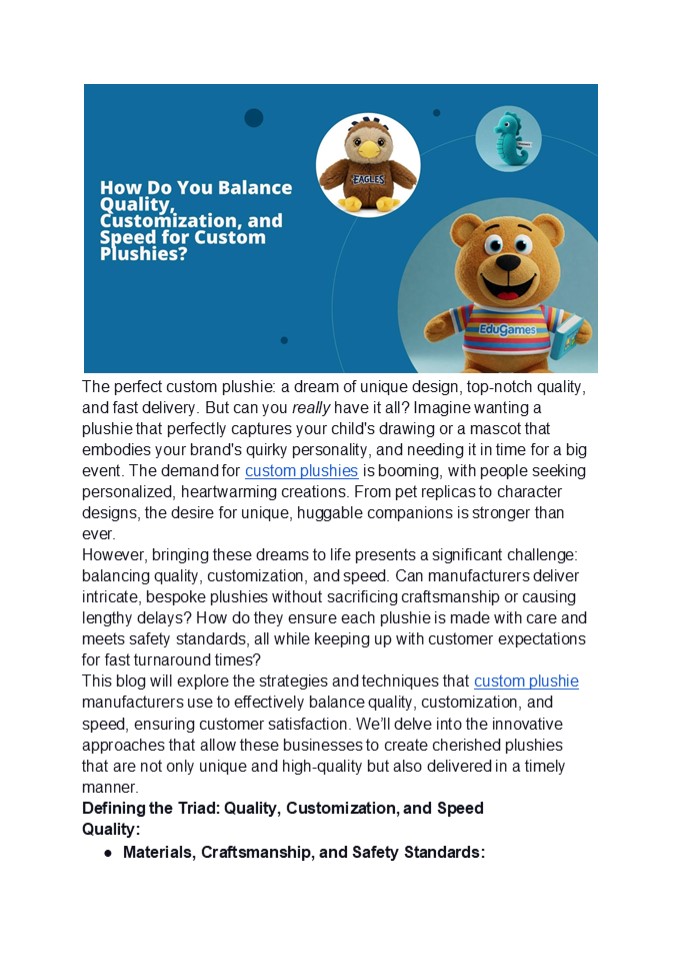
Title: How Do You Balance Quality, Customization, and Speed for Custom Plushies?
1
- The perfect custom plushie a dream of unique
design, top-notch quality, and fast delivery. But
can you really have it all? Imagine wanting a
plushie that perfectly captures your child's
drawing or a mascot that embodies your brand's
quirky personality, and needing it in time for a
big event. The demand for custom plushies is
booming, with people seeking personalized,
heartwarming creations. From pet replicas to
character designs, the desire for unique,
huggable companions is stronger than ever. - However, bringing these dreams to life presents a
significant challenge balancing quality,
customization, and speed. Can manufacturers
deliver intricate, bespoke plushies without
sacrificing craftsmanship or causing lengthy
delays? How do they ensure each plushie is made
with care and meets safety standards, all while
keeping up with customer expectations for fast
turnaround times? - This blog will explore the strategies and
techniques that custom plushie manufacturers use
to effectively balance quality, customization,
and speed, ensuring customer satisfaction. Well
delve into the innovative approaches that allow
these businesses to create cherished plushies
that are not only unique and high-quality but
also delivered in a timely manner. - Defining the Triad Quality, Customization, and
Speed Quality - Materials, Craftsmanship, and Safety Standards
2
- Quality in custom plushies encompasses the
selection of durable, safe, and aesthetically
pleasing materials. This includes hypoallergenic
fillings, high-grade fabrics, and non-toxic dyes. - Craftsmanship refers to the skill and precision
involved in sewing, stitching, and assembling the
plushie. Attention to detail, such as reinforced
seams and securely attached components, is
crucial. - Safety standards, particularly for children's
toys, are paramount. This involves compliance
with regulations like ASTM F963 and ensuring that
plushies are free from choking hazards and
harmful chemicals. - Imagine a custom plushie designed for a baby. The
materials must be extremely soft, safe, and
easily washable. - Impact on Customer Satisfaction and Brand
Reputation - High-quality plushies lead to delighted
customers, fostering repeat business and positive
word-of-mouth. - A reputation for quality builds trust and brand
loyalty, setting a manufacturer apart from
competitors. - Conversely, poor quality can lead to negative
reviews, returns, and damage to the brand's
image. - Customization
- Range of Customization Options
- Customization can range from simple choices like
fabric color and size to complex requests like
replicating detailed drawings or creating unique
character designs. - Options may include
- Material selection (e.g., fleece, velvet, organic
cotton). - Color palettes and pattern designs.
- Embroidery and printing.
- Accessory additions (e.g., clothing, props).
- Shape and size variations.
- Think of a customer who wants a plushie that is a
replica of their own original character. They
will want to choose very specific colors and
materials. - Challenges of Handling Unique Requests and
Maintaining Consistency
3
- Each unique request requires careful attention to
detail and may involve specialized techniques or
materials. - Maintaining consistency across different orders
while accommodating unique customizations can be
challenging. - Manufacturers must balance the desire for
personalization with the need for efficient
production. - Speed
- Impact of Turnaround Time on Customer
Expectations and Market Competitiveness - In today's fast-paced market, customers expect
quick turnaround times. - Speed is particularly important for
time-sensitive orders, such as gifts for special
occasions or promotional items for events. - Manufacturers that can deliver high-quality,
customized plushies quickly gain a competitive
advantage. - Challenges of Maintaining Speed Without
Compromising Quality or Customization - Rushing production can lead to errors, defects,
and compromised quality. - Balancing speed with the need for meticulous
craftsmanship and attention to detail is a
constant challenge. - For example, if a company gets a very large
order, they will need to make sure that they can
produce the plushies quickly but also maintain
the high quality that the customer expects. - Strategies for Balancing the Triad Technology
Integration - Use of 3D Modeling, Digital Design Tools, and
Automated Cutting/Sewing - 3D modeling allows for precise design
visualization and the creation of digital
prototypes. - Digital design tools enable customers to
customize their plushies online and provide
detailed specifications. - Automated cutting and sewing machines increase
production speed and accuracy.
4
- Imagine a customer who uploads a 3d model of a
character they designed. That 3d model can then
be used to create a perfect plushie. - Streamlining Processes and Improving Accuracy
- Technology streamlines the design and production
process, reducing errors and waste. - Automation improves efficiency and consistency,
allowing manufacturers to produce high-quality
plushies faster. - Efficient Workflow and Production Planning
- Optimized Production Schedules and Inventory
Management - Efficient production schedules minimize downtime
and maximize output. - Inventory management ensures that materials are
readily available, preventing delays. - Use of Lean Manufacturing Principles and Process
Optimization - Lean manufacturing principles focus on
eliminating waste and improving efficiency. - Process optimization involves continuously
analyzing and improving production processes. - Skilled Craftsmanship and Training
- Role of Skilled Artisans in Maintaining Quality
and Handling Complex Designs - Skilled artisans are essential for handling
intricate details and ensuring high-quality
craftsmanship. - They can provide expertise in sewing, embroidery,
and other specialized techniques. - Importance of Ongoing Training and Skill
Development - Ongoing training ensures that artisans stay
up-to-date with the latest techniques and
technologies. - Skill development allows manufacturers to expand
their capabilities and offer a wider range of
customization options. - Clear Communication and Client Collaboration
5
- Manufacturers should provide realistic timelines
and keep customers informed throughout the
production process. - Value of Client Feedback and Iterative Design
Processes - Client feedback is invaluable for refining
designs and ensuring that the final product meets
expectations. - Iterative design processes allow for adjustments
and revisions based on client feedback. - Modular Design and Pre-Fabricated Components
- Use of Standardized Components and Modular
Designs to Speed Up Production - Modular designs allow for the use of
pre-fabricated components, reducing assembly
time. - Standardized components ensure consistency and
quality. - Balance Between Standardization and
Customization - Manufacturers must balance the desire for
customization with the need for efficient
production. - Modular designs can be combined with custom
elements to create unique plushies. - Strategic Partnerships and Outsourcing
- Benefits of Collaborating with Specialized
Suppliers and Manufacturers - Collaborating with specialized suppliers allows
manufacturers to access high-quality materials
and expertise. - Outsourcing certain tasks, such as embroidery or
printing, can improve efficiency and expand
capabilities. - Improving Efficiency and Expanding Capabilities
- Strategic partnerships and outsourcing allow
manufacturers to focus on their core
competencies. - They can also help manufacturers to scale their
production and meet growing demand. - Overcoming Common Challenges Discuss Potential
Pitfalls
6
- For instance, a particular shade of fabric needed
for a custom plushie might become unavailable,
causing delays. - Design Revisions
- Clients may request design revisions after
production has begun, leading to rework and
increased costs. - Imagine a customer who initially approved a
plushie design, but then wants to change the
color of the eyes or add an accessory. - Unexpected Delays
- Equipment malfunctions, shipping delays, or
unforeseen circumstances can disrupt production
schedules. - For example, a machine used for embroidery might
break down, or a shipment of materials could be
delayed due to weather. - Maintaining consistent quality
- When production numbers increase, it can be hard
to maintain quality, especially with highly
detailed plushies. - Provide Solutions and Best Practices
- Material Shortages
- Maintain a diverse network of suppliers to
minimize reliance on a single source. - Keep a buffer inventory of essential materials to
mitigate potential shortages. - Communicate openly with clients about potential
delays and offer alternative material options. - Design Revisions
- Establish a clear revision policy and communicate
it to clients upfront. - Use digital mockups and prototypes to ensure
client approval before production begins. - Implement a system for tracking and managing
design revisions. - Unexpected Delays
7
- Build buffer time to production schedules.
- Maintaining Consistent Quality
- Implement strict quality control checks at every
stage of production. - Provide regular training for staff to maintain
high standards of craftsmanship. - Use high-quality machines and materials.
- For example, having a dedicated quality control
team that inspects each plushie before it ships,
will cut down on mistakes. - Conclusion
- Balancing quality, customization, and speed in
custom plushie production is a complex but
achievable goal. By implementing the strategies
and best practices outlined in this blog,
manufacturers can create cherished plushies that
delight customers and build lasting brand
loyalty. - Connect with EverLighten
- Ready to bring your custom plushie visions to
life? Connect with EverLighten today! - 100 Customization Design every detail of your
plushie, from the shape and size to the colors
and accessories. - 100 Quality Check We ensure that every plushie
meets our rigorous quality standards. - Free Design Help Our expert design team is here
to assist you in creating the perfect plushie
design. - Worldwide Delivery We ship your custom plushies
to any location around the globe. - 24/7 Support Our dedicated support team is
available around the clock to assist you. - Unlimited Revisions We work with you until your
design is perfect, offering unlimited revisions. - Low MOQ (Minimum Order Quantity) We cater to
businesses and individuals of all sizes with
flexible and low minimum order quantities. - Visit our website or contact us today to begin
your custom plushie project! - FAQs
8
- How do you handle material shortages?
- We maintain a diverse network of suppliers and
keep a buffer inventory of essential materials.
We also communicate openly with clients about any
potential delays. - What happens if I need to make a design revision?
- We have a clear revision policy and work with
clients to make necessary changes. We use digital
mockups and prototypes to minimize revisions. - How do you ensure quality control?
- We implement strict quality control checks at
every stage of production, from material
selection to final packaging. - What is your typical turnaround time?
- Turnaround times vary depending on the complexity
of the design and the order quantity. We provide
estimated timelines during the consultation
process. - Do you offer rush orders?
- Yes, we can accommodate rush orders on a
case-by-case basis. Please contact us to discuss
your specific needs.
Recommended

