

Gasket Failures – Identification And Prevention PowerPoint PPT Presentation
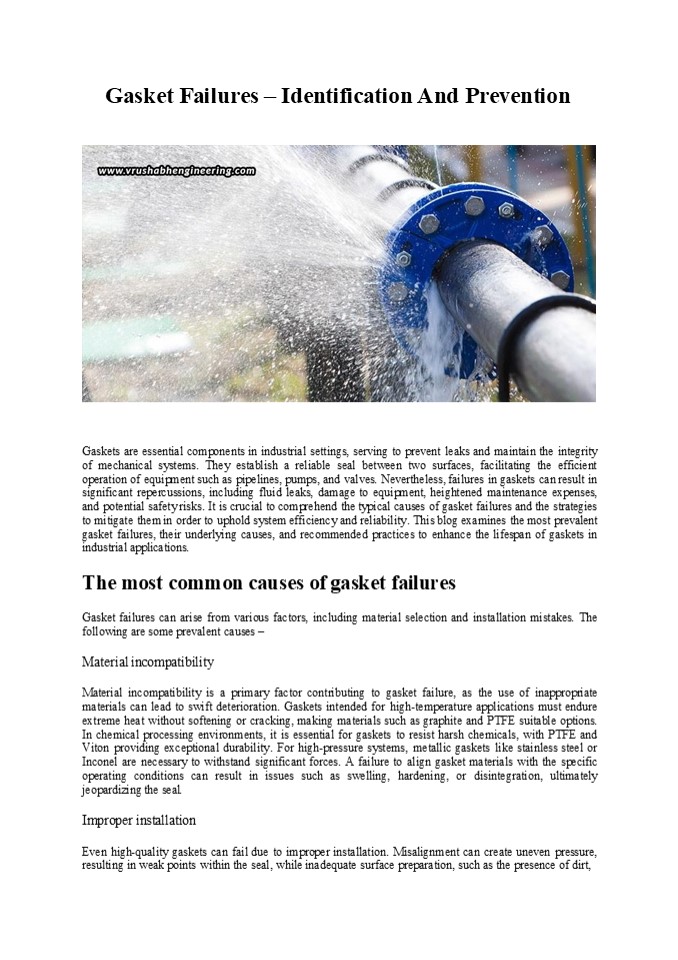
Title: Gasket Failures – Identification And Prevention
1
Gasket Failures Identification And Prevention
Gaskets are essential components in industrial
settings, serving to prevent leaks and maintain
the integrity of mechanical systems. They
establish a reliable seal between two surfaces,
facilitating the efficient operation of equipment
such as pipelines, pumps, and valves.
Nevertheless, failures in gaskets can result in
significant repercussions, including fluid leaks,
damage to equipment, heightened maintenance
expenses, and potential safety risks. It is
crucial to comprehend the typical causes of
gasket failures and the strategies to mitigate
them in order to uphold system efficiency and
reliability. This blog examines the most
prevalent gasket failures, their underlying
causes, and recommended practices to enhance the
lifespan of gaskets in industrial
applications. The most common causes of gasket
failures Gasket failures can arise from various
factors, including material selection and
installation mistakes. The following are some
prevalent causes Material incompatibility Mater
ial incompatibility is a primary factor
contributing to gasket failure, as the use of
inappropriate materials can lead to swift
deterioration. Gaskets intended for
high-temperature applications must endure extreme
heat without softening or cracking, making
materials such as graphite and PTFE suitable
options. In chemical processing environments, it
is essential for gaskets to resist harsh
chemicals, with PTFE and Viton providing
exceptional durability. For high-pressure
systems, metallic gaskets like stainless steel or
Inconel are necessary to withstand significant
forces. A failure to align gasket materials with
the specific operating conditions can result in
issues such as swelling, hardening, or
disintegration, ultimately jeopardizing the
seal. Improper installation Even high-quality
gaskets can fail due to improper installation.
Misalignment can create uneven pressure,
resulting in weak points within the seal, while
inadequate surface preparation, such as the
presence of dirt,
2
rust, or remnants of old gaskets, can hinder
effective sealing. Incorrect torque application,
whether excessive or uneven, can lead to
irregular compression and potential leaks. To
ensure the reliability of gaskets, it is vital to
employ proper installation techniques, which
include thorough surface cleaning, accurate
alignment, and controlled torque
application. Compression issues Correct
compression of gaskets is essential for
establishing a dependable seal. Over-tightening
can compress the gasket material excessively,
leading to deformation and premature failure.
Conversely, under-tightening may result in
inadequate sealing, causing leaks. Achieving
balanced compression is crucial, as it allows the
gasket material to conform to surface
irregularities while preserving its structural
integrity. Adhering to the torque values
recommended by the manufacturer is vital to
prevent these complications. Aging and
degradation Gaskets experience natural
deterioration over time due to factors such as
extreme temperature fluctuations, chemical
reactions, and mechanical pressures. Rubber-based
gaskets may harden and crack as they lose their
flexibility, while thermal cycling induces
expansion and contraction, resulting in material
fatigue. Furthermore, vibrations from machinery
can lead to gradual wear and the loosening of
gaskets. Conducting regular inspections and
replacing gaskets in a timely manner can mitigate
failures associated with aging and degradation,
thereby maintaining effective sealing
performance. Flange surface irregularities Defect
s on flange surfaces can greatly affect the
performance of gaskets, as a reliable seal
depends on the integrity of these surfaces.
Issues such as scratches, corrosion, or warping
can hinder complete contact between the gasket
and the flange, diminishing sealing
effectiveness. Additionally, uneven distribution
of load on the flange, often resulting from
improper tightening, can create localized
pressure points that may hasten gasket failure.
It is crucial to perform regular maintenance on
flanges and to choose the correct type of gasket
suited for specific surface conditions to ensure
durable, leak-free operation. How gasket
failures can be prevented Preventing gasket
failures necessitates meticulous material
selection, appropriate installation, and
consistent maintenance. The following approaches
can significantly improve gasket performance and
durability. Selecting the appropriate gasket
material The selection of the appropriate gasket
material is crucial for achieving a dependable
seal in any application. Environments with high
temperatures demand materials such as graphite or
PTFE, whereas systems that encounter aggressive
chemicals benefit from chemically resistant
materials like PTFE and Viton. For applications
involving high pressure, metallic or reinforced
fibre gaskets offer the necessary strength and
durability. Engaging with gasket manufacturers or
consulting industry-standard compatibility charts
can assist in identifying the most appropriate
material for specific operational
conditions. Ensuring correct installation Correct
installation is vital for establishing a secure
and enduring gasket seal. Thoroughly cleaning
flange surfaces is essential to eliminate debris,
oil, and remnants of old gaskets that could
jeopardize the seal. Proper alignment is
necessary to ensure even pressure distribution,
and utilizing calibrated torque wrenches aids in
applying the correct bolt-tightening sequence and
pressure. In certain instances, the application
of anti-seize lubricants can further enhance
performance. Adhering to these best practices
reduces installation errors and bolsters gasket
reliability.
3
- Routine inspection and maintenance
- Routine inspection and maintenance are essential
for identifying early signs of gasket wear or
failure, thereby preventing expensive system
downtime. Scheduled inspections should focus on
detecting leaks, material degradation, and
misalignment, while pressure testing or
ultrasonic leak detection can uncover potential
issues before they develop into significant
problems. Prompt replacement of worn gaskets is
crucial for maintaining system efficiency and
avoiding unforeseen failures. - Best practices for extending gasket life
- Extending the lifespan of gaskets necessitates a
strategic approach that includes careful material
selection, correct installation practices, and
regular maintenance. Adopting the following best
practices can significantly improve the
efficiency and longevity of gaskets in industrial
settings. - Invest in premium gaskets Select gaskets from
trusted manufacturers that comply with industry
standards for both durability and performance. - Optimize flange and bolt conditions Conduct
routine inspections and maintenance of flange
surfaces, ensuring that bolt tension is
appropriately applied. - Use protective coatings In challenging
environments, the application of protective
coatings on gaskets can bolster their resistance
to corrosion and wear. - Implement preventive maintenance programs A
proactive maintenance strategy for gaskets allows
for the early detection and resolution of
potential issues, preventing major failures. - Where to get your gaskets?
- Vrushabh Engineering, a prominent high-quality
gaskets supplier in India, provides solutions
designed for a variety of industrial
applications. With a focus on durability,
precision, and reliability, Vrushabh Engineering
guarantees that industries receive optimal
sealing solutions tailored to their requirements.
For expert advice and top-tier gasket products,
reach out to Vrushabh Engineering today. - Resource Read more
Recommended

