

Unmasking the Differences: A Look at Custom Plushie Manufacturing Variations PowerPoint PPT Presentation
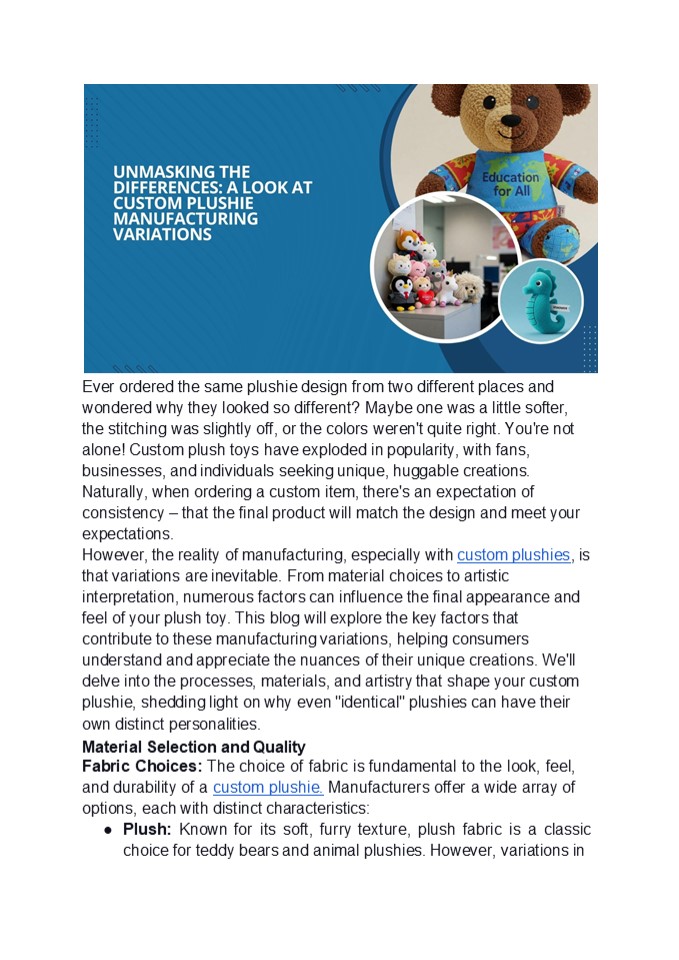
Title: Unmasking the Differences: A Look at Custom Plushie Manufacturing Variations
1
- Ever ordered the same plushie design from two
different places and wondered why they looked so
different? Maybe one was a little softer, the
stitching was slightly off, or the colors weren't
quite right. You're not alone! Custom plush toys
have exploded in popularity, with fans,
businesses, and individuals seeking unique,
huggable creations. - Naturally, when ordering a custom item, there's
an expectation of consistency that the final
product will match the design and meet your
expectations. - However, the reality of manufacturing, especially
with custom plushies, is that variations are
inevitable. From material choices to artistic
interpretation, numerous factors can influence
the final appearance and feel of your plush toy.
This blog will explore the key factors that
contribute to these manufacturing variations,
helping consumers understand and appreciate the
nuances of their unique creations. We'll delve
into the processes, materials, and artistry that
shape your custom plushie, shedding light on why
even "identical" plushies can have their own
distinct personalities. - Material Selection and Quality
- Fabric Choices The choice of fabric is
fundamental to the look, feel, and durability of
a custom plushie. Manufacturers offer a wide
array of options, each with distinct
characteristics - Plush Known for its soft, furry texture, plush
fabric is a classic choice for teddy bears and
animal plushies. However, variations in
2
- pile height, density, and fiber type can
significantly affect the plushie's appearance and
feel. A high-quality plush fabric will have a
dense, even pile and a luxurious feel, while a
lower-quality version might be thin, sparse, and
prone to shedding. - Fleece A popular choice for its warmth,
softness, and affordability, fleece is often used
for character plushies and simpler designs. - Different fleece types, such as polar fleece,
microfleece, and anti-pill fleece, offer varying
levels of thickness, softness, and durability. A
premium fleece will maintain its softness and
shape after washing, while a lower-grade fleece
might pill or become matted. - Velvet Velvet adds a touch of luxury and
sophistication to plushies. Its smooth, lustrous
surface creates a visually appealing texture.
However, velvet can be delicate and prone to
crushing or marking. High-quality velvet will
have a rich, even pile and a soft, supple feel,
while cheaper velvet might be thin, stiff, and
prone to wrinkling. - Other Fabrics Beyond these, manufacturers use a
variety of other fabrics, including cotton,
linen, and synthetic blends, depending on the
desired effect. Each fabric has its own unique
texture, drape, and durability. - The quality of the same fabric can vary
significantly between suppliers. For example, two
plush fabrics labeled "plush" might have
different fiber compositions, weave densities,
and finishing processes. This can result in
noticeable differences in softness, sheen, and
durability. A high-end plush toy manufacturer
will often source fabrics from reputable
suppliers who adhere to strict quality standards.
Imagine a custom plushie of a cat. One
manufacturer uses a very high-quality plush that
is very soft, and the other manufacturer uses a
cheaper plush that is less soft and sheds easily.
The two cats will look and feel very different. - Filling Materials The filling material
determines the plushie's squishiness, shape
retention, and overall comfort. Common filling
options include - Polyester Fiberfill The most common filling
material, polyester fiberfill is soft,
lightweight, and hypoallergenic. It's available
in various densities and fiber types, allowing
manufacturers to achieve different levels of
firmness and squishiness. High-quality
3
- fiberfill will maintain its loft and shape over
time, while a lower-quality version might clump
or flatten. - Beanbag Filling Small plastic beads or pellets,
beanbag filling adds weight and texture to
plushies. It's often used for weighted plushies
or plushies designed to sit upright. However,
beanbag filling can be less cuddly than fiberfill
and might not be suitable for all designs. - Other Filling Materials Manufacturers may also
use other filling materials, such as cotton
batting, foam, or natural fibers, depending on
the desired effect. - Hypoallergenic and safe filling materials are
crucial, especially for plushies intended for
children or individuals with allergies.
High-quality polyester fiberfill is generally
considered hypoallergenic, but it's essential to
ensure that the filling material is free from
harmful chemicals or contaminants. A plushie
intended for a baby should only use
hypoallergenic materials. - Trims and Embellishments Trims and
embellishments add detail and character to
plushies, but their quality and appearance can
vary significantly. - Buttons Buttons come in various materials,
sizes, and designs. High-quality buttons will be
securely attached and have a smooth, even finish.
Cheaper buttons might be prone to breaking or
have rough edges. - Zippers Zippers are used for plushies with
removable components or hidden compartments.
High-quality zippers will glide smoothly and have
durable teeth. Cheaper zippers might snag or
break easily. - Embroidery Threads Embroidery threads come in
various colors, thicknesses, and materials.
High-quality embroidery threads will have a
vibrant color and a smooth, even finish. Cheaper
threads might be prone to fraying or fading. - Other Trims Other trims, such as ribbons, lace,
and appliques, also contribute to the plushie's
overall appearance. The quality and craftsmanship
of these trims can vary significantly between
manufacturers. - The quality of trims and embellishments can
significantly impact the plushie's overall
appearance and durability. High-quality trims will
4
- enhance the plushie's design and withstand wear
and tear, while cheaper trims might detract from
the plushie's aesthetic and break easily. A
custom plushie with embroidered eyes will look
much better if very high-quality thread is used. - Design Interpretation and Artistry
- Pattern Making Pattern making is the foundation
of any plushie, determining its shape,
proportions, and overall design. Variations in
techniques can lead to noticeable differences in
the final product. - Different Pattern-Making Techniques
- Manufacturers may employ different pattern-making
methods, such as draping, flat pattern drafting,
or 3D modeling. Each technique has its own
strengths and weaknesses, leading to variations
in the plushie's shape and proportions. - For example, draping, which involves shaping
fabric directly on a mannequin, can result in
more organic and flowing shapes. However, it
requires a high level of skill and may not be
suitable for complex designs. - Flat pattern drafting, which involves creating
patterns on paper based on measurements, is more
precise and suitable for intricate designs.
However, it requires careful calculations and may
not capture the nuances of organic shapes. - Digital vs. Hand-Drawn Patterns
- Digital pattern making, using computer-aided
design (CAD) software, offers greater precision
and consistency. Digital patterns can be easily
scaled, modified, and shared, ensuring that all
plushies are made to the exact specifications. - Hand-drawn patterns, while offering a more
organic and artistic approach, are prone to
variations and inconsistencies. The accuracy of
hand-drawn patterns depends on the skill and
experience of the pattern maker. - A custom plushie designed from a digital pattern
will have very precise, and repeatable shapes. A
hand-drawn pattern will have slight variations
between each plushie.
5
- Sewing and Assembly Sewing and assembly are
crucial steps in the plushie manufacturing
process, requiring skill, precision, and
attention to detail. - Role of Skilled Artisans
- Skilled artisans play a vital role in ensuring
the quality and craftsmanship of plushies. Their
expertise in sewing techniques, fabric handling,
and finishing processes contributes to the
plushie's overall appearance and durability. - Variations in sewing techniques, such as stitch
length, seam allowance, and finishing methods,
can affect the plushie's strength, appearance,
and longevity. - Hand-Sewn vs. Machine-Sewn Plushies
- Hand-sewn plushies offer a unique, artisanal
touch. They often feature intricate details and
meticulous stitching, showcasing the artisan's
skill and craftsmanship. However, hand-sewing is
time-consuming and labor-intensive, making it
less suitable for large-scale production. - Machine-sewn plushies are more efficient and
consistent, allowing for mass production and
faster turnaround times. Modern sewing machines
offer a wide range of stitch types and features,
enabling manufacturers to create high-quality
plushies with precision and speed. - A hand-sewn plushie will have a very unique look,
with slight variations in the stitching. A
machine-sewn plushie will look very uniform. - Embroidery and Detailing Embroidery and
detailing add intricate features and
embellishments to plushies, enhancing their
visual appeal and character. - Variations in Embroidery
- Variations in embroidery machines, thread
quality, and artisan skill can affect the
appearance of embroidered details. High-quality
embroidery machines offer precise stitching and a
wide range of thread colors and types. - Artisan skill is crucial in ensuring that
embroidered details are accurately placed and
neatly finished. Variations in stitch density,
thread tension, and finishing techniques can
affect the embroidery's appearance.
6
- A high-quality embroidery machine, and
high-quality thread, will have a very crisp and
clean look. - Hand Painting vs. Machine Printing
- Hand painting offers a unique, artistic touch,
allowing for intricate details and custom color
blending. However, hand painting is
time-consuming and labor-intensive, making it
less suitable for large-scale production. - Machine printing, such as screen printing or
digital printing, offers greater efficiency and
consistency. Machine-printed designs can be
reproduced with high accuracy and speed. However,
machine printing may not capture the nuances of
hand-painted details. - Hand-painted details will have a very unique, and
artistic look. Machine-printed details will look
very uniform. - Manufacturing Processes and Technology
- Cutting and Shaping The cutting and shaping
stage is critical for achieving the desired
plushie form. Variations in cutting methods can
significantly affect accuracy and consistency. - Manual vs. Automated Cutting
- Manual Cutting Involves using scissors or rotary
cutters to cut fabric according to the pattern.
This method relies heavily on the skill and
precision of the cutter. Manual cutting is often
used for small-batch production or intricate
designs where flexibility is needed. However, it
can lead to variations in shape and size due to
human error. - Automated Cutting Employs computer-controlled
cutting machines, such as CNC cutters or die
cutters, to precisely cut fabric. Automated
cutting offers greater accuracy and consistency,
especially for large-scale production. It
minimizes human error and ensures that all pieces
are cut to the exact specifications. - For example, a complex pattern with many small
curves will be much more accurately cut by an
automated machine. - Laser Cutting
- Laser cutting uses a high-powered laser beam to
cut fabric with exceptional precision. It can
create intricate shapes and
7
- fine details that are difficult to achieve with
manual or traditional automated cutting methods. - Laser cutting also offers clean edges, minimizing
fraying and enhancing the plushie's overall
appearance. However, it can be more expensive
than other cutting methods and may not be
suitable for all fabric types. - Laser cutting would be ideal for a plushie with
very fine details, such as complex facial
features, or very detailed clothing. - Production Scale The scale of production
significantly influences the manufacturing
process, quality control, and consistency of
custom plushies. - Large-Scale Manufacturing
- Large-scale manufacturers produce plushies in
high volumes, often using automated machinery and
assembly lines. This allows for economies of
scale, reducing production costs and enabling
faster turnaround times. - However, large-scale production can sometimes
lead to compromises in quality control and
attention to detail. With high volumes, it may be
difficult to inspect every plushie thoroughly,
resulting in occasional defects or
inconsistencies. - Small-Batch Production
- Small-batch manufacturers focus on producing
smaller quantities of plushies, often with a
greater emphasis on craftsmanship and attention
to detail. They may use more manual processes and
devote more time to inspecting each plushie. - Small-batch production allows for greater
flexibility and customization, enabling
manufacturers to cater to unique client requests
and create highly personalized plushies. However,
it can be more expensive and time-consuming than
large-scale production. - A small batch manufacturer would be ideal for a
highly detailed, one-of-a-kind plushie. - Impact on Quality Control and Consistency
8
- Large-scale manufacturers may implement
statistical quality control methods, inspecting a
sample of plushies from each production run.
However, this may not catch every defect. - Small-batch manufacturers often have more
rigorous quality control processes, inspecting
each plushie individually. This ensures higher
quality and consistency, but it can also increase
production costs. - Quality Control Measures Quality control
measures vary significantly between
manufacturers, impacting the consistency and
quality of the final product. - Varying Levels of Quality Control
- Some manufacturers may have minimal quality
control measures, relying primarily on visual
inspections or random sampling. This can lead to
inconsistencies in stitching, filling, and
overall appearance. - Other manufacturers may implement more rigorous
quality control processes, including - Material Inspection Thoroughly inspecting raw
materials for defects or inconsistencies. - In-Process Inspection Monitoring the production
process at each stage to identify and correct any
issues. - Final Inspection Inspecting each finished
plushie for defects in stitching, filling, and
overall appearance. - Testing Conducting tests to ensure that the
plushies meet safety standards and durability
requirements. - Impact on Finished Product
- Manufacturers with robust quality control
measures are more likely to produce high-quality,
consistent plushies. - Plushies from these manufacturers will typically
have - Even stitching and secure seams.
- Consistent filling and shape.
- Accurate placement of details and embellishments.
- No visible defects or flaws.
- Conversely, plushies from manufacturers with
minimal quality control may have - Uneven stitching or loose seams.
9
- Inconsistent filling or shape.
- Misaligned details or embellishments.
- Visible defects or flaws.
- For example, a plushie from a manufacturer with
high-quality control will have perfectly
symmetrical eyes. A plushie from a manufacturer
with low-quality control might have eyes that are
not symmetrical. - Communication and Client Collaboration
- Design Communication Effective communication
between the client and the manufacturer is
paramount for ensuring that the final plushie
accurately reflects the desired design.
Misunderstandings and misinterpretations can lead
to significant variations in the finished
product. - Variations in Communication and Interpretation
- Verbal Descriptions Relying solely on verbal
descriptions can be problematic, as different
individuals may interpret the same words
differently. For example, describing a color as
"light blue" can result in a wide range of shades
depending on the manufacturer's interpretation. - Visual References Even with visual references,
such as photos or sketches, variations can occur.
Different manufacturers may interpret the
proportions, colors, and details differently. - Cultural Differences Communication styles and
interpretations can also vary across cultures,
leading to misunderstandings. - For example, a client may describe a plushie as
"chubby", one manufacturer may make the plushie
very round, and another may make the plushie just
slightly wider than normal. - Importance of Detailed Design Documentation
- Written Specifications Detailed written
specifications, including dimensions, materials,
colors, and specific features, provide a clear
and unambiguous guide for the manufacturer. - Technical Drawings Technical drawings, including
orthographic projections and cross-sections,
provide precise information about the plushie's
shape and proportions.
10
- Color Swatches Providing physical color swatches
or Pantone color codes ensures accurate color
matching. - Reference Images Supplying high-resolution
reference images from multiple angles helps the
manufacturer understand the design's overall
appearance. - Material Samples Supplying material samples
ensures that the manufacturer uses the proper
materials. - For example, a detailed document that states the
exact shade of blue, the type of plush fabric,
the dimensions of each part of the plushie, and
pictures from multiple angles, will ensure that
the plushie is made correctly. - Sample Approval Process
- The sample approval process is a crucial step in
ensuring that the final plushie meets the
client's expectations. It allows the client to
review a physical prototype and make any
necessary revisions before mass production. - Importance of Sample Approvals
- Visual Confirmation Sample approvals provide a
visual confirmation of the design, allowing the
client to assess the plushie's overall
appearance, proportions, and details. - Material Assessment Clients can evaluate the
quality and feel of the materials used in the
sample. - Functionality Testing Clients can test the
functionality of any moving parts or interactive
features. - Revision Opportunities Sample approvals provide
an opportunity to make revisions before mass
production, minimizing costly errors. - How Different Manufacturers Handle Revisions
- Unlimited Revisions Some manufacturers offer
unlimited revisions, allowing clients to
fine-tune the design until they are completely
satisfied. - Limited Revisions Other manufacturers may offer
a limited number of revisions, typically two or
three. - Revision Fees Some manufacturers may charge
revision fees for changes made after the initial
sample approval. - Communication Styles
11
- Clear and concise communication is essential for
a smooth revision process. Manufacturers who are
responsive and provide timely feedback are more
likely to achieve successful revisions. - Manufacturers who are open to feedback and
willing to collaborate with clients are also more
likely to achieve positive outcomes. - Differing communication styles can lead to
misunderstandings, delays, and frustration. For
example, a manufacturer who is slow to respond to
emails or provides vague feedback may hinder the
revision process. - For example, a manufacturer who provides clear,
and detailed feedback, and provides pictures of
the changes they make, will have a much smoother
revision process. - Conclusion
- Understanding the factors that contribute to
manufacturing variations in custom plushies
empowers you to make informed decisions and
appreciate the unique qualities of your
creations. By choosing a reputable manufacturer
with clear communication, detailed documentation,
and robust quality control, you can minimize
variations and ensure that your plushies meet
your expectations. - Ready to bring your custom plushie vision to life
with confidence? Connect with EverLighten today! - We're committed to delivering high-quality custom
plushies with exceptional attention to detail and
customer satisfaction. - 100 Customization Design every aspect of your
plushie, from materials and colors to shapes and
sizes. - 100 Quality Check We ensure that every plushie
meets our rigorous quality standards. - Free Design Help Our expert design team is here
to assist you in bringing your vision to life. - Worldwide Delivery We ship your custom plushies
to any location around the globe. - 24/7 Support Our dedicated support team is
available around the clock to assist you.
12
- Unlimited Revisions We work with you until your
design is perfect, offering unlimited revisions. - Low MOQ (Minimum Order Quantity) We cater to
businesses and individuals of all sizes with
flexible and low minimum order quantities. - Visit our website or contact us today to begin
your custom plushie project! - FAQs
- Why do my custom plushies from different
manufacturers look different? - Variations in materials, pattern making, sewing
techniques, and quality control can all
contribute to differences in the final product. - How important is detailed design documentation?
- Detailed design documentation, including written
specifications, technical drawings, and color
swatches, is crucial for minimizing variations
and ensuring that the manufacturer accurately
interprets your design. - What is the sample approval process and why is it
important? - The sample approval process allows you to review
a physical prototype of your plushie and make any
necessary revisions before mass production. It's
essential to ensure that the final product meets
your expectations. - How does production scale affect the quality of
custom plushies? - Large-scale manufacturing may lead to compromises
in quality control due to high volumes, while
small-batch production allows for greater
attention to detail and craftsmanship. - What quality control measures should I look for
in a custom plushie manufacturer? - Look for manufacturers who implement robust
quality control processes, including material
inspection, in-process inspection, final
inspection, and testing.
13
(No Transcript)
Recommended

