

From Toe to Cuff: Unveiling the Inspection Process for Custom Socks PowerPoint PPT Presentation
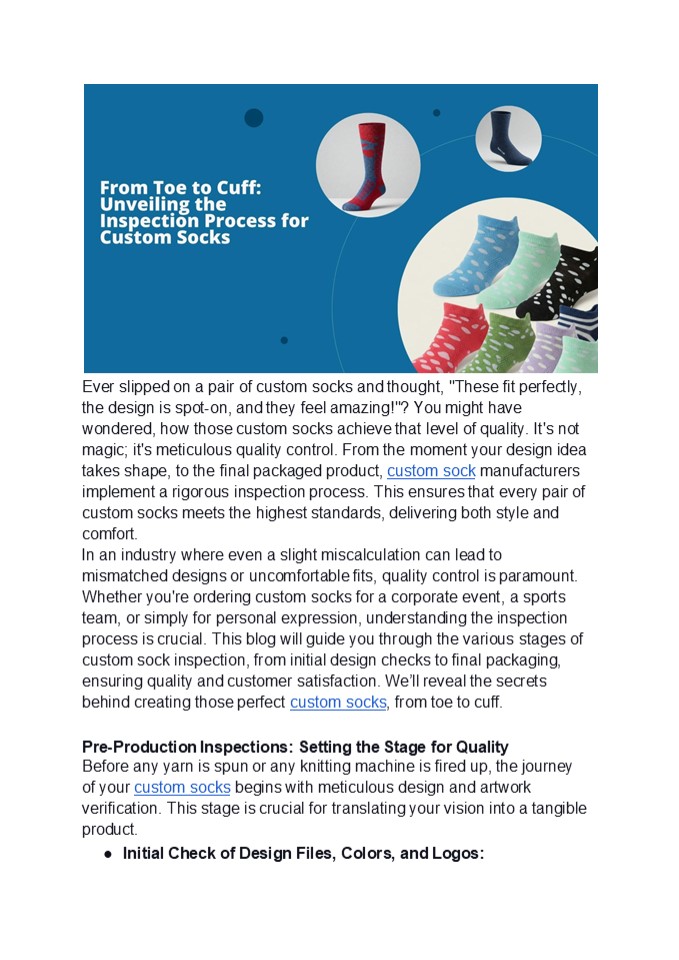
Title: From Toe to Cuff: Unveiling the Inspection Process for Custom Socks
1
- Ever slipped on a pair of custom socks and
thought, "These fit perfectly, the design is
spot-on, and they feel amazing!"? You might have
wondered, how those custom socks achieve that
level of quality. It's not magic it's meticulous
quality control. From the moment your design idea
takes shape, to the final packaged product,
custom sock manufacturers implement a rigorous
inspection process. This ensures that every pair
of custom socks meets the highest standards,
delivering both style and comfort. - In an industry where even a slight miscalculation
can lead to mismatched designs or uncomfortable
fits, quality control is paramount. Whether
you're ordering custom socks for a corporate
event, a sports team, or simply for personal
expression, understanding the inspection process
is crucial. This blog will guide you through the
various stages of custom sock inspection, from
initial design checks to final packaging,
ensuring quality and customer satisfaction. Well
reveal the secrets behind creating those perfect
custom socks, from toe to cuff. - Pre-Production Inspections Setting the Stage for
Quality - Before any yarn is spun or any knitting machine
is fired up, the journey of your custom socks
begins with meticulous design and artwork
verification. This stage is crucial for
translating your vision into a tangible product. - Initial Check of Design Files, Colors, and Logos
2
- The manufacturer will scrutinize your submitted
design files, ensuring they are in the correct
format and resolution. Colors are checked against
provided Pantone codes or color swatches to
guarantee accuracy. Logos are examined for
clarity and detail, ensuring they will be legible
when knitted into the sock. - Imagine you've designed a custom sock for your
company's anniversary, featuring a complex logo
and specific brand colors. A thorough design
verification ensures that the logo isn't
distorted or pixelated when knitted and that the
colors match your brand guidelines perfectly. - Ensuring Design Feasibility for Sock Knitting
- Not all designs are easily translated into
knitted socks. The manufacturer will assess the
design's complexity, considering factors like the
number of colors, the intricacy of patterns, and
the placement of logos. - For example, a design with very fine lines or
gradients might not be feasible for sock
knitting. The manufacturer will work with you to
simplify or adjust the design to ensure it can be
accurately reproduced. They might say, "That
gradient will look much better as a series of
stripes in the sock knitting process". This
prevents disappointment and ensures the final
product meets your expectations. - Material Inspection
- The quality of the yarn directly impacts the
comfort, durability, and appearance of your
custom socks. Material inspection is a critical
step in ensuring that only the best yarns are
used. - Inspection of Yarn Types, Colors, and Quality
- The manufacturer will inspect the yarn for fiber
composition (cotton, wool, nylon, etc.), color
consistency, and overall quality. They will check
for any defects, such as knots, snags, or uneven
thickness. - If you've requested custom athletic socks with
- moisture-wicking properties, the manufacturer
will verify that the yarn contains the
appropriate blend of synthetic fibers. - They'll also check that the yarn's color matches
your chosen
3
- palette, preventing any unexpected variations in
the final product. - Verifying Yarn Consistency and Suitability
- Yarn consistency is essential for uniform sock
production. Variations in yarn thickness or
texture can lead to inconsistencies in the
knitted fabric. The manufacturer will ensure that
the yarn is suitable for the intended sock type
and knitting machines. - For example, a high-quality combed cotton yarn
will ensure a smooth, soft feel, while a
lower-grade yarn might result in a rougher, less
comfortable sock. The manufacturer ensures the
correct yarn is used. - Sample Sock Review
- The sample sock review is your opportunity to see
and feel your design come to life. It's a crucial
step in ensuring that the final product meets
your expectations. - Creation and Inspection of a Sample Sock
- The manufacturer will create a single sample sock
based on your approved design and yarn
selections. This sample allows you to assess the
sock's overall appearance, fit, and feel. - You will receive this sample, and be able to
inspect it closely. - Checking for Accurate Design Reproduction, Fit,
and Feel - You will meticulously examine the sample sock,
checking for accurate color matching, pattern
clarity, and logo placement. You'll also assess
the sock's fit, ensuring it's comfortable and
conforms to the intended size. - For example, you might check that the logo is
centered, the colors are vibrant, and the sock
fits snugly around your calf. You'll also feel
the fabric's texture, ensuring it's soft and
comfortable. - The sample is the last chance to make changes
before a large order is made. If the heel pocket
does not seem deep enough, that change can be
made. If the company logo is slightly off-center,
that can be fixed. This step is vital to customer
satisfaction. - In-Production Inspections
4
- Knitting Machine Checks
- Once the design and materials are approved, the
manufacturing process begins. To ensure
consistent quality throughout production,
knitting machine checks are essential. - Inspection of Knitting Machines for Proper
Calibration and Operation - Knitting machines are complex pieces of machinery
that require precise calibration to produce
high-quality socks. Manufacturers conduct regular
inspections to ensure that all components are
functioning correctly. This includes checking
needle alignment, tension settings, and yarn feed
mechanisms. - Imagine a row of knitting machines churning out
custom athletic socks for a marathon. Each
machine must be precisely calibrated to maintain
consistent stitch density and pattern accuracy.
If a machine is out of calibration, it could
produce socks with uneven knitting or distorted
designs. - The machines are checked for proper lubrication,
and any worn parts are replaced. This ensures
that the machines operate smoothly and
efficiently, minimizing the risk of breakdowns
and production delays. - Preventing Knitting Errors and Inconsistencies
- Proper machine checks are crucial for preventing
knitting errors such as dropped stitches, holes,
and uneven patterns. Consistent machine operation
ensures that each sock in a batch is identical in
size, shape, and design. - For example, if the yarn tension is not properly
set, it can lead to loose stitches or uneven
knitting. This can result in socks that are
uncomfortable to wear or that have a poor
appearance. Regular machine checks prevent these
issues, ensuring that your custom socks meet the
highest quality standards. - By ensuring that the machines are working
correctly, large amounts of defective socks are
prevented. - Real-Time Quality Monitoring
5
- During the knitting process, real-time quality
monitoring is essential to catch and correct any
defects as they occur. - Continuous Monitoring of Sock Production for
Defects - Skilled operators continuously monitor the sock
production process, visually inspecting the socks
as they come off the knitting machines. This
allows for the early detection of defects such as
loose threads, holes, and uneven knitting. - For example, an operator might notice a loose
thread on a custom logo sock and immediately stop
the machine to correct the issue. This prevents
the defect from propagating to other socks in the
batch. - Checking for Issues Like Loose Threads, Holes,
and Uneven Knitting - Loose threads can cause discomfort and reduce the
sock's durability. Holes can render the sock
unusable. Uneven knitting can affect the sock's
fit and appearance. Real-time monitoring ensures
that these issues are identified and addressed
promptly. - If a hole is detected, the machine can be
stopped, and the problem can be addressed. If
loose threads are noticed, they can be trimmed
immediately. If uneven knitting is discovered,
the machine settings can be adjusted. - This constant monitoring is especially important
when producing custom-designed socks, where even
minor defects can be highly visible. - Size and Fit Checks
- Accurate sizing and a comfortable fit are
essential for customer satisfaction. Size and fit
checks during production ensure that your custom
socks meet these requirements. - Measurement of Sock Dimensions to Ensure Accurate
Sizing - Operators periodically measure the dimensions of
the socks to ensure that they conform to the
specified size chart. This includes checking the
length of the foot, the height of the cuff, and
the width of the sock. - For example, if you've ordered custom crew socks
in a specific size, operators will measure the
socks to ensure that they match the dimensions
specified in your order. This
6
- prevents you from receiving socks that are too
large or too small. - Checking for Proper Elasticity and Fit
- Elasticity is crucial for ensuring that the socks
stay in place and provide a comfortable fit.
Operators check the elasticity of the cuff and
other parts of the sock to ensure that they have
the proper stretch and recovery. - For instance, if you've ordered custom
compression socks, operators will check the
elasticity of the sock to ensure that it provides
the correct level of compression. They will also
check the fit of the heel and toe to ensure that
the sock is comfortable to wear. - By performing these checks, the manufacturer
ensures that the socks not only look good but
also feel good. - Post-Production Inspections Ensuring Final
Product Excellence Visual Inspection - After the socks are knitted, they undergo a
rigorous visual inspection to ensure they meet
the highest aesthetic standards. This stage is
crucial for identifying any flaws that may have
slipped through during production. - Thorough Examination of Finished Socks for Visual
Defects - Inspectors meticulously examine each sock, both
inside and out, under bright lighting. They look
for any imperfections, such as loose threads,
snags, holes, stains, or uneven stitching. - For example, imagine a batch of custom novelty
socks featuring a detailed cartoon character. The
inspectors will carefully check that the
character's features are clear and sharp, with no
blurred lines or missing details. They'll also
ensure that there are no stray threads or visible
seams that could detract from the design. - Checking for Color Accuracy, Pattern Clarity, and
Overall Appearance - Color accuracy is vital, especially for branded
custom socks. Inspectors compare the sock's
colors to the approved design files or color
swatches to ensure a perfect match. Pattern
7
- clarity is also essential, ensuring that
intricate designs and logos are sharp and
well-defined. - If a client has ordered custom team socks with
specific team colors, the inspectors will verify
that the colors are consistent across all socks
in the order. They will also check that the team
logo is clearly visible and accurately
reproduced. The overall appearance is assessed to
ensure that the socks are clean, wrinkle-free,
and presentable. - A well-done visual inspection will prevent a
customer from receiving socks that do not look
like the approved design. - Dimensional Inspection
- Dimensional inspection ensures that the finished
socks match the specified size and shape. This is
particularly important for ensuring a consistent
fit across the entire order. - Final Measurement of Sock Dimensions to Confirm
Accuracy - Inspectors use calibrated measuring tools to
check the length, width, and cuff height of the
socks. They compare these measurements to the
size chart to ensure that the socks are within
the specified tolerances. - For instance, if a client has ordered custom
compression socks in various sizes, the
inspectors will measure each sock to ensure that
it matches the corresponding size chart. This
guarantees that customers receive socks that fit
comfortably and provide the intended level of
compression. - Ensuring Consistent Sizing Across the Entire
Order - Consistent sizing is crucial for customer
satisfaction, especially for large orders.
Dimensional inspection ensures that all socks in
the order are uniform in size, preventing any
discrepancies that could lead to customer
complaints. - If a company orders custom logo socks for their
employees, they expect all the socks to be the
same size. Dimensional inspection ensures that
this consistency is maintained, providing a
professional and uniform appearance. - Functional Testing
- Functional testing verifies that the socks
perform as intended, ensuring they are durable
and comfortable for their intended use. - Detailing Functional Tests Performed
8
- Functional tests may include stretch tests to
assess the elasticity and recovery of the sock's
cuff and body. Durability checks may involve
abrasion tests to evaluate the sock's resistance
to wear and tear. - For example, custom athletic socks may undergo
stretch tests to ensure that they maintain their
shape and compression during intense activity.
Durability checks may involve rubbing the socks
against abrasive surfaces to simulate wear and
tear, ensuring they can withstand repeated use. - Ensuring the Sock Will Hold Up to Its Intended
Use - Functional testing ensures that the socks are not
only visually appealing but also perform well in
their intended environment. This is especially
important for specialized custom socks, such as
athletic socks or medical compression socks. - If a client orders custom hiking socks,
functional testing will ensure that they can
withstand the rigors of outdoor activity. This
includes checking for durability,
moisture-wicking properties, and comfort. - Packaging Inspection
- Packaging inspection ensures that the socks are
packaged correctly, with accurate labeling and a
professional presentation. - Inspection of Packaging for Accuracy and Quality
- Inspectors check that the correct number of socks
is included in each package and that the
packaging is free from damage or defects. They
also verify that the labeling is accurate,
including size, material composition, and care
instructions. - For example, custom gift socks may be packaged in
decorative boxes or sleeves. Inspectors will
ensure that the boxes are intact and that the
socks are neatly arranged inside. They will also
check that the gift tags or labels are correctly
attached. - Ensuring Proper Labeling and Presentation
- Proper labeling is crucial for providing
customers with essential information about the
socks. A professional
9
- presentation enhances the perceived value of the
product and creates a positive impression. - If a company is selling custom-branded socks,
then the packaging is part of the brand. The
packaging needs to look professional, and high
quality. - Accurate labeling ensures that customers know the
size, material composition, and care instructions
for their socks. A professional presentation
enhances the perceived value of the product,
creating a positive impression and reinforcing
brand identity. - Addressing Defects and Maintaining Quality
Standards - When defects are identified during inspections,
they need to be classified and reported
accurately. This step is crucial for implementing
corrective actions and preventing future issues. - How defects are classified (minor, major,
critical) - Minor Defects These are imperfections that do
not significantly affect the functionality or
appearance of the sock. They are usually cosmetic
and may include things like loose threads that
can be easily trimmed, slight color variations,
or minor pattern inconsistencies. While not
ideal, they generally do not render the sock
unusable. - Major Defects These defects affect the
functionality or appearance of the sock to a
greater degree. They may include holes,
significant pattern errors, noticeable color
discrepancies, or uneven knitting that impacts
fit. These defects are likely to be noticed by
the customer and may lead to dissatisfaction. - Critical Defects These are defects that pose a
safety hazard or render the sock completely
unusable. Examples include sharp objects embedded
in the sock, severe holes or tears that
compromise the sock's structure, or the presence
of harmful substances. These defects are
unacceptable and require immediate action. - For example, a small loose thread on a
custom-designed novelty sock might be classified
as a minor defect, while a large hole in the heel
of a custom athletic sock would be a
10
- major defect. A needle left in a sock would be a
critical defect. - The importance of accurate defect reporting and
tracking - Accurate defect reporting provides valuable data
for quality control. It allows manufacturers to
identify trends, pinpoint problem areas in the
production process, and implement targeted
corrective actions. - Tracking defects helps to monitor the
effectiveness of quality control measures over
time. This data can be used to set quality
targets, measure progress, and identify areas for
continuous improvement. - For instance, if a manufacturer notices a
recurring issue with loose threads on custom logo
socks, they can investigate the cause and
implement changes to prevent it from happening
again. This might involve adjusting machine
settings, improving operator training, or
sourcing higher-quality yarn. - Detailed records of defects also serve as
evidence in case of customer complaints or
disputes. Accurate reporting demonstrates a
commitment to quality and helps to resolve issues
fairly. - Corrective Actions and Rework
- Once defects are identified and classified,
corrective actions are necessary to address the
issues and prevent them from recurring. - The process for addressing defects and
implementing corrective actions - When a defect is identified, the first step is to
determine the root cause. This may involve
analyzing production data, examining the
defective socks, and interviewing operators. - Once the cause is identified, corrective actions
are implemented to prevent the defect from
happening again. This may involve adjusting
machine settings, replacing faulty equipment,
retraining operators, or revising production
procedures. - For example, if a manufacturer discovers that a
specific knitting machine is consistently
producing socks with uneven knitting, they will
investigate the machine's settings and
11
- make the necessary adjustments. They might also
retrain the operator to ensure they are using the
machine correctly. - The rework process for repairable defects
- Repairable defects, such as loose threads or
minor holes, can be addressed through rework.
This involves sending the defective socks to a
rework station where skilled operators can fix
the issues. - The rework process should be standardized and
documented to ensure consistency. This may
involve using specific tools and techniques to
repair different types of defects. - After rework, the socks are inspected again to
ensure that the defects have been corrected and
that the socks meet quality standards. - For example, if a custom sports sock has a small
hole in the toe, it can be sent to a rework
station where an operator will carefully repair
the hole using a specialized sewing machine. The
sock will then be inspected to ensure that the
repair is invisible and that the sock is
structurally sound. - Continuous Improvement
- Quality control is not a one-time effort it's an
ongoing process of continuous improvement. - The importance of using inspection data to
improve manufacturing processes - Inspection data provides valuable insights into
the effectiveness of current manufacturing
processes. By analyzing this data, manufacturers
can identify areas for improvement and implement
changes to enhance quality and efficiency. - For example, if inspection data reveals a high
rate of defects in a specific production stage,
the manufacturer can investigate the causes and
implement changes to streamline the process. - Data-driven decisions will create a better
product. - The role of feedback in maintaining and enhancing
quality standards
12
- Feedback from customers, employees, and suppliers
is essential for maintaining and enhancing
quality standards. Customer feedback can provide
valuable insights into the performance of the
socks in real-world conditions. - Employee feedback can help to identify potential
problems in the production process. Supplier
feedback can help to improve the quality of raw
materials. - For example, if customers report that custom
compression socks are losing their elasticity
after a few washes, the manufacturer can
investigate the issue and work with their yarn
supplier to improve the yarn's durability. - Feedback loops, and consistent data analysis,
will create the best possible custom socks. - Conclusion
- The journey from toe to cuff in creating
exceptional custom socks is a testament to the
meticulous inspection process. By understanding
each stage, from pre-production checks to
post-production evaluations, you can appreciate
the dedication and effort that goes into ensuring
your custom socks are of the highest quality.
This commitment to quality translates to customer
satisfaction, brand loyalty, and the confidence
that your custom socks will meet and exceed
expectations. - Ready to experience the EverLighten difference
and create custom socks that truly stand out?
Connect with us today! - We're dedicated to delivering premium custom
socks with unmatched attention to detail and
customer care. - 100 Customization Design every aspect of your
custom socks, from intricate patterns to vibrant
colors and personalized logos. - 100 Quality Check We guarantee that every pair
of socks undergoes rigorous inspections to meet
our exacting quality standards. - Free Design Help Our expert design team is here
to assist you in bringing your creative vision to
life. - Worldwide Delivery We ship your custom socks to
any location around the globe, ensuring timely
and reliable delivery. - 24/7 Support Our dedicated support team is
available around the clock to address any
questions or concerns you may have. 1
13
- Unlimited Revisions We work with you until your
design is perfect, offering unlimited revisions
to ensure your complete satisfaction. - Low MOQ (Minimum Order Quantity) We cater to
businesses and individuals of all sizes with
flexible and low minimum order quantities. - Visit our website or contact us today to start
your custom sock project! - FAQs
- Why is pre-production inspection important for
custom socks? - Pre-production inspections, like design
verification and material checks, ensure that the
initial design and materials meet the required
standards, preventing costly errors later in the
production process. - What types of defects are checked during
in-production inspections? - In-production inspections focus on identifying
defects like loose threads, holes, uneven
knitting, and incorrect sizing, ensuring that the
socks meet quality standards during
manufacturing. - How do post-production inspections ensure
quality? - Post-production inspections involve visual
checks, dimensional measurements, functional
tests, and packaging inspections, guaranteeing
that the finished socks meet all quality and
presentation requirements. - What happens when defects are found during the
inspection process? - Defects are classified, reported, and tracked.
Corrective actions are implemented to address the
issues, and repairable defects are reworked. This
data is used for continuous improvement. - Why should I choose a manufacturer with a
rigorous inspection process? - A rigorous inspection process ensures that you
receive high-quality custom socks that meet your
expectations,
14
enhancing customer satisfaction and protecting
your investment.
Recommended

